

Shower Stools and Shower Chairs: How to Choose a Safe One
By Mobile Occupational Therapist • 29 September 2026 • 13 min read
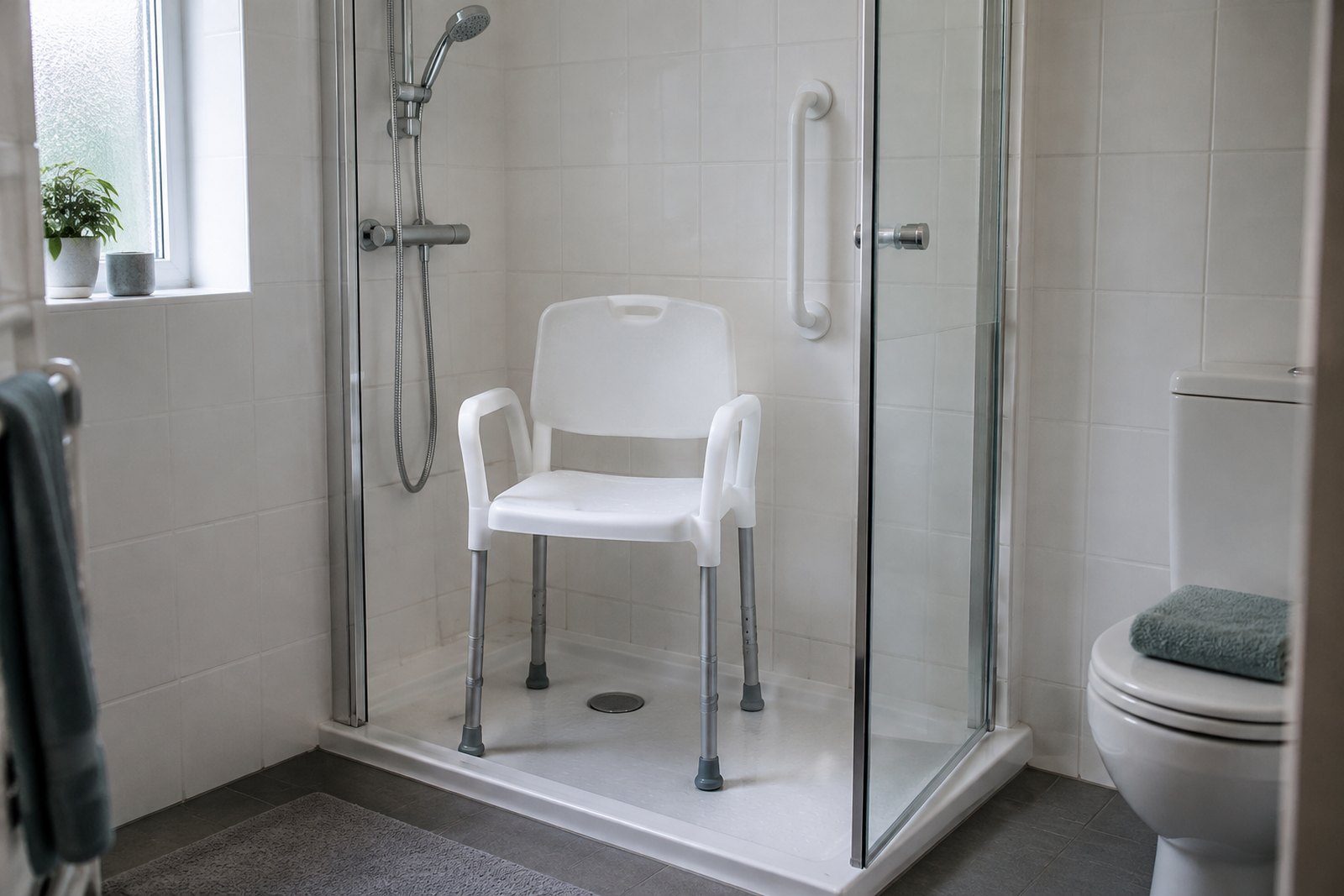
A shower stool is a small seat with no back that stands in your shower so you can sit down to wash. A shower chair is the same idea with a backrest, and usually arms. A wall-mounted shower seat folds down from the wall. A wheeled shower commode chair is different again: a waterproof chair on castors that you are wheeled into a level-access shower on. Which one is safe for you depends less on the seat than on you. How steady you are sitting, how you get on and off, and the shape of your shower all matter more than the colour of the plastic.
The short answer: if you can sit upright without support and stand up fairly easily, a stool is often enough. If you lean, tire quickly or need to push up with your hands to stand, choose a chair with a back and arms. If your shower is small or the bathroom is shared, a fold-down wall seat may suit better. And if you cannot step into the shower safely at all, no seat will fix that on its own. Whatever you choose must be the right height, stand level on sound rubber feet and be rated for your weight. This guide covers all of that, plus the one seat that should never go in a shower.
The four main types and who each one suits
Shower stools
A round, square or corner-shaped seat on three or four legs, usually with height adjustment. They are small, light and easy to move. A stool suits someone who can sit upright on their own, has reasonable balance and mainly struggles with standing for the length of a shower: after an operation, with breathlessness, with fatigue or with legs that tire.
The drawbacks are simple. There is nothing to lean back on and nothing to push up from. Four legs are generally steadier than three. Corner stools, shaped to sit into the corner of a tray, can fit small showers where a square seat will not. Some stools have hand-holds moulded into the seat edge, which help a little with getting up.
Shower chairs with a back and arms
A backrest gives you something to lean against, and arms stop you sliding sideways and give you something to push up from. A chair suits people who tire easily, whose sitting balance is not great, or who need a carer to wash their back or hair while they sit. People living with a stroke, Parkinson's, MS or dementia often do better with a chair than a stool.
Chairs are bigger, so they need a bigger tray. The arms can also get in the way if someone needs to slide on from the side or if a carer is helping with washing. Models with removable or flip-up arms solve that.
Wall-mounted fold-down seats
These are fixed to the wall and fold up out of the way when not in use. They suit small showers, wet rooms and bathrooms shared with people who would rather stand. Because they do not move, there are no feet to slip.
The catch is that the height and position are fixed once it is fitted, and the wall must be strong enough. Tiled plasterboard or stud walls need the right fixings or extra support behind them, so this is a job for a competent fitter, not a quick DIY drill. Some models have fold-down legs for extra support. If you rent, ask your landlord first. Decide the height before anyone drills.
Wheeled shower commode chairs
A waterproof chair on castors with an opening in the seat, so it can be wheeled over a toilet and then into the shower. Some are pushed by a carer; others have large rear wheels so the user can push themselves. More specialist versions tilt back to support someone with very little sitting balance.
These suit people who cannot stand to transfer safely, people moved with a hoist and people whose carer helps with all personal care. They need a level-access shower or wet room, wide enough doorways and room to turn. They will not go over a shower tray step. The brakes must be on before anyone gets on or off. Because they are specialist, they are best chosen with an occupational therapist, and are often provided on loan. Our guide to commodes and how to use one with dignity covers the toilet side of this.
Getting the seat height right
This is the most common mistake. A seat that is too low makes standing up hard work, puts your knees above your hips and can strain a new hip or knee. A seat that is too high means your feet do not sit flat, so you slide forwards on a wet seat.
Aim for this: sitting with your feet flat on the floor, knees bent at roughly a right angle, and hips level with or slightly higher than your knees. To find the number:
- Take your shoes and socks off. You will be barefoot in the shower.
- Sit on a firm, flat chair with your feet flat.
- Measure from the floor to the crease at the back of your knee. That is roughly the seat height you want.
- Measure from the floor of the shower tray, not the bathroom floor. A tray may sit lower or higher.
If you have had a hip replacement, follow the seat height advice the hospital gave you. It may need to be higher than this.
On adjustable stools and chairs, set every leg to the same hole and check that each push-button has clicked fully through. Press down firmly on the seat before you sit. A leg that has not locked can collapse under you.
Rubber ferrules and a level floor
The rubber feet on each leg (ferrules) are what stop the seat skating across a wet tray. Check that every leg has one, and that none are split, worn smooth or showing metal through the bottom. Replace worn ferrules with ones of the right size for that equipment. Some seats have suction feet instead; these only grip on smooth surfaces and need checking just the same.
Shower trays slope towards the drain, and wet room floors are built with a deliberate fall. So a seat that is perfectly steady on your kitchen floor can rock in the shower. Place it so no foot sits on the drain cover or on the curved edge where the tray meets its upstand. Some seats let you adjust legs individually to level them, but only for small differences. If you need the legs at very different heights, the seat is in the wrong spot.
The test is simple. Before you sit, press down on each corner of the seat in turn. If it rocks at all, sort it out before you use it. Never put a towel or bath mat under the legs to level them.
Fitting it in your shower tray
Measure before you buy. You need:
- The inside width and depth of the tray at floor level, not at the top of the lip. The sides of many trays curve in.
- The seat's footprint. The listed size often refers to the seat top, but the legs usually splay wider.
- Room in front of the seat for your feet, and room to turn round as you sit.
- How the shower door opens. A hinged or bifold door that hits the seat is a trip hazard.
- The height of the step into the tray.
Position the seat so you can reach the controls and shower head while sitting. A handheld shower head on a sliding rail makes washing seated much easier. If you cannot move quickly out of the way of hot water, it is worth knowing whether your shower is thermostatic, as this helps keep the temperature steady.
If your shower is over a bath, a shower stool is the wrong answer. You would be stepping into the bath and standing on a slippery curved surface to sit down. A bath board or a bath lift is the usual option; see our guide to bath and shower aids for older adults.
Weight limits
Every shower seat has a maximum user weight, shown on a label or in the instructions. It varies a lot between models, so check rather than assume. Remember that dropping onto a seat puts far more force through it than sitting down slowly. Heavy-duty (bariatric) versions are available for larger users. For wall seats, the limit also depends on the wall and the fixings, not just the seat. If you are offered a second-hand seat with no label, you do not know what it will hold.
Getting on and off safely
Set everything up before you get wet: towel within reach, toiletries where you can get them seated, water temperature tested before you get in. If you have reduced feeling in your hands or feet, test with your elbow or a bath thermometer, or ask someone else to check.
Getting in: hold a properly fixed grab rail as you step in. Turn so your back is to the seat and step back until you feel it against the backs of your legs. Reach back for the arms or rail with both hands, then lower yourself slowly.
Getting up: shuffle forward to the front of the seat, put your feet slightly back, lean forwards so your nose goes over your toes, and push up through the arms or rail. Pause standing for a moment before you move.
Never hold onto a towel rail, shower door, soap dish, shower head rail or the edge of a basin. None of them are built to take your weight. Our guide to grab rails and what not to grab explains where rails usually go.
Hot water can make some people light-headed. If you feel faint, sit down, turn the water cooler and wait. If you often feel dizzy or have blacked out, see your GP. If someone collapses and does not come round, has chest pain, or develops sudden weakness on one side or a drooping face, call 999.
Why a perching stool must never go in the shower
A perching stool is a tall stool with a seat that slopes forwards, so you are half sitting, half standing. It is designed for kitchens and worktops, for things like peeling vegetables or ironing. Our guide to perching stools explains who they help.
In a shower, that forward slope plus wet skin plus soap means you slide straight off the front. Many have padded seats that soak up water and frames not made for wet use. The same goes for garden chairs, kitchen stools, plastic patio seats and children's step stools. None are designed for a wet, sloping floor or tested for this use. Use a seat made for showering.
Cleaning and checking
After each shower, rinse off soap and shampoo, which make the seat slippery, and leave it to drain and dry. Once a week, wash it with warm water and a mild detergent, following the manufacturer's instructions. Strong chemicals can damage plastic and rubber over time.
Once a month, check for:
- Cracks or splits in the seat or backrest
- Rust, especially at joints and leg ends
- Loose screws or wobbly arms
- Worn or missing ferrules
- Height buttons that do not click fully through
- Black mould in joints and under the seat
If anything is cracked or bent, stop using it. If the seat was loaned by the council or NHS, report the fault to the equipment service rather than repairing it yourself.
Getting a shower seat free from community equipment services
In England, your council's adult social care team can assess your needs, and if you are eligible, equipment such as shower stools and chairs is often loaned free through the local community equipment service. Rules vary between councils, and some will suggest you buy smaller items yourself. You can usually ask through adult social care directly, through your GP, or through the hospital team if you are being discharged. Wales, Scotland and Northern Ireland have their own arrangements, so contact your local council or health and social care trust. Our guide to borrowing equipment from community equipment services explains how it works.
If the real problem is the step into the shower, a level-access shower may be the answer. In England and Wales the Disabled Facilities Grant can help with that; check eligibility on GOV.UK. In Northern Ireland and Scotland, ask your local council or housing authority about their own schemes.
Where an occupational therapist fits
An occupational therapist looks at the whole routine, not just the seat: undressing, stepping in, washing, drying, getting out and getting dressed. They watch how you actually move, measure you and the shower, and recommend the right type and height of seat, where rails should go, and whether the tray step is the real problem. They can teach a family carer safe ways to help, and support an application for adaptations. A private occupational therapist visiting at home can often come sooner and give you a written report; see our equipment and aids page for what that covers.
Other professionals lead on some things. A physiotherapist is the right person for balance and strength exercises. Your GP should see you for dizziness, unexplained falls or new weakness. A district nurse deals with skin and wound care. If in doubt about whether something is urgent, call NHS 111.
Frequently asked questions
Is a shower stool or a shower chair safer?
Neither is safer for everyone. A chair with a back and arms gives more support and help standing up. A stool is fine if your sitting balance is good and it fits your tray better. The safest seat is the one that matches how you move.
Can I use an ordinary plastic stool or garden chair in the shower?
No. They are not designed for wet, sloping floors, often have no rubber feet, and their weight rating for this use is unknown. Use a seat made for showering.
Can I get a shower chair free on the NHS?
Often, yes, through your council's community equipment service after an assessment, if you meet local criteria. The wait and the rules vary by area. Ask adult social care or your GP.
What height should a shower stool be?
Roughly the distance from the floor to the back of your knee when you are barefoot, measured from the floor of the tray. Your feet should be flat and your hips level with or slightly above your knees.
Can I put a shower stool in the bath?
No. Standing in a bath to sit on a stool is unstable and slippery. A bath board or bath lift is the usual answer for an over-bath shower.
How long does a shower stool last?
There is no fixed lifespan. Check it monthly and replace it if it is cracked, rusty, wobbly or the legs no longer lock. Replace worn ferrules straight away.
Next steps
If you are not sure which seat is right, or whether the shower itself needs changing, an occupational therapist can assess it with you at home. See our home assessment page, or current guide prices, and choose your area below.

Talk to an occupational therapist near you
This guide is general information. For advice about your own situation - or someone you look after - a local occupational therapist can visit you at home and see it for themselves.
Choose your area: