

Perching Stools: What They Are, Who They Suit, and How to Get One
By Mobile Occupational Therapist • 18 August 2026 • 10 min read
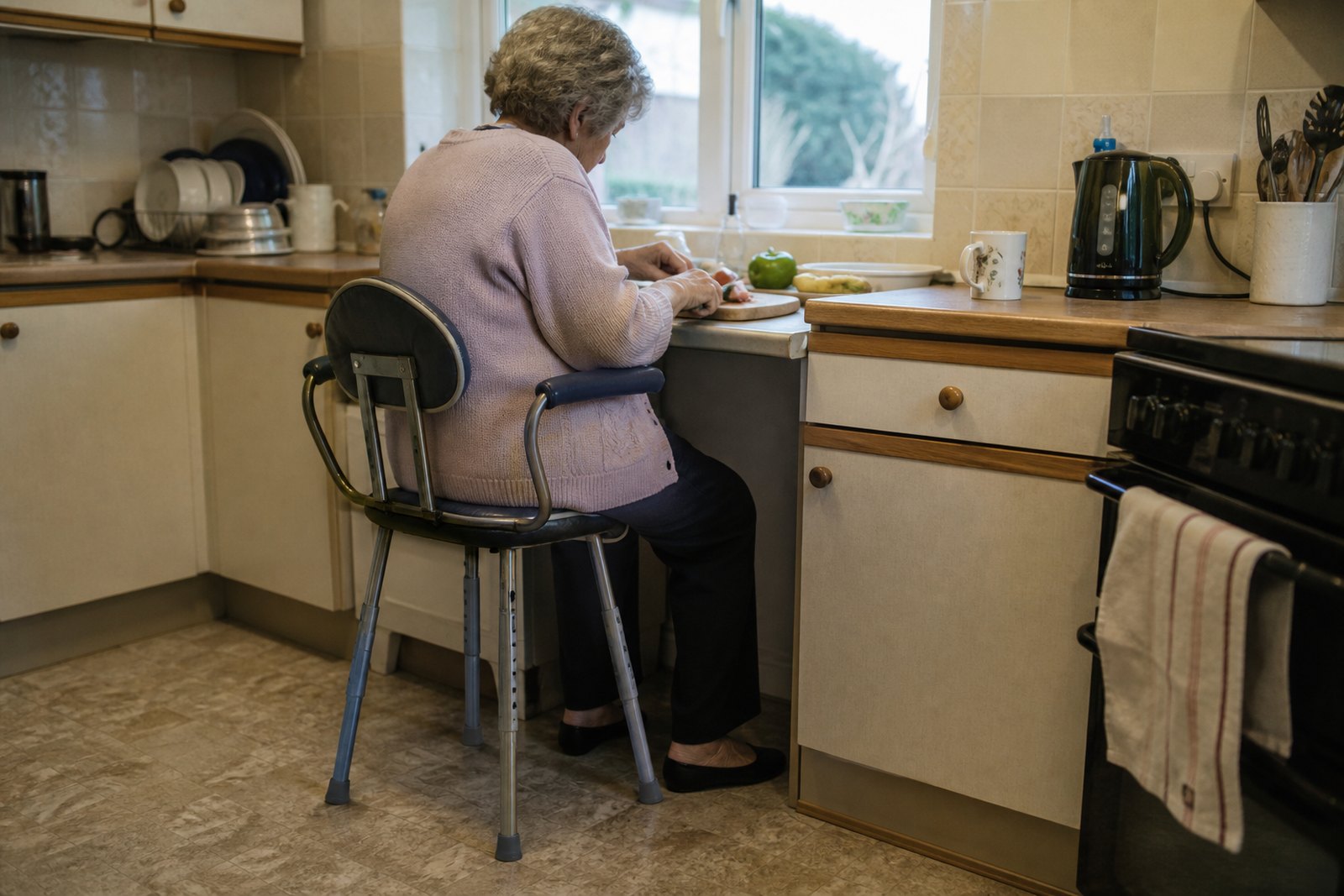
A perching stool is one of the most useful pieces of equipment an occupational therapist recommends, and one of the least understood. It looks like an ordinary tall stool with a strange sloping seat, and people often assume it is simply a chair for a kitchen. It is not. It is designed for a specific problem - standing to do a task is too tiring, or too unsteady, but sitting down properly puts you too low to do the task at all.
What a perching stool actually is
A perching stool is a high stool with a seat that slopes gently forwards, usually with a padded back rest and arm rests. The height sits somewhere between standing and sitting, which is where the word "perching" comes from - you are half-sitting, half-standing, with your weight shared between the stool and your feet.
The forward slope is the part that matters, and it is what makes a perching stool different from a tall kitchen stool bought from a furniture shop. Because the seat tips you slightly forwards, your hips stay open and your feet stay planted, which keeps you in a position to reach a worktop, a sink or a basin. A flat stool at the same height tends to slide you backwards, so you end up either perched on the front edge with nothing supporting you, or sitting back and unable to reach.
Who a perching stool helps
The common thread is fatigue or unsteadiness during a standing task, rather than difficulty with the task itself. That includes people who are:
- Short of breath on exertion, including many people with COPD, heart failure or long COVID, for whom standing to prepare a meal is genuinely tiring
- Recovering from surgery or illness, where stamina is temporarily reduced
- Living with a long-term condition that causes fatigue, such as multiple sclerosis, rheumatoid arthritis or chronic fatigue syndrome
- Unsteady on their feet for longer periods, but safe when their weight is partly supported
- Living with pain on weight-bearing, particularly through the hips, knees or lower back
It is also frequently used the other way round - not to make a task possible, but to make it sustainable. Someone who can stand to wash up but is then too tired to do anything else for an hour has a fatigue problem worth solving, even though nothing looks wrong from the outside.
Where people use them
By a long way the most common place is the kitchen, at a worktop or sink, which is why "perching stool for the kitchen" is such a common search. But they are used at a bathroom basin for washing and shaving, at a workbench or hobby table, at an ironing board, and occasionally by a front door for someone who struggles to stand while putting shoes on.
What matters is not the room, it is the height of the surface. A perching stool only works if it can be set to the right height for the specific surface you are using it at - which is the single most common thing people get wrong.
Getting the height right
This is the part that determines whether a perching stool helps or hinders, and it is worth taking time over.
- Your feet must be flat on the floor. Not tiptoes, not dangling. Your feet are taking part of your weight, and they cannot do that if they are not properly planted.
- Your hips should be higher than your knees. This is what keeps you upright and able to reach forwards. If your knees are higher than your hips, the stool is too low.
- You should be able to reach the worktop without leaning or stretching. If you find yourself reaching up, the stool is too low; if you are looking down at your hands and hunching, it is too high.
- Check the height at the surface you will actually use it at. A kitchen worktop and a bathroom basin are usually different heights, and a stool set for one will be wrong at the other.
Most perching stools adjust in fixed increments via push-button legs. Adjust all four legs to the same setting, and check each one has clicked home before putting weight on it - an unnoticed half-engaged leg is a genuine cause of falls.
When a perching stool is not the right answer
An honest guide has to include this, because a perching stool is not suitable for everyone and is occasionally unsafe.
- If you cannot get on and off it safely and independently. Perching stools sit high, and getting on and off involves a moment of transferring weight. If that moment is unsafe, the stool creates a fall risk rather than reducing one.
- If you need full back support or cannot sit unsupported. The back rest on a perching stool is a light rest, not a supportive back. Someone with poor trunk control needs a properly supportive chair.
- If your balance is significantly impaired. Perching keeps you partly weight-bearing, which requires some balance.
- If the real problem is the task, not the standing. If reaching into a low cupboard is the difficulty, a perching stool does not address it, and rearranging the kitchen might.
- On a wet bathroom floor or any slippery surface, unless the feet are appropriate and the stool is stable. Bathrooms are the highest-risk room in most homes.
This is precisely the kind of judgement an occupational therapist makes during a home assessment - not just whether a piece of equipment would help in principle, but whether it is safe for you, in your home, doing the task you actually want to do.
Can you get a perching stool on the NHS?
Often, yes, and it is worth trying this route first because it costs nothing and includes an assessment.
Daily living equipment is generally provided through your local council's adult social care service rather than directly by the NHS, though the two often work together and people usually experience it as one process. The usual route is a needs assessment, which you can request yourself - you do not need a GP referral, and it is free. If an occupational therapist assesses that you need a perching stool, it is typically provided free of charge on long-term loan.
You may also be offered one on discharge from hospital, or after a referral from a community therapy team. If you have already been assessed and the equipment has not arrived, chasing the specific team who assessed you is usually more effective than starting again.
The honest caveats: waiting times vary considerably by area, eligibility is assessed against national criteria, and simple equipment is sometimes signposted to buy privately rather than issued. If you need something quickly, or you have been told you do not meet the threshold, buying privately is a reasonable choice - perching stools are one of the cheaper pieces of daily living equipment.
If you are buying one privately
A few practical points that are easy to miss:
- Check the height range against your worktop before ordering, not after. Manufacturers list a seat height range; measure your worktop and make sure the range comfortably covers what you need.
- Check the maximum user weight. This is a safety limit, not a suggestion, and it varies more between models than people expect.
- Look at the feet. Non-slip ferrules matter, particularly on hard kitchen and bathroom flooring, and they wear out - they are replaceable and should be replaced when the tread is gone.
- Decide whether you need arms. Arm rests help with getting on and off, but can stop the stool tucking close to a worktop.
- VAT relief. If the stool is for personal use by someone who is chronically sick or disabled, you may not have to pay VAT on it. Suppliers of daily living equipment will normally have a short declaration form for this.
Looking after it
Perching stools need almost no maintenance, but they do need occasional checking. Every few months, look at whether the leg buttons are still fully engaged, whether the ferrules have worn smooth, and whether any of the fixings have loosened. If the stool has started to rock, wobble or slide, stop using it until it has been checked. Equipment that has quietly become unstable is a common and entirely preventable cause of falls.
Frequently asked questions
What is the purpose of a perching stool?
It lets you keep doing a standing task when standing has become too tiring or too unsteady, without dropping so low that you cannot reach. The forward-sloping seat holds you in a half-standing position with your feet still taking some weight, so you stay at working height at a worktop, sink or basin.
What is a perching stool on the NHS?
The same piece of equipment, provided to you rather than bought. Daily living equipment is usually arranged through your local council's adult social care service, often working alongside NHS therapy teams, following an assessment by an occupational therapist. NHS-issued stools are standard height-adjustable models, normally supplied on long-term loan rather than as a gift, and returned when no longer needed.
Can I get a perching stool on the NHS?
Often, yes, and it costs nothing to try. Request a free needs assessment from your council - you can do this yourself, without a GP referral. If an occupational therapist assesses that you need a perching stool, it is typically provided free. Waiting times and eligibility thresholds vary by area, and some councils signpost simple equipment to be bought privately instead.
Are perching stools good for you?
For the right person, genuinely - they let people keep cooking, washing and staying independent when fatigue or unsteadiness would otherwise stop them, and reducing exhaustion has knock-on benefits through the rest of the day. But they are not universally good. If you cannot get on and off one safely, need real back support, or have significantly impaired balance, a perching stool adds a fall risk rather than removing one. It is equipment for a specific problem, not a general comfort chair.
How do I choose the right perching stool?
Start with height: check the model's seat-height range against the worktop or basin you will use it at, before buying. Then check the maximum user weight, decide whether you want arm rests (they help you get on and off, but can stop the stool tucking close to a worktop), and look at the feet - non-slip ferrules matter on hard kitchen and bathroom floors. If you are unsure, an occupational therapist can measure the surface and try the position with you before you spend anything.
Can I use a perching stool in the shower?
No. Perching stools are not designed for use inside a bath or shower. They are not built to be constantly wet, the feet are not intended for a soaked shower tray, and the height and forward slope are wrong for washing safely. Use purpose-made shower seating - a shower stool, shower chair or wall-mounted fold-down seat - which is designed for wet use and can be fitted at the right height. A perching stool can reasonably be used at a bathroom basin, on a dry floor, which is a different thing.
Next steps
If standing to cook, wash or shave has become tiring or unsteady, a perching stool is often a small change with a disproportionate effect - but only when it is the right height and the right answer to the actual problem. An occupational therapist can check both in your own kitchen or bathroom, along with anything else that has quietly become harder. See the areas we cover to find your local therapist, our guide to kitchen aids and mealtime independence for related equipment, or current guide pricing.
Talk to an occupational therapist near you
This guide is general information. For advice about your own situation - or someone you look after - a local occupational therapist can visit you at home and see it for themselves.
Choose your area: