

Grab Rails: Where They Go, What They Hold, and What Not to Grab
By Mobile Occupational Therapist • 18 August 2026 • 11 min read
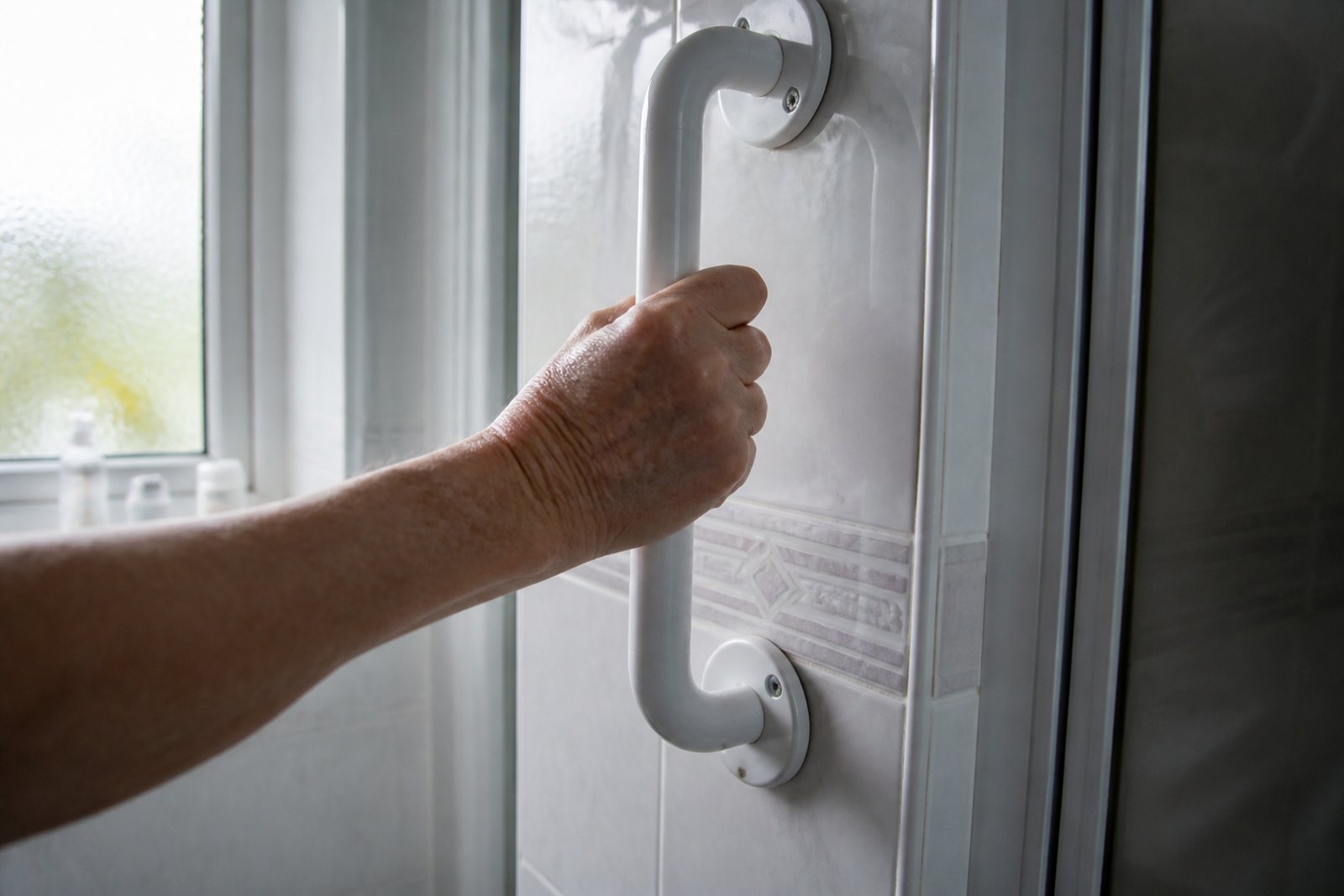
A grab rail is one of the cheapest and most effective pieces of equipment in a home. It is also the one most often fitted in the wrong place, at the wrong height, or into a wall that cannot hold it. A rail in the right position turns a risky movement into a safe one. A rail in the wrong position gets used anyway, because it is there, and quietly makes things worse.
This guide covers what actually determines whether a rail helps: where it goes, how high, which type, and what it is fixed into.
Position is the whole job
People tend to choose a rail first and decide where to put it second. It is worth doing the opposite.
The right position is determined by the movement you are actually struggling with - and specifically by where your hand naturally goes at the hardest moment of that movement. Standing up from a toilet, stepping into a shower and pulling up from a low chair are three different movements, needing rails in three different places, at three different angles.
A practical way to find it: carry out the movement slowly, without a rail, and notice where your hand reaches for support. That point, roughly, is where the rail belongs. If someone is already gripping a radiator, a basin edge or a door frame at that moment, they have shown you exactly where a rail is needed - and exactly which unsafe fitting it needs to replace.
What not to grab
This is the part of the guide that matters most, and it is worth being blunt about. In most homes, people are already holding on to something. Very often it is not designed to take their weight.
- Towel rails - designed to hold a wet towel, not a person. They pull out of plasterboard readily, usually at the worst moment.
- Basins and sinks - a basin is fixed to hold its own weight plus water. People lever themselves up on the front edge routinely, and basins do come away from walls.
- Shower screens and shower doors - hinged glass, fixed to a frame, with no load rating for a person pulling sideways on it.
- Radiators and pipework - brackets are not load-bearing, and a hot radiator adds a burn risk.
- Door handles and door frames - a door can swing away as you put weight on it, which is a classic cause of falls.
- Furniture on castors, and lightweight furniture generally - it moves.
If you notice any of these being used as a handhold, treat it as a request for a grab rail in exactly that spot.
Getting the height right
There is no single correct height, because the right height depends on the person and the movement. What follows are the principles rather than a universal measurement.
- For pulling up from sitting - the rail wants to be roughly where the hand falls when the arm is bent, so you can pull with the arm rather than reach above your head. A rail set too high means pulling downwards from an outstretched arm, which is much weaker and less controlled.
- For steadying while standing - around hip to lower-chest height for most people, so the elbow stays slightly bent.
- For stepping in or out of a shower or bath - positioned so it can be reached before the step begins and still held once the step is complete. A rail you have to let go of mid-step is worse than no rail.
- Always fit to the person who will use it, not to a standard measurement - and if two people with very different heights use the same bathroom, that is a genuine design problem worth discussing rather than splitting the difference.
Horizontal, vertical or angled?
The orientation should follow the direction of the force you need.
- Vertical rails suit pulling up and steadying at a fixed spot - beside a toilet, or at the point of stepping into a shower. They allow the hand to slide up or down to find the right height, which is useful when the same rail is used by people of different heights.
- Horizontal rails suit sideways movement and support along a route - alongside a bath, or a run of wall you walk along.
- Angled (diagonal) rails suit a movement that changes height as it moves, most obviously rising from a toilet or moving up a step. They are frequently the right answer and the least often fitted.
Drop-down rails, hinged to fold up against the wall, are worth knowing about for a toilet used by more than one person, or where a fixed rail would block a wheelchair transfer.
Grab rails in the bathroom
The bathroom is where most rails go, because it combines wet floors, hard surfaces, and movements that require balance while partly undressed. It is also the room where the wrong handhold is most likely to be used.
Common positions worth considering:
- Beside the toilet, at the side you naturally lead with - angled or vertical, positioned for pulling up rather than for leaning on.
- At the entry point to a shower, reachable from outside the tray and still holdable once you are in.
- Inside a shower where you turn or wash, particularly if you close your eyes to rinse - a moment when balance is genuinely reduced.
- Along the length of a bath, for someone still bathing rather than showering, though a bath transfer often needs a bath board or seat rather than a rail alone.
On tiled walls, fixing goes through the tile into whatever is behind it, and it is the substrate that carries the load, not the tile. Drilling tile without the right technique cracks it, and a cracked tile in a wet room is a water-ingress problem as well as a cosmetic one. This is a job worth paying someone to do properly. See our guide to bathing aids and bathroom safety for how rails fit alongside seats, boards and non-slip flooring.
Grab rails for outside steps and the front door
Outdoor rails have a harder job than indoor ones. They deal with weather, uneven ground, and the transition from bright daylight to a dark hallway or vice versa, which affects depth perception at exactly the moment someone is negotiating a step.
Points worth knowing:
- Material matters outdoors. Metal becomes very cold in winter and can be painful or difficult to grip with arthritic hands; it can also become slippery when wet or icy. Coated or textured finishes generally grip better.
- The rail should extend beyond the step, at both top and bottom, so it can be held before the first step and after the last. A rail that stops level with the top step lets go of you exactly where you need it.
- Fixing into masonry, brick or render is a different job from fixing into an internal wall, and needs appropriate fixings for that substrate.
- Consider lighting at the same time. A rail and a light on the same steps solve more together than either does alone.
- Check what you own. If you rent, or the steps are shared or in a communal area, you will usually need permission from the landlord, housing association or freeholder before fitting anything.
Fixing: the part that actually carries the load
A grab rail is only as strong as what it is screwed into. This is where DIY installations most often go wrong, because the rail feels solid when it is fitted and fails later, under load, when someone is relying on it.
- Solid masonry is generally straightforward with correct plugs and screws.
- Plasterboard (stud walls) needs fixing into the timber studs themselves, or the use of proper heavy-duty cavity fixings rated for the load. Standard plasterboard plugs are not adequate for a rail that will take a person's weight in a snatch load.
- Dot-and-dab plasterboard - board bonded to masonry with a gap behind - is common and deceptive: it feels solid, but a fixing that only grips the board has an air gap behind it.
- Never fix into tile alone.
- Suction rails are not grab rails. They are useful as a positional guide for someone with good balance, but they can and do release without warning, particularly on textured or imperfectly clean surfaces. They should never be relied upon for weight-bearing, and they should not be used by anyone whose safety depends on the rail holding.
The load a rail must survive is not a steady lean - it is a sudden snatch when somebody slips. That is the moment it has to hold, and it is why professional installation is money well spent.
How to get grab rails fitted
Grab rails are one of the most commonly provided pieces of equipment through local authority adult social care, usually following a free needs assessment. You can request one yourself without a GP referral. Minor adaptations of this kind are frequently supplied and fitted at no cost, and many councils have a fast-track route for small items, though waiting times vary considerably by area.
For larger work - a level-access shower, structural changes, a stair lift - the route is usually a Disabled Facilities Grant, which is means-tested and involves an occupational therapy assessment. Our guide to the Disabled Facilities Grant covers how that works.
Arranging privately is also perfectly reasonable, particularly if you want it done quickly. If you do, it is worth having the position assessed before the holes are drilled - moving a badly placed rail means making good two sets of fixings in a tiled wall.
Frequently asked questions
Where should grab rails be placed?
Wherever your hand naturally reaches for support at the hardest moment of the movement you are struggling with. Do the movement slowly without a rail and notice where you reach - that is the position. In practice this most often means beside the toilet, at the entry point to a shower, inside the shower where you turn, and alongside a bath.
What height should a grab rail be?
There is no single correct height - it depends on the person and the movement. As a principle, position it so the elbow stays slightly bent when the rail is held, so you can pull with the arm rather than reach above your head. Fit it to the person who will actually use it rather than to a standard measurement.
Can grab rails be fitted to plasterboard walls?
Yes, but only into the timber studs, or with heavy-duty cavity fixings specifically rated for the load. Standard plasterboard plugs are not adequate. Watch for dot-and-dab walls, where board is bonded to masonry with a gap behind - these feel solid but leave a fixing with nothing but air behind it.
Are suction grab rails safe?
Not for weight-bearing. A suction rail can be useful as a positional guide for someone with good balance, but suction cups can release without warning, especially on textured, cold or imperfectly clean surfaces. If your safety depends on the rail holding, it needs to be screw-fixed.
Can I get grab rails free from the council?
Often, yes. Grab rails are among the most commonly provided minor adaptations, usually supplied and fitted free following a free needs assessment you can request yourself. Waiting times vary by area, and many councils operate a faster route for small items than for major adaptations.
What can I hold on to instead of a grab rail?
Ideally nothing - that is the point. Towel rails, basins, shower screens, radiators and door handles are all commonly used as handholds and none are designed to take a person's weight. If someone is holding one of these, it is a clear sign a proper rail is needed in that exact spot.
Next steps
If you are unsure where a rail should go, or whether a rail is even the right answer, that judgement is the useful part - and it is much cheaper to get right before anything is drilled. An occupational therapist can watch the movement that is causing difficulty in your own home and advise on position, type and height, alongside anything else that has become harder. See the areas we cover, our guide to falls prevention at home, or current guide pricing.
Talk to an occupational therapist near you
This guide is general information. For advice about your own situation - or someone you look after - a local occupational therapist can visit you at home and see it for themselves.
Choose your area: