

Commodes: Types, Who They Suit and Using One With Dignity
By Mobile Occupational Therapist • 17 September 2026 • 9 min read
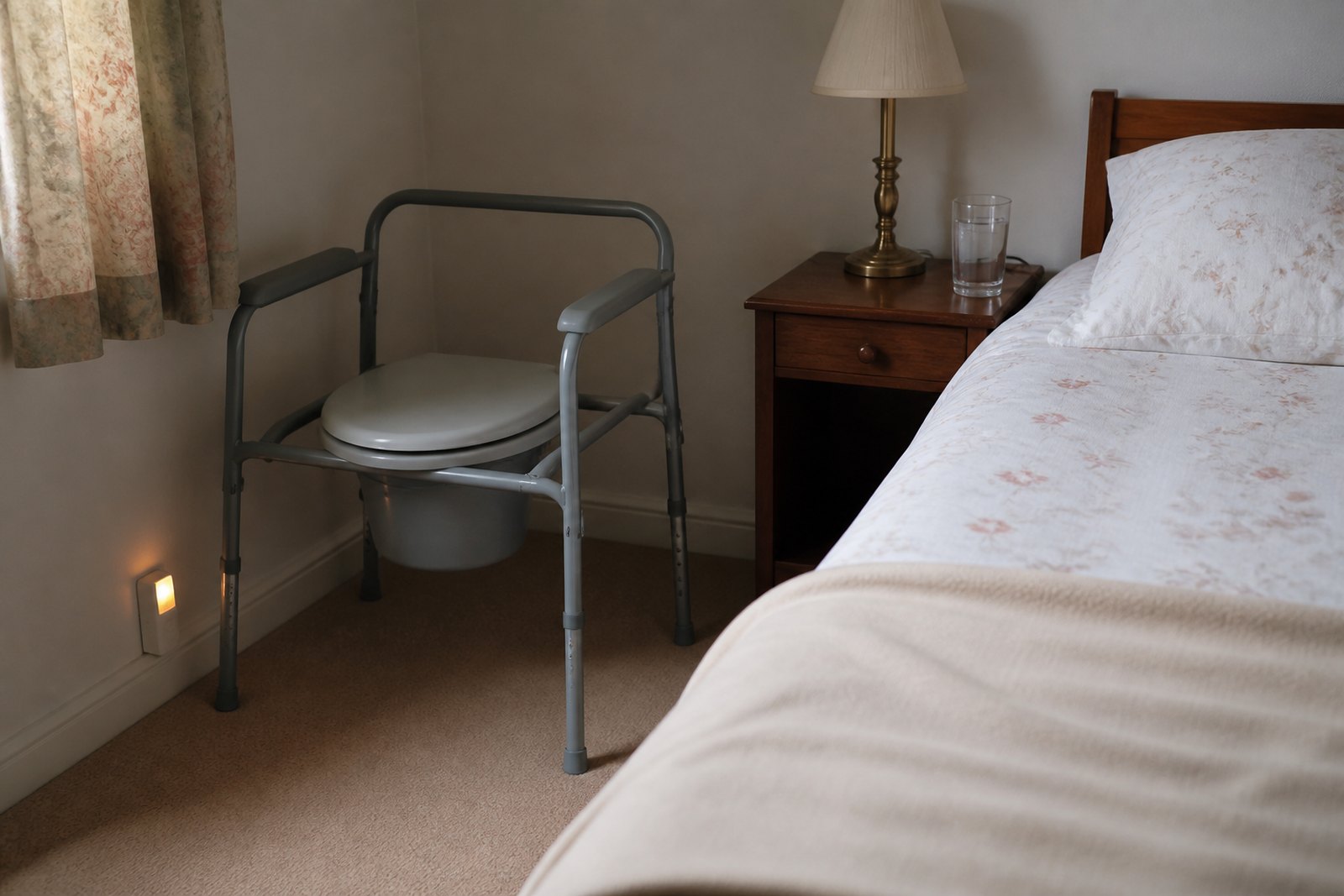
A commode is a chair with a removable pan under the seat, used as a toilet in a room that is not the bathroom. That is the whole of it, and yet it is one of the hardest things to accept into a house, because of what people feel it says about them. This guide covers the main types of commode, who a commode chair actually suits, when it is the wrong answer, and the practical business of using one with dignity - which turns out to be mostly about placement, routine and who empties it, rather than about the chair.
It helps to start from what a commode is for. It buys back a night's sleep for somebody who cannot face the stairs at three in the morning, removes a walk that has quietly become a fall waiting to happen, and sometimes gets a person home from hospital sooner. Used overnight, or for a few weeks after an operation, it is a small and often temporary thing. The dread most people feel is about the permanent version they imagine, not the one they are offered.
The main types of commode
Most people picture one kind. The differences are practical, and choosing the wrong sort is the commonest reason a commode ends up unused in a spare room.
- Static or bedside commode chairs. The standard item: arms, a lift-off lid and seat, a pan in a bracket beneath, usually height adjustable at the legs. Some look like an ordinary armchair, which matters more than it sounds in a room somebody sits in by day.
- Wheeled commodes and shower commodes. The same idea on castors, so it can be moved with the person on it, wheeled over a standard toilet, or wheeled into a level access shower. Good in a wet room, poor anywhere with a step, a narrow doorway or a toilet the frame will not fit over.
- Folding and travel commodes. Lighter frames that fold flat for storage or a stay with family. Generally less stable, with lower weight limits, so they suit somebody steady rather than somebody who leans heavily on the arms.
- Over-toilet frames that double as a commode. A toilet frame with a raised seat and a pan that clips underneath: a toilet surround by day, a commode in the bedroom at night. In a small home this is often the sensible compromise: one item instead of two.
- Bariatric commodes. Wider seats, stronger frames and a much higher safe working load. If the standard weight limit is anywhere near being reached, look at this category rather than hoping: frames give way at the seat and the arms, exactly where somebody is pushing.
Who a commode suits
A commode earns its place when the distance to the toilet, rather than the toilet itself, is the problem. That covers more than people expect: night times, when somebody is half asleep, unsteady and in a hurry; the weeks after surgery or illness when any distance is exhausting; a house where the only toilet is upstairs; and a bladder or bowel that gives very little warning, so the walk is possible but not in the time available.
It suits carers too. Two steps from bed to commode is safer for everybody than a supported walk along a landing at night, and our guide to safe moving and handling for family carers is worth reading before you start. After an operation, particularly a hip or knee replacement, the surgeon's, hospital's or physiotherapist's own instructions about hip position, weight bearing and seat height override anything general here.
When a commode is the wrong answer
This is the section a shop will not write. A commode solves getting there. It does not solve getting on and off, which is often the actual difficulty.
- The problem is standing up, not walking there. Then a raised seat, a frame or a fixed rail at the toilet is the answer and the toilet stays where it is. Our guide to raised toilet seats, toilet frames and rails covers which does what.
- A downstairs toilet is possible. If the house has the space and the need is likely to last years, converting a cloakroom or utility room is a permanent solution that a commode only postpones, and it may be fundable through a grant.
- A urinal bottle would do. For a man who only needs something overnight and manages the walk by day, a hand held urinal is smaller, quieter and easier to live with. Female urinals exist too.
- The bed is in the wrong place. Moving a bed downstairs, or nearer the door, sometimes removes the whole problem.
- The real risk is the transfer itself. Somebody who is unsafe standing alone in the dark is unsafe standing alone in the dark next to a commode. That situation needs assessing, not furnishing.
Dignity in practice
Dignity is not a feeling you talk somebody into. It is a set of arrangements, and they are all quite ordinary.
- Placement. Beside the bed on the person's stronger side, within a step or two, and out of the line of sight of an open door. If the room is used in the daytime, a chair style commode with the lid down reads as a chair.
- Screening. A folding screen, a curtain across a corner, or a closed door that people knock on. Where a room is shared, screening is not optional.
- Who empties it, and when. Agree this out loud, once, rather than leaving it to whoever notices. Most distress about commodes is really about not knowing whether somebody will have to deal with it.
- A prompt routine. Emptied and rinsed after each use where possible, and always before visitors. Leaving it until the morning is what makes a commode feel degrading.
- Talking about it. Plain words, briskly, then a change of subject. Occupational therapists raise commodes directly because most people will not, and because the alternative is somebody quietly not drinking after four o'clock.
Safety, cleaning and odour
These matter, because a commode is used at night, by somebody sleepy, often alone.
- Brakes on before anybody moves. A wheeled commode must have both brakes locked before any transfer on or off it, every time. One that rolls away as somebody lowers onto it is among the more predictable falls in a home.
- Get the heights right. Feet flat on the floor, hips no lower than knees, arms at a height that lets the person push down rather than pull up. Most frames adjust at the legs, and most are left as they arrived.
- Check the weight limit. It is printed on the frame or in the instructions, and varies enormously between a folding travel model and a bariatric one.
- Look at the floor and the light. Rugs, trailing flexes and slippery vinyl undo everything else, and a plug in night light matters as much as the chair.
- Cleaning. Empty, rinse and clean the pan after use with ordinary household cleaner, and wash hands afterwards. Disposable liners help where emptying is difficult, and a closed lid plus an open window handles most odour. If urine smells strongly, looks cloudy, or the person becomes confused or unwell, contact the GP or district nurse rather than buying stronger cleaner.
How to get a commode without buying one
Commodes are among the items most reliably supplied free of charge, so try this route first. A hospital occupational therapist can arrange one as part of discharge planning, often delivered before the person gets home. A district nurse can order one. Adult social care can supply one after a needs assessment you may request yourself, and in most areas commodes come through the community equipment service on loan. Our guide to borrowing equipment instead of buying it explains how that works. Hospices and some local charities lend them too.
Buying privately, a plain static commode is usually fifty to a hundred and fifty pounds, a chair style one a hundred and fifty to four hundred, and wheeled or shower commodes from about a hundred and fifty upwards. Most people with a long term condition or disability can buy equipment like this without paying VAT, worth asking about at the point of sale.
Frequently asked questions
What is the best commode for an elderly person?
The one that matches the transfer, not the one with the most features. For somebody who can stand with a push through their arms, a static bedside commode at the right height with firm arms is usually best. For somebody who cannot weight bear, a wheeled shower commode may suit, if the doorways, floor and shower allow it. Seat height, arm height and weight limit matter far more than the finish.
Can I get a commode free from the NHS or the council?
Very often, yes. Commodes are routinely issued on loan through community equipment services after an assessment by an occupational therapist, a district nurse or the hospital team before discharge. There is normally no charge, and the item is collected when it is finished with, though waiting times vary by area.
How do you stop a commode smelling?
Empty and rinse it promptly, keep the lid down between uses, use disposable liners if emptying is hard, and ventilate the room. Odour is nearly always a sign that the emptying routine is not working rather than that the commode needs replacing.
Is a commode or a raised toilet seat better?
They solve different problems. A raised toilet seat helps somebody who can reach the toilet but struggles to get up from it. A commode helps somebody who can get up but cannot reach the toilet in time. Plenty of people need both.
Next steps
If a commode is being considered, it is worth having the whole night time picture looked at with it: the route, the lighting, the bed, the transfer and what happens if somebody falls. An occupational therapist can assess all of that at home and will say honestly if a rail and a night light would do instead. Our equipment and aids service covers this kind of decision. Find your local occupational therapist via our areas we cover page, or see our prices page.
Talk to an occupational therapist near you
This guide is general information. For advice about your own situation - or someone you look after - a local occupational therapist can visit you at home and see it for themselves.
Choose your area: