

Shower Commode Chairs: What They Are and Who They Suit
By Mobile Occupational Therapist • 22 September 2026 • 13 min read
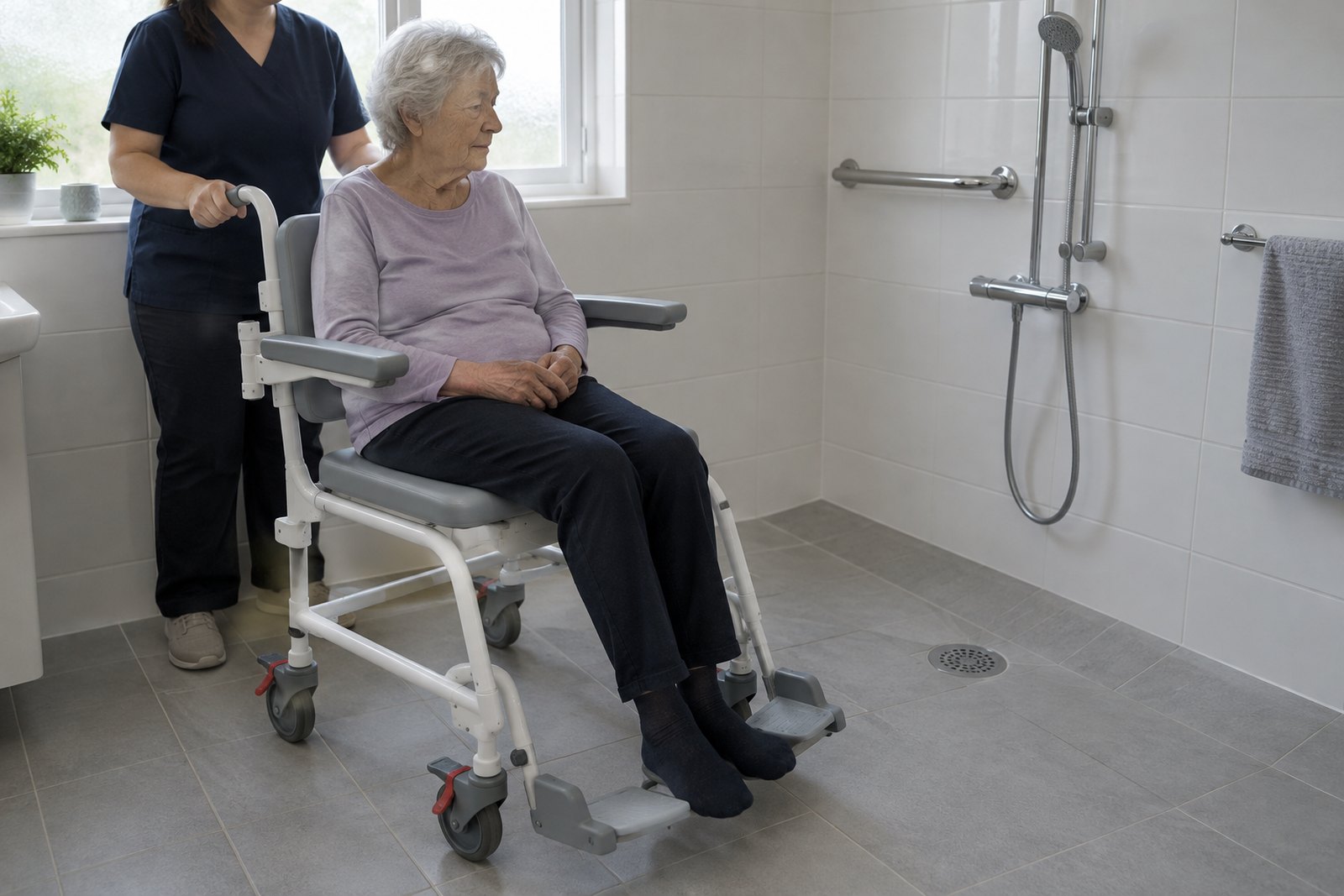
A shower commode chair is a wheeled chair made to get wet, with an opening (an aperture) in the seat. It does three jobs. It can be wheeled over an ordinary toilet, used with a removable pan as a commode, and rolled straight into a level-access shower so the person can be washed sitting down. One chair, one transfer, instead of shuffling between a bed, a commode, a shower stool and back again.
They suit people who can sit up but cannot safely walk or stand for long enough to use the toilet and shower in the usual way, and who usually have someone helping them. They do not suit everyone. They need a shower with no step or lip, enough space to manoeuvre, and a toilet the chair can actually fit over. If you have a bath and a standard shower tray, a shower commode chair will probably sit in the hallway being expensive. The rest of this page explains how to tell whether one is right, which type, and how to use it without anyone getting hurt.
What a shower commode chair actually is
It helps to know the parts, because most of the problems people have come down to one of them.
- The frame is made from rust-resistant metal or plastic-coated tubing so it can go under running water.
- The seat has an opening, usually a horseshoe or keyhole shape, so the person can use the toilet and have their bottom and groin washed without standing. Many have a lift-out cover that turns it into a solid seat. Seats can be hard plastic or padded.
- The pan slides in under the seat on runners when the chair is used as a commode, and slides out when it goes over a toilet or into the shower.
- The backrest and armrests. Armrests often flip up or lift off, which matters for sideways transfers.
- Footplates are usually swing-away or removable, and often height adjustable.
- Castors and brakes. Most have four small swivelling castors, each with its own brake. Some have larger rear wheels.
If you want the plain commode version, without wheels for the shower, our guide to commodes and using one with dignity covers those. If the person can walk into the shower and just needs to sit once there, a shower stool or static shower chair is simpler and cheaper; see shower stools and shower chairs.
The main types
Attendant-propelled
This is the most common type. Four small castors, push handles on the back, and a carer does the pushing. They are compact, which helps in small bathrooms, and they go over a toilet more easily. The person sitting in it cannot move themselves around, so it suits someone who will always have help with toileting and washing anyway.
Self-propelled
These have large rear wheels with push rims, like a wheelchair, so the person can wheel themselves. They suit someone with good arm strength and sitting balance who wants to manage alone, for example some people with spinal cord injury. The trade-off is size. They are wider and longer, the big wheels can get in the way of a sideways transfer, and they need more space to turn. Measure before you fall in love with the idea.
Tilt-in-space
Here the whole seat tips backwards as one unit, keeping the angle at the hips and knees the same. This is different from a backrest that simply reclines. Tilting spreads the person's weight over their back as well as their bottom, helps them stay upright without sliding forward, and can make washing and dressing easier for the carer. They suit people with poor trunk control, very low energy, significant spasticity, advanced neurological conditions such as motor neurone disease or later-stage multiple sclerosis, or high pressure risk. They are almost always attendant-propelled, larger and heavier, and they are the type most worth having properly assessed, because the settings matter.
Who a shower commode chair suits, and who it does not
It is often a good answer when:
- The person can sit in a chair safely but cannot stand for more than a moment, or cannot walk to the bathroom.
- Getting to the toilet and then to the shower involves several risky transfers, and one chair would cut that down.
- A carer is already helping with toileting and washing and is struggling with the logistics.
- The person is hoisted, and the chair is compatible with their sling and hoist (this needs checking, not assuming).
It is usually the wrong answer when:
- The person can still walk to the toilet with a frame and a bit of support. A toilet frame or raised seat and a shower chair will keep them moving, which is worth protecting.
- There is no level-access shower and no realistic prospect of one.
- The bathroom or doorways are too narrow for the chair to get in, turn and get out.
- The toilet is too high, too low or boxed in, so the chair will not fit over it.
- The person would end up sitting in it for hours because it is convenient. It is not a day chair.
You need a level-access shower
This is the deal-breaker, so check it first. A shower commode chair rolls in on castors. It cannot go into a bath, and it cannot go over the lip of a raised shower tray without someone tipping it, which is exactly how people get hurt. You need a wet room or a level-access shower where the floor is flush, with a gentle slope to the drain.
Look at the whole route, not just the shower:
- Doorways. Measure the clear width with the door open, and compare it with the overall width of the chair, including wheels and armrests.
- Thresholds. Even a small raised strip at the bathroom door can stop small castors dead or jolt the person forward.
- Turning space. Can a carer get the chair in, turn it and position it under the shower and over the toilet?
- The floor slope. Wet room floors fall towards the drain. That is how they work, and it also means a chair with brakes off will drift.
If you are thinking about changing a bathroom, our guide to wet rooms and level-access showers explains what to ask for and how a Disabled Facilities Grant might help. It makes sense to choose the chair and design the bathroom together, so one fits the other.
Using it over a toilet
This is where many chairs disappoint, because toilets vary more than people think. Before buying or accepting one, measure:
- The height of the toilet from the floor to the top of the toilet seat (or the rim, if you will take the seat off).
- The height of the underside of the chair seat, and the space between the frame rails. The chair has to roll over the toilet with room to spare.
- The distance from the front of the toilet to the cistern or wall, so the opening in the seat lines up with the bowl rather than sitting too far forward.
- Anything in the way, such as a pedestal basin, a boxed-in pipe or a toilet-roll holder at the wrong height.
When using it: slide the pan out first, back the chair slowly over the toilet, check the opening sits over the bowl, then put all the brakes on. Some chairs have a splash guard. If the chair will not line up, it can still be used with the pan beside the bed or in the bathroom, but that is a different routine and more emptying.
Transferring safely
Most accidents with these chairs happen getting on or off, not while sitting. A few rules make a big difference.
- Brakes on, every time. All of them, before anyone sits down or stands up. Not most of the time. Every time.
- Footplates out of the way. Swing them aside or remove them before a transfer. Nobody should ever stand on a footplate; the chair can tip forward.
- Armrest off on the transfer side if moving sideways, for example with a transfer board.
- Sit well back in the seat, so the person is supported and centred over the opening rather than perched on the front edge.
- Feet on footplates while moving, so they do not catch under the chair.
- Go slowly over any lip or change in floor surface, and if the chair tilts, check its position before moving.
If the person is hoisted, follow the moving and handling plan they have been given. If they have not been given one, that is a reason to ask for an assessment, not to work it out as you go. Do not add straps or belts to stop someone slipping unless a professional has recommended them for that person; a belt can cause harm if used wrongly, and slipping is usually a sign the chair or its setup is not right.
In the shower
The opening in the seat is the whole point here. It lets you wash the person thoroughly without asking them to stand. Keep the brakes on throughout. Check the water temperature with your own hand before it reaches them, especially if they have reduced feeling. People sitting on an open seat get cold quickly, so have towels ready and warm the room first. A long-handled sponge or a hand-held shower head on a slide rail makes reaching easier for both of you. Dry the skin carefully, including around the buttocks and in skin folds, before any clothes go back on.
Pressure and skin
An open seat puts more of a person's weight onto a smaller area around the rim of the opening. For short spells that is usually fine. For long spells, or for someone who is thin, has poor circulation, cannot shift position or already has fragile skin, it can contribute to pressure damage.
- Keep time in the chair to what the job needs. Toilet, shower, back out.
- Ask about padded or pressure-relieving seats if the person is at risk.
- Check the skin regularly, particularly the buttocks, the backs of the thighs and around the tailbone.
If you see red or discoloured patches that do not fade within a short while, skin that feels hot, hard or broken, or blisters, tell the GP or district nurse promptly. Pressure damage can worsen quickly. Our guide to pressure relief cushions and mattresses explains the warning signs in more detail.
Weight limits
Every chair has a maximum user weight, often called the safe working load. It is usually on a label on the frame and in the manual. Check it before anyone uses the chair, and check again if the person's weight changes. Do not guess and do not exceed it. Heavier-duty (bariatric) versions exist, and they are wider, so the bathroom measurements matter even more.
Cleaning and checks
These chairs get wet and dirty every day, so a routine helps.
- Empty and clean the pan straight after use, then rinse the chair.
- Clean the seat, opening and frame using the products the manufacturer recommends; some cleaners damage plastic or padding.
- Dry it, including joints and under the seat, so water does not sit in the frame.
- Every week or so, look for cracks in the seat, rust, loose bolts, worn castors and brakes that no longer grip.
If anything is damaged, stop using it. If the chair is on loan, report it to whoever supplied it rather than repairing it yourself.
Borrowing or buying
If the person has an assessed need, a shower commode chair can often be loaned free through your council's community equipment service, usually after an assessment by an NHS or council occupational therapist. Our guide to community equipment services explains how that works. Waiting times vary by area.
If you buy one privately, measure the person, the bathroom, the doorways and the toilet first. People with a long-term illness or disability may be able to buy equipment like this without VAT; GOV.UK explains who qualifies.
Where an occupational therapist fits
An occupational therapist looks at the whole routine: how the person gets out of bed, onto the chair, to the toilet, into the shower and back, and who is helping. They can tell you whether a shower commode chair is the right answer at all, which type, and which size and settings. They measure the toilet, doorways and shower, watch the transfers, show carers how to do them safely, and check skin and pressure risk alongside the person's other equipment. If the bathroom needs changing, they can advise on adaptations and support a grant application.
A private occupational therapist visiting at home can do this, with a written report if you need it; see our equipment and aids page. They are not the right person for everything. Skin damage is for the GP or district nurse. Continence problems are worth raising with the GP, who can refer to the NHS continence service. Building work is for a builder, ideally working from an occupational therapist's recommendations.
Frequently asked questions
Can a shower commode chair go over any toilet?
No. It depends on the toilet height, the space under the chair seat and whether anything blocks the way, such as a pedestal basin or boxed-in pipes. Measure both before you buy or accept one.
Can I use one in a bath or on a raised shower tray?
Not safely. These chairs are designed for level floors. Tipping one over a shower tray lip or trying to use it in a bath risks a fall for the person and injury for the carer. If you only have a bath, look at bath aids or a level-access shower instead.
Can someone sit in a shower commode chair all day?
It is not designed for that. The open seat concentrates pressure, the chair is not built for comfort over hours, and long spells raise the risk of pressure damage. Use it for toileting and washing, then move to a proper chair.
Should I choose self-propelled or attendant-propelled?
Choose self-propelled only if the person has the arm strength, sitting balance and space to manage it. Otherwise an attendant-propelled chair is usually smaller, easier to get over a toilet and easier for a carer to steer.
How do I stop it rolling on a wet room floor?
Put all the brakes on as soon as it is in position, and keep them on while the person is washing. Check the brakes regularly, because worn ones may not hold on a slope.
Can I get a shower commode chair free?
Often, yes, if an NHS or council assessment finds a need. Ask your council's adult social care team or the GP for an occupational therapy assessment.
Next steps
See our equipment and aids page or home adaptations page, or current guide prices, and choose your area below.

Talk to an occupational therapist near you
This guide is general information. For advice about your own situation - or someone you look after - a local occupational therapist can visit you at home and see it for themselves.
Choose your area: