

Repositioning in Bed: How Often and How to Do It Safely
By Mobile Occupational Therapist • 23 October 2026 • 14 min read
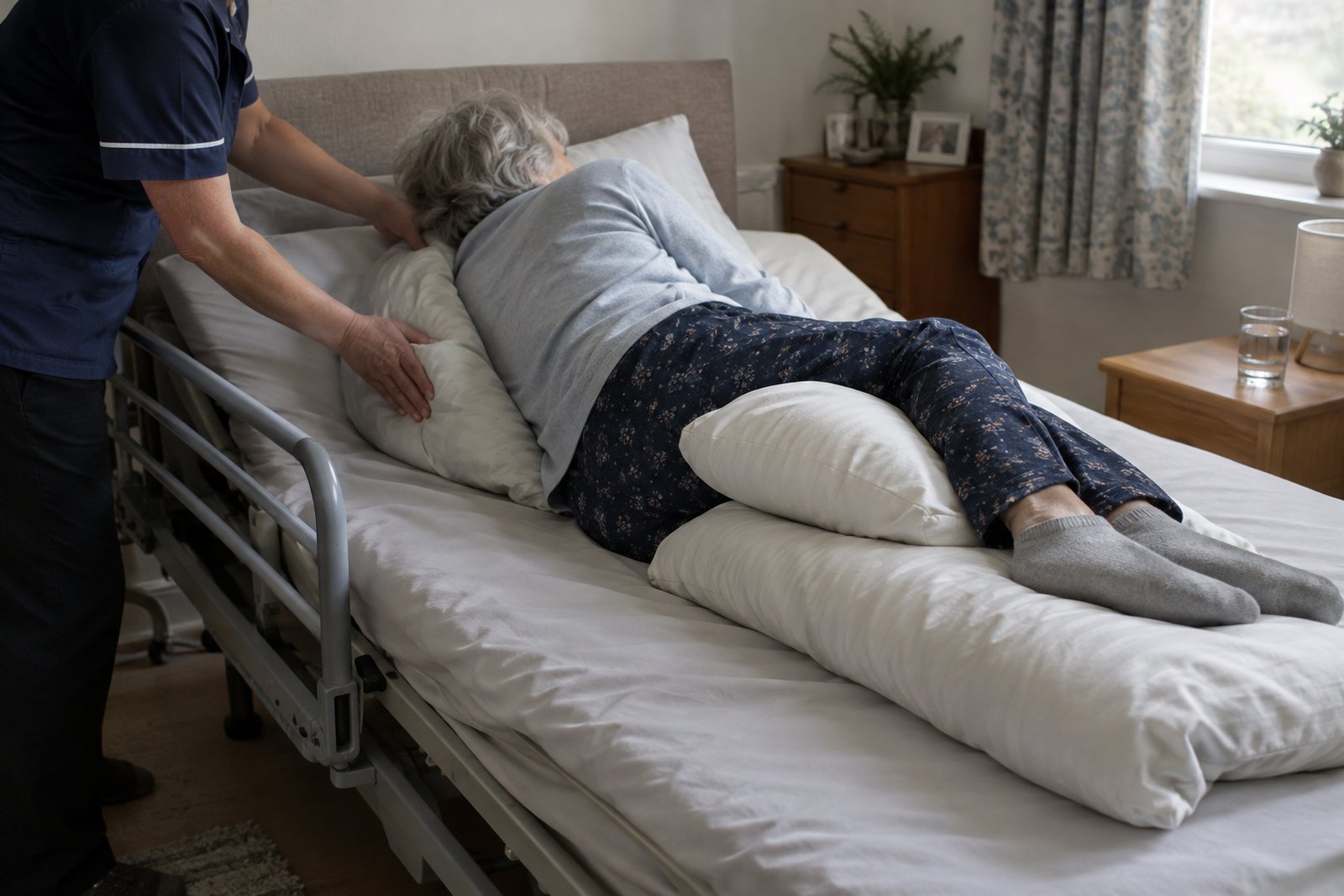
If someone you care for spends most of the day or night in bed, they need to change position regularly to protect their skin. How often depends on the person: how fragile their skin is, how much they can move themselves, how unwell they are and what they are lying on. There is no single number that suits everyone. The most useful answer is the one written in their care plan by the district nurse.
If nobody has given you a plan yet, sort that out first. Ring the GP surgery and ask for a district nurse visit or a pressure area assessment. In the meantime, this guide covers why turning matters, how to do it without hurting either of you, the positions that take weight off the places that break down first, and the signs that mean you should call someone today rather than next week.
Why repositioning matters
Pressure ulcers (also called pressure sores or bed sores) happen when skin and the tissue beneath it are squashed between bone and a surface for too long. Blood cannot get through properly and the tissue starts to break down. Friction and shear make it worse. Shear is what happens when the skin stays put on the sheet while the body slides, for example when someone slips down the bed.
The places most at risk are where bone sits close to the skin: the bottom and the base of the spine, the hips, heels, ankles, elbows, shoulder blades and the back of the head. Ears, too, when someone lies on their side.
Damage can develop quickly in someone who is frail, very thin, unwell, incontinent, not eating much or unable to feel discomfort. It can be slow to heal and, at its worst, painful and dangerous. Changing position moves the load around so no single area carries it for too long. Our guide to pressure ulcer categories explains what each stage looks like, so you know what you are checking for.
How often to turn someone in bed
This is the question most people type into Google, and the honest answer is: as often as their plan says, with a plan made for them specifically.
National guidance from NICE sets general minimums for adults at risk of pressure ulcers, but many people need turning more often than the minimum. A district nurse will decide the frequency based on things like:
- How at risk their skin is, usually scored with a recognised risk assessment
- Whether there is already redness or damage anywhere
- The type of mattress they are on
- How much they can shift their own weight
- Continence, eating and drinking, and how unwell they are overall
The plan is not fixed. If their skin stays healthy and they get stronger, turns may become less frequent. If redness appears, they may need to become more frequent. If you are not sure the plan still fits, ask for it to be reviewed.
Small shifts count too
A full turn is not the only thing that helps. If the person can move a little, encourage it: lifting one leg, shifting their hips, rolling partly towards you, wriggling their bottom across. Prompting every so often, especially when they are awake and watching television, adds up. People who are drowsy or in pain often stop doing these small movements on their own, which is when the risk climbs.
The mattress changes the plan but does not replace it
Pressure-relieving mattresses range from high-specification foam to alternating air mattresses that inflate and deflate in sections. They reduce pressure, but most people on them still need repositioning unless the nurse has specifically said otherwise. A few practical points:
- Keep what goes between the person and the mattress to a minimum. Extra sheets, folded towels and several incontinence pads layered up reduce how well the mattress works. Ask the nurse what is allowed.
- For powered mattresses, check it is switched on, inflated and not showing an alarm. If it goes flat or alarms, call the number on the equipment or the district nurse.
- Never switch a mattress setting yourself unless you have been shown how and why.
Our guide to pressure relief cushions and mattresses covers the types and how people usually get them through the NHS.
Before you start: set up so neither of you gets hurt
Most injuries to carers happen in the first few seconds of a move, when someone leans over a low bed and pulls. A minute of preparation prevents most of that.
- Tell them what you are about to do, even if they seem not to follow. Being moved without warning is frightening and people often grab or stiffen, which makes it harder.
- Raise the bed to around your hip height if it is height-adjustable, and put the brakes on. When you have finished, lower it back to the height set in their plan, usually the lowest, and put any bed rails back as they were.
- Lower the backrest if they can tolerate lying flat for a moment. Check first if they get breathless lying down or have been told to stay upright.
- Get pillows ready before you move them, not halfway through.
- Check for anything that could catch: catheter tubing, a drain, a pad that has rucked up, the call bell lead.
- Get the second person in place first if the plan says two people. Do not start on your own and hope.
Never drag, never lift
Dragging someone up the bed or across the sheet causes exactly the friction and shear that tears fragile skin. Lifting their weight, by hooking under their armpits, pulling on their arms or holding their clothes, can injure their shoulders and your back. The old habit of two people lifting someone up the bed under their arms is now recognised as unsafe. Please do not do it, even in a hurry.
If someone cannot help with the move at all, or is heavy for the people doing it, the plan may need a hoist or more help. That is a conversation for the district nurse or an occupational therapist, not something to push through.
Using a slide sheet
A slide sheet is a piece of slippery fabric, usually a tube or a pair of flat sheets, that lets someone glide rather than be dragged. With two people it makes turning and moving up the bed far easier and kinder. Our guide to how to use a slide sheet goes through it in detail. In outline, for a turn onto the side:
- One person stands on each side of the bed, with the bed at a good working height.
- Roll the slide sheet up. Gently tilt the person a little towards one carer, tuck the rolled sheet under them, let them back down and unroll it from the other side.
- Prepare them for the turn: bend the knee furthest from the direction of travel, bring the arm across, and ask them to turn their head the way they are going if they can.
- Move in small, slow stages, using your legs and a shift of your weight rather than pulling with your arms.
- Put the pillows in place while they are supported.
- Remove the slide sheet by pulling the underneath layer out low and flat, back under itself.
Always take the slide sheet away afterwards unless you have been told it is a type designed to stay in place. Left in the bed, it can let someone slide out. Ask the district nurse, or ask about moving and handling training for family carers. Being shown once, on the actual bed with the actual person, is worth more than any written guide, this one included.
Positions that take the pressure off
The 30-degree tilt
Rolling someone fully onto their side puts their weight straight onto the hip bone, which is one of the places most likely to break down. A partial tilt, roughly a third of the way over, with pillows supporting their back, keeps weight off both the bottom and the point of the hip. It is often called the 30-degree tilt. The usual pattern is to alternate between a tilt to the left, lying on the back and a tilt to the right, but follow whatever pattern the nurse sets.
Using pillows well
- A pillow along the length of their back to hold the tilt
- A pillow between the knees and lower legs so bony knees and ankles are not pressing on each other
- Support under the upper arm so it is not dragging the shoulder forwards
- A quick check that the lower ear is not folded over
Floating the heels
Heels are small, so all the weight of the leg goes through a tiny area. A pillow placed lengthways under the calves, so the heels hang just clear of the mattress, takes the pressure off completely. The knee should be very slightly bent and supported, not pushed straight or propped up on a single pillow under the knee. Some people need heel protection boots as well. See our guide to heel protectors and pressure relief boots.
The head of the bed
When the backrest is raised high, people slowly slide down the bed, and the skin over the bottom gets dragged. Keep the backrest as low as is comfortable and safe for them. If it needs raising for eating, drinking or breathing, raise the knee section first on a profiling bed to stop the slide, then lower things again afterwards. Some people must stay propped up for breathing or swallowing reasons. In that case follow the advice of the nurse or speech and language therapist.
Things to avoid
- Lying them on an area that is already red
- Leaving them lying directly on the point of the hip
- Wrinkled sheets, crumbs, tubing or a rucked pad underneath them
- Rubbing or massaging red areas, which can make damage worse
Check the skin every time
Every turn is a chance to look. Check the bony areas, gently, while they are tilted. You are looking for:
- Redness that does not fade. Press lightly on a red patch with a fingertip. If it goes pale and the colour comes back, that is usually less worrying. If it stays red, report it.
- Changes on darker skin. Redness can be hard or impossible to see. Look for areas that look purple, blue, grey or darker than the surrounding skin, and feel for patches that are warmer, cooler, firmer or puffier than nearby skin.
- Blisters, broken skin or dark patches, however small.
- Pain, tingling or itching in one spot. Ask them, and watch for wincing if they cannot tell you.
Keep skin clean and dry, change wet pads promptly, and use the barrier or moisturising products the nurse has advised.
Keep a simple turning chart
A chart is not about proving you have done your job. It stops the day blurring, helps when more than one person is caring, and gives the nurse something real to look at. The district nurse may give you one. If not, a sheet of paper with these columns is enough:
- Time
- Position moved to (for example left tilt, back, right tilt, sitting out)
- Skin: anything new or different
- Who did it
- Notes: refused, in pain, ate well, pad changed
Keep it by the bed. If you notice the same spot going red after the same position, that pattern is exactly what the nurse needs to know.
When to call the district nurse, GP, 111 or 999
Call the district nurse the same day if you notice redness that does not fade, a blister, broken skin or a dark patch; new pain in one area; you cannot keep to the turning plan; the mattress is faulty or alarming; they keep sliding down the bed; or they have stopped eating or drinking much.
Contact the GP or call NHS 111 if a sore looks infected: spreading redness, swelling, warmth, pus, a bad smell, or they have a high temperature or seem generally unwell.
Call 999 if they become suddenly very unwell, for example newly confused, struggling to breathe, or with blue, grey or blotchy skin.
If the plan includes night turns
Turning someone through the night, every night, on your own, is not sustainable for long. If that is where you are, say so plainly to the district nurse. Ask whether the mattress could be reviewed, and contact council adult social care to ask for a needs assessment for the person you care for and a carer's assessment for you. Being honest about what you can manage is part of keeping them safe.
Where an occupational therapist fits
District nurses lead on pressure ulcer prevention at home. They assess risk, set the turning plan, arrange pressure-relieving mattresses and treat any wounds. For complicated or slow-healing wounds, a tissue viability nurse may be involved. A physiotherapist may help with chest care, movement and strength. If you are worried about skin or a wound, the nurse is the right person, not an occupational therapist.
Where an occupational therapist helps is the set-up around the turning. An occupational therapist can:
- Look at the bed, its height and the space around it, and whether a profiling bed would make turning safer
- Work out whether slide sheets, a hoist or other moving and handling equipment are needed, and how many carers that takes
- Watch how you move the person and suggest safer, easier techniques
- Help the person do more of the moving themselves, which protects their skin and their independence
- Look at sitting as well as lying, because pressure damage also happens in chairs
NHS and council occupational therapists do this work, usually through a referral from the GP, district nurse or adult social care. A private occupational therapist visiting at home can also assess and recommend equipment and techniques, and will usually work alongside the district nurse rather than instead of them.
Frequently asked questions
How often should you turn someone in bed?
As often as their care plan says. NICE sets general minimums for people at risk, but many people need turning more often, and the right frequency depends on their skin, health, mattress and how much they can move. If you have no plan, ask the GP surgery for a district nurse assessment.
Do you still need to turn someone on an air mattress?
Usually yes. Pressure-relieving mattresses reduce the risk but rarely remove the need to change position. Only change the routine if the district nurse has told you to.
Can I turn someone on my own?
Sometimes, if the person can help and the plan says one carer is enough. If they cannot help, the plan may say two people with a slide sheet, or a hoist. Do not take on a two-person move alone. Ask for the plan to be reviewed instead.
Should I wake someone at night to turn them?
If the plan includes night turns, they usually need doing, but gently and with as little disturbance as possible. If waking them is causing real distress or exhaustion for either of you, tell the district nurse. The mattress or the plan may be able to change.
What if they refuse to be turned?
Try again a little later, explain why, and check whether pain, fear or cold is the reason. Note refusals on the chart and tell the district nurse, who can look at pain relief, positioning options and the person's right to make their own choices.
Does sitting in a chair all day cause pressure sores too?
Yes. Sitting puts a lot of weight through the bottom and base of the spine. People who sit for long periods may need a pressure-relieving cushion and regular changes of position too, so ask for the chair to be included in the assessment.
Next steps
See our equipment and aids page, or current guide prices, and choose your area below.

Talk to an occupational therapist near you
This guide is general information. For advice about your own situation - or someone you look after - a local occupational therapist can visit you at home and see it for themselves.
Choose your area: