

Slide Sheets: How to Use One to Move Someone in Bed
By Mobile Occupational Therapist • 25 September 2026 • 14 min read
A slide sheet is a piece of very slippery fabric that goes underneath someone lying in bed so they can be slid, rather than dragged or lifted, into a new position. It is the standard way to help someone move up the bed or turn onto their side when they cannot manage it themselves. Used properly, it protects their skin and your back at the same time.
The short version of how to use one: two layers of slippery fabric glide over each other, you move the person in small, smooth shifts using your body weight rather than your arms, and then you take the sheet out again. Every time. The longer version is that technique matters a great deal, it needs to be shown to you in person by someone trained, and many moves need two people. This guide explains what you are dealing with, so the demonstration makes sense and you know what to ask for.
What a slide sheet actually is
Despite the name, a slide sheet is not bedding. You do not make the bed with it and nobody sleeps on it. It is a length of low-friction fabric, usually a smooth, shiny material, which you slip underneath a person only for the few moments it takes to reposition them.
The trick is that it works in two layers. The bottom layer stays still against the mattress, the top layer moves with the person, and because the two surfaces barely grip each other, a person who would take real effort to drag can be shifted with a gentle, steady push. That matters for two reasons. Dragging someone across a cotton sheet pulls their skin against the surface, which can damage fragile skin and contribute to pressure sores. And hauling a person up the bed by their arms or under their armpits is one of the classic ways family carers injure their backs and shoulders, and hurt the person they are helping.
What a slide sheet is not is a lifting device. It reduces friction. It does not take anyone's weight off the bed, and it is never to be used to lift a person up or carry them.
Tubular or flat: the two main types
Tubular slide sheets
A tubular slide sheet is a continuous loop of fabric, like a very wide, flattened tube. When it is under someone, the loop automatically gives you the two layers sliding against each other. Tubular sheets are quick to use and are the type many families are given. They come in different lengths and widths, and the size chosen depends on the person and the move. A short one might go just under the hips and shoulders; a longer one might cover most of the body.
Flat slide sheets
A flat slide sheet is a single layer. Flat sheets are usually used in pairs, one on top of the other, or a single large sheet is folded to create the two layers. They can be more flexible for some moves, such as turning, and some carers find them easier to remove without disturbing the person. They take a little more practice to lay out correctly.
Some sheets have handles or loops sewn in. These are for the carers to hold, not for pulling hard. You may also come across specialist sheets designed to stay in place in the bed. These are different products and should only be used if a professional has assessed for them. An ordinary slide sheet is never one of them.
Which type is right is genuinely a question for whoever assesses the person. It depends on their size, their skin, how much they can help, the bed, and how many carers there are.
Before you start
Most mistakes with slide sheets happen before anyone moves at all. A few minutes of setting up makes the move itself much easier.
- Talk to the person. Explain what you are about to do, even if they have dementia or seem not to follow. Tell them which way they are going. Agree a signal such as "ready, steady, slide" so everyone moves together.
- Check for pain. If they are hurting somewhere new, stop and think before moving them. See the safety section below.
- Get the bed to the right height. If you have a height-adjustable bed, raise it so you are working around hip height without stooping. On an ordinary low bed, you will be bending, which is one reason families are often moved on to a profiling bed. Put the brakes on.
- Lower the head of the bed if it is safe. Sliding someone uphill is hard work. But some people cannot lie flat because they become breathless or uncomfortable, so check what has been advised for them.
- Clear the space. Move pillows out of the way apart from the one under their head, and make room on both sides of the bed for carers to stand.
- Check the sheet. Look for tears, thinning or seams coming apart. A worn sheet does not slide well and you end up pulling harder.
Moving someone up the bed: the general steps
What follows is the general shape of the move, so you know what to expect. It is not a substitute for being shown. A trained person should watch you do it, correct your stance and hand position, and agree how many carers are needed. Moving someone up the bed is very often a two-person job, with one carer on each side.
- Get the sheet underneath. The usual way is to roll the person slightly towards one side, tuck the sheet in loosely rolled or folded like a fan, then roll them gently back over it and ease it through from the other side. Some people can lift their hips a little to help instead.
- Position the sheet. It needs to sit under the heaviest parts of the body, the shoulders and hips, with the head supported. The sheet should lie flat with no rucks.
- Ask the person to help if they can. Someone who can bend their knees, tuck their chin in and push gently through their heels does a surprising amount of the work.
- Stand properly. Each carer stands facing the direction of travel, feet apart, one foot in front of the other, knees soft and back straight. You will move by shifting your weight from your back foot to your front foot, not by pulling with your arms.
- Hold the top layer, not the person. Carers grip the top layer of the sheet close to the person's body, usually around shoulder and hip level. Never pull on their arms or hook your hands under their armpits.
- Slide in small steps. On the agreed word, everyone shifts their weight together and the person glides a short distance up the bed. Several small slides are safer and kinder than one big heave.
- Take the sheet out, then make them comfortable. More on removal below.
Turning someone onto their side
Turning is used for changing position to protect skin, for personal care, for changing bedding and for getting a sheet underneath for other moves. Again, this is the general idea only.
- Decide which way they are turning and make sure there is enough room on that side of the bed so they do not end up on the edge. If one carer is standing on the side they are rolling towards, that carer is there to receive and steady them, not to pull.
- Prepare the body. Turn their head towards the direction of the turn, bring the far arm across their chest and bend the far knee, or cross the far leg over. This sets the body up to roll as one piece rather than twisting.
- Position the sheet under them in the way you have been shown. With a turn, the sheet often helps you first slide them slightly towards the opposite side of the bed, so that after turning they land in the middle rather than at the edge.
- Roll smoothly on an agreed word, with your hands on the top layer of the sheet or flat on the shoulder and hip as shown, and your weight moving through your legs.
- Support them in the new position with pillows as advised, then remove the sheet.
If the person is in pain, has a recent fracture, has had recent surgery, or has a spinal problem, there may be specific instructions about how they can and cannot be turned. Get those from their medical or therapy team before you try.
Getting the slide sheet out again
This is the step people skip when they are tired, and it is the one that causes falls. A slide sheet left under someone turns the bed into an ice rink. They can slide down the bed, or sideways and out of it, especially if they shift in their sleep or try to sit up.
The usual method is to pull the bottom layer out from underneath, keeping it low and flat against the mattress. With a tubular sheet you typically tuck the end of the bottom layer under itself and draw it out slowly, so the sheet peels out rather than dragging the person with it. Pull along the line of the mattress, never upwards. Your trainer will show you the version that suits your sheet.
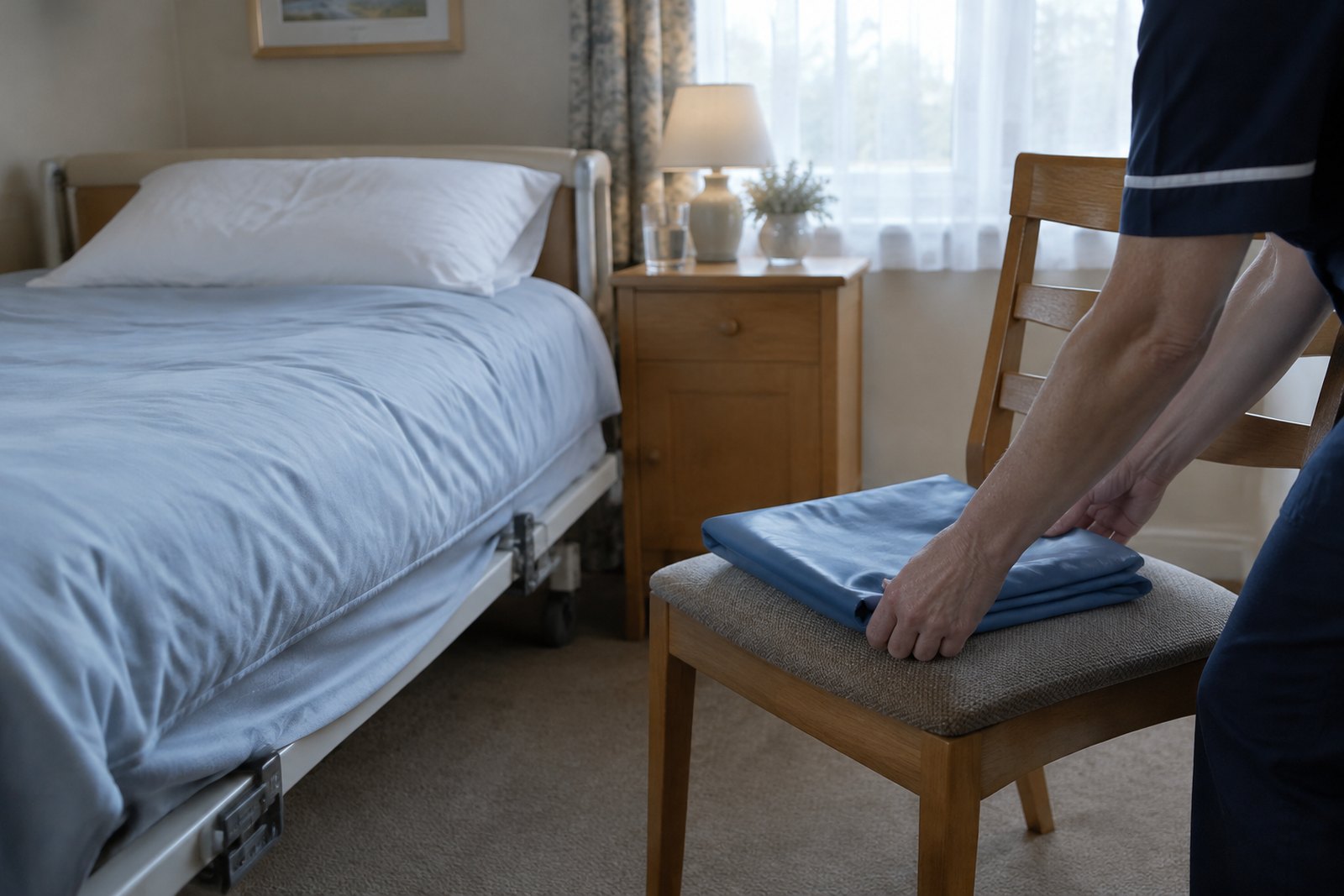
Then put it somewhere sensible, out of the bed. Many families keep it folded on a bedside chair or in a drawer so it is to hand next time without being tempting to leave in place.
The dangers, plainly
- Never leave a slide sheet under someone. Not overnight, not while you make a cup of tea, not in a chair. Take it out as soon as the move is done.
- Never use it to lift. It is not strong enough, nobody's back is strong enough, and it is not designed for it. If a person needs lifting, they need a hoist and an assessment, not a slide sheet.
- Never pull on arms or under armpits. This can injure shoulders, particularly after a stroke or in frail older people.
- Do not do a two-person move alone. If you have been told a move needs two carers, one tired family member trying it solo is exactly how injuries happen.
- Watch the edges of the bed. A sheet makes people move further and faster than you expect. Know where the edge is before you start. If bed rails are in use, they need to be assessed and fitted properly, and a slide sheet is not a reason to add them without advice.
- Do not use it on the floor without training. Slide sheets are sometimes used by trained staff to move someone who has fallen in a tight space. That is not a job to work out for yourself.
- Look after the sheet. Wash it as the care label says, and replace it if it is torn or worn.
Our guide to safe moving and handling for family carers covers the wider principles, including what to do when someone starts to fall.
When to ask for a moving and handling assessment
A slide sheet is usually given as part of a moving and handling plan, ideally after someone has assessed the person and shown the carers what to do. If you have one but nobody has ever shown you how to use it, or you bought one yourself, ask for an assessment. Also ask if any of these apply:
- You are getting back, neck or shoulder pain from helping.
- The person keeps slipping down the bed and you are moving them up many times a day.
- They can do less to help than they could, or are getting heavier or weaker.
- A move you were shown for two people is now being done by one, because that is who is there.
- You are coming home from hospital and the person's needs have changed.
- You notice red or sore areas on their skin, particularly on the bottom, hips or heels.
- You are not sure whether a slide sheet is still enough, or whether they now need a hoist.
Routes in include the GP or district nursing team, a request to your council adult social care team for an assessment, or the hospital team before discharge. Slide sheets and other moving equipment are commonly provided on loan through the local community equipment service once someone has assessed the need.
Some things are not equipment questions. If the person suddenly cannot move as they normally do, becomes newly confused, or may have hurt themselves in a fall, contact the GP or NHS 111. Call 999 if they are seriously hurt, struggling to breathe, or you think they may have had a stroke. Skin that is broken or redness that does not fade should be seen by the district nurse or GP.
Where an occupational therapist fits
Moving and handling at home is a core part of what occupational therapists do. An occupational therapist can watch how the person currently moves and how you help them, work out which moves are safe for one carer and which need two, recommend the right equipment (which sheet, which bed, whether a hoist is needed), demonstrate techniques with you at the bedside, and write a moving and handling plan everyone in the house and any paid carers can follow.
Council and NHS occupational therapists do this for free, though there can be a wait. A private occupational therapist visiting at home can do the same assessment, and may help if you need advice sooner or want a report to support equipment or care requests. See our equipment and aids service page for what that involves.
Other professionals lead on other parts. A physiotherapist leads on rehabilitation and exercises to rebuild strength and movement. District nurses lead on skin care and pressure sores. The GP leads on any medical change, pain or new symptom. Good moving and handling usually involves several of these people working together, and it is fine to ask each of them what they think.
Frequently asked questions
Can I use a slide sheet on my own?
Sometimes. Some moves, particularly with a person who can help a lot, are safe for one carer. Many are not, especially moving someone up the bed if they cannot help. Whether a move is a one or two-person job should be decided by whoever assesses you, not by how many people happen to be home.
Can I leave the slide sheet under them so it is ready next time?
No. An ordinary slide sheet must come out after every move. Left in place, it can let the person slide down or out of the bed. Keep it folded nearby instead.
Are slide sheets free on the NHS?
They are often provided on loan through the community equipment service after an assessment by a nurse, occupational therapist or physiotherapist. Arrangements vary by area, so ask your GP, district nurse or council adult social care team what applies locally.
Which is better, a tubular or flat slide sheet?
Neither is better in general. Tubular sheets are quick and simple for many moves; flat sheets can be more flexible, for example when turning. The right choice depends on the person, the bed and the carers, which is why it is worth having it assessed.
Can I use a slide sheet to get someone up off the floor?
Not to lift them, ever. Trained staff sometimes use slide sheets to reposition someone on the floor before using other equipment, but this needs proper training. If someone has fallen and cannot get up safely, keep them warm and comfortable and call for help, or 999 if they are hurt.
How do I stop them sliding down the bed in the first place?
Sliding down often happens when the head of the bed is raised and nothing supports the hips and knees. On a profiling bed, raising the knee section slightly before the back can help, as can positioning advice from an occupational therapist or nurse. If it is happening constantly, that is a good reason to ask for an assessment.
Next steps
If you are moving someone in bed and want it checked by a professional, see our home assessment page, or current guide prices, and choose your area below.

Talk to an occupational therapist near you
This guide is general information. For advice about your own situation - or someone you look after - a local occupational therapist can visit you at home and see it for themselves.
Choose your area: