

Pressure Ulcer Stages: A Plain Guide for Family Carers
By Mobile Occupational Therapist • 10 October 2026 • 13 min read
Pressure ulcers are also called pressure sores or bed sores. They are described in categories, sometimes still called stages or grades. Category 1 is skin that is still unbroken but stays red or discoloured when you press it gently. Category 2 is a blister or shallow open sore. Categories 3 and 4 are deeper wounds, going down through the skin to the fat, muscle or bone. Nurses also use two extra labels: unstageable, when the bottom of the wound is covered so its depth cannot be seen, and deep tissue injury, when the damage is underneath skin that may still look intact.
If you are caring for someone and have noticed a patch of skin that worries you, the most important thing to know is this: you do not need to work out the category. That is the nurse's job. Your job is to take the pressure off that spot straight away and ring the district nurse or GP surgery the same day. A category 1 mark is a warning, not a verdict, and it often settles if it is acted on quickly.
What a pressure ulcer actually is
When someone sits or lies in one position for a long time, their weight squashes the skin and tissue between the bone and whatever is underneath them. Blood cannot get through properly, and the tissue starts to be damaged. Sliding down a bed or chair adds another problem, called shear, where the skin stays put while the bone underneath moves, stretching the small blood vessels. Damp skin from sweat or incontinence breaks down more easily too.
The people most at risk are those who cannot easily change position on their own: someone who is bed-bound or spends most of the day in a chair, someone recovering from a hip fracture or major surgery, people with advanced dementia, Parkinson's, MS, stroke or spinal injury, and anyone who is very frail, poorly nourished or near the end of life. Reduced feeling, for example from diabetes or nerve damage, is a risk because the person does not feel the discomfort that would normally make them shift.
Where they form
Pressure ulcers usually appear over bony places. These are the areas to check:
- The base of the spine, the tailbone and the buttocks
- Heels and ankles
- Hips, particularly if they lie on their side
- Shoulder blades and spine
- Elbows
- The back of the head and the ears
- Knees, where they press together when lying on the side
They can also form under anything pressing on the skin for a long time: oxygen tubing behind the ears, catheter tubing against the thigh, a splint or brace, tight socks, shoes that have become too small because of swollen feet, or even a deep crease in a sheet or a forgotten object in the bed.
Pressure ulcer stages in plain terms
The NHS in England now generally uses the word category rather than stage or grade, but they mean the same thing. Below is what each looks like, described for a carer rather than a clinician. It is here to help you recognise when to ask for help, not so you can grade a wound yourself.
Category 1: unbroken skin that stays discoloured
The skin is intact, but there is a patch that looks different and does not fade when pressed. On lighter skin it is usually red. If you press gently with a fingertip for a few seconds and lift off, healthy skin goes pale and then pinks up again. A category 1 area stays red. Nurses call this non-blanching.
On darker skin, redness can be hard or impossible to see, and the press test is less reliable. Look instead for a patch that is darker than the surrounding skin, or looks purple, blue or greyish. Feel it with the back of your hand: it may be warmer or cooler than the skin around it, and may feel firmer, spongy or swollen. The person may say it is sore, itchy or burning. Trust these signs and mention them, even if you cannot see any colour change.
Category 2: a blister or shallow sore
The top layer of skin is broken. It may look like a blister (whole or burst), a graze, or a shallow open sore with a pink or red base. Category 2 ulcers can be confused with skin damage from incontinence, which is one reason a nurse should look.
Category 3: a deeper wound
The wound goes through the full thickness of the skin into the fat underneath, so it looks like a small crater. Muscle and bone cannot be seen.
Category 4: down to muscle or bone
The deepest category. Muscle, tendon or bone may be visible. These are serious wounds with a real risk of infection, including infection in the bone, and they can take a long time to heal.
Unstageable
The bottom of the wound is covered by soft yellow, grey or green dead tissue (slough) or a hard black or brown scab (eschar), so no one can see how deep it goes. It is treated as a serious wound until the nurse can tell otherwise.
Deep tissue injury
A purple or maroon patch on skin that may still be unbroken, or a blister filled with blood. The damage is in the deeper tissue, and it can open up into a deep wound over the following days even with good care. Heels are a common place for this, often after a long time lying on a trolley or in bed, or after a fall where someone was on the floor for a while.
Why category 1 matters so much
It is tempting to think a red mark is not worth bothering anyone about. It is the opposite. Category 1 is the point at which damage is most likely to be reversible, and it tells you that whatever is happening now - the chair, the mattress, the position, the hours spent still - is not enough to protect that person's skin. Leave it, and the next step is usually broken skin.
It also matters because what you see on the surface is not always the whole story. Pressure damage can start deep, close to the bone, and work outwards. A small mark can sit over a bigger problem.
What to do if you spot a mark
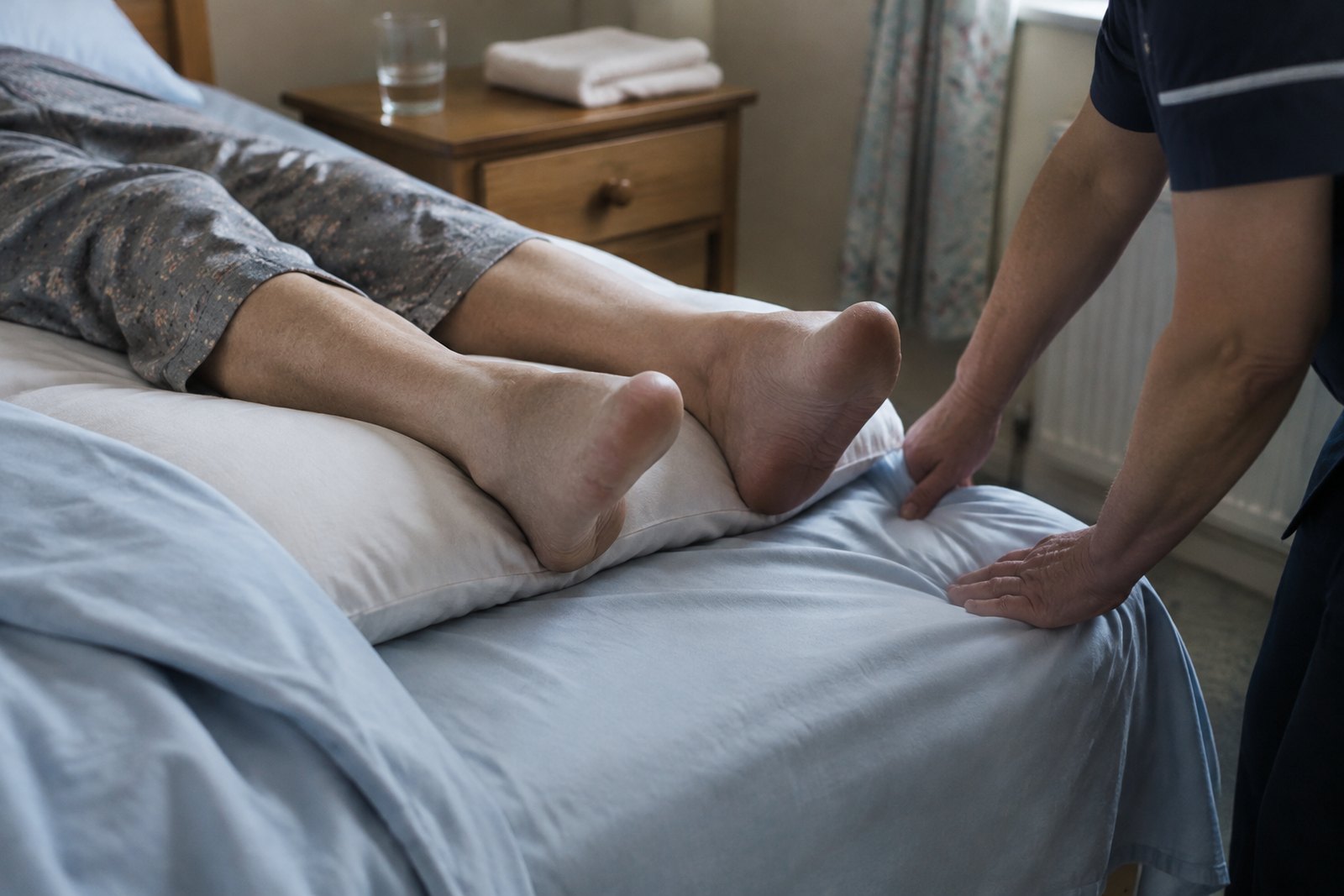
- Take the pressure off that area now. Help them change position so they are not lying or sitting on it. For a heel, a pillow placed lengthways under the calves can lift the heel clear of the mattress so it floats rather than presses. Keep them off that spot as much as you can until a nurse has seen it.
- Contact the district nurse or GP surgery the same day. If the person is housebound, the district nursing team is usually the right people, and the GP practice can refer you or give you the number. If district nurses already visit, ring the team directly. If it is evening or the weekend and the skin is broken or getting worse, call NHS 111.
- Do not massage or rub the area. This used to be common advice. It is not now: rubbing reddened skin over a bony area can damage the fragile tissue underneath.
- Do not pop blisters or put anything on broken skin other than what a nurse advises. Leave dressings to the nurse.
- Keep the skin clean and dry. Wash gently with warm water, pat dry rather than rub, and change wet pads or clothing promptly.
- Write down what you saw. Where it is, roughly how big, the colour, whether the skin is broken and when you first noticed it. A photo, if the person agrees, can help the nurse see changes over time.
When it is urgent
Signs of infection need medical help quickly. Call the GP urgently or NHS 111 if the area becomes more red, swollen, hot or painful, if there is pus or a bad smell, or if the person has a high temperature or feels shivery. Call 999 if they seem very unwell: confused or drowsy when they are not usually, breathing fast, or with cold, clammy or mottled skin. These can be signs of sepsis.
Prevention: the SSKIN idea in plain terms
Nurses often use the word SSKIN as a reminder of five things that protect skin: surface, skin inspection, keep moving, incontinence and moisture, and nutrition. You do not need the acronym, just the ideas.
Surface
What they sit and lie on matters. Someone at risk may need a pressure-relieving mattress or cushion, usually provided through the district nurse or the community equipment service after an assessment. Our guide to pressure relief cushions and mattresses explains the main types. Many nurses advise against ring-shaped cushions, because they can create pressure around the edge. And more layers are not always better: piling extra sheets, pads or blankets underneath someone on a pressure mattress can stop it working properly.
Skin inspection
Look at the at-risk areas at least once a day, perhaps when washing or dressing. Ask whether anything is sore. If they cannot tell you, watch for wincing or restlessness when they move or are moved. A hand mirror can help someone who is able to check themselves.
Keep moving
Changing position is the single biggest protection. Encourage small shifts if they can manage them: leaning forward, rocking side to side, standing for a moment, walking a few steps. If they cannot move themselves, they will need help to change position regularly, including at night. How often depends on the person, their skin and their mattress, so ask the nurse for a plan. National guidance from NICE covers this, and the nurse will apply it to your situation.
How you move them matters too. Dragging someone up the bed causes shear. A slide sheet used correctly reduces it. Watch for slumping in a chair, and for sliding down the bed when the head end is raised high.
Incontinence and moisture
Wet skin breaks down faster. Change pads promptly, clean gently and use whatever barrier product the nurse recommends. If continence is a problem, the NHS continence service can help, and our guide to free incontinence pads and NHS continence services explains how to get a referral. Sweat counts too, so watch for overheated rooms and too many synthetic layers.
Nutrition and hydration
Skin needs protein, energy and fluid to stay strong and to heal. If someone has lost weight, is eating very little or is struggling to swallow, tell the GP. They may refer to a dietitian, or to a speech and language therapist if swallowing is the problem.
Where an occupational therapist fits
To be clear first: an occupational therapist does not treat pressure ulcers. Wound care, dressings and grading belong to the district nurse, practice nurse or tissue viability nurse, who is a specialist in wounds and pressure care. The GP deals with infection and the wider health picture. If you are worried about a mark, ring them, not an OT.
Where an occupational therapist can help is with the everyday reasons pressure builds up. Plenty of damage starts in a chair rather than a bed, because someone sits for hours in a chair that is the wrong height, too deep or too soft, gradually slides forward, and cannot shift their weight. An occupational therapist can look at:
- Seating and posture: whether the chair fits, whether they slump or slide, and what would help them sit well and shift their weight
- The bed set-up, including whether a profiling bed or other bed equipment would make positioning easier
- Transfers: how someone gets in and out of bed and chair, and how carers can help without dragging
- Routines: how to build movement and position changes into the day in a way that actually happens
- Sleeping in a chair overnight, which is common and puts sustained pressure on the buttocks and heels
- Washing, toileting and continence equipment that keeps skin cleaner and drier
Through the NHS or council, an occupational therapist may be involved after a hospital stay or through adult social care. A private occupational therapist visiting at home can look at the whole picture - chair, bed, bathroom, daily routine and how much the carer is doing - and recommend equipment and aids that fit the person and the home. They work alongside the nursing team, not instead of it. A physiotherapist may also help with strength and mobility.
Frequently asked questions
Are pressure ulcer stages, grades and categories the same thing?
Broadly, yes. Older leaflets talk about grades or stages, and the NHS in England now generally uses categories. They all describe how deep the damage goes. Bed sores and pressure sores are older names for the same problem.
Can a category 1 pressure ulcer heal?
Often, yes, if the pressure is removed and the cause is dealt with. That is why it is worth acting quickly. A nurse should still look, because the damage underneath can be worse than the surface suggests, and whatever caused it needs to change.
How do I check for pressure damage on dark skin?
Do not rely on redness. Look for patches darker than the surrounding skin, or purple, blue or grey tones. Feel for warmth, coolness, hardness or swelling compared with the same spot on the other side of the body, and ask whether it hurts. Tell the nurse what you have noticed even if you are unsure.
Should I put cream or a plaster on a pressure sore?
Not without a nurse's advice. Barrier creams have a place in protecting skin from moisture, but the wrong product, or a sticky plaster on fragile skin, can do harm. Leave dressings to the nurse.
Who do I call if a pressure ulcer gets worse at the weekend?
If district nurses already visit, many teams have an out-of-hours number, so check any paperwork they left. Otherwise call NHS 111. If the person is very unwell, confused or has signs of sepsis, call 999.
My mum is in a care home and has a pressure sore. What should I do?
Ask the staff what happened, which category it is, who is treating it and what has changed in her care plan. These are reasonable questions. If you are not satisfied, raise it with the manager, and if you are seriously worried about her care you can contact the council's adult social care team.
Next steps
If you care for someone who spends long hours in a chair or bed, an occupational therapy visit can help with seating, positioning and equipment alongside the nursing team. See our home assessment page, or current guide prices, and choose your area below.

Talk to an occupational therapist near you
This guide is general information. For advice about your own situation - or someone you look after - a local occupational therapist can visit you at home and see it for themselves.
Choose your area: