

De Quervain's Tenosynovitis: Thumb and Wrist Pain and What Helps
By Mobile Occupational Therapist • 21 September 2026 • 13 min read
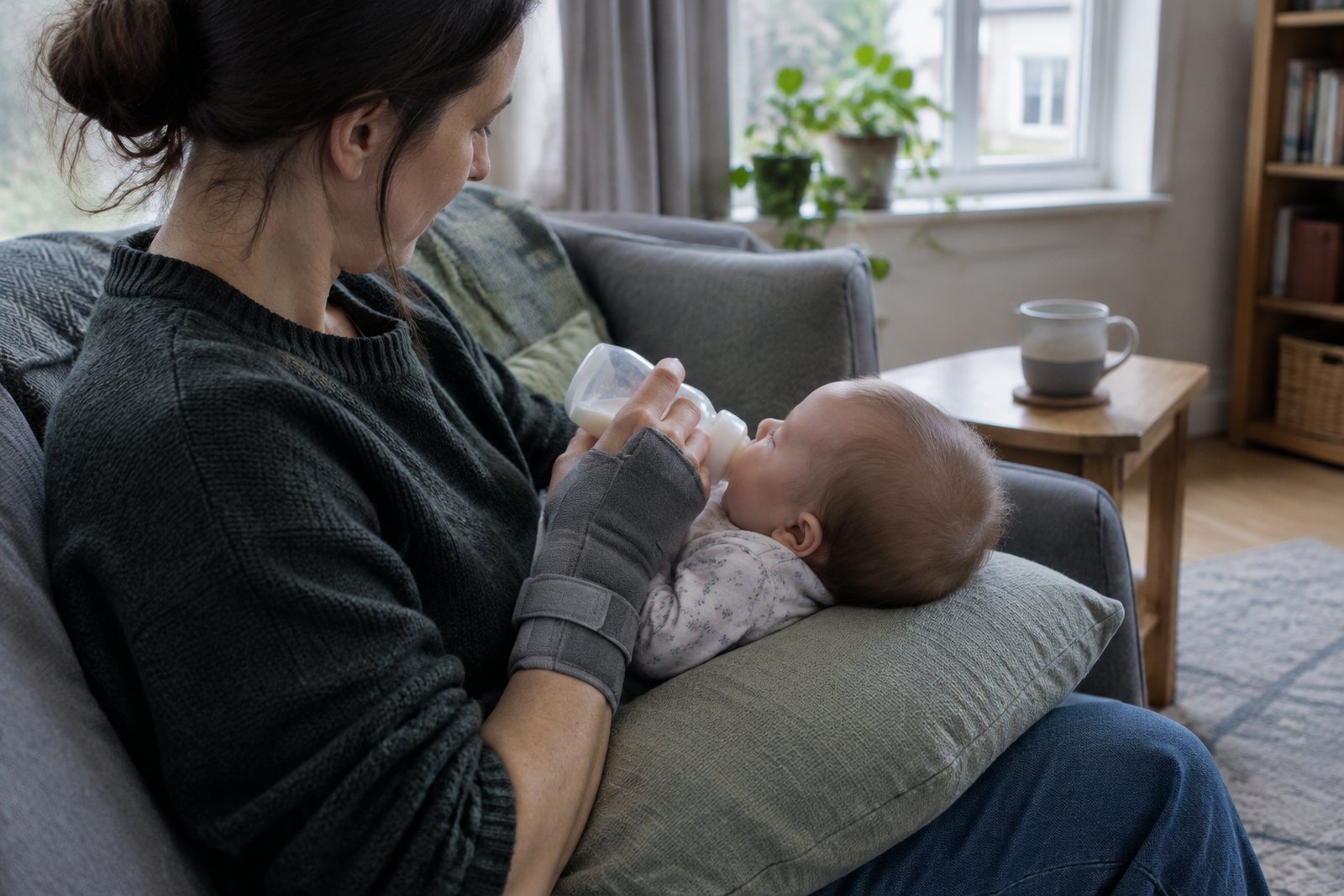
De Quervain's tenosynovitis is a painful irritation of two tendons that run along the thumb side of your wrist. It may be what you have if it hurts at the base of your thumb when you lift a kettle, pick up a baby, wring out a cloth or type on your phone, and the pain shoots up your forearm. It is common in new parents, which is why people call it "mummy thumb". Anyone who uses their hands the same way over and over can get it.
The good news is that it usually settles with sensible changes. Rest the tendons, wear a splint that holds the thumb and wrist still, and change how you do the tasks that set it off. If it is not easing after a couple of weeks of looking after it yourself, see your GP. This page explains what is going on, the movements that aggravate it and the practical changes that make a real difference. It is general information, not medical advice, and it does not replace seeing a doctor.
What is actually going on in your wrist
Two tendons move your thumb outwards and back. They run through a narrow tunnel, called a sheath, on the thumb side of your wrist, just above the bony bump. When they are worked hard and often, the sheath can become thickened and inflamed. This is especially likely with the thumb stretched out and the wrist bent. The tendons then rub instead of gliding, and that friction is the pain.
It is not a broken bone and it is not arthritis, though it can feel alarming. The problem is a soft tissue tunnel that has become too tight for the tendons running through it. That is why rest and position matter so much. The less the tendons are dragged through the tunnel while it is swollen, the sooner it calms down.
Symptoms: how to recognise it
- Pain, and sometimes swelling, on the thumb side of the wrist near the base of the thumb
- Pain that gets worse when you grip, pinch, twist or move your thumb
- Pain that spreads up the forearm or down into the thumb
- Difficulty moving the thumb and wrist, especially when pinching or gripping
- A creaking or catching feeling as the thumb moves
- Sometimes numbness on the back of the thumb and index finger
It usually comes on gradually rather than overnight. Many people first notice it during one particular task, such as lifting the baby out of the cot or opening a jar, and then realise it is there most of the day.
The test a doctor might do
A GP or physiotherapist will often ask you to tuck your thumb into your palm and close your fingers over it. You then gently bend your wrist towards your little finger. With de Quervain's this tends to be sharply painful on the thumb side of the wrist. There is no need to keep doing this at home to prove a point. If ordinary tasks already hurt in that spot, that is reason enough to treat it seriously.
What else it could be
- Arthritis at the base of the thumb. This is usually a deeper ache in the joint where the thumb meets the wrist. It is more common in older adults and is often stiff first thing. Our guide to arthritis and your hands covers it.
- Carpal tunnel syndrome. This causes tingling or numbness in the thumb, index and middle fingers. It is felt more on the palm side and is often worse at night.
- A broken bone. If the pain started after a fall onto an outstretched hand, it needs checking the same day. A broken scaphoid, a small bone at the base of the thumb, can feel similar and is easy to miss.
Why new parents get it so often
"Mummy thumb" is a fair nickname, though dads, grandparents and anyone doing a lot of baby care can get it too. Two things come together.
The first is the way most of us pick up a baby. Hands go under the armpits, thumbs spread wide, wrists bent, and the whole weight is lifted through the thumbs. Do that dozens of times a day, add feeding, nappy changes, car seat carrying and rocking, and the tendons rarely get a rest. The second is that hormonal changes and fluid retention during pregnancy and after birth are thought to play a part. That is why some people develop it before the baby arrives.
The baby also gets heavier every week, so the load goes up just as you are getting the least sleep. It is not a sign you are doing anything wrong. It is a sign that the usual technique puts all the work on the smallest tendons available.
The everyday movements that make it worse
The common thread is the thumb working hard while stretched out, the wrist bending sideways towards the little finger, or both at once.
- Lifting with the thumb spread in an L shape: babies, toddlers, shopping bags, pans
- Pinching and gripping hard: opening jars, using scissors or secateurs, pegging washing
- Twisting: wringing cloths, turning keys, unscrewing lids
- Thumb typing and scrolling on a phone, especially one-handed
- Pouring from a full kettle or a heavy pan
- Repetitive work tasks: using a computer mouse or hand tools, scanning at a till, hairdressing, using a gaming controller
- Racquet sports, golf, rowing and lifting weights
Practical changes you can make today
The aim is not to stop using your hand. It is to stop using the thumb as a hook and a lever. Share the load with the bigger muscles of your forearm, upper arm and shoulders instead. Most of these changes feel awkward for a few days and then become habit.
Lifting and holding a baby
- Scoop, do not grab. Slide one hand, palm up, under the baby's bottom. Slide the other under the head and shoulders, then bring the baby in to your chest. Keep your thumbs alongside your fingers rather than spread wide.
- Keep your wrists straight. Imagine a straight line from your forearm through the back of your hand. Lift with your arms and legs, not with bent wrists.
- Use your forearm as a cradle. When holding the baby, let them lie along your forearm with their head near the crook of your elbow. That is better than holding their weight in your hand.
- Work at a sensible height. Change nappies on a surface around waist height rather than bending over the floor, and keep everything you need within reach.
- Carry the car seat less. Car seats are heavy and awkward. If you must carry one, hook it in the crook of your elbow and keep it close to your body. For longer distances, a pram or a well fitted sling or carrier lets your body take the weight instead of your hands.
- Share the lifting. Swap sides, and let a partner or family member do the heavier lifts when they are around.
Feeding
- Use pillows or a firm cushion to bring the baby up to the right height. Your hands should be guiding, not holding the full weight.
- Avoid supporting the baby's head with your wrist bent back and your thumb spread. Let your forearm take it.
- When bottle feeding, wrap your whole hand around the bottle rather than pinching it between thumb and fingers, and switch hands during the feed.
- If finding a comfortable breastfeeding position is a struggle, ask your midwife, health visitor or local infant feeding team. They can suggest positions that take strain off your wrists.
Phones, tablets and keyboards
- Hold the phone in one hand and type with the index finger of the other, rather than thumb typing.
- Use voice typing and voice notes where you can.
- Prop the phone or tablet on a stand or a cushion rather than gripping it through long scrolls. This matters most during night feeds.
- At a desk, keep your wrists level and your hand relaxed on the mouse. Some people find a larger or upright style of mouse easier. Learning keyboard shortcuts cuts down mouse work.
- Take short, frequent breaks rather than one long one.
If the pain is linked to your job, a workstation assessment and some reasonable adjustments can help a great deal. See our page on work and ergonomics assessments.
Around the house
- Use both hands for anything heavy: the kettle, pans, bags, the laundry basket.
- Fill the kettle only as much as you need, or use a kettle tipper, a cradle that lets you pour without lifting.
- Use a jar opener. Or press down on the lid with a flat palm and turn from the shoulder rather than gripping with the thumb.
- Squeeze cloths by pressing them flat against the sink instead of wringing them.
- Choose thicker handles on cutlery, pens and garden tools. Foam tubing can build up handles you already own.
- Spread heavy jobs across the day and the week rather than doing them all at once.
Rest, ice and splints
A splint is one of the most useful things you can try. The usual type is a thumb spica splint, which holds the wrist straight and keeps the thumb still while the tendon sheath settles. Ready-made versions are sold in pharmacies. Wear it during the tasks that aggravate the pain and, if advised, at night. Follow any advice from your GP or therapist about how long to wear it.
A splint should be snug but not tight. Your fingers should stay a normal colour and you should be able to move them freely. If you get tingling, numbness, colour change or new pain, loosen or remove it. Keep your fingers, elbow and shoulder moving so the rest of your arm does not stiffen.
An ice pack or a bag of frozen peas wrapped in a tea towel, held on the sore area for short spells, can ease pain and swelling. Never put ice directly on your skin. For pain relief, speak to a pharmacist, especially if you are pregnant or breastfeeding. Rest here means doing fewer of the aggravating tasks, not keeping your hand completely still.
When to see your GP
See your GP if:
- the pain is not improving after a couple of weeks of rest, splinting and changing how you do things
- it is stopping you caring for your baby, working or sleeping
- you are not sure what it is
- it keeps coming back
Get help the same day if the pain started after a fall or injury, or your wrist looks misshapen. Go to an urgent treatment centre or A&E. If the area becomes hot, red and swollen, or you feel feverish or unwell, call NHS 111 or your GP urgently, because an infection needs prompt treatment.
In some parts of England you can refer yourself to NHS musculoskeletal physiotherapy without seeing a GP first. Your GP practice or local NHS website can tell you if this is available where you live.
What a doctor may offer
A GP can usually confirm the diagnosis by examining your wrist, and scans are not usually needed. They may advise on splinting and activity, or refer you to physiotherapy or hand therapy. A steroid injection into the tendon sheath is a common option to calm the inflammation. Talk it through with your doctor, especially if you are pregnant or breastfeeding. If other treatments have not worked, a small operation to release the tight sheath may be offered. The NHS page on de Quervain's tenosynovitis sets out the current options.
Where an occupational therapist fits
Hand therapy is a specialism within occupational therapy and physiotherapy, so a hand therapist may come from either profession. For de Quervain's, hand therapy usually involves:
- A made-to-measure splint. This is moulded from thermoplastic to fit your hand exactly. It is often more comfortable than an off-the-shelf splint, which matters if you are wearing it for weeks.
- Looking at what you actually do all day. Lifting, feeding, work, hobbies. The therapist works out which movements are causing the trouble and how to change them. An occupational therapist's focus on everyday tasks is especially useful here.
- Exercises at the right time. Gentle movement once the worst pain has settled, then gradual strengthening so it is less likely to return.
- Equipment and adapted handles that reduce pinch and grip.
- Rehabilitation after an injection or surgery. This covers swelling, scar care and getting movement and strength back.
- Advice for work, including adjustments to suggest to your employer.
To be clear about what an occupational therapist does not do: they do not diagnose, prescribe or inject. Your GP or a doctor leads on diagnosis, medication, injections and surgery. If you are already in an NHS physiotherapy pathway, the physiotherapist may lead your care. If the pain is getting worse quickly or you are unsure what it is, see a doctor first.
On the NHS, hand therapy usually needs a referral from your GP or a hospital team. Some people choose a private occupational therapist who visits at home instead. This can suit new parents who cannot easily get to a clinic. The therapist can also see your real set-up: the changing surface, the feeding chair, the desk. Our guide to hand therapy at home explains what that involves, and there is more on hand and upper limb problems. Whoever you see, check they are registered with the Health and Care Professions Council.
Frequently asked questions
How long does de Quervain's tenosynovitis last?
It varies. Many people improve over a few weeks once they rest the tendons, wear a splint and change how they do things. For some it takes longer, particularly if the aggravating tasks cannot be avoided. If it is not improving after a couple of weeks, see your GP rather than putting up with it.
Is mummy thumb the same as de Quervain's?
Yes. Mummy thumb is the everyday name for de Quervain's tenosynovitis when it appears in pregnancy or after having a baby. In new parents it often eases as the baby grows and the way you lift and feed them changes.
Should I wear my splint at night?
Many people find it helps, because it stops the wrist curling into a painful position while they sleep. Follow the advice of whoever gave you the splint. Take it off if it causes numbness, tingling or colour changes in your fingers.
Can I keep using my hand?
Yes, for light tasks. The aim is to cut down the specific movements that hurt, not to stop using your hand. Gentle use of the rest of your arm helps prevent stiffness. Pushing through sharp pain usually sets you back.
Will I need surgery?
Most people do not. Surgery is usually considered only when rest, splinting, therapy and possibly an injection have not worked. If it is offered, your surgeon will explain what it involves and the recovery time.
Can I see a hand therapist without a GP referral?
Privately, yes. You can contact an HCPC-registered occupational therapist directly. On the NHS, hand therapy usually needs a referral, though some areas allow self-referral to musculoskeletal physiotherapy. It is still sensible to have a GP confirm the diagnosis, especially if it is not clear what is causing the pain.
Next steps
If thumb and wrist pain is getting in the way of everyday life, a private occupational therapist can visit to look at how you lift, feed, work and use your hands at home. They can also advise on splints, equipment and practical changes. See our equipment and aids page, or current guide prices, and choose your area below.

Talk to an occupational therapist near you
This guide is general information. For advice about your own situation - or someone you look after - a local occupational therapist can visit you at home and see it for themselves.
Choose your area: