

Carpal Tunnel Exercises, Splints and Daily Changes That Help
By Mobile Occupational Therapist • 21 September 2026 • 15 min read
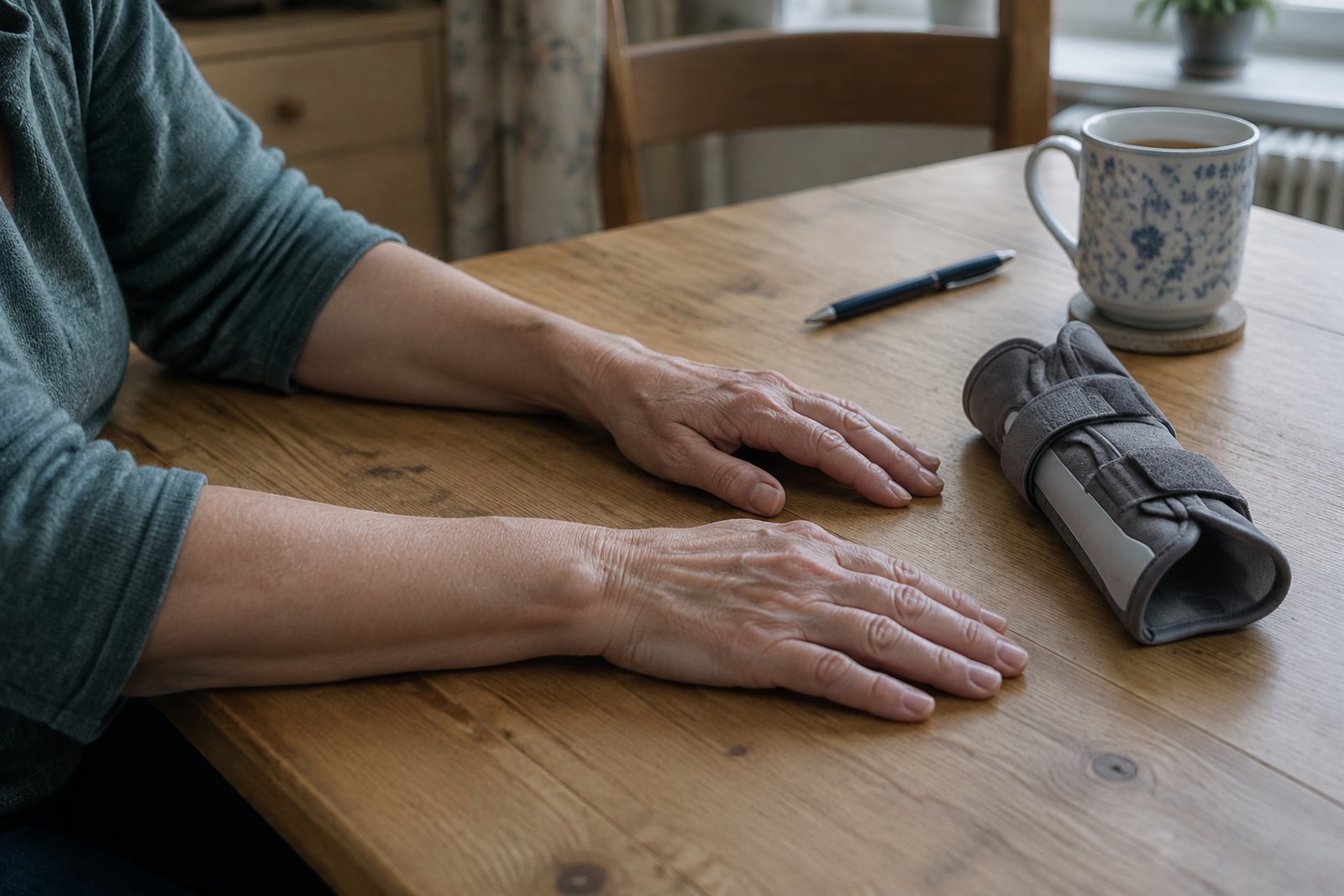
Carpal tunnel syndrome is pressure on the median nerve where it passes through a narrow channel at the front of your wrist. It usually shows up as tingling, numbness or pain in the thumb, index finger, middle finger and half of the ring finger, and it is often worst at night or first thing in the morning. For many people, mild to moderate symptoms settle with three things: a wrist splint worn at night, gentle exercises that keep the nerve and tendons moving, and changes to how you use your hands during the day.
Carpal tunnel exercises are not a cure on their own, and they are not about building strength. They are gentle movements to help things glide. The splint usually matters more than the exercises, and changes to how you use your hands during the day can help both work better. If you have weakness, numbness that never goes away, or the muscle at the base of your thumb is getting thinner, skip the home remedies for now and see your GP. More on that below.
What carpal tunnel syndrome feels like
The carpal tunnel is formed by the small bones of the wrist with a tough band of tissue across the top. Through it run the median nerve and the tendons that bend your fingers and thumb. When the space gets tighter, from swelling, fluid, the wrist being bent for long periods or changes in the joint, the nerve gets squeezed.
Typical signs include:
- Pins and needles or numbness in the thumb, index and middle fingers. The little finger is usually left out, which is a useful clue.
- Waking at night with a burning or dead hand, and shaking it to get the feeling back.
- Aching that can travel up the forearm.
- Clumsiness: dropping cups, fumbling buttons, struggling with coins, earrings or zips.
- A weaker grip or pinch, especially between thumb and fingers.
It is more common in pregnancy, in people with diabetes, an underactive thyroid or rheumatoid arthritis, after a wrist fracture, and in people whose work or hobbies involve repeated gripping, bending the wrist or using vibrating tools. Often there is no single obvious cause.
Why it is worse at night
Most people curl their wrists while they sleep. Tucked under a pillow, bent under the chin, folded against the chest. A bent wrist narrows the tunnel further, and lying still for hours means fluid is not being moved along by muscle activity. So the nerve spends the night under more pressure than it does during the day. That is why the classic story is waking at 3am with a hand that feels like it belongs to someone else.
It is also why the single most useful thing for many people is not an exercise at all. It is keeping the wrist straight overnight.
Carpal tunnel splints: how to use one properly
A carpal tunnel splint holds the wrist in a straight, neutral position, roughly in line with the forearm, neither bent forwards nor cocked right back. Your GP may suggest one first, and many people buy a ready-made one from a pharmacy.
What to look for
- A rigid stay, usually metal or plastic, along the palm side that stops the wrist bending forwards. Some ready-made wrist supports hold the wrist tipped back quite a lot because they are designed for other problems. For carpal tunnel, closer to straight is usually better.
- Fingers and thumb free to move.
- Straps that close firmly but not tightly.
- The right hand and the right size. If sizes are given by wrist measurement, measure rather than guess.
How to wear it
- Wear it at night, every night, while symptoms are active. That is where most of the benefit is.
- Some people also wear it for short spells during activities that set symptoms off. Wearing it all day, every day is generally not advised, because the wrist stiffens and the muscles weaken. Ask your GP, physiotherapist or hand therapist what suits you.
- Check your fingers. If they swell, go pale or dusky, or feel more numb than before, the splint is too tight or the wrong fit. Loosen it or stop using it.
- Keep the skin underneath clean and dry, and look for red marks, especially if you have diabetes or reduced feeling.
Give it a fair trial. Improvement tends to be gradual over a few weeks rather than overnight. If a few weeks of wearing it every night makes no difference, that is useful information for your GP.
If a ready-made splint will not fit, presses in the wrong place, or you cannot get it on and off yourself, a hand therapist can make one moulded to your hand.
Carpal tunnel exercises: gentle nerve and tendon gliding
The two types of exercise most often taught are tendon gliding and nerve gliding. The idea is to help the finger tendons and the median nerve slide smoothly through the tunnel, not to stretch hard. The evidence for them is mixed: some people find them helpful, others notice little. They are low risk if done gently, and they are an addition to a splint, not a replacement for one.
Ground rules before you start:
- Move slowly and stay well inside comfort. You should feel, at most, a mild pull.
- Tingling that starts during a movement and settles within a few seconds of stopping is a sign to ease off. Tingling or numbness that lingers afterwards means you went too far. Do less next time, or stop and ask.
- Start with a handful of repetitions, a couple of times a day. More is not better.
- If you have had wrist surgery, a recent fracture or arthritis that flares, have these checked by a physiotherapist or hand therapist first.
- Best of all, have someone show you once. Written descriptions only go so far.
Tendon gliding
Sit with your elbow resting on a table and your forearm upright, palm facing you. Keep the wrist straight throughout. Move slowly into each position and hold it for a few seconds:
- Straight hand. Fingers straight and together, pointing up.
- Hook fist. Bend only the top two joints of your fingers so the fingertips come down towards the top of the palm, with the big knuckles still straight. It looks like a claw.
- Full fist. Curl the fingers fully into a soft fist, thumb resting across the outside.
- Tabletop. Open out, then bend only at the big knuckles, keeping the fingers straight, so the hand makes an L shape.
- Straight fist. Bend at the big and middle knuckles so the fingertips touch the base of the palm, keeping the top joints straight.
Return to the straight hand between each position. The fists should be relaxed, not clenched.
Median nerve gliding
This one puts the nerve on a gentle, gradual slide. Sit or stand with your elbow bent at about a right angle and your forearm in front of you. Go through the steps in order and stop at the step where you first feel a mild pull or tingle:
- Make a loose fist, wrist straight, thumb outside the fingers.
- Open the hand, fingers and thumb straight and together.
- Keeping the fingers straight, gently tip the wrist back so the palm faces away from you.
- Move the thumb out to the side, away from the fingers.
- Turn the forearm so the palm faces up towards the ceiling.
- Only if all of that is comfortable, use your other hand to ease the thumb a little further out. Very gently.
Hold each step briefly, then come back to the start. Many people do not get past step 3 or 4 at first, and that is fine. Some versions add tilting the head away, which increases the pull on the nerve. Leave that out unless a physiotherapist or hand therapist has shown you.
What to skip
Hard stretches where you pull the fingers right back and hold them there. Squeezing stress balls or grip trainers to strengthen the hand. Anything that brings on your tingling and keeps it going. Strengthening has a place later, especially after surgery, but squeezing hard on an irritated nerve usually makes things worse.
Daily changes that take pressure off the wrist
This is the dull bit, and often the bit that makes the most difference. The aim is less time with the wrist bent, less hard gripping, and more breaks.
At a desk
- Sit so your forearms are roughly level with the keyboard and your wrists are straight, not bent up or down. Raise the chair if you need to, and support your feet if they no longer reach the floor.
- Fold away the little feet under the keyboard. A keyboard tilted up bends the wrists back.
- Do not rest the heel of your hand on the desk edge or a hard wrist rest while you type. Rest there in pauses, not during.
- Keep the mouse close so you are not reaching, and move it from the elbow and shoulder rather than flicking the wrist. Some people find a vertical or larger mouse, or switching hands for a while, helps. Try one change at a time so you know what worked.
- Type with a lighter touch. Many people hammer the keys without noticing.
- Take short, frequent breaks, letting your hands drop and relax. Little and often beats one long break.
- Use voice dictation for long pieces of writing if you can.
Employers have legal duties around computer workstations, including assessing them. If your symptoms are linked to desk work, ask your manager for a workstation assessment, and check the HSE guidance on display screen equipment listed below.
Phones and tablets
Holding a phone with a bent wrist for long spells while scrolling with your thumb is a common trigger. Prop the phone or tablet on a stand or cushion, swap hands, and use voice features where you can.
In the kitchen and around the house
- Thicken handles. Foam tubing on cutlery, pens and toothbrushes means you do not have to grip so hard.
- Use two hands for kettles, pans and jugs, and only fill the kettle as much as you need.
- Choose tools with large, soft handles: peelers, knives, can openers. A jar opener or non-slip mat saves twisting.
- Carry bags over the forearm or shoulder rather than hanging from bent fingers.
- Cut down sustained pinching: rest a book on a cushion instead of holding it open, use a mop with a squeeze lever instead of wringing cloths, loosen your hold on the steering wheel.
- Break up long jobs like gardening, knitting, DIY and decorating into shorter spells.
Our guide to kitchen aids and meal-time independence has more on equipment that takes the strain off your hands.
Vibrating tools
Regular use of vibrating tools such as drills, grinders, sanders or hedge trimmers is linked to nerve problems in the hands, and the HSE has specific guidance for workers and employers. Use them in short bursts, keep your grip relaxed, keep your hands warm, and tell your employer if your work involves this.
At night
- Wear the splint.
- Try not to sleep with your hands under the pillow or your head.
- If you wake with tingling, let the arm hang over the side of the bed and gently open and close the hand, rather than shaking it hard.
When to see your GP
See your GP if:
- Symptoms have not improved after a few weeks of splinting and changes, or they keep coming back.
- The numbness is there all the time, not just at night or with certain activities.
- Your thumb is weak, you keep dropping things, or you struggle with buttons, keys and coins.
- The fleshy muscle at the base of your thumb looks flatter or hollow compared with the other hand.
- You have diabetes, symptoms in both hands, or symptoms that are troubling you during pregnancy.
Constant numbness, weakness and muscle wasting matter because pressure on a nerve over a long time can damage it permanently. Exercises will not fix that, and waiting it out is not a good plan.
Your GP may examine your hand, suggest a splint, refer you to physiotherapy or hand therapy, arrange nerve conduction tests, or discuss a steroid injection or surgery to release the band across the tunnel. Surgery is usually considered when symptoms are severe or other treatment has not helped. The NHS page listed in the sources below sets out the options clearly.
Get help urgently if numbness or weakness comes on suddenly, especially with a drooping face, slurred speech or weakness in an arm or leg. Call 999, as this could be a stroke. If hand symptoms come with neck pain, numbness in both arms or legs, or problems with balance, call NHS 111 or speak to your GP the same day. If you also have new problems controlling your bladder or bowels, go to A&E or call 999. The same applies to new numbness after an injury to the wrist.
What hand therapy involves
Hand therapists are occupational therapists or physiotherapists with extra training in hands and arms. On the NHS you usually reach them through a GP or hospital referral. Privately, you can often refer yourself.
A first session typically includes:
- Questions about when symptoms happen, your work, hobbies and sleep, and what you are struggling with.
- Checking sensation, grip and pinch strength, and the thumb muscles.
- Watching how you actually use your hands: holding a pen, a mug, a phone, a tool.
- Fitting or making a splint, sometimes moulded from heat-shaped plastic so it holds the wrist exactly where it should be.
- Teaching nerve and tendon gliding properly, adjusted to what your hand tolerates.
- A plan for changing activities, and when to come back.
After carpal tunnel surgery, hand therapy may cover scar care, swelling, getting movement back, gradual strengthening and returning to work. Our guide to hand therapy at home explains more.
Where an occupational therapist fits
It helps to be clear about who does what. Your GP diagnoses carpal tunnel syndrome and decides on tests, injections and surgical referral. A physiotherapist or hand therapist often leads on exercises and splinting. An occupational therapist is most useful for the everyday part: how you do your job, housework and hobbies so your wrists get a rest.
A private occupational therapist visiting at home or at work can:
- Watch you at your desk, workbench or kitchen counter and spot the positions that set off symptoms.
- Suggest changes to workstation set-up and working patterns, and write a report for your employer if adjustments are needed.
- Recommend equipment by type: thicker handles, easier tools, stands, writing aids.
- Help you pace activities and plan breaks that fit around real life.
- Provide splinting and exercise programmes, if they have hand therapy training. Ask before booking, as not every occupational therapist does this.
Occupational therapy will not reverse nerve damage or replace surgery when surgery is needed. It is about making daily life less punishing on your wrists while the nerve settles, and helping you back to full use afterwards. See our page on hand and upper limb problems for more.
Frequently asked questions
How long does carpal tunnel syndrome take to get better?
It varies. When it is linked to something temporary, such as pregnancy or a spell of heavy hand use, it often eases once the cause settles. In other people it lingers or comes and goes. If you are not improving after a few weeks of wearing a splint at night and changing how you use your hands, see your GP.
Should I wear a carpal tunnel splint during the day?
Night is where a splint usually helps most. Some people wear one for short periods during activities that trigger symptoms, but wearing it all day can stiffen the wrist and weaken the muscles. Ask your GP, physiotherapist or hand therapist before wearing it for long periods.
Do carpal tunnel exercises actually work?
The evidence is mixed. Gentle tendon and nerve gliding helps some people and makes little difference for others. They are worth trying alongside a night splint and daily changes, as long as they do not leave you with lasting tingling or numbness.
Is carpal tunnel syndrome caused by typing?
Computer use is often blamed, but the link is less clear than many people assume. What is clear is that bent wrists, hard gripping and long spells without breaks can make existing symptoms worse, so changing your set-up and habits is still worthwhile.
Will carpal tunnel go away after pregnancy?
It often eases after the baby is born, but not always. Tell your midwife or GP about your symptoms, wear a splint at night if it helps, and get checked if numbness becomes constant or your thumb feels weak.
Can I see a hand therapist without a GP referral?
Privately, usually yes. On the NHS you normally need a referral from your GP or hospital, although some areas let you refer yourself to NHS physiotherapy. Ask your GP practice what is available locally.
Next steps
If your hands are struggling at work or at home, see our work and ergonomics and equipment and daily living aids pages, or current guide prices, and choose your area below.

Talk to an occupational therapist near you
This guide is general information. For advice about your own situation - or someone you look after - a local occupational therapist can visit you at home and see it for themselves.
Choose your area: