

Mobility Scooters: An Honest Guide Before You Buy
By Mobile Occupational Therapist • 15 September 2026 • 7 min read
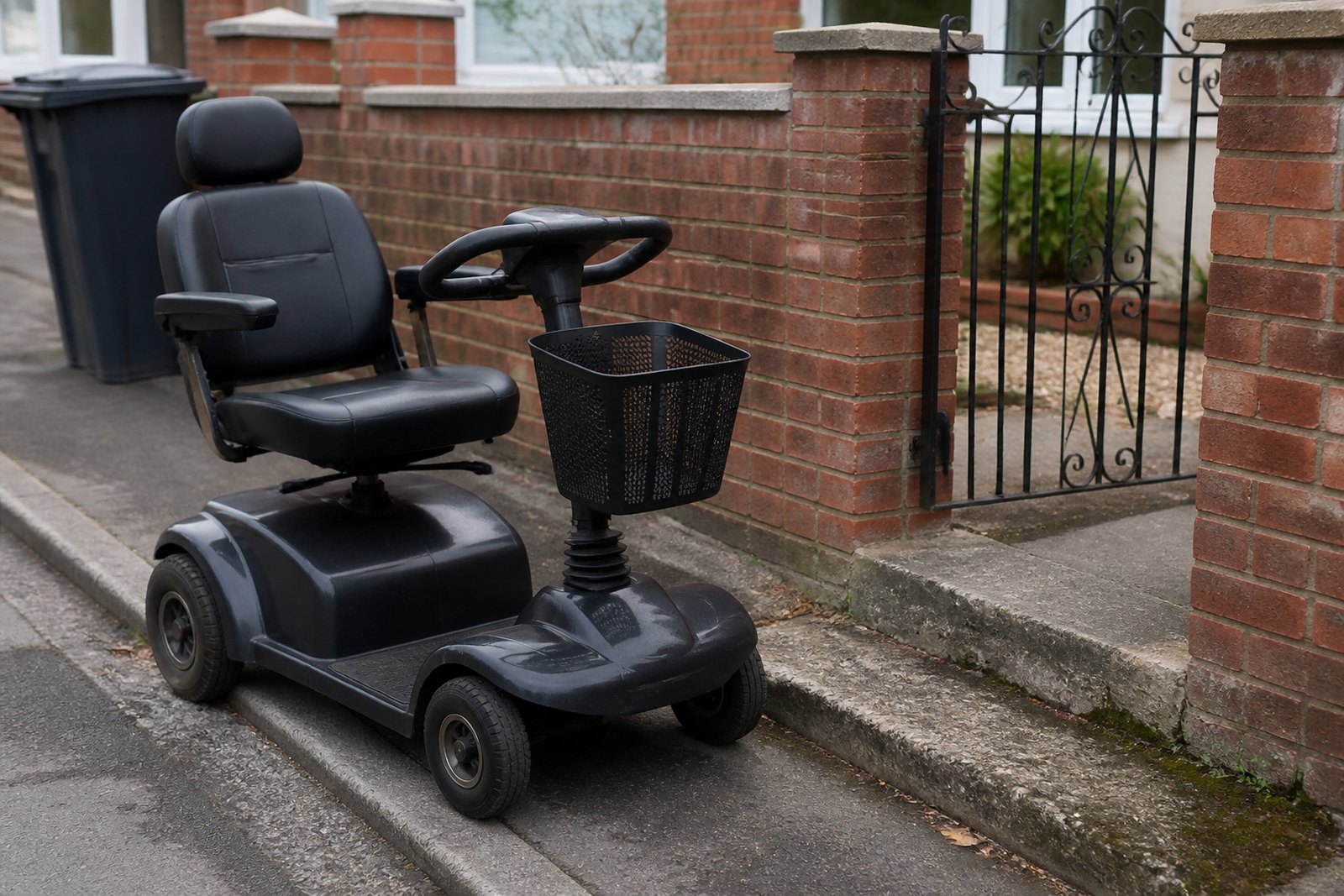
Before you buy a mobility scooter, the most useful question is not "which model?" but "where will it live, and how will it get out of the house?" We put that first because it is the question most often left unasked in a showroom, and it is the one that turns an expensive purchase into an expensive object in the hall. A mobility scooter genuinely transforms life for some people - it gives back the shops, the park, an afternoon out without asking anyone for a lift. For others it is the wrong answer to the right problem, and a walking aid, a powered wheelchair or a different way of making the same trip would serve them far better. We assess rather than sell, so this guide is written to help you decide either way.
The classes of mobility scooter in plain English
Scooters fall broadly into two groups. Pavement scooters are smaller and slower, limited to pavements and pedestrian areas, and are the sort most people picture. Road-legal scooters are larger and faster, with lights, indicators and a horn, and may be used on the road as well as the pavement. Road-legal scooters must be registered with the DVLA, and the rules on registration, where each type may be used and who may use them do change - so check GOV.UK for the current position rather than relying on what a neighbour or a salesperson tells you.
The practical difference matters more than the labels. A larger road-legal scooter is more stable, copes better with kerbs and camber, and goes further on a charge. It is also heavier, wider, harder to store and harder to manoeuvre in a shop doorway. A smaller pavement scooter is easier to live with and less capable on rough ground. Neither is better. The right one suits the journeys you actually make and the home you actually have.
The questions showrooms do not ask
A good assessment covers the boring practicalities, because those decide whether a scooter gets used. Before you commit to anything, work through these:
- Where will it be stored and charged? Scooters need a dry, secure place with a mains socket. A shed with no power, or a communal hallway where it is not permitted, will not do. Charging a battery in an unheated outbuilding also shortens its life.
- How does it get out of the house? A step, a lip at the back door, a gravel path or a narrow side gate between the scooter and the pavement is the whole problem. Sometimes a threshold ramp or a change to the path solves it - our guide to how an OT assessment works for home adaptations covers what is possible.
- Can you get on and off safely? Transferring onto a scooter seat, sometimes with a swivelling seat and an armrest in the way, is a real physical task. If standing and turning is already difficult, that needs trying, not assuming.
- Can you turn your head to look behind? Reversing safely means checking over your shoulder. Stiff necks, frozen shoulders and painful backs make that harder than people expect.
- Is your eyesight and judgement up to a busy pavement? Reaction time, peripheral vision and confidence in crowds all matter. This is a difficult conversation in families, and it is better had before the money is spent.
Boot-sized scooters and the honest weight problem
"Portable" and "car boot" scooters are sold on the promise that they come apart and travel with you. They do come apart. The pieces are still heavy. The battery pack alone can be a real lift, and the base section is usually the heaviest single item - often too heavy for an older partner to lift into a boot repeatedly, especially with arthritic hands, a sore back, or on a wet day in a car park.
If a scooter is only useful when somebody else loads it, be honest about who that person is, how old they are and how their own health is. We would always suggest lifting the parts yourself, in the car park, before buying. Some families find a boot hoist or a folding scooter that stays in one piece works better. Others discover the whole plan does not work, which is a much cheaper thing to find out in a showroom than at home.
Insurance, training and looking after it
Insurance is not a legal requirement for every type of scooter, but it is sensible for all of them. Scooters get stolen and damaged, and it is entirely possible to injure someone or damage property with one. Third party cover, breakdown recovery and theft cover are all worth having.
Training matters too. A scooter handles nothing like a car, and some local schemes and shopping centres offer practice sessions; a quiet car park and an unhurried hour with a family member is the low-tech version. Practise reversing, turning in a tight space and stopping smoothly before the first real outing.
When a mobility scooter is not the right answer
This is the part sales conversations skip. A scooter helps someone who can walk a little, transfer safely and needs distance. It does not help indoors - it is too big for most homes - so it does nothing for the trip to the kitchen or the bathroom. If the real problem is walking around the house, unsteadiness or fear of falling, a scooter solves nothing. A well-fitted walking aid may be the answer instead, and our guide to walking frames, sticks and wheeled walkers explains the differences.
If someone cannot safely steer, judge speed or manage a busy pavement, a powered wheelchair with attendant controls, or a manual wheelchair pushed by someone else, may give more freedom with less risk. And if the person is generally unsteady on their feet, the wider picture of falls and frailty matters more than any purchase. There is no shame in concluding that the money is better spent elsewhere.
Frequently asked questions
What is the best mobility scooter for an elderly person?
There is no single best model. The best mobility scooter for an elderly person is the one that matches their transfers, their storage, their route out of the house and the journeys they want back. A very light scooter suits someone who travels by car with a fit helper; a larger, more stable one suits someone going a mile to the shops on uneven pavements. Try before buying, and try it on the ground you will actually use.
Do I need an assessment before buying a mobility scooter?
You do not have to have one, but an independent assessment from someone with nothing to sell is the cheapest insurance against a costly mistake. An occupational therapist looks at your posture, your transfers, your hands, your vision, your home access and your daily journeys, then tells you honestly whether a scooter fits and which sort. Our guide to what happens in a private OT assessment sets out the process.
Can I try a mobility scooter before I buy one?
Yes, and you should. Ask to try the exact model outdoors, on a slope and over a kerb drop if you can, not just on a showroom floor. Some shopping centres and visitor attractions loan scooters, which is a low-risk way to find out whether you enjoy using one at all. Some areas also have equipment loan arrangements worth asking adult social care about before you spend anything.
Next steps
If you are weighing up a scooter, start with the route out of your house and the place it will be stored, then look at the journeys you want back. An occupational therapist can assess all of that with you at home, including transfers, seating and access, and will happily tell you if the answer is no purchase at all. Our equipment and aids service covers exactly this kind of decision, and a home assessment is usually the sensible first step. To arrange one, see the areas we cover and our prices.
Talk to an occupational therapist near you
This guide is general information. For advice about your own situation - or someone you look after - a local occupational therapist can visit you at home and see it for themselves.
Choose your area: