

Low Vision Aids and Living With Sight Loss at Home
By Mobile Occupational Therapist • 21 October 2026 • 13 min read
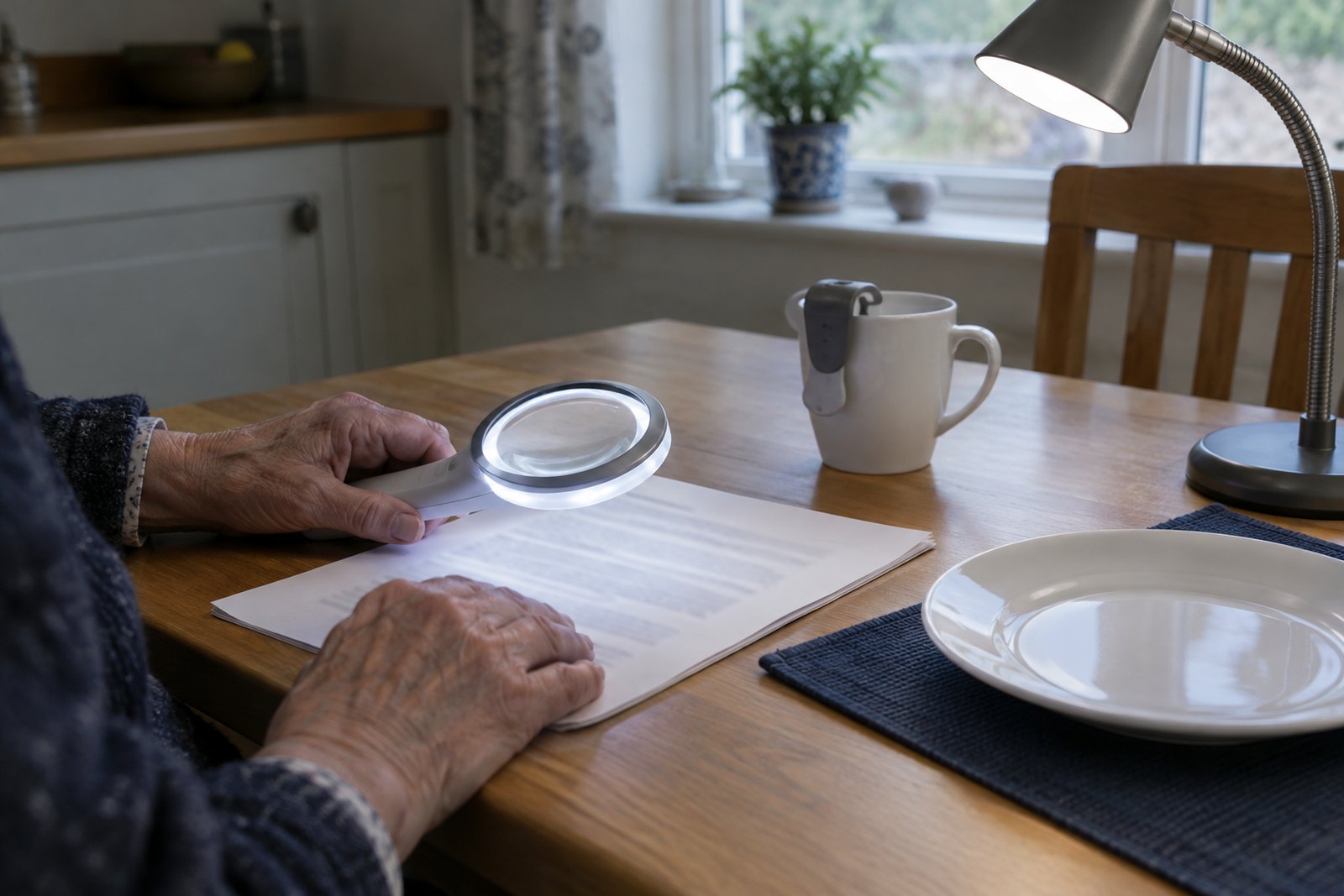
Low vision aids are the tools and tricks that help you make the most of the sight you still have: magnifiers, better lighting, strong contrast, large print, audio and the accessibility settings already built into phones and tablets. They will not bring sight back. Used well, they can mean reading your own post again, making a cup of tea without scalding yourself and getting round the house without bruised shins.
The best place to start is a low vision assessment, usually through the hospital eye service or a community optometrist, where someone works out which aids actually suit your eyes. Alongside that, your council's sensory team can visit to help with daily life, and their assessment and rehabilitation are usually free. The rest of this guide covers what you can do at home today, most of it cheap or free.
First: if your sight has changed suddenly
Before anything else. Low vision aids are for sight loss that has been diagnosed and is being looked after. They are not for new or sudden changes.
- Call 999 if sudden loss of vision comes with a drooping face, weakness in an arm or leg, slurred speech or confusion. That can be a stroke.
- Get same-day help from an optometrist, NHS 111 or A&E if you notice sudden loss of sight in one or both eyes, a shadow or curtain coming across your vision, a sudden shower of new floaters or flashes of light, or a painful red eye.
- Contact your eye clinic or optometrist quickly if straight lines suddenly look wavy or bent, or a new blurred or dark patch appears in the middle of your vision. With some macular conditions, quick treatment matters.
Slower changes still deserve a proper check. Many people get free NHS sight tests, including everyone aged 60 or over in England; the NHS website explains who qualifies where you live.
Getting a low vision assessment
Who does it
Low vision services are run by hospital eye departments, and in some areas by community optometrists or local sight loss charities working with the NHS. If you are under the eye clinic, ask them to refer you. If not, ask your optometrist or GP what exists locally, because how it is organised varies from area to area. In many places the assessment is free and magnifiers are loaned rather than sold.
What happens and how to prepare
A low vision practitioner checks what you can see at different distances and sizes, then lets you try magnifiers and lighting with real tasks. Go prepared. Take:
- A list of the three or four things you most want to do again. "Read bank statements", "see the cooker dial", "do the crossword" is far more useful than "see better".
- Examples: a letter, a medicine box, the TV guide, a recipe, your knitting pattern.
- Your current glasses and any magnifiers you already own.
- Someone with you if you can, to help remember advice.
Ask how to use each aid, how far from the page to hold it, and who to contact if it does not work at home. Many people are handed a magnifier and given up on it a week later because nobody explained the distance or the light.
Magnifiers: what the main types do
Stronger is not always better. The more a magnifier enlarges, the smaller the area you see through it, and the closer and steadier you have to be. That is why a proper assessment beats guessing.
Hand magnifiers
Light, portable and good for short jobs: price labels, a bus timetable, a dial on the washing machine. Harder to use for long reading because you have to hold them at the right distance, which tires the arm. Not ideal if you have a tremor or arthritis in your hands.
Stand magnifiers
The lens sits on a frame that rests on the page, so the distance is fixed for you. You slide it along. Better for longer reading and for anyone with shaky or painful hands.
Illuminated magnifiers
Hand or stand magnifiers with a built-in light. Many people with macular conditions find light makes as much difference as size. Check you can work the switch and change or charge the batteries yourself.
Electronic magnifiers
A camera shows an enlarged image on a screen. Portable ones are like a small tablet; desktop ones have a large screen and a tray to slide your paper under. They can change contrast (for example white text on black), which many people find easier. They cost considerably more, so try before you buy, ideally through the low vision service or a sight loss charity resource centre.
Do not forget your phone or tablet camera. Most now have a built-in magnifier setting that zooms in and lights up what is in front of it. For a quick look at a label, it is often all you need.
Lighting: usually the cheapest big win
Older eyes need much more light than younger ones, and damaged eyes need more again. Ceiling lights rarely do the job on their own.
- Use task lighting. An adjustable lamp with a flexible arm, positioned close to what you are doing and to the side of your better eye, beats a brighter ceiling bulb. Angle it so it lights the page, not your eyes.
- Brighter, whiter bulbs help many people see detail. Keep lighting even from room to room, because moving from a bright room into a dim hallway is a common moment for trips.
- Tackle glare. Net curtains or blinds soften low sun. Matt surfaces are easier than gloss. Many people with sight loss find bright light dazzling, so tinted or filter glasses, recommended at your assessment, can help outdoors.
- Light the dark spots: stairs, the top and bottom steps, inside wardrobes and cupboards, and the route to the toilet at night. Plug-in night lights and motion-sensor lights are useful here.
Contrast: making things stand out
When detail goes, contrast does a lot of the work. The idea is simple: put light things on dark backgrounds and dark things on light ones.
- A white plate on a dark placemat. Dark coffee in a white mug, milk in a dark one.
- A dark chopping board for onions and pastry, a light one for meat and dark vegetables.
- Coloured tape on the edge of each step, the edge of the bath, light switches and the front of shelves. Use a colour that stands out against the surface behind it.
- A contrasting towel or throw over a chair the same colour as the carpet, so you can find the seat.
- Bump-ons: small raised tactile dots you stick on to mark settings. Put one on the cooker dial at the temperature you always use, on the washing machine programme you need, on the microwave start button and on the "5" of a phone keypad.
Large print, audio and talking things
You do not have to struggle with standard print. You can ask your bank, energy supplier, GP surgery and council to send letters in large print, braille, audio or by email so your device can read them aloud. Under equality law, organisations are generally expected to make reasonable adjustments for disabled people, and the NHS has its own standard on accessible information, so it is worth asking clearly and in writing.
Libraries have large print books and audiobooks, often free to borrow, and RNIB runs a talking books service. Talking clocks, watches, kitchen scales and thermometers exist for the jobs where you need a number. Smart speakers can tell you the time, read the news, set timers and call family by voice.
Phones, tablets and computers
The accessibility settings built into phones, tablets and computers are some of the most powerful low vision aids there are, and they cost nothing. Look in the settings menu under "Accessibility". Useful features include:
- Larger text and bold text across the whole device.
- Zoom or magnification to enlarge part of the screen.
- High contrast, dark mode or inverted colours if a white screen dazzles.
- A screen reader that reads out everything on screen and changes how you tap and swipe. It takes practice, but it is life-changing for people with little useful sight.
- Voice control and dictation, so you can send messages and search without typing.
- Apps that read printed text aloud or describe objects using the camera.
If a family member sets these up, sit with them and learn how to switch them on and off yourself. Sight loss charities and some libraries run free sessions. Our guide to assistive technology at home covers smart speakers and other gadgets in more detail.
Labelling and finding things
Much of daily frustration is not reading, it is finding. A system helps more than any gadget.
- A place for everything. Keys, glasses, phone and remote always go back to the same spot. Ask family not to tidy things away.
- Big, bold labels written with a thick black marker on white or yellow card, for jars, freezer bags and files.
- Tactile markers: an elastic band round the shampoo and not the conditioner, a bump-on on the decaf. Tins can be stored in labelled baskets by type.
- Talking labels: recordable tags or a pen-style device that plays your own voice message when you touch a sticker. Handy for clothes, medicines and the freezer.
- Medicines: ask your pharmacist for large print labels and about other ways to tell packs apart. Never guess a tablet by its colour in poor light.
Kitchen safety
The kitchen is where sight loss and danger meet, but most people can keep cooking with a few changes.
- Liquid level indicator: a small device that hooks over the rim of a cup and beeps or vibrates when hot liquid nears the top. One of the most useful low vision aids there is.
- Fill the kettle using a jug, or choose a kettle you can fill through the spout and pour while it sits on a tipping stand.
- Mark cooker and oven settings with bump-ons. Many people find a microwave or slow cooker easier and safer than a hob.
- Use long oven gloves that cover the forearm. Pull the shelf out before reaching in.
- Knives with a brightly coloured handle, a contrasting chopping board, and fingers curled away from the blade. Store knives in a block, never loose in a drawer.
- Keep cupboard doors and drawers shut. A half-open door at head height is a classic injury.
More ideas are in our guide to kitchen aids and mealtime independence.
Moving around the home safely
Sight loss raises the risk of falls, especially when combined with unsteadiness or medication side effects.
- Clear clutter from walkways, and tape down or remove loose rugs and trailing cables.
- Mark step edges with contrasting tape and have a sturdy rail on both sides of the stairs if possible.
- Keep furniture where it is. Moving the sofa without telling someone can undo years of memory.
- Light the route to the toilet at night.
- If you have lost part of your field of vision after a stroke, our guide to hemianopia and visual field loss explains scanning techniques and how to set up a room.
Our article on preventing falls at home goes further. Outside the home, a rehabilitation officer for visual impairment can teach you to use a cane and learn safe routes, which is specialist training an ordinary family cannot really provide.
Certification, registration and the council sensory team
If your sight meets certain criteria, a consultant ophthalmologist can certify you as sight impaired (partially sighted) or severely sight impaired (blind). In England this uses a form called the Certificate of Vision Impairment; the paperwork differs slightly in other parts of the UK. With your consent, a copy goes to your council, which should then offer to add you to its register.
Registration is voluntary. It can make it easier to access some concessions and support, such as certain travel, tax and TV licence concessions, and in some cases a Blue Badge. Rules change, so check the current details on GOV.UK or with RNIB.
You do not have to be registered to get help from the council. Most councils have a sensory team with rehabilitation officers for visual impairment, sometimes called ROVIs or vision rehabilitation workers. They can visit at home, assess your needs, teach new ways to do everyday tasks, help with mobility training and provide some small equipment. You can usually contact adult social care directly and ask. Our guide to the Care Act needs assessment explains how council assessments work.
Where an occupational therapist fits
Be clear about who does what. Your optometrist and the hospital eye service look after the health of your eyes and lead on prescribing magnifiers. A rehabilitation officer for visual impairment is the specialist for cane training, orientation and many sight-specific skills. Your GP is the route for general health, mood and medication reviews.
An occupational therapist is most useful when sight loss is part of a bigger picture: someone who also has arthritis, dementia, Parkinson's, frailty or is recovering from a stroke or fall. A private occupational therapist visiting at home can look at the whole house and the whole day: lighting and contrast room by room, bathroom and kitchen safety, getting on and off the toilet or into the shower, equipment, and routines that reduce falls. They can also write reports to support benefit claims or housing applications. Our page on sensory needs explains this kind of work, and our guide to sensory impairment and how OTs help covers sight and hearing together.
Frequently asked questions
Can I get low vision aids free on the NHS?
Often, yes. Low vision services attached to hospital eye departments, or run by community optometrists in some areas, commonly loan magnifiers free after an assessment. What is offered varies by area, so ask your eye clinic or optometrist what exists locally.
Should I just buy a magnifier online?
You can, but many people end up with one that is too strong, too weak or unusable with their hands. If you can, get assessed first, or try aids at a sight loss charity resource centre before spending money.
Why do reading glasses no longer help?
Glasses correct focus. Conditions such as macular degeneration, glaucoma or diabetic eye disease damage the eye itself, so sharper focus does not fix the missing detail. That is where magnification, light and contrast come in. Keep up your regular eye tests anyway.
Do I need to be registered blind to get help?
No. The council sensory team can assess you whatever your registration status, and charities support anyone with sight loss. Registration can help with some concessions.
Can I still drive with sight loss?
That depends on your condition and whether you meet the legal eyesight standard. Many eye conditions must be reported to the DVLA. Ask your optometrist or eye clinic and check the current rules on GOV.UK before driving.
Sight loss is getting me down. Is that normal?
Very. Losing sight is a real loss, and low mood, worry and isolation are common. Talk to your GP, and contact RNIB or the Macular Society, both of which offer emotional support and peer groups.
Next steps
See our home assessment and sensory needs pages, or current guide prices, and choose your area below.
Talk to an occupational therapist near you
This guide is general information. For advice about your own situation - or someone you look after - a local occupational therapist can visit you at home and see it for themselves.
Choose your area: