

Hemianopia: Living With Visual Field Loss After a Stroke
By Mobile Occupational Therapist • 23 September 2026 • 13 min read
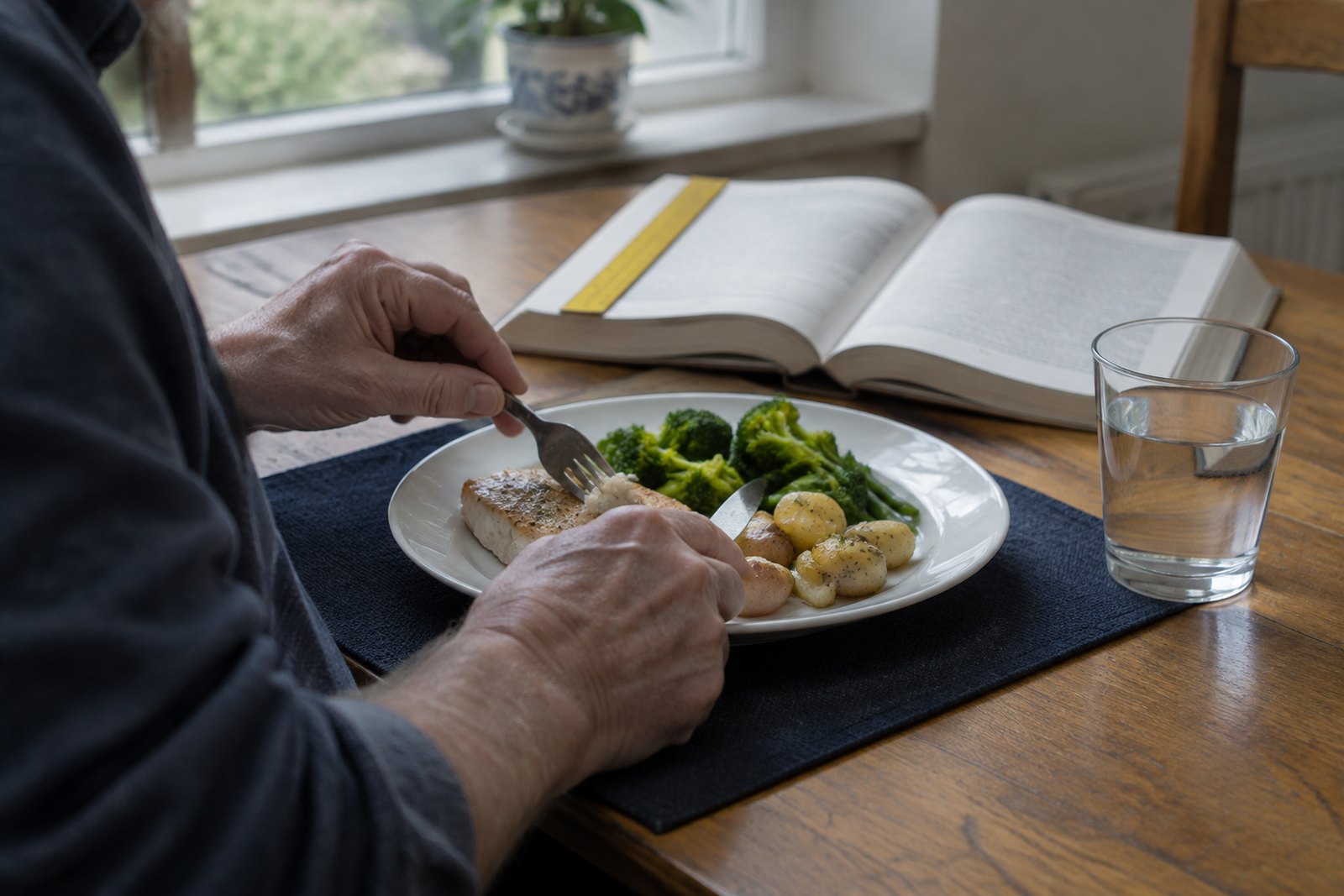
Hemianopia (sometimes spelled hemianopsia) means losing half of your field of vision. After a stroke it is usually homonymous hemianopia: the same half is missing in both eyes. If it affects your left side, everything to the left of centre is gone whether you look with your left eye, your right eye or both. Your eyes themselves are usually healthy. The damage is in the part of the brain that makes sense of what the eyes send it, which is why new glasses do not fix it.
Some people get back some of their vision in the weeks and months after a stroke. Many are left with a lasting gap. The honest good news is that most people learn to work around it. The main tools are deliberate scanning (training your eyes and head to look into the missing side), sensible changes at home, and specific tricks for reading. This guide covers all of those, how hemianopia differs from neglect, the rules on driving, and who can help.
What hemianopia actually is
Each side of the brain handles the opposite half of what you see. So a stroke on the right side of the brain can take away the left half of your vision in both eyes, and a stroke on the left side can take away the right half. Sometimes only a quarter of the field is lost, usually the upper or lower quarter on one side. This is called quadrantanopia and the advice below still applies.
People are often surprised by what it feels like. It is rarely a black curtain. More often the missing part simply is not there, and the brain quietly fills the gap with a plausible guess. That is why people walk into a door frame and genuinely did not know it was there. It is not carelessness, and it is not something you can fix by trying harder to see.
If vision is lost suddenly, or comes with face drooping, arm weakness or slurred speech, call 999. That could be a new stroke. Any new or worsening change in vision that is not an emergency still needs an urgent GP appointment or a call to NHS 111.
Hemianopia or neglect? Why the difference matters
Hemianopia and neglect (also called visual inattention or spatial neglect) are often confused, and they can happen together, particularly after strokes on the right side of the brain.
- Hemianopia is a problem with seeing. The information from one side does not reach the brain. Most people know, or can be shown, that something is missing, and can learn to turn and look.
- Neglect is a problem with attention. The brain stops paying attention to one side of the world, and sometimes one side of the body, even when the eyes can see it perfectly well. People with neglect often do not realise anything is wrong.
Signs that point towards neglect include eating everything on one half of the plate and saying they have finished even when told otherwise, shaving or washing only one side of the face, ignoring people who stand on that side, or drawing a clock with all the numbers crammed onto one half.
The difference matters because what helps is different. Scanning training can help with hemianopia because the person can understand the gap and choose to look into it. With neglect, the person may not believe there is a problem, so family and carers usually need to prompt, set things up carefully and approach from the attended side. The stroke team, an orthoptist or an occupational therapist can test for both. If you are not sure which one your relative has, ask.
How it shows up in everyday life
The effects are wide and often tiring. Common ones include:
- Bumping into door frames, furniture and people on the affected side.
- Missing food on one side of the plate, or knocking over a cup you did not know was there.
- Losing things you put down a moment ago.
- Reading becoming slow, with lost lines or missed words.
- Being startled when someone appears suddenly from the blind side.
- Struggling in busy places like shops, stations and pavements.
- Crossing roads, where a car from the blind side may be invisible until late.
- Tiredness and headaches by the end of the day, because constant looking takes effort.
Confidence often takes a knock too. People who bump into things in public can start avoiding going out. That is understandable, and it is worth tackling early, because staying in tends to make the world feel smaller and harder.
Scanning: the most useful skill to learn
Scanning means deliberately moving your eyes, and your head, into the missing side so that you bring it into view. It sounds obvious. The difficulty is that your brain does not tell you there is anything there to look for, so the habit has to be built on purpose until it becomes automatic.
A helpful image is a lighthouse: a regular, sweeping look across the whole scene, going well past where you think the edge is. Big, deliberate eye movements into the blind side tend to work better than small, hesitant ones.
How to practise at home
- Start somewhere calm and familiar, sitting down.
- Before you do anything, sweep your eyes all the way into the blind side, then back across to the seeing side.
- Practise on simple searches: find all the red objects in a room, or every item on a cluttered tray.
- Use a marker on the blind side as a target. A brightly coloured strip on the edge of a table or tray tells you how far to look.
- Gradually move to everyday tasks: laying the table, finding things in the fridge, tidying a shelf.
- Practise little and often. Short sessions through the day beat one long, exhausting one.
An orthoptist may give you structured scanning exercises, including on-screen ones. Do those as advised, and practise in real life as well, because the aim is to use the skill in the kitchen and on the street, not only on a screen.
When you are out
- Walk with someone at first, on your blind side, so they can warn you and help you practise.
- Slow down in busy places and keep sweeping. Walk nearer the wall or shop fronts on your blind side if that helps, so fewer people can come from that direction.
- At roads, stop at the kerb, turn your head fully both ways, and then do it again. Use pedestrian crossings with lights wherever you can, and allow plenty of time.
- Be extra careful with cyclists, electric scooters and quiet vehicles, which give little warning by sound.
Your council's adult social care or sensory team may offer help from a rehabilitation officer for visual impairment, who can do mobility and road safety training. Ask for this; it is not always offered automatically.
Setting up your home
Small changes reduce bumps and lost items while the scanning habit develops. Early on, it can help to put important things on the seeing side. Over time, a therapist may suggest gently moving some back so that you keep practising looking into the blind side.
Around the house
- Clear clutter, trailing cables and low furniture from walkways, especially on the blind side of routes you use most.
- Keep furniture and everyday items in the same place. Predictability does a lot of the work.
- Improve lighting in hallways, stairs and the bathroom, and keep a light on for night-time trips to the toilet.
- Use colour contrast: a contrasting strip on step edges, a dark mat against a pale floor, contrasting grab rails and light switches.
- Think about which side of the bed you get out of. Many people prefer the door and the bedside table on their seeing side.
- Close doors and cupboards fully so open edges are not left sticking out on the blind side.
If you have had falls or near misses, our guide to preventing falls at home has more practical ideas.
Mealtimes
- Use a plain plate that contrasts with the food and the table, for example a white plate on a dark placemat.
- Before you eat, sweep your eyes across the whole plate. When you think you have finished, turn the plate round and look again.
- Put your drink in the same place every time, slightly towards the seeing side to start with.
- A plate with a raised rim helps stop food being pushed off the blind edge.
In the kitchen
- Keep sharp knives and hot pans in consistent places and turn pan handles inwards.
- Work in a clear space and scan the worktop before reaching.
- Cook simple meals at first, with someone around, until you are confident.
For family and visitors
- Approach and speak from the seeing side, or say who you are before you arrive on the blind side.
- Do not move things without saying so.
- Prompt scanning rather than doing everything: "Have a look to your left" is often more useful than handing over the item.
Reading with hemianopia
Reading is one of the most common frustrations, and which side is affected changes the problem.
- Right-sided loss: because English is read left to right, you cannot see where the line is going. Reading becomes slow and words at the end of lines get missed.
- Left-sided loss: you can read along the line but struggle to find the start of the next one, so you lose your place or skip lines.
Things that often help:
- Put a brightly coloured strip or ruler down the margin on the blind side as an anchor. Find it at the start or end of every line.
- Run a finger or a card under the line you are reading.
- Try larger print and good, direct lighting.
- Some people find turning the page sideways, so text runs vertically, helps. It is worth a try.
- On a tablet or e-reader, increase text size and use a narrow column so each line is shorter.
- Use audiobooks, read-aloud settings and radio to rest your eyes and keep enjoying books and news.
Reading usually improves with practice. If it does not, ask your orthoptist about specific reading training.
Driving
Hemianopia has big implications for driving. You must meet a minimum visual field standard to drive legally, and most people with a full homonymous hemianopia do not meet it for a car licence. There are separate rules for stroke itself, and stricter ones for bus and lorry licences.
Do not drive until you have checked. If you have hemianopia you must tell the DVLA, and they may arrange a visual field test. A limited exceptional cases route exists for some car drivers. The rules and forms are on GOV.UK: search for "visual field defects and driving" and "stroke and driving". If you are later allowed to drive, a specialist driving assessment centre can assess you; your stroke team or GP can tell you about these.
Losing driving can hit hard, particularly for independence and work. It is worth asking about bus passes, community transport and other options early rather than waiting.
Registering as sight impaired
Depending on how much vision is lost, a consultant eye doctor can complete a Certificate of Vision Impairment so that you can register with your council as sight impaired, which can open the door to council support and some concessions. Ask the eye clinic whether this applies to you.
Where orthoptists and occupational therapists fit
Orthoptists lead on the vision itself. They work in hospital eye departments and often with stroke units. They assess visual fields and eye movements, check for other stroke-related eye problems such as double vision, teach scanning and reading exercises, and sometimes try special prism lenses. If your relative has not seen an orthoptist and has vision problems after a stroke, ask the stroke team or GP about a referral to the hospital eye service. An ophthalmologist (eye doctor) and your GP handle medical questions.
An occupational therapist works on how the vision loss affects everyday life. That means watching how you actually manage making a drink, getting washed, finding things, using the stairs, reading post or getting to the shop, and then working with you on strategies and changes that fit your home. An occupational therapist can:
- Assess safety in the kitchen, bathroom and on stairs.
- Practise scanning in real tasks rather than exercises alone.
- Suggest lighting, contrast and layout changes, and equipment where it genuinely helps.
- Look at vision alongside other stroke effects, such as weakness, fatigue, memory or neglect, which often matter just as much.
- Support a return to work, hobbies or getting out again.
An occupational therapist does not measure visual fields, prescribe lenses or decide whether you can drive. Those belong to orthoptists, eye doctors and the DVLA.
NHS stroke and community teams provide occupational therapy, though how much varies by area. Some people also choose a private occupational therapist visiting at home, for example after NHS input ends. See our guide to stroke recovery at home, our stroke page, our explainer on sensory impairment and how OTs help, and our sensory needs service page.
Frequently asked questions
Will my vision come back?
Some people get partial recovery, usually in the first few months after the stroke. Many are left with a permanent gap. Your orthoptist or eye clinic can repeat field tests and tell you what they are seeing in your case. Even without recovery, scanning and practical changes usually make daily life much easier.
Will glasses help with hemianopia?
Ordinary glasses do not restore a lost field, because the problem is in the brain, not the eyes. Keep your normal glasses up to date for clear sight in the vision you have. Prism lenses are sometimes tried by orthoptists; they do not suit everyone, so ask whether they are worth trying for you.
Can I drive with homonymous hemianopia?
Most people with a full homonymous hemianopia do not meet the visual field standard for driving. Do not drive until you have checked the rules on GOV.UK and, where required, told the DVLA.
Why am I so tired?
Constant scanning takes concentration, and fatigue after a stroke is common anyway. Plan demanding tasks for when you are freshest and build in rests. If tiredness is severe or getting worse, mention it to your GP.
Can someone with hemianopia live alone safely?
Many people do, especially once scanning becomes a habit and the home is set up well. It depends on the person, other effects of the stroke and the home itself. An occupational therapy home assessment can look at the specific risks and what would reduce them.
How do I know if it is neglect rather than hemianopia?
The biggest clue is awareness. People with hemianopia usually know or can accept that part of their vision is missing; people with neglect often do not. Formal testing by the stroke team, an orthoptist or an occupational therapist is the reliable way to tell.
Next steps
If hemianopia is making daily life harder, an occupational therapist visiting at home can look at the tasks that matter most to you. See our neurological rehabilitation page, or current guide prices, and choose your area below.

Talk to an occupational therapist near you
This guide is general information. For advice about your own situation - or someone you look after - a local occupational therapist can visit you at home and see it for themselves.
Choose your area: