

Living With Multiple Sclerosis at Home: Fatigue, Heat and Daily Life
By Mobile Occupational Therapist • 16 October 2026 • 14 min read
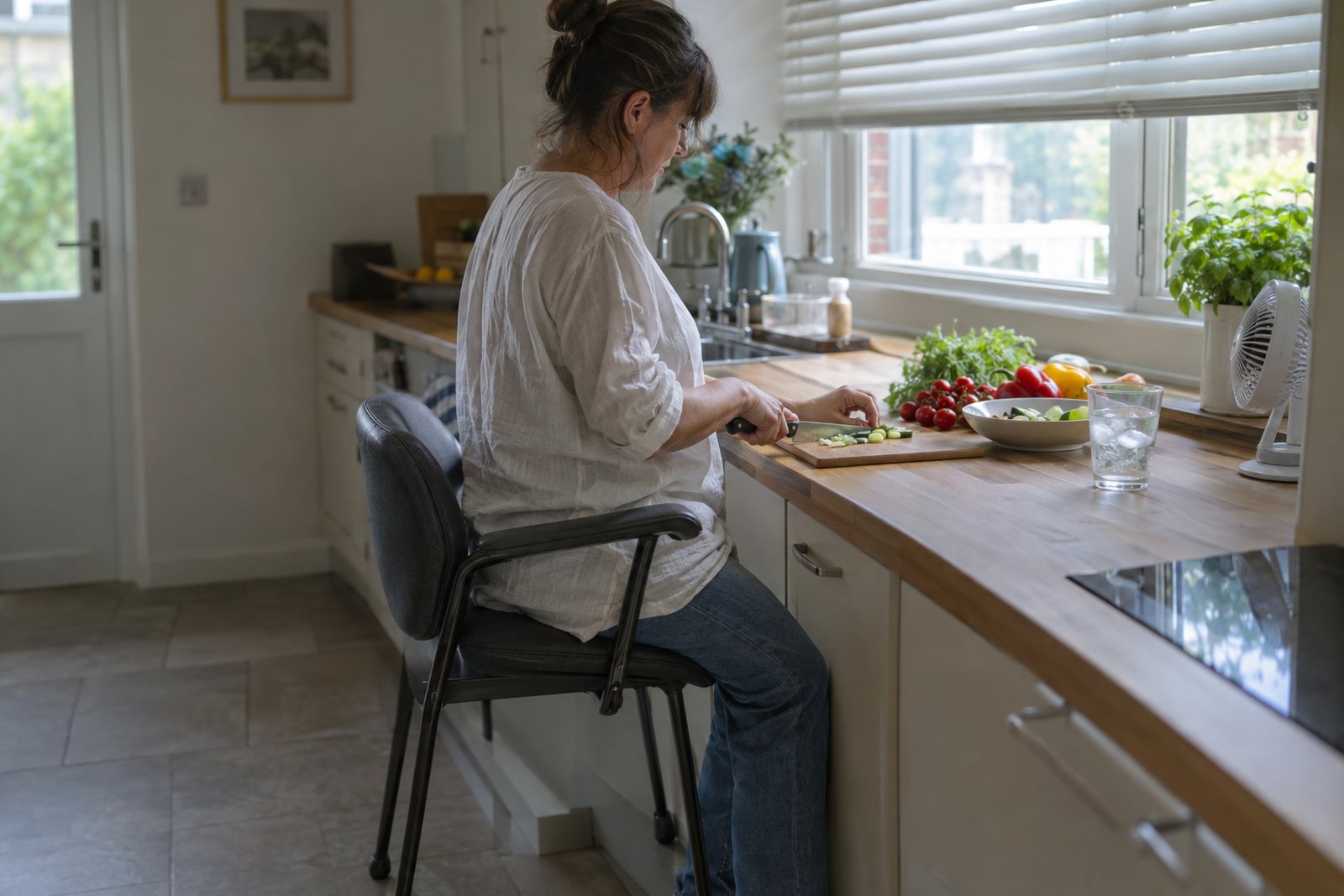
Living with multiple sclerosis at home usually comes down to a handful of everyday problems. Fatigue that is nothing like ordinary tiredness. Symptoms that flare in the heat. A bladder that will not wait. A brain that drops the thread mid-sentence. Hands that fumble buttons, and legs you cannot always trust. No single gadget fixes any of that. What helps is a mix of pacing your energy, keeping cool, changing how you do some tasks, getting the right equipment at the right time, and knowing who to call when something changes.
MS varies hugely from person to person, and from week to week in the same person, so the aim is not a perfect plan. It is a home and a routine that bend with you. This guide covers the practical side of each problem, how to tell a relapse from a bad day, how to plan adaptations without overspending or underplanning, and where an occupational therapist fits alongside your MS nurse, neurologist, physio and GP. For a shorter overview, see our multiple sclerosis page.
MS fatigue: why it is different and what actually helps
MS fatigue is one of the most common symptoms and one of the hardest to explain. It can arrive without warning, it is often worse later in the day or in warm weather, and a good night's sleep does not always shift it. "Have a rest" misses the point. You can be rested and still have nothing in the tank.
What works for most people is not doing less of everything. It is spending energy on purpose.
- Find your pattern. Keep a simple diary for a week or two: what you did, when, and how tired you felt afterwards on a scale of 1 to 10. Most people spot something useful, such as mornings being better, or a shower wiping out the next hour.
- Put the important things where your energy is. If mornings are better, that is when the shopping, the phone call to the council or the hard work task goes. Not the hoovering.
- Break tasks up and stop before you crash. Change the bed in two halves. Make the sauce in the morning and cook the pasta at teatime. Stopping while you still have something left feels wasteful, but it is usually what lets you do something tomorrow.
- Sit down for anything you can. Preparing vegetables, ironing, drying your hair, getting dressed. A perching stool in the kitchen is one of the cheapest energy savers there is.
- Cut out the walking. Keep things you use every day between waist and shoulder height, in the room where you use them. A wheeled trolley saves trips between kitchen and table.
- Plan rest rather than collapsing. Short, planned rests, lying down with your eyes closed and no phone, often do more than one long afternoon sleep.
Our guide to fatigue management and pacing goes through the method step by step. It covers several conditions, but the principles carry straight over to MS. Fatigue can also be made worse by poor sleep, low mood, pain, infections, a bladder that wakes you at night and some medicines, so ask your MS nurse or GP to look at those too. Many MS services run fatigue management courses. If nobody has mentioned one, ask.
Heat sensitivity and keeping cool
Many people with MS find their symptoms get temporarily worse when their body temperature rises: hot weather, a hot bath, exercise, a fever, a stuffy room. Vision may blur, legs may weaken, fatigue comes early. Heat slows signals along nerves already affected by MS. Once you cool down, symptoms usually settle back to where they were. It is not a relapse, but it can still make a summer afternoon unusable.
- Keep one room cool. Close curtains or blinds on the sunny side during the day, open windows in the cooler evening, and use a fan.
- Drink cold drinks through the day. Ice lollies and ice cubes count.
- Choose lukewarm showers over hot baths. Running cool water over your wrists or soaking your feet can help quickly.
- Try cooling aids before buying. Cooling vests, neck wraps, cooling towels and a water spray bottle all exist. Some people swear by them, others find them fiddly. Borrow or buy the cheapest version first.
- Move demanding tasks to the cool part of the day in summer, and wear loose layers of natural fabric.
- Exercise is still worth doing. A physio can suggest ways to keep cool before and during it.
Some people are also sensitive to cold, which can increase stiffness. And if MS has reduced the feeling in your hands or feet, check bath water with a thermometer or an unaffected part of your body. You may not feel a burn happening.
Bladder problems and getting continence help
Bladder symptoms are common in MS and often very treatable, yet many people put up with them for years. Typical problems are urgency, going often, getting up at night, leaking, and not emptying fully, which can feel like still needing to go or dribbling afterwards. Repeated urine infections are also more likely.
The most important thing: do not cut back on drinking to cope. Concentrated urine can irritate the bladder and make infections more likely. Instead:
- Tell your MS nurse or GP and ask about a referral to the NHS bladder and bowel (continence) service. They can assess what is going on, check whether your bladder is emptying, and suggest treatments and techniques. Some people learn to empty their bladder with a catheter themselves, which sounds far worse than most find it.
- Try cutting down caffeine and fizzy drinks gradually and see if urgency improves.
- Shorten the dash to the toilet. Clear the route, add plug-in night lights, and choose clothes that are quick to undo. A urinal or commode by the bed at night can stop a rushed walk in the dark.
- Get the toilet height right so you can sit and stand quickly. A raised seat or toilet frame may help.
Urine infections can make MS symptoms suddenly worse. If you have burning, cloudy or smelly urine, or your symptoms suddenly worsen, contact your GP or NHS 111 the same day. A high temperature with shivering or pain in your back or side needs urgent advice. Our guide to NHS continence services and free pads explains how referral works.
Cognitive fog: memory, concentration and losing your thread
Not everyone with MS has thinking problems, but many notice slower thinking, trouble finding words, difficulty doing two things at once, or forgetting why they walked into a room. It is usually worse when you are tired, hot or stressed, which is useful, because those are things you can partly control.
- One place for everything. A single notebook or one notes app, not scraps of paper.
- Let your phone remember. Alarms for appointments, medicines and bin day. A large wall calendar for the household.
- Fixed homes for keys, glasses and phone. A bowl by the door does more than any memory exercise.
- One thing at a time. Turn the television off when you phone the bank.
- Do thinking jobs at your best time of day, the same way you plan around fatigue.
- Write questions down before appointments, and take someone with you if you can.
- Tell people what helps. "Give me a second, I'm thinking" is a perfectly good sentence.
If thinking changes are new, worrying or affecting work, tell your MS team. They can arrange a proper assessment, sometimes with a neuropsychologist. Low mood and anxiety also affect concentration and are worth raising in their own right.
Hands, dressing and everyday tasks
Numbness, tingling, weakness, tremor or clumsiness in the hands turn fiddly jobs into slow ones: buttons, zips, jar lids, cutlery, writing, using a phone. Add fatigue and getting dressed can use up a big share of the morning's energy.
- Dress sitting down, with clothes laid out in order the night before.
- Choose clothes that do the work. Elasticated waists, pull-on tops, front-fastening bras, slip-on shoes or elastic laces, magnetic fastenings.
- Simple aids like a button hook, zip puller, sock aid, long-handled shoehorn and dressing stick can save a lot of effort. Our guide to dressing aids and easier ways to get dressed covers each one.
- In the kitchen, lightweight pans, a kettle tipper, a jar opener, non-slip mats and thick-handled cutlery reduce grip effort. Buying ready-chopped vegetables is not cheating.
- For writing and phones, try thicker pens, voice-to-text, larger keyboards and accessibility settings.
Mobility, balance and falls
Leg weakness, stiffness, poor balance, dizziness and foot drop, where the toes catch on the ground, all raise the risk of falling. Falls often happen late in the day, when you are tired, hot or rushing to the toilet. That is why the earlier sections matter here too.
- Clear trip hazards: loose rugs, trailing cables, clutter on stairs.
- Improve lighting, especially on stairs and the route to the toilet at night.
- Fit rails where you push and pull: by the front door, both sides of the stairs, beside the toilet and in the shower.
- Get walking aids assessed by a physio rather than buying one off the shelf. The wrong height or type can make things worse.
- Ask about foot drop. A physio or orthotist may assess you for an ankle splint or an electrical stimulation device.
- Plan for a fall. Keep a phone on you, consider a personal alarm, and learn how to get up safely or stay warm until help arrives.
Our guide to preventing falls at home goes room by room. Physiotherapists lead on walking, balance, strength and stiffness, so ask your GP or MS team for a referral if you are not already seeing one.
Home adaptations: planning for change without overdoing it
The difficulty with MS is uncertainty. Some people have little disability for decades. Others change more steadily. You do not want to rip out a bathroom you may not need changed, but you do not want to do a cheap job now and redo it in three years either.
- Start small and reversible. Rails, a shower seat, a perching stool, a raised toilet seat, furniture raisers and better lighting. Much of this can be loaned free through your council's community equipment service after an assessment.
- Future-proof work you are doing anyway. If you are refitting a bathroom or kitchen or moving house, think about a level-access shower rather than a bath, wider doorways, space to turn, reinforced walls for future rails, sockets at reachable heights and a downstairs room that could become a bedroom.
- Plan for your bad days, not your average day.
- Look at funding early. In England and Wales, councils can provide Disabled Facilities Grants for eligible adaptations, usually with an occupational therapy assessment involved. Northern Ireland and Scotland have their own schemes, so ask your council or housing provider what applies where you live. You may also not have to pay VAT on some equipment and building work. Check current rules on GOV.UK and with your council.
- Talk about housing honestly. If your home cannot sensibly be adapted, raising a move early gives you more choice.
Work: staying in it on your terms
Under the Equality Act 2010, MS counts as a disability from the point of diagnosis, whatever your symptoms are now. That means your employer must consider reasonable adjustments. You do not have to tell them, but they can only make adjustments if they know.
Useful adjustments often include flexible start times to suit fatigue, some home working, planned rest breaks, a desk near the toilet, a fan or a cooler spot, a parking space near the entrance, written instructions and reminders, and a phased return after a relapse. The government's Access to Work scheme can help pay for support and equipment beyond what an employer must provide. See our guide to reasonable adjustments at work, and check Acas and GOV.UK for current rules. If you drive, you must tell the DVLA (or the DVA in Northern Ireland) that you have MS. Read the GOV.UK guidance on MS and driving and talk to your MS team if you are unsure whether your symptoms affect your driving.
Relapse or progression? Telling them apart in plain terms
A relapse is new symptoms, or old ones getting clearly worse, lasting more than 24 hours, and not explained by heat, infection or another cause. Relapses usually build over hours or days, then improve partly or fully over weeks or months. A pseudo-relapse looks similar but is triggered by something like a urine infection or overheating, and settles once that is dealt with.
Progression is a slow worsening over months or years, not tied to clear episodes. You notice you cannot walk as far as last year, or tasks take longer. It can happen from the start in progressive MS, or later after a relapsing pattern.
- Suspected relapse: contact your MS nurse or MS team promptly. Do not wait for your next routine appointment. If you cannot reach them, call your GP or NHS 111.
- Check for infection first, especially a urine or chest infection.
- Gradual change: raise it at your next review, sooner if it affects your safety, and ask to be reassessed by physio and occupational therapy.
- Call 999 for a drooping face, sudden arm weakness, slurred speech, sudden confusion, a sudden severe headache, chest pain or difficulty breathing. These may not be MS and need emergency care.
Jot down when a change started and what you can no longer do. It helps your team far more than "I've been worse".
Where an occupational therapist fits
Occupational therapy focuses on the things you need and want to do, and how to keep doing them. With MS, an occupational therapist can help you build a fatigue and pacing plan, look at how you wash, dress, cook, use the toilet and get in and out of bed, recommend equipment, plan adaptations and write reports for grants or housing, suggest strategies for memory and concentration, and assess your workstation or working day.
Many NHS MS and neurological rehabilitation teams include occupational therapists, and council adult social care occupational therapists handle equipment and adaptations. Waiting times vary by area. A private occupational therapist visiting at home can be useful for a detailed assessment, a report for work or adaptations, or practical help while you wait. It works alongside your MS team, not instead of it.
Others lead on different things. Your MS nurse and neurologist handle relapses, disease-modifying treatment and symptom medicines. Physios lead on walking, balance and stiffness. The continence service leads on bladder and bowel. Speech and language therapists help with swallowing and speech. Psychologists help with mood and thinking. Your GP is the first stop for infections and general health.
Frequently asked questions
Is MS fatigue just being tired?
No. MS fatigue can come on suddenly, is often worse in heat or later in the day, and may not improve much with sleep. Pacing, planned rest and energy-saving changes usually help more than pushing through.
Does getting too hot cause lasting damage?
Heat usually makes symptoms worse only temporarily, and they settle once you cool down. It is still worth avoiding because it can wipe out your day. If symptoms do not settle once you are cool, contact your MS team.
How do I know if it is a relapse or just a bad day?
A relapse lasts more than 24 hours and is not explained by heat, infection or tiredness. If you are unsure, ring your MS nurse. They would rather hear from you than have you wait.
Do I have to tell my employer I have MS?
No, but adjustments depend on them knowing. MS is protected under the Equality Act from diagnosis. Acas has clear guidance on your rights.
Can I get help paying for home adaptations?
Possibly. Councils provide equipment on loan and may fund larger adaptations through a Disabled Facilities Grant, which has eligibility rules. Contact your council's adult social care team and check GOV.UK.
Should I buy equipment now in case I need it later?
Generally not. Get what helps you today, borrow where you can, and future-proof only the building work you are already doing. Needs change, and equipment bought too early often sits unused.
Next steps
See our neurological occupational therapy and home adaptations pages, or current guide prices, and choose your area below.

Talk to an occupational therapist near you
This guide is general information. For advice about your own situation - or someone you look after - a local occupational therapist can visit you at home and see it for themselves.
Choose your area: