

Fatigue Management and Pacing for Long Covid, ME and Cancer
By Mobile Occupational Therapist • 24 September 2026 • 13 min read
Fatigue management is a set of practical ways to spend a limited supply of energy on the things that matter to you, without paying for it for days afterwards. The heart of it is pacing: doing a bit less than you think you can, breaking jobs into smaller pieces, resting before you need to, and planning your week so a good day does not wipe out the next three. The basic approach is similar whether your fatigue comes from long Covid, ME/CFS, or cancer and its treatment, but there are important differences between them, and we cover those below.
It is not about trying harder, and it is not a slow road back to the gym. For ME/CFS in particular, the NICE guideline says graded exercise therapy should not be offered. What helps is treating energy like money in a tight month: knowing what you have, knowing what things cost, and not spending tomorrow's.
Think of energy as a budget
Most people with ongoing fatigue know the feeling of waking up with less in the account than everyone else seems to have. The useful shift is to stop measuring yourself against what you used to manage and start measuring what each part of your day actually costs.
Everything costs something. Showering, getting dressed, making a phone call, sitting in a noisy café, filling in a form, having a difficult conversation, even worrying. Physical effort is the obvious one, but thinking, concentrating and coping with emotion draw from the same account. Many people are caught out by this: they rest their body all morning and then spend two hours sorting paperwork and wonder why they crash.
When you overspend, there is interest to pay. That might be a heavier tiredness the next day, aching, poor sleep, brain fog or feeling unwell. Once you see energy as a budget, the aim becomes simple to say, if not to do: spend it on purpose, keep a little in reserve, and avoid going into the red.
The boom and bust cycle
Boom and bust is the pattern almost everyone with fatigue falls into at some point. You have a better day. You feel almost normal. So you do the washing, the shopping, the hoovering and see a friend, because who knows when you will next feel like this. Then you spend the next two, three or more days flat, feeling worse than before. As soon as you recover a little, the jobs have piled up, so you boom again.
The trouble is that over time the crashes can get longer and the good days rarer. The answer is not to do nothing on good days. It is to aim for a steadier level of activity that you can manage on most days, including the not-so-good ones, and to stop when you reach it even if you feel you could carry on. That last part is the hardest, and it is the part that makes the difference.
The 3 Ps: pace, plan, prioritise
Occupational therapists often teach fatigue management around three simple words. They sound obvious. Using them every day is another matter.
Pace
Break activities into smaller chunks with rest in between, rather than doing a whole job in one go. Stop before you are exhausted, not when you are. Some people use a timer: ten minutes of a task, then a proper rest. Alternate heavy and light jobs, and alternate physical tasks with thinking tasks, so no one part of you is doing all the work.
Plan
Look at the day and the week as a whole. If Thursday has a hospital appointment, keep Wednesday and Friday light. Spread big jobs across the week. Do demanding things at the time of day you usually feel best, which for many people is mid-morning. Build rest into the plan as a fixed appointment, not something you do only once you have run out.
Prioritise
Ask of each task: does it need doing, does it need doing today, does it need doing by me, and does it need doing this way? Some things can be dropped. Some can be done less often. Some can be handed to someone else or done differently. Make sure some of your budget goes on things you enjoy, not only chores. A life that is all rest and housework is not a life most people can sustain.
Some therapists add a fourth P for position: how you set yourself up to do a task, which we come to below.
Keep an activity diary
An activity diary is the most useful single tool in fatigue management, because it shows you patterns you cannot see from inside a busy, foggy week.
- For one or two weeks, jot down roughly what you did in each part of the day, including rest and sleep.
- Mark each activity as high, medium or low effort. Coloured pens or highlighters work well.
- Rate your fatigue and any other symptoms, say from 0 to 10, a few times a day.
- At the end of the week, look back. When did crashes happen, and what came before them?
Many people find the crash does not follow straight after the activity. It can arrive a day or two later, which is why it is so easy to miss the link. The diary also shows your realistic baseline: the amount you can do on most days without making things worse. That baseline, not your best day, is the level to plan around.
Keep it simple. A notebook by the kettle is fine. If writing it all down becomes another tiring job, record less.
Practical ways to save energy at home
Rest breaks that actually rest you
Rest means low stimulation: lying or sitting comfortably, eyes closed if you like, quiet, no screen. Scrolling on a phone or watching a lively programme may feel restful but still uses energy. Short, regular rests spread through the day usually work better than one long collapse in the afternoon. Try to rest before symptoms build, not only once they have.
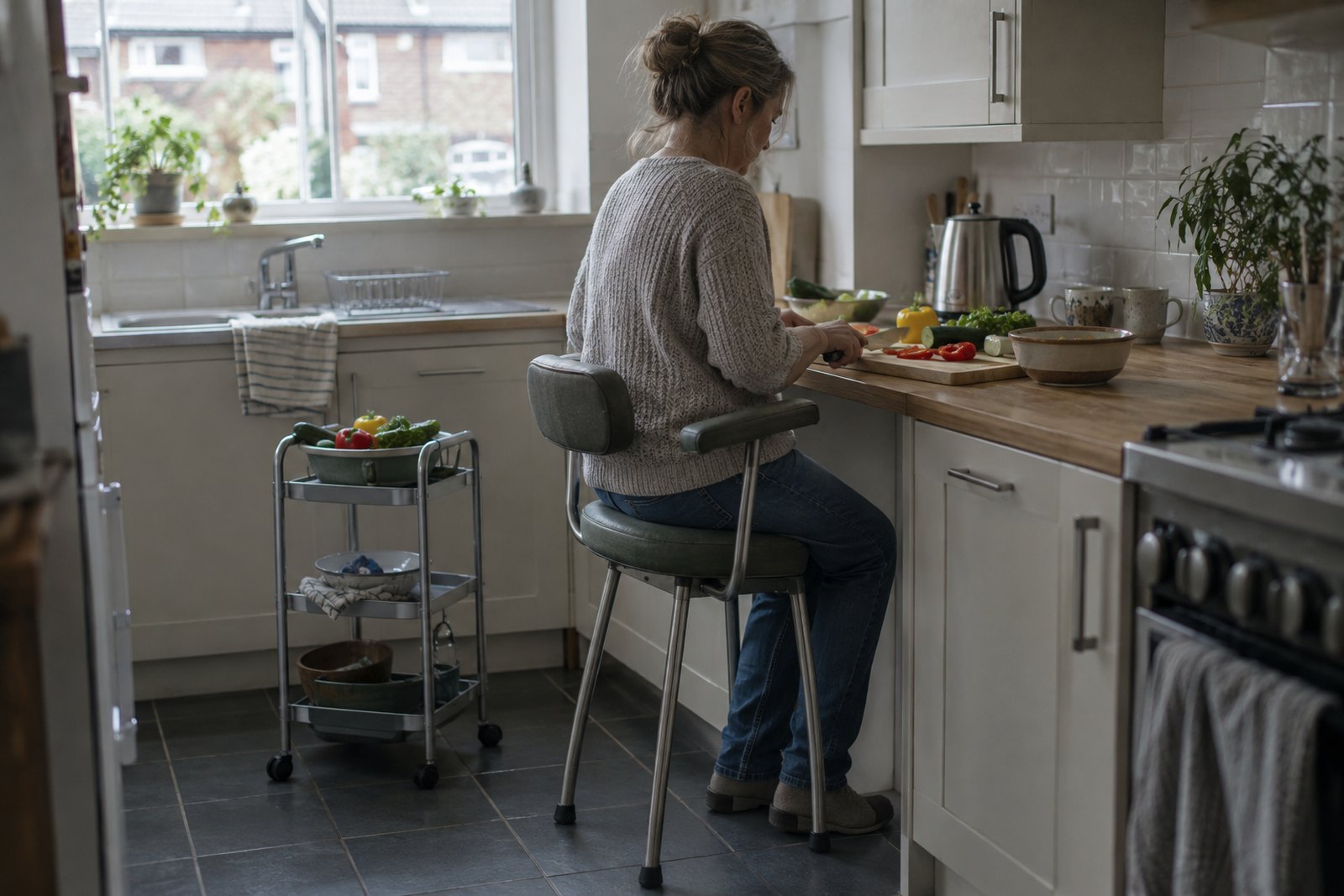
Sit down to do it
Standing uses more energy than sitting. Wherever you can, sit.
- Sit on a stool to prepare food, wash up or iron. A perching stool lets you work at kitchen worktop height while partly supported.
- Sit to dress, and lay clothes out the night before.
- Use a shower stool or seat, and dry off by putting on a towelling dressing gown rather than rubbing yourself dry.
- Sit to brush your teeth, do your hair or shave.
Spread the heavy jobs
- Do one load of washing a day rather than four on a Saturday. Hang it out in two goes, or use a clothes airer indoors at waist height.
- Clean one room, or one part of a room, per day.
- Shop online, or ask someone to help with the heavy items.
- On a better day, cook a double portion and freeze half, rather than spending the good day batch cooking for a fortnight.
- Keep things you use often between waist and shoulder height, so you are not bending and reaching.
- If stairs are hard work, keep a set of essentials on each floor and plan trips so you go up and down less often.
- Use a kitchen trolley to move plates, drinks and laundry instead of carrying them.
Sleep
Fatigue and poor sleep feed each other. Some steps that commonly help: getting up at roughly the same time each day, having a short wind-down routine, keeping the bedroom dark, cool and quiet, and keeping late-evening screens and caffeine to a minimum. Long or late daytime sleeps can make night-time sleep harder for some people, though for others, especially with ME/CFS, rest during the day is essential, so be guided by your own pattern and your clinician. If sleep problems persist, or someone tells you that you snore heavily or stop breathing in your sleep, tell your GP, as there may be something treatable going on.
Long Covid fatigue
Fatigue is one of the most common ongoing symptoms after Covid-19. Many people also notice that symptoms flare after physical or mental effort, sometimes a day or two later. That pattern is a strong reason to pace carefully and not to push through, even if you were fit and active before.
Long Covid often comes with other symptoms, such as breathlessness, brain fog, palpitations, or feeling dizzy or faint when you stand up. These should be checked by your GP rather than simply managed with pacing. In England, specialist post-Covid services exist in many areas and are usually reached through a GP referral, so ask about them. Going back to work is often best done gradually, with a phased return and adjustments agreed in advance. Our guide to getting back to work after illness or injury covers how that can be organised.
ME/CFS
ME/CFS (myalgic encephalomyelitis or chronic fatigue syndrome) is a long-term condition where a key feature is post-exertional malaise: a worsening of symptoms after activity, often delayed, that can last days or longer. The NICE guideline for ME/CFS (NG206, published in 2021) is clear on several points worth knowing:
- Graded exercise therapy should not be offered, and nor should any programme based on fixed, step-by-step increases in physical activity or exercise.
- Energy management should be personalised and help people stay within their current energy limits. It is not a way of pushing people to do more.
- Cognitive and emotional activity count as activity, not just physical effort.
In practice that means your baseline may be very low, and that is fine. Pacing here is about stability and reducing crashes, not building up on a schedule. If anyone offers you a programme that increases activity by set amounts regardless of how you feel, it is reasonable to point to NG206 and ask questions. People with severe ME/CFS may spend most or all of their time in bed and may need help with equipment, positioning, light and noise, and support for carers. You can read the guideline yourself on the NICE website.
Cancer-related fatigue
Cancer-related fatigue is not ordinary tiredness. It can be overwhelming, does not always improve with rest, and can carry on for months after treatment has finished, which many people are not warned about. It can be caused or made worse by the cancer itself, treatment, anaemia, pain, poor sleep, low mood or not eating well. Some of these are treatable, so always tell your cancer team or GP about fatigue rather than assuming you have to put up with it.
Pacing, planning and the energy-saving tips above all apply. One difference from ME/CFS is that your cancer team may suggest gentle, gradual physical activity, which can help many people with cancer-related fatigue. Ask them what is suitable for you and your treatment. If you are having chemotherapy or other cancer treatment and you develop a high temperature or suddenly feel very unwell, do not put it down to fatigue: call the 24-hour helpline number your cancer team gave you straight away.
When to see your GP
Fatigue management is for fatigue that has been looked into. See your GP if:
- You have been tired for several weeks and do not know why.
- You have unexplained weight loss, night sweats, swollen glands or a persistent high temperature.
- Your fatigue is getting steadily worse, or new symptoms appear.
- You feel dizzy, faint or your heart races when you stand up.
- You are short of breath with everyday activity.
- Your mood is low, you have lost interest in things, or you feel anxious most of the time.
Call 999 for chest pain, severe difficulty breathing, collapse, or signs of a stroke such as a drooping face or weakness on one side. If you are not sure how urgent something is, call NHS 111. If you have thoughts of harming yourself, call NHS 111 and choose the mental health option, or call 999 if you are in immediate danger.
Where an occupational therapist fits
Occupational therapists are trained to look at how you do everyday activities and how to make them possible with the energy you have. An occupational therapist can help you work out your baseline, go through an activity diary with you, break specific tasks down, rearrange your home so things take less effort, suggest equipment such as perching stools, shower seats or trolleys, and help you plan a realistic week. They can also help with work: talking through reasonable adjustments, phased returns and how to pace a working day. A private occupational therapist visiting at home sees your actual kitchen, stairs and bathroom, which often makes the advice more practical.
An occupational therapist does not diagnose the cause of fatigue, order tests or advise on medication. That is your GP or specialist team. A physiotherapist may help with things like breathing pattern problems after Covid, though with ME/CFS any physical approach should follow the NICE guideline. A psychologist or NHS talking therapies can help with low mood or anxiety, and a dietitian with eating and weight. Some NHS long Covid, ME/CFS and cancer services include occupational therapy, so ask your team. If you are weighing up the options, our guide to NHS or private occupational therapy may help.
Frequently asked questions
Is pacing the same as resting all the time?
No. Pacing is about doing activity in manageable amounts with planned rest, so your energy is steadier. Resting is part of it, but so is doing the things that matter to you, just in smaller, well-spaced pieces.
Should I make the most of a good day?
Enjoy it, but try not to cram everything in. Doing a bit more than usual is often fine. Doing double or triple is how the boom and bust cycle starts. Check your diary to see what happened after past good days.
How long before pacing helps?
It varies a great deal. Some people notice fewer crashes within a few weeks of finding their baseline; for others it takes longer, and with conditions like ME/CFS the aim may be stability rather than steady improvement. It is worth keeping your diary going so you can see change that is too gradual to notice day to day.
Is exercise good or bad for fatigue?
It depends on the cause. With ME/CFS, NICE says graded exercise therapy should not be offered, and activity should stay within your energy limits. With cancer-related fatigue, your team may recommend gentle activity. With long Covid, symptoms can flare after exertion, so get advice before increasing activity. Speak to the professionals treating you.
Can I get energy-saving equipment for free?
Sometimes. If you have difficulty with everyday tasks, you can ask your council's adult social care team for a needs assessment, and some equipment may be provided on loan. Rules and waiting times vary by area, so check with your local council. Small items are also widely available to buy.
Can an occupational therapist help me stay in work?
Yes. An occupational therapist can look at your job, help you plan a phased return and suggest adjustments. If your condition counts as a disability under the Equality Act 2010 (England, Scotland and Wales), your employer has a duty to make reasonable adjustments. Cancer counts as a disability from the point of diagnosis. The Access to Work scheme on GOV.UK may also be able to help with support at work.
Next steps
See our work and ergonomics page or our equipment and aids page, or current guide prices, and choose your area below.
Talk to an occupational therapist near you
This guide is general information. For advice about your own situation - or someone you look after - a local occupational therapist can visit you at home and see it for themselves.
Choose your area: