

Lewy Body Dementia: Daily Life, Falls and Hallucinations
By Mobile Occupational Therapist • 31 October 2026 • 13 min read
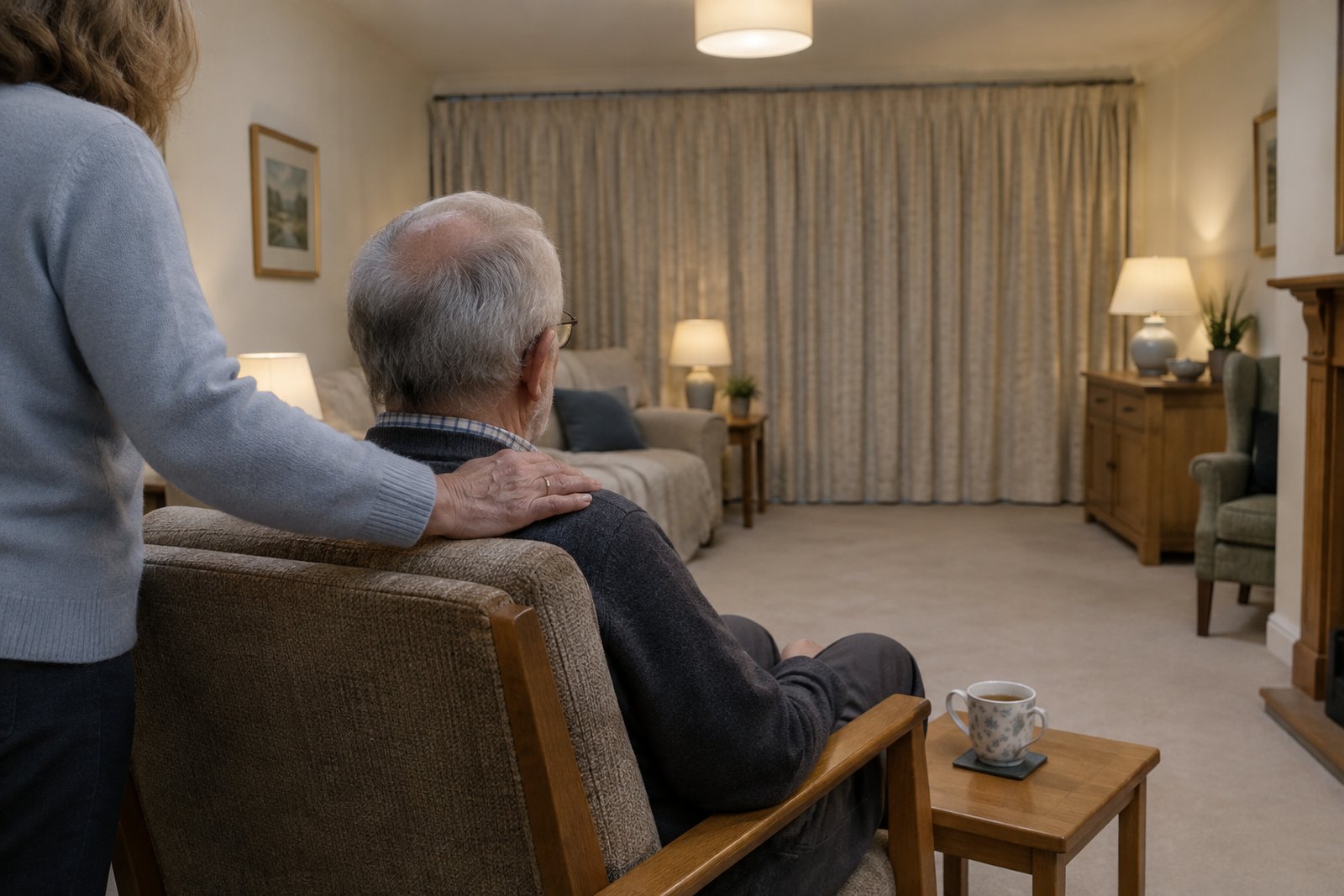
Lewy body dementia is a type of dementia caused by small clumps of protein, called Lewy bodies, building up inside nerve cells in the brain. The term covers dementia with Lewy bodies and Parkinson's disease dementia, which are closely related. What families notice first is that it often does not look like the dementia they expected. Memory can hold up reasonably well early on, while alertness, attention, judging space and distance, and movement are hit harder. Someone can be bright and chatty at breakfast and barely able to follow a sentence by teatime.
Four things set it apart: alertness that comes and goes, visual hallucinations, Parkinson's-like stiffness and slowness, and acting out dreams during sleep. Day to day, that tends to mean more falls, broken nights and seeing things that are not there. There is also one medicine warning every family needs to know about. This guide covers all of it in practical terms, and when to bring in a GP, a speech and language therapist or an occupational therapist.
What makes Lewy body dementia different
Good hours, bad hours
Fluctuation is the hallmark. Your dad might do the crossword in the morning, then spend the afternoon staring into space, drowsy and muddled, then perk up again in the evening. The swings can last minutes, hours or days. It is exhausting to live alongside because you can never quite plan, and it is easy for visitors, or professionals, to see a good hour and think you are exaggerating.
Seeing things that are not there
Visual hallucinations are common and often very detailed: people in the room, children, animals, insects on the carpet. Some people are quite unbothered by them and may even know they are not real. Others are frightened. Misperceptions are common too, where something real is seen as something else, like a dressing gown on a door becoming a stranger.
Movement that looks like Parkinson's
Stiffness, slowness, a shuffling walk, a quieter voice, a stooped posture and sometimes a tremor. These make walking, turning and getting out of a chair harder, and they are a big part of why falls are so common.
Acting out dreams
Many people shout, punch, kick or thrash during vivid dreams. This sleep problem can start years before any memory or thinking changes appear, so families sometimes look back and realise it was an early sign.
Other things that often come with it
Dizziness or fainting on standing (a drop in blood pressure), constipation, bladder problems, heavy daytime sleepiness, low mood, anxiety and difficulty judging distances or finding the edge of a chair. Mention all of these to the GP or memory team. Several can be treated, and several add to the risk of falls.
Falls: why they happen and what helps
Falls in Lewy body dementia rarely have one cause. Slowness and shuffling, a dizzy spell on standing, a moment of reduced alertness, misjudging where a step or chair is, and rushing to answer the door can all combine. Things that genuinely help:
- Slow the get-up. Sit on the edge of the bed or chair for a short while before standing, then stand and pause before walking. This gives blood pressure a chance to catch up.
- Remove the rush. A doorbell that can be answered by video, a phone kept within reach, and agreed times for visitors all reduce the hurried dash across the room.
- Clear the main routes. Bedroom to toilet and chair to kitchen should have no loose rugs, trailing cables or low furniture to catch a shuffling foot.
- Get chair and bed heights right. A stable chair with firm arms, at a height where feet are flat and knees are roughly level with hips, makes standing far easier than a low, soft sofa.
- Something solid to hold. Grab rails at the toilet and bath, a second stair rail, and furniture that will not tip if leant on.
- Be careful with walking aids. A wheeled walker can roll away from someone who walks with small, hurried steps. Get a walking aid assessed rather than bought on spec.
- Time the risky jobs. Showering, stairs and outings go best in the person's usual good hours.
Tell the GP about any falls or dizziness on standing, as medicines and blood pressure may need reviewing. After a fall, call 999 if the person has hit their head and is drowsy, vomiting or more confused than usual, cannot get up, seems badly hurt, or has hit their head and is taking anticoagulant (blood thinning) medicine. Call NHS 111 if you are unsure. Our guide to preventing falls at home goes into more detail.
Lighting, shadows and misperceptions
Because the brain is struggling to make sense of what the eyes see, a dim, shadowy or busy room gives it more to get wrong. This is one of the most useful areas to work on, and much of it costs little.
- Use bright, even lighting, with more than one light source in a room so corners do not fall into shadow.
- Close curtains before dusk, so dark windows do not turn into mirrors full of moving shapes.
- If reflections cause distress, cover or move mirrors, and watch for glossy surfaces and glass-fronted cabinets.
- Swap patterned rugs, throws and busy wallpaper for plain ones where you can. Speckles can look like insects, dark patches like holes.
- Move coats, hats and dressing gowns off the backs of doors and chairs, especially in the bedroom.
- Leave a soft night light on the route to the toilet, and use contrasting colours for the toilet seat, rails and step edges.
Our guides to lighting and colour contrast and a dementia-friendly home, room by room cover this in more depth. Make sure eyesight is checked and glasses are clean and current too, as poor vision makes misperceptions more likely.
Responding to hallucinations calmly
Your instinct may be to tell them it is not real. It rarely works. To them, the man in the corner is as real as you are, and arguing tends to leave them frightened and you frustrated.
- Check whether it matters. If they are calmly watching children playing in the garden and are not upset, you may not need to do anything.
- Look at what they are looking at. Switch on a light, move the coat, close the curtain. Sometimes the hallucination is a misperception with a simple fix.
- Respond to the feeling, not the content. Something like: "I can't see him, but I can see you're worried. I'm here and you're safe." You are not lying and you are not arguing.
- Change the scene. Moving to another room, putting the kettle on or switching on music can break the spell.
- Offer reassuring touch if they find it comforting, and speak slowly and quietly.
Contact the GP if hallucinations are new, suddenly worse, frightening, or come with a sudden change in confusion. A sharp change can be a sign of delirium, often caused by an infection, dehydration, constipation or a new medicine, and needs checking the same day. If hallucinations seem worse after a medicine has been started or changed, tell the prescriber, but do not stop it yourself.
Sleep and acting out dreams
Someone acting out a dream is not being aggressive on purpose, and they usually remember little of it. But they can fall out of bed, hit furniture, or hurt a partner. Practical steps:
- Move bedside tables, lamps, glasses of water and anything sharp or breakable away from the bed.
- Pad or remove hard corners near the bed.
- Think about bed placement. A lower bed, or one side against the wall, can reduce the distance and the routes for a fall. Check this does not trap the person when they need the toilet at night.
- A soft mat beside the bed can cushion a fall, but it can also trip someone getting up. This is worth discussing with a professional first.
- If they are thrashing, speak calmly from a safe distance rather than grabbing them.
- Sleeping in a separate bed or room is a safety decision, not a failure of the relationship.
Do not fit bed rails without advice. For someone who is confused or restless, rails can cause entrapment or a worse fall from a greater height. Our guide to low beds, crash mats and safer nights explains the options. Tell the GP or memory team about dream enactment, as there are treatments that may help.
Heavy daytime sleepiness is also common. Daylight, a gentle routine, meals at regular times and something worth getting up for all help. Some days, though, the person will simply sleep a lot, and that is part of the illness.
The medicine warning: tell every doctor
People with Lewy body dementia can react very badly to some antipsychotic medicines, which are sometimes given for agitation or hallucinations, particularly in hospital or by out-of-hours services who do not know the person. Reactions can include severe stiffness, sudden worsening of confusion, extreme drowsiness and falls, and can be life-threatening. National guidance for clinicians already advises great caution, but it only helps if the people treating them know the diagnosis.
- Make sure the diagnosis is clearly on the GP record.
- Tell every new doctor, paramedic, A&E team, ward and pharmacist, every time. Do not assume the notes have travelled.
- Write it into a hospital passport and keep a copy in the hospital bag.
- Carry a card or note in their wallet or handbag stating the diagnosis. The Lewy Body Society can tell you what information to include.
- When any new medicine is suggested, ask: "Is this safe with Lewy body dementia?"
Never stop or change a prescribed medicine without talking to the doctor or pharmacist first.
Eating, drinking and swallowing
Swallowing can become harder as the illness progresses, and fluctuating alertness makes it riskier still. Watch for coughing or spluttering at meals, a wet or gurgly voice after drinking, food held in the mouth, meals taking much longer, weight loss or repeated chest infections. Tell the GP, who can refer to a speech and language therapist. They lead on swallowing, not an occupational therapist.
In the meantime, offer food and drink when the person is most alert, sitting fully upright, with no rushing and small mouthfuls. Do not give food or drink to someone who is very drowsy. If someone is choking and cannot cough, speak or breathe, call 999.
Planning ahead
Because alertness fluctuates, good conversations need to happen in good hours, and sooner rather than later. Worth doing now:
- Lasting power of attorney for health and welfare, and for property and financial affairs. It can only be made while the person still has the mental capacity to do so. Check the current process on GOV.UK.
- Advance care planning. Talk about what matters to them, where they would want to be cared for, and record it with the GP.
- Driving. A dementia diagnosis usually needs to be reported to the DVLA. Check the current rules on GOV.UK.
- Support for you. As a carer you can ask the council for a carer's assessment, and for a needs assessment for the person you care for.
- Home changes before a crisis. Rails, a downstairs toilet or a level-access shower can take time to arrange, so start looking early.
Where an occupational therapist fits
An occupational therapist looks at how someone manages everyday life at home and what would make it safer and easier. In Lewy body dementia, that usually means a home visit to look at falls risks, lighting, the bedroom set-up, the bathroom and toilet, chair and bed heights, and the routines that go well or badly depending on alertness. They can advise on equipment such as rails, raised toilet seats, bathing aids and safer bed arrangements, teach family carers safer ways to help with standing and moving, and write reports to support council adaptations.
They do not diagnose, prescribe or change medicines. That is the GP, memory clinic, neurologist or old age psychiatrist. Swallowing is led by a speech and language therapist, and balance and walking exercise by a physiotherapist. A good occupational therapist will tell you when someone else is the right person.
You can ask for an NHS or council occupational therapist through the GP, memory team or council adult social care, which is usually free for the assessment but may involve a wait and some services, equipment or adaptations can be means tested or charged for. A private occupational therapist visiting at home can usually come sooner and spend longer looking at the whole home. See our page on home assessments for what a visit covers.
Frequently asked questions
Is Lewy body dementia the same as Parkinson's disease?
Not quite, though they are closely linked and share the same protein clumps. If thinking problems start before, or around the same time as, movement problems, it is usually called dementia with Lewy bodies. If someone has had Parkinson's for some time before dementia develops, it is usually called Parkinson's disease dementia. Day-to-day help at home is very similar.
Should I tell my mum the things she sees are not real?
Usually it does more harm than good. Acknowledge what she is feeling, say gently that you cannot see it, check the lighting, and change the scene if she is upset. If the hallucinations are new, suddenly worse or frightening, speak to the GP.
Why is he so much worse on some days?
Fluctuating alertness is a core part of Lewy body dementia. A simple diary of good and bad times helps the GP and memory team, and helps you plan. But a sudden change that is different from his usual pattern can be delirium from an infection or other cause, so ring the GP or NHS 111 the same day.
How quickly does Lewy body dementia progress?
It varies a great deal from person to person, and no one can give an exact timescale. Falls, infections and hospital stays can bring on a step down, which is one more reason to put falls prevention and planning in place early.
Can someone with Lewy body dementia keep living alone?
Some people can for a time, with the right set-up and support, but fluctuating alertness and falls make it harder than with some other dementias. A needs assessment from the council and a home visit from an occupational therapist can help you judge what is safe and what would need to change.
Do we need a GP referral to see an occupational therapist?
For NHS or council occupational therapy, you go through the GP, memory team, hospital or council adult social care. You can contact a private occupational therapist directly without a referral. Check they are registered with the HCPC.
Next steps
If falls, broken nights or a home that no longer fits are wearing you down, a home visit can help you work out what to change first. See our home assessment and neurological occupational therapy pages, or current guide prices, and choose your area below.

Talk to an occupational therapist near you
This guide is general information. For advice about your own situation - or someone you look after - a local occupational therapist can visit you at home and see it for themselves.
Choose your area: