

Dementia Lighting and Colour Contrast: Simple Changes at Home
By Mobile Occupational Therapist • 3 October 2026 • 14 min read
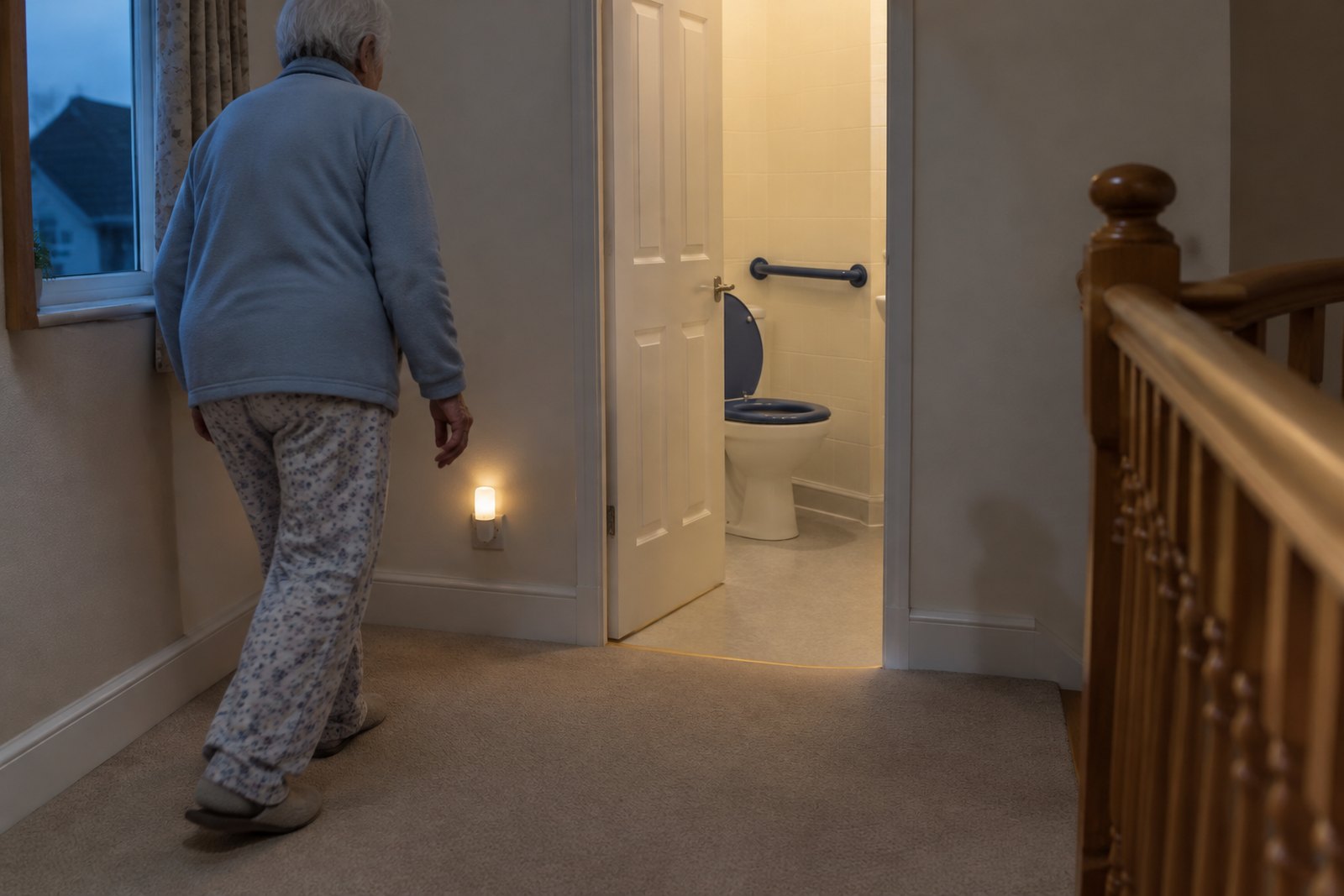
If someone you care about has dementia, sight loss or simply older eyes, the two changes that usually make the biggest difference at home are better light and better contrast. That means more light, spread evenly, with fewer shadows and less glare. It also means strong colour contrast on the things you want them to find (the toilet seat, the plate, the grab rail, the edge of a step) while keeping floors plain, so nothing looks like a hole or an obstacle.
None of this needs a builder. Most of it is bulbs, lamps, a few cheap swaps and moving things around. Below is what to change, what to avoid, and how to tell whether it is working. For the wider picture, our guide to a dementia-friendly home covers layout, memory and safety room by room. This page sticks to light and colour.
Why seeing gets harder with dementia and age
Two things often happen at once, and it helps to separate them.
The first is the eye itself. As we age, the lens yellows and lets less light through, pupils get smaller, and conditions such as cataracts, macular degeneration and glaucoma become more common. Older eyes need more light to see the same detail, take longer to adjust when moving from a bright room to a dark one, and are more bothered by glare.
The second is the brain. Dementia can affect how the brain makes sense of what the eyes send it, even when the eyes are healthy. People may struggle to judge depth and distance, to pick out an object against a background of a similar colour, or to interpret shadows and patterns. This is why someone might step high over a dark doormat, refuse to cross a shiny floor, or not notice white mashed potato on a white plate. They are not being difficult. What they see genuinely looks different.
Put the two together and you have someone working hard just to make sense of their surroundings. That is tiring, and it tends to get worse as the light fades, which is one reason late afternoons can be harder. Our piece on sundowning goes into that in more detail.
Lighting: brighter, even and without shadows
More light, spread evenly
The aim is a room that is bright all over, not one bright spot in the middle and gloomy corners. A single ceiling bulb tends to give you exactly the gloomy version. Better:
- Fit brighter bulbs, within the maximum shown on the light fitting. LED bulbs give much more light for less heat and power. When buying, compare the lumens figure on the box rather than watts: more lumens, more light.
- Add lamps to dark corners and especially where tasks happen: beside the favourite chair, over the kitchen worktop, by the bed.
- Use under-cupboard lights in the kitchen so the person is not working in their own shadow.
- Light the hall, landing and stairs well, top and bottom, with switches at both ends if possible.
- Keep light levels similar from room to room. Stepping from a bright kitchen into a dark hall is where eyes struggle most.
- Replace failing bulbs promptly and dust the shades. Dark or heavy lampshades swallow light.
Bulbs are also sold by the colour of their light. Cool white or daylight bulbs look crisper, and many people find them easier for reading and close work. Warm white feels cosier and suits the evening. A sensible pattern is brighter, cooler light during the day where tasks happen, and softer, warmer light as bedtime approaches.
Getting rid of shadows
Shadows matter more than most people realise. To someone with dementia, a dark patch on the floor can look like a hole, a step or a spill, and a shadow in a corner can look like a person or an animal. Common culprits:
- A single overhead light, which throws shadows of furniture across the floor.
- Lamps placed behind the person, so they cast their own shadow over what they are doing.
- Stairs lit from one end only, leaving every other tread in shade.
- Low winter sun through a window, throwing stripes from blinds or banisters.
- Coats on the back of a door or a dressing gown on a hook, which can look like someone standing there at night.
Spreading light from several sources rather than one is the main fix. If someone keeps reporting people or animals in the room, note when and where it happens and check for shadows and reflections first. Then mention it to their GP. Some types of dementia, and some eye conditions such as Charles Bonnet syndrome, can cause visual hallucinations, and the GP needs to know.
Cutting glare
Glare is light bouncing off shiny surfaces or shining straight into the eyes. Older eyes cope with it badly, and it can make a floor look wet or hide what is on a table.
- Shade bare bulbs and use frosted or opal bulbs rather than clear ones.
- Use blinds or net curtains to soften strong direct sun, but open them fully when the sun moves round so you do not lose daylight.
- Choose matt over gloss: matt paint, and a tablecloth or matt placemats on a glass or polished table.
- Do not polish floors to a high shine.
- Angle lamps so the bulb cannot be seen from where the person sits.
Switches and smart bulbs
Light only helps if it is switched on. Switches that contrast with the wall are easier to find: a dark switch on a pale wall, or a coloured surround behind a white switch. Smart bulbs that come on by timer or by voice can help someone who forgets to put lights on as it gets dark, though they need someone to set them up and do not suit everyone; plug-in motion-sensor lights are a simpler alternative.
Night-time: lighting the route to the toilet
Night is when poor lighting causes most trouble. Someone wakes, disorientated, needs the toilet and sets off in the dark. Lighting that route is one of the most useful single changes you can make.
- Use plug-in motion-sensor night lights low down along the route from bed to toilet, so the floor is lit as they walk.
- Leave a low light on in the bathroom with the door open, so the destination is visible from the bed.
- Put a lamp or touch light within easy reach of the bed, so they are not walking to a wall switch in the dark.
- Keep the route clear of shoes, bags and trailing flexes.
- Choose soft, warm light for night use: enough to see by without fully waking them.
There is more on this, including bed height and alarms, in our guide to night-time safety for older adults.
Daylight and the body clock
Our body clock is set largely by light. Bright light in the morning helps us feel awake; dimness in the evening helps us feel sleepy. People with dementia, particularly those who spend most of the day indoors, often get too little daylight and the clock drifts. Days blur into a long doze and nights become restless.
Lighting will not fix this on its own, but it helps to:
- Open curtains fully first thing and keep them open during the day.
- Move the favourite chair nearer a window, facing across the light rather than straight into it.
- Get outside in the morning or early afternoon, even for ten minutes in the garden or to the end of the road.
- Eat breakfast and lunch in the brightest room.
- Dim and warm the lighting through the evening, and keep the bedroom dark apart from the toilet route.
If sleep is badly disrupted, talk to their GP. Pain, infections, medicines and other health problems can all affect sleep and need checking.
Colour contrast that helps
Contrast is the difference between something and what is behind it. The question is not whether it is red, but whether it stands out from its surroundings. A white toilet against a white floor and white walls can be almost invisible to some people. Make the important things easy to spot.
- Toilet seat. A coloured seat on a white toilet helps people find it and sit down accurately.
- Grab rails. Rails in a colour that stands out from the wall are easier to see and reach for. White rails on white tiles defeat the point.
- Plates and cups. Plain plates that contrast with both the food and the table, so someone can see what is there to eat. A plain placemat under the plate helps on a patterned tablecloth.
- Door frames and doors. Painting the frame or door of the toilet or bedroom in a contrasting colour helps people find it. A cupboard you would rather they ignored can be painted the same as the wall.
- Stair edges. A contrasting strip along the front edge of each step shows where it ends. Plain stair carpet helps; busy patterns hide the edges.
- Light switches, handrails and banisters. Anything they need to find and hold should stand out from the wall.
- Basin and soap. Coloured soap or a contrasting soap dish on a white basin.
- Chairs. A chair seat that contrasts with the floor, or a plain throw over it, helps people judge where to sit.
Many older people find strong, warm colours easier to tell apart than pale blues, greens and greys, which can merge together. But the difference in lightness matters more than the colour itself. A dark blue rail on a cream wall works. A mid red rail on a mid green wall may not.
A quick way to check
Take a photo of the room on your phone and switch it to black and white. If the toilet seat, the rail or the step edge disappears into the background, the contrast is too weak. It is a rough test, but surprisingly revealing.
Contrast and patterns that confuse
Contrast is useful where you want something noticed. On the floor, it often backfires.
- Dark mats and rugs. A black doormat or dark rug can look like a hole. People may step over it, stop dead or walk round it, and lose their balance. Rugs are a trip hazard anyway. Remove them where you can, or if a mat is needed, choose a flat, non-slip one close in tone to the floor and make sure the edges cannot curl or slide.
- Changes of floor colour at doorways. A strong change from a light hall carpet to a dark kitchen floor can look like a step. If you are replacing flooring, aim for similar tones running through.
- Busy patterns. Strongly patterned carpets, curtains, wallpaper and tablecloths can be confusing. Spots and flowers may look like things to pick up; stripes may look like steps. Plain or gently textured surfaces are calmer.
- Shiny floors. A glossy floor can look wet, so the person shuffles or refuses to cross it. Matt finishes are better.
- Mirrors. Some people with dementia stop recognising their own reflection and think a stranger is in the room. Others are fine with mirrors for years. If a mirror seems to cause distress, try covering it with a cloth, and remove it if that settles things. There is no need to remove mirrors that are not causing a problem. Dark windows at night can do the same, so draw the curtains at dusk.
Signs with pictures
Simple signs can help someone find the toilet, bedroom or kitchen, especially at night. They work best when they:
- Combine a clear picture with a word, such as a picture of a toilet with the word Toilet underneath.
- Use bold, plain lettering with strong contrast, such as dark on light.
- Are fixed on the door itself, not beside it, and lower than you might think. Many older people look down as they walk.
- Have a matt finish so they do not catch the light.
- Are few. A sign on every cupboard becomes noise.
Some families use a photo of the actual room, which can be easier to recognise than a general symbol.
Eye tests: do not skip them
Before buying a single bulb, make sure their eyes have been checked recently. Cataracts are common and treatable, and up-to-date glasses can make more difference than any lighting change. People with dementia can still have eye tests; tell the optician about the dementia so they can adapt how they do it.
- In England, NHS sight tests are free for people aged 60 and over, and for some other groups. Rules differ across Scotland, Wales and Northern Ireland, so check the NHS website for where you live.
- If someone cannot get to an optician unaccompanied because of illness or disability, they may be able to have an NHS eye test at home. Ask local opticians or check the NHS website.
- Adults are generally advised to have a test every two years, or more often if the optician recommends it.
- Keep glasses clean, label reading and distance pairs, and check they are actually being worn.
If sight loss is significant, the council's sensory or visual impairment team and charities such as RNIB can help. Our guide to low vision aids and living with sight loss at home covers magnifiers, talking devices and registration.
When it is urgent: sudden loss of sight, or changes in vision with face drooping, arm weakness or slurred speech, is an emergency. Call 999. A painful red eye, or a sudden shower of new floaters or flashes, needs same-day advice from an optician, NHS 111 or A&E. A sudden worsening of confusion can be a sign of infection or other illness, so contact the GP or NHS 111.
Where an occupational therapist fits
You can make most of these changes yourself. An occupational therapist is useful when you have tried the obvious things and problems continue, when falls or near misses are happening, or when you are not sure what is causing the trouble: eyes, dementia, mobility or the layout of the home.
A private occupational therapist visiting at home can watch how the person actually moves around, where they hesitate, what they miss and what time of day things go wrong. They can look at lighting, contrast and layout alongside equipment such as rails, toilet frames and seating, and give you a prioritised list of changes. You can also ask council adult social care for an assessment, which may involve an occupational therapist.
An occupational therapist does not test eyes or treat eye conditions; that is the optician and, if needed, a hospital eye clinic. Diagnosing dementia, reviewing medicines and investigating hallucinations or sleep problems is for the GP and memory services. For mobility training with serious sight loss, the council's visual impairment rehabilitation workers usually lead.
Frequently asked questions
What colours are best for someone with dementia?
There is no single best colour. What matters is contrast in lightness between an object and its background, such as a dark seat on a pale toilet. Many older people find strong, warm colours easier to pick out than pale blues and greens.
Are daylight bulbs good for dementia?
They can help during the day, especially for reading, cooking and close tasks, because the light looks crisp. In the evening, warmer, softer light is usually more restful. Brightness and even spread matter more than the bulb type.
Should we cover or remove mirrors?
Only if they are causing distress. If someone seems frightened by their reflection or talks to it as a stranger, try covering the mirror first. Many people with dementia have no problem with mirrors.
Will night lights keep them awake?
Low, warm night lights placed near the floor along the route to the toilet light the way without lighting up the bedroom. Motion-sensor lights only come on when needed, which helps.
How bright should lighting be for older people?
There is no fixed figure that suits everyone, but it is usually brighter than younger family members expect. Watch the person doing everyday tasks. If they lean in, squint, hesitate or miss things, add light where they are working.
Can I get help paying for changes?
Many of these changes cost little. Council adult social care can assess needs and may provide some equipment, such as rails, free of charge. Larger adaptations may be eligible for grants depending on circumstances, so ask the council.
Next steps
If you would like someone to look at light, contrast and safety together, see our home assessment page, or current guide prices, and choose your area below.
Talk to an occupational therapist near you
This guide is general information. For advice about your own situation - or someone you look after - a local occupational therapist can visit you at home and see it for themselves.
Choose your area: