

How to Push a Wheelchair Safely: Kerbs, Slopes and Transfers
By Mobile Occupational Therapist • 6 October 2026 • 14 min read
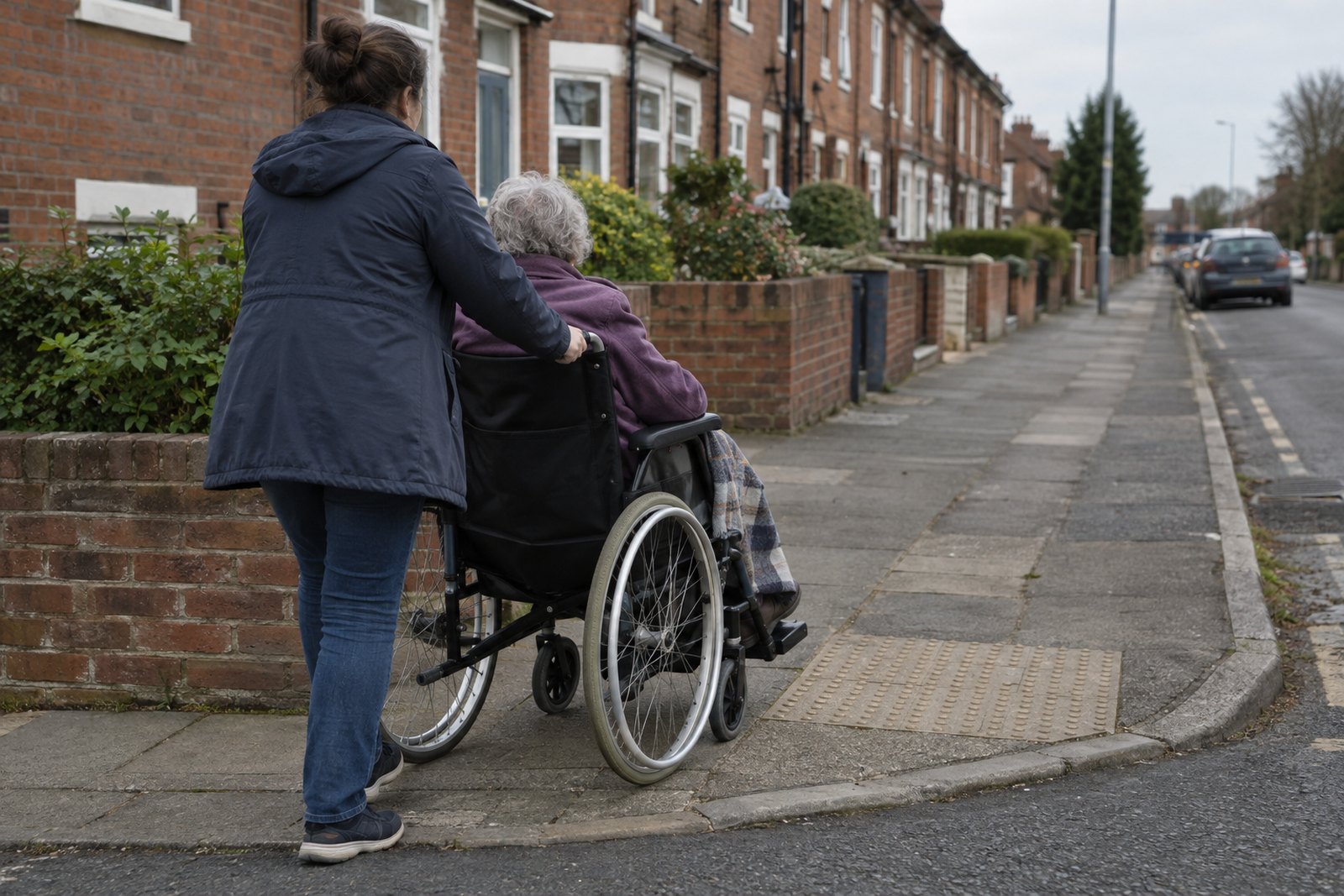
To push a wheelchair safely, check the brakes, tyres and footplates before you set off, make sure the person is sitting right back with both feet on the footplates, and always tell them before you do anything that will tip or jolt them. Take kerbs up forwards, tipping the chair back onto its big wheels with the tipping lever. Take kerbs down backwards, big wheels first. On steep slopes, go down backwards too, so the chair cannot run away from you.
That is most of it. The rest is technique and a bit of planning. Pushing someone in a wheelchair looks easy until the first time a front wheel catches on a paving slab and the person you care about lurches forward. This guide goes through it in the order you will meet it: setting off, pavements, kerbs, slopes, doors and lifts, your back, getting in and out of the chair, and the car.
Before you set off: the two-minute check
A lot of trouble on a trip out starts before you leave the house. Run through this every time until it becomes habit.
- Brakes. Put both on and try to push the chair. It should not move. If one side slips, get it fixed before you go anywhere with a slope.
- Tyres. Air-filled tyres that are soft make the chair heavier to push and make the brakes less effective. Solid tyres need checking for wear and splits.
- Footplates. Both fitted, locked in place and at the right height, so the person's thighs are supported and their feet rest flat.
- Sitting right back. The person's bottom should be at the back of the seat, not perched on the front edge. Perching makes it far easier to slide out when the chair tips or stops suddenly.
- Feet on the footplates. Not trailing on the ground. A foot that slips off can be dragged under the chair and badly injured.
- Hands and elbows in. Hands resting on the lap or armrests, well away from the wheels and the door frames you are about to go through.
- Clothing and blankets. Tuck in scarves, coat hems and blankets so nothing can wind into the wheels.
- Cushion. The right way round and flat. If the chair came with a specific cushion, use it.
- Belt. If a lap belt has been provided as part of their seating, use it as advised. It is there for positioning, not as a restraint.
- Anti-tip bars. Many chairs have small bars at the back that stop the chair tipping over backwards. Know whether yours has them and how they work, because some need moving to get up kerbs. Check the instructions or ask whoever supplied the chair.
Talk to the person in the chair
The single most important rule: never tip, turn or reverse the chair without warning the person first. Being tipped backwards with no warning is frightening and can make someone grab at the wheels or lean forward at exactly the wrong moment. Say what you are about to do, every time. "Kerb coming, tipping you back now." It feels odd at first and then it does not.
Ask them, too. If they have used the chair for a while, they may know its quirks better than you do, and they will certainly know what feels unsafe.
Pushing on the flat
Hold both handles, stand upright and close to the chair, with your arms slightly bent. Walk at a steady pace that the person is comfortable with. That is often slower than you think.
Watch the ground about two or three paces ahead. The small front wheels, called castors, catch on things the big wheels ride straight over: lifted paving slabs, drain covers, the raised bumps at crossings, door thresholds. If a castor catches, stop. Do not shove harder, because that is how people get pitched forward. Tip the chair back slightly to lift the castors over, or go round.
Many pavements slope towards the road, and the chair will drift that way. Correct it with steady pressure rather than jerks. On grass, gravel or sand, it is often easier to tip the chair back onto its big wheels, or to turn round and pull it backwards.
Kerbs: going up
Look for a dropped kerb first. It is usually worth the extra walk. If you have to go up a kerb, do it like this:
- Approach the kerb forwards and square on, not at an angle.
- Stop just before the front castors touch it. Put nothing on the brakes.
- Tell the person you are about to tip them back.
- Put one foot on the tipping lever (the bar sticking out at the back near the ground) and press down while pulling gently back and down on the handles. The chair tips back onto its big wheels.
- Roll forward until the castors are over the kerb, then lower them gently onto the pavement.
- Push the chair forward until the big wheels touch the kerb, then lift and roll them up, using your legs rather than your back. Keep the chair close to you.
If the kerb feels too high, it is too high. Find another way. And never lift a wheelchair by its armrests or footplates, as some of these are designed to come off.
Kerbs: going down
Going down backwards is usually safer, because the person stays sitting back in the chair rather than being tipped forward towards the road.
- Turn the chair round so you are facing away from the kerb, with your back to the road. Check behind you for traffic and cyclists.
- Tell the person what you are doing.
- Step down off the kerb yourself first.
- Ease the big wheels down slowly, taking the weight through your arms and legs so they roll down rather than drop.
- Once the big wheels are on the road, tip the chair back slightly, step backwards until the castors are clear of the kerb, then lower them gently.
- Turn and carry on, keeping an eye on traffic.
Some carers take very small kerbs forwards with the chair tipped back. If you do, keep it tipped until both big wheels are down. But backwards is the safer default, especially while you are learning.
Slopes and ramps
Going up
Go up forwards. Lean into the chair, take shorter steps and keep going steadily if you can, because stopping halfway and restarting is hard work. If you do need to stop, keep firm hold of the handles and put the brakes on before you let go with either hand.
Going down
On gentle slopes you can go down forwards, slowly, holding the chair back. On steep slopes, turn round and go down backwards, looking over your shoulder. That way the chair is above you and you are braking it with your body, rather than trying to hold it back as it rolls away. If the chair has attendant brakes (brake levers on the handles), use them to control your speed.
Never let go of a wheelchair on a slope, even for a moment. If there is a wrist strap on the handles, use it. Take extra care with wet leaves, ice and painted surfaces, which can be slippery. On a slope that runs across your path, the chair will try to turn downhill, so keep steady pressure on the uphill side.
If you are thinking about a ramp at home, the gradient matters a lot. Our guide to ramps, rails and thresholds explains what to look at before anything is fitted.
Doors, lifts and tight spots
Doors
For a door that opens towards you, open it, hold it with your back or hip, and pull the chair through backwards. For a door that opens away from you, the easiest way is often to reverse through, pushing the door open with your back as you go. Watch the person's hands and feet near the door frame. And ask for help. Most people are glad to hold a door if asked.
Lifts
Check the lift is level with the floor before you go in. The small castors can catch in the gap, so many carers find it easier to reverse in and out, letting the big wheels cross the gap first. Put the brakes on once you are inside if the lift is busy.
Escalators and stairs
Never take a wheelchair on an escalator. Do not try to take someone up or down stairs in a wheelchair on your own. It needs more than one trained person, and in almost every public building there is a lift or another route. Ask staff.
Buses and shops
On a bus, use the ramp, go into the wheelchair space, and put the brakes on. In shops, the footplates stick out further than you think, so watch other people's ankles at the end of aisles.
Protecting your back
Pushing a wheelchair is repetitive, and the strain builds up over weeks rather than all at once. Small things make a big difference.
- Handle height. The handles should let you stand upright with your elbows slightly bent. Some chairs have adjustable handles. If the chair is from NHS wheelchair services, ask them.
- Keep the tyres pumped up. Soft tyres make every push harder.
- Stay close. Walk close behind the chair rather than pushing at arm's length.
- Use your legs. Push from your legs and body weight, not your shoulders and lower back.
- Do not twist. Turn by stepping your feet round, not by twisting your back.
- Two hands, always. Pushing one-handed while carrying shopping or holding a dog lead puts uneven strain on your back and gives you less control.
- Plan the route. Fewer kerbs and hills means less strain. Rest when you need to, with the brakes on.
If you are pushing a heavier person, or live somewhere hilly, there are powered add-ons that help the person pushing. Ask wheelchair services or an occupational therapist whether one would suit your chair.
If you develop back pain, see your GP or a physiotherapist rather than pushing through it. Go to A&E or call 999 if back pain comes with numbness around your bottom or genitals, or new problems controlling your bladder or bowels. For more on looking after yourself while helping someone move, see our guide to safe moving and handling for family carers.
Getting in and out of the wheelchair
Transfers are one of the most common times for falls around wheelchairs, so take particular care. Before anyone moves in or out of the chair:
- Put both brakes on. Check them.
- Swing the footplates out of the way or take them off. Never let anyone stand on the footplates, as the chair can tip forward.
- Take off the armrest on the transfer side if the person is sliding across.
- Put the chair close to where they are going, usually at a slight angle.
- Make sure their feet are flat on the floor.
Let the person do as much as they safely can, and do not lift them bodily. Never pull someone up by their arms or under their armpits, which can injure their shoulders and your back. If they cannot take their weight on their legs, a transfer board or other equipment may be the answer, and that needs proper assessment and teaching first.
When they are back in the chair, help them get their bottom right to the back of the seat before you put the footplates back and set off.
Getting the wheelchair into a car
The person first
Park where there is room to open the door fully. Slide the car seat right back. Bring the wheelchair alongside, brakes on, footplates away. The person sits down onto the car seat first, then swings their legs in, rather than stepping in one leg at a time. Our guide to getting in and out of a car covers swivel cushions, handles and other aids that help.
Then the chair
Make the chair as light as possible before you lift it. Take off the cushion, footplates and anything else that comes off. Fold it. If it has quick-release wheels, remove them. Lift with the chair close to your body, knees bent, and do not twist as you put it in the boot. Lifting over a high boot lip is often the hardest part.
If you cannot lift the chair safely, do not keep doing it. Options include a lighter chair, a boot hoist, or a vehicle that the chair can be pushed into. A mobility centre can assess car access properly.
Where the wheelchair comes from
If someone needs a wheelchair long term, NHS wheelchair services can assess them and provide a chair, usually after a referral from a GP or therapist, and they look after repairs on chairs they supply. Our guide to NHS wheelchair services explains how it works. Ask them to show you how to use the brakes, tipping lever and anti-tip bars on that particular chair.
Where an occupational therapist fits
An occupational therapist looks at how someone gets through their day, and a wheelchair is only part of that. A private occupational therapist visiting at home can:
- watch and improve transfers between bed, chair, toilet, wheelchair and car, and teach you safe techniques;
- recommend transfer equipment and show you how to use it;
- look at getting in and out of the house, door widths, thresholds and turning space, and advise on adaptations;
- help plan routines so you are not wearing yourself out.
Be clear on who leads what. The wheelchair itself, its size, seating and cushion, is the job of NHS wheelchair services if they supplied it (their team often includes occupational therapists and physiotherapists). A physiotherapist leads on strength and walking. Your GP is the right person if the person in the chair is getting new pain, sores or weakness, or if you are getting back pain. See our equipment and aids page for more on how an occupational therapist can help.
Frequently asked questions
Should you go down a kerb forwards or backwards in a wheelchair?
Backwards is usually safer. The big wheels go down first, the person stays sitting back in the chair, and you can control the descent. Check behind you for traffic before you step into the road.
Is it safer to go down a steep slope backwards?
Yes. Going backwards means you are below the chair, braking it with your body, so it cannot run away from you. On gentle slopes, going forwards slowly while holding the chair back is usually fine.
How high a kerb can I take a wheelchair up?
There is no single safe height, because it depends on the chair, the person and your own strength. If a kerb feels too high, or you cannot lower the chair gently, find a dropped kerb or another route.
Can I push a wheelchair with one hand?
It is best not to. You have less control, especially if a castor catches or the path slopes, and it strains your back. Hang a bag from the back of the chair only if it will not make the chair tip, or use a rucksack.
What should I do if the person slides forward in the chair?
Stop, put the brakes on and help them shuffle back in the seat rather than pulling them under the arms. If it keeps happening, the seating may not be right for them. Contact wheelchair services or an occupational therapist.
Who can show me how to push a wheelchair properly?
Ask whoever supplied the chair, as NHS wheelchair services can usually show you the controls on that model. An occupational therapist can also teach transfers and safe techniques at home.
Next steps
If transfers, getting out of the house or the car are becoming a struggle, see our equipment and aids or home assessment pages, or current guide prices, and choose your area below.

Talk to an occupational therapist near you
This guide is general information. For advice about your own situation - or someone you look after - a local occupational therapist can visit you at home and see it for themselves.
Choose your area: