

Transfer Boards: Moving Between Bed, Chair, Wheelchair and Car
By Mobile Occupational Therapist • 25 September 2026 • 13 min read
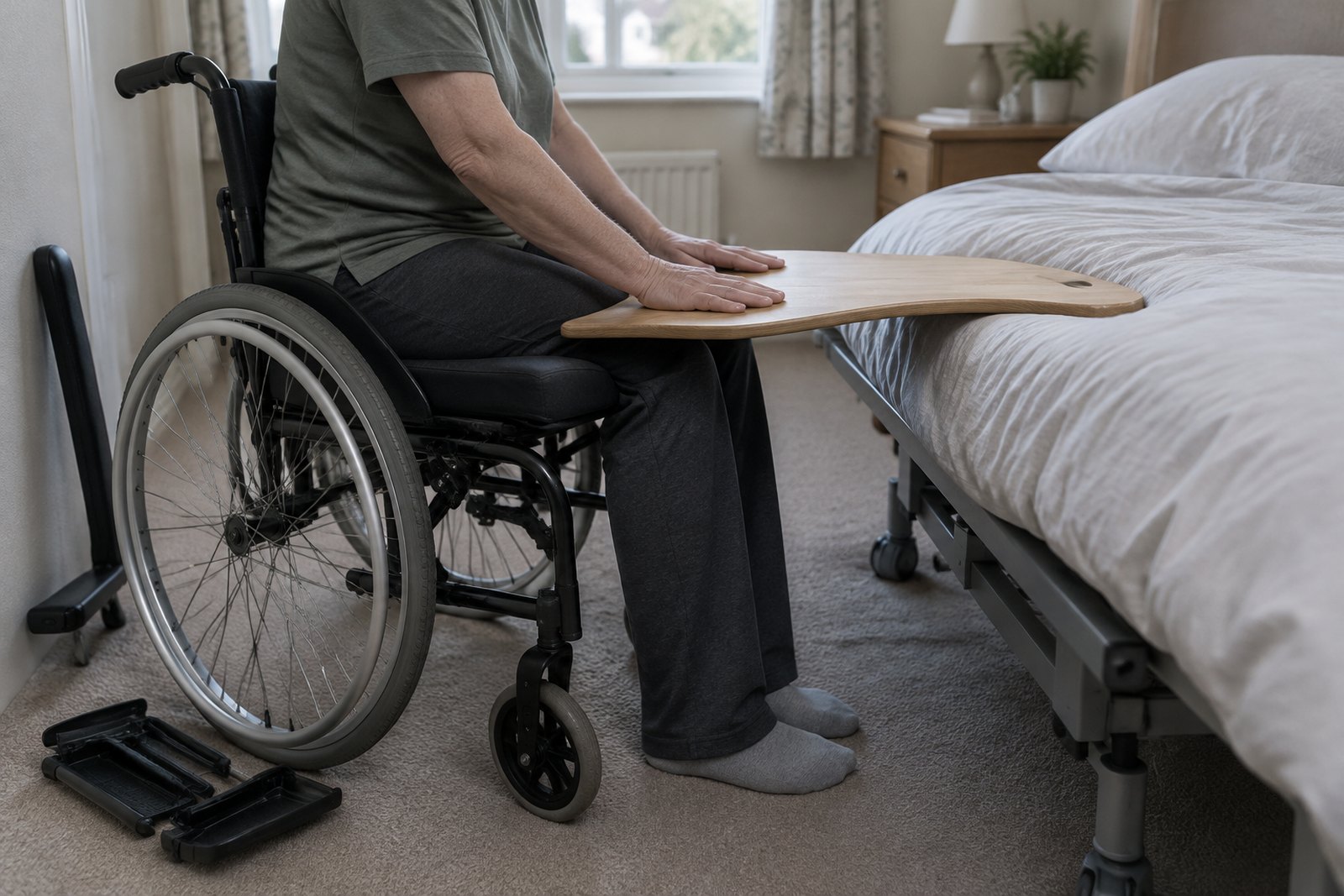
A transfer board is a smooth, rigid board that bridges the gap between two seats, so you can slide across in sitting instead of standing up. People use them to get between a bed and a wheelchair, a wheelchair and an armchair or commode, or a wheelchair and a car seat. You may also hear them called sliding boards or banana boards (after the curved kind).
They suit people who can sit steadily on the edge of a bed without holding on, who have enough strength in their arms and trunk to lean and shuffle their bottom along, but who cannot safely stand up to move. They do not suit people who cannot balance in sitting, or anyone who would need a carer to lift or drag them across. The board looks simple, and it is, but the technique matters, and it should be taught in person by an occupational therapist or physiotherapist before you rely on it.
Who a transfer board suits, and who it does not
A board takes the standing part out of a transfer. That makes it useful for a fairly specific group of people. You are likely to be a good fit if you:
- can sit on the edge of a bed or seat without support and stay balanced while you lean slightly forwards and to the side
- can push down through at least one arm, or lean and shift your weight well enough to move your bottom in small steps
- cannot stand, or can stand only briefly and unsafely, so a stand-and-turn transfer is a risk
- can understand and remember a sequence of steps, or have a carer who can prompt you through it
People who often use boards include those with spinal cord injury, leg amputation, some types of stroke, multiple sclerosis and other conditions that weaken the legs but leave reasonable sitting balance. Some people use a board for a few weeks while recovering, then move back to standing transfers. Others use one for years.
A board is usually the wrong answer if:
- you slump or tip sideways when sitting unsupported
- you cannot take much weight through your arms, and a carer would end up pulling you across
- you are very drowsy, confused or unpredictable in how you move
- your skin is fragile or already damaged on the bottom or thighs
- pain stops you moving in the way the transfer needs
- your weight is above the limit printed on the board
If that sounds like your situation, other options exist. A standing aid, a turning disc or a hoist may be safer. Our guide to hoists at home explains what those involve.
The main types of transfer board
Straight boards
The basic version is a flat, rectangular board, usually wood or tough plastic, with tapered ends so it slips under the thigh easily. Many have cut-out handholds, which make it easier to position and lift away. They work well between two seats that sit side by side, such as a bed and a commode, or a wheelchair with a removable armrest and a bed.
Curved or banana boards
These have a curve or a scoop cut out of one side. The curve goes round the back of the wheelchair wheel, so the board can sit closer to the person and the transfer follows a gentle arc rather than a straight line. They are popular for wheelchair to bed, wheelchair to toilet and wheelchair to car transfers, where the two seats are rarely perfectly side by side.
Boards with a sliding seat or rotating disc
Some boards have a small seat or disc that glides along a track on top of the board, and may also rotate. You sit on the disc and it slides with you, rather than your skin or clothes dragging across the board. This reduces friction, which can help people who find shuffling hard work or whose skin needs protecting. The trade-off is that they are heavier, bulkier and need careful positioning so the disc does not move before you are ready.
Other things that vary
- Length. Shorter boards are easier to carry and suit cars and small gaps. Longer boards bridge wider gaps, but a long gap is itself a warning sign.
- Surface. Some have a low-friction top and non-slip pads underneath to stop the board shifting.
- Weight limit. Always check it. It applies to the person, not the person plus a carer leaning on it.
Setting up a safe transfer
Most problems with boards come from the set-up, not the sliding. Get these right before anyone moves.
Get the heights level
The two surfaces should be as close to the same height as possible. Sliding slightly downhill is easier; sliding uphill is hard work and much riskier. A height-adjustable bed makes this straightforward. With an ordinary bed, armchair or toilet, you may need raisers, a different cushion or a different piece of furniture. A pressure-relieving cushion on the wheelchair changes its seat height, so measure with it in place.
Brakes on, everything still
Wheelchair brakes go on, every time. If you are moving onto a bed or commode with wheels, those brakes go on too. Check them by giving the chair a gentle push. A wheelchair that rolls away halfway through a transfer is one of the most common ways people end up on the floor.
Clear the way
- Remove the wheelchair armrest on the side you are moving towards. If your wheelchair arms do not come off, a board transfer may not be possible with that chair. Talk to the wheelchair service; our guide to NHS wheelchair services explains how.
- Swing the footplates out of the way or remove them, so your feet can rest flat on the floor.
- Close the gap. Park the chair as close and as level to the other seat as you can, usually at a slight angle.
Position the board
Lean away from the direction of travel to unweight the thigh nearest the other seat, and slide the board well under that thigh. It should rest firmly on both surfaces with a good overlap on each, not balanced on an edge. The board should not sit under the bony part of your bottom, and it should never be propped at a steep angle.
Check clothing and skin
Bare skin sticks and can drag or tear. Thin, smooth clothing slides best. Very slippery fabrics on a slippery board can make you move faster than you meant to, so practise. Make sure nothing is caught, such as a catheter tube, a trouser leg or a blanket.
The transfer itself
Your therapist will teach the version that suits your body. A typical sequence looks like this:
- Sit near the front of the seat with your feet flat on the floor, slightly under your knees and pointing roughly towards where you are going.
- Place your leading hand flat on the surface you are moving to, or at the far end of the board well clear of where your bottom will slide, fingers pointing outwards. Your other hand pushes on the seat you are leaving.
- Lean forwards and slightly away from where you are heading. This takes weight off your bottom.
- Push down through your hands and shift your bottom a short distance along the board. Small shuffles, not one big heave.
- Rest between shuffles if you need to. Move your feet a little as you go so they stay under you.
- When you are fully on the new seat, lean away again and slide the board out. Do not try to remove it while you are still sitting on it.
Keep your fingers on top of the board. Curling them under the edge is a very easy way to trap them under your own weight.
Car transfers
Getting into a car is the transfer people most want and find hardest. The car seat is often a different height from the wheelchair, there is a gap and a door sill to cross, and you have to duck your head and bring your legs in at the end.
Things that usually help:
- Use the front passenger seat, pushed right back, with the backrest reclined a little.
- Park on level ground with room to open the door fully.
- Bring the wheelchair in close, at an angle to the seat, brakes on, armrest off.
- A short or curved board often works better than a long straight one.
- Go in bottom first, then head, then lift your legs in one at a time, using your hands or a leg lifter if needed.
- Do not use the car door as a support. It can swing as you lean on it.
Car height makes a big difference. Some cars suit board transfers far better than others, so if you are choosing a vehicle, it is worth trying the transfer before you buy. A Driving Mobility centre can assess passengers as well as drivers and advise on cars, transfer methods and adaptations such as swivel seats.
For family carers
A board is designed for the person to do the work, with a carer helping. Your job is usually to set up the equipment, check brakes and heights, steady the board, stay close to guard, and talk the person through each step.
What you should not do is lift, pull them by the arms, or hold them under the armpits. That can injure their shoulders and your back. If you find you are doing more of the work each week, that is information, not a failure. It means the plan needs reviewing. Our guide to safe moving and handling for family carers covers the principles in more detail.
Why it must be taught in person
You can find videos of board transfers online, and they show the general idea. What they cannot do is see you. Which side you transfer to, where your feet go, which board, how high the bed should be, whether your wheelchair cushion makes things harder: these depend on your strength, balance, pain, skin and home. A therapist will usually watch you transfer, adjust the set-up, and practise with you and your carer until it is reliable, then check again after a few weeks.
If you were taught in hospital, the transfer at home may feel quite different. Beds, chairs and floor space rarely match the ward. It is reasonable to ask for a home visit to go through it again.
When a transfer board is no longer safe
Conditions change, and a board that worked last year may not work now. Stop and ask for a reassessment if:
- sitting balance is getting worse, or the person tips or slumps during transfers
- transfers are taking much longer or leave them exhausted
- there has been a fall or a near miss
- the carer is having to take more weight, or has back or shoulder pain
- there is new redness, broken skin or bruising on the bottom, thighs or hands
- pain, confusion or drowsiness has increased
- weight has changed significantly
If someone falls and is hurt, has hit their head, or cannot get up, call 999. If there is a sudden change in strength, balance or confusion, that needs medical attention the same day: contact the GP or NHS 111, or call 999 if it could be a stroke. A board problem can sometimes be the first sign of a health problem.
Getting a transfer board
If an NHS or council occupational therapist or physiotherapist assesses you and decides a board is right, it is usually supplied on loan through the local community equipment service. Our guide to community equipment services explains how that works.
Boards are also widely sold. They are not expensive compared with much equipment, so it is tempting to buy one and give it a go. Please do not use it until someone has assessed the transfer and shown you how. The risk is not in the board; it is in a fall or injury while you work it out alone.
Where an occupational therapist fits
An occupational therapist looks at the whole transfer in the place you actually do it: your strength and balance, your bed, chair, toilet and car, the space around them, and who helps you. They can decide whether a board is the right method, choose the type and length, set the furniture heights, check the wheelchair set-up, and teach you and your carer until you are confident. They can also suggest other equipment, such as bed raisers, a commode with removable arms or a leg lifter, and review things as your needs change. See our equipment and aids page for more on this side of the work.
Other professionals lead on some parts. A physiotherapist often leads on strength, balance and transfer practice, particularly early in rehabilitation. The NHS wheelchair service provides and adjusts NHS wheelchairs, including removable arms and cushions. A Driving Mobility centre is the specialist for car transfers and vehicle adaptations. Your GP is the starting point if anything about your health has changed.
If you are waiting for an NHS assessment, or want help sooner, a private occupational therapist visiting at home can assess transfers, recommend equipment and teach the technique. They cannot supply loan equipment from the NHS store, but their written recommendations can help when you ask for it.
Frequently asked questions
Is a banana board the same as a transfer board?
Yes, it is a type of transfer board. The name comes from its curved shape, which fits round a wheelchair wheel. Sliding board, transfer board and banana board are often used interchangeably.
Can a carer use a transfer board to move someone who cannot help?
No. A transfer board relies on the person leaning, pushing and shuffling for themselves. If they cannot do most of the work, a carer pulling them across risks injury to both of you. Ask for a reassessment; a hoist or other method may be needed.
How do I stop the board slipping?
Make sure it rests firmly on both surfaces with a good overlap, the surfaces are level and both are braked. Boards with non-slip pads underneath help. If it keeps slipping, the set-up or the board itself probably needs changing, which is worth checking with a therapist.
Can I use a transfer board with an air mattress or pressure cushion?
Often, yes, but soft or air-filled surfaces can sink at the edge and make the board unstable. Some mattresses have a firmer edge or a setting for transfers. Check with whoever supplied the mattress or cushion, and have the transfer assessed with it in place.
Will I always need a transfer board?
Not necessarily. Some people use one while recovering, then return to standing transfers as strength improves. Others use one long term. Your needs should be reviewed if things change in either direction.
Can I do a board transfer on my own?
Many people do, once they have been taught and practised. Whether it is safe for you to transfer alone is something to decide with your therapist, based on how consistent and steady your transfers are.
Next steps
If transfers are becoming harder or you have been given a board without much explanation, an assessment at home can make a real difference. See our home assessment page, or current guide prices, and choose your area below.
Talk to an occupational therapist near you
This guide is general information. For advice about your own situation - or someone you look after - a local occupational therapist can visit you at home and see it for themselves.
Choose your area: