

Getting In and Out of a Car: Swivel Seats and Transfer Aids
By Mobile Occupational Therapist • 21 September 2026 • 13 min read
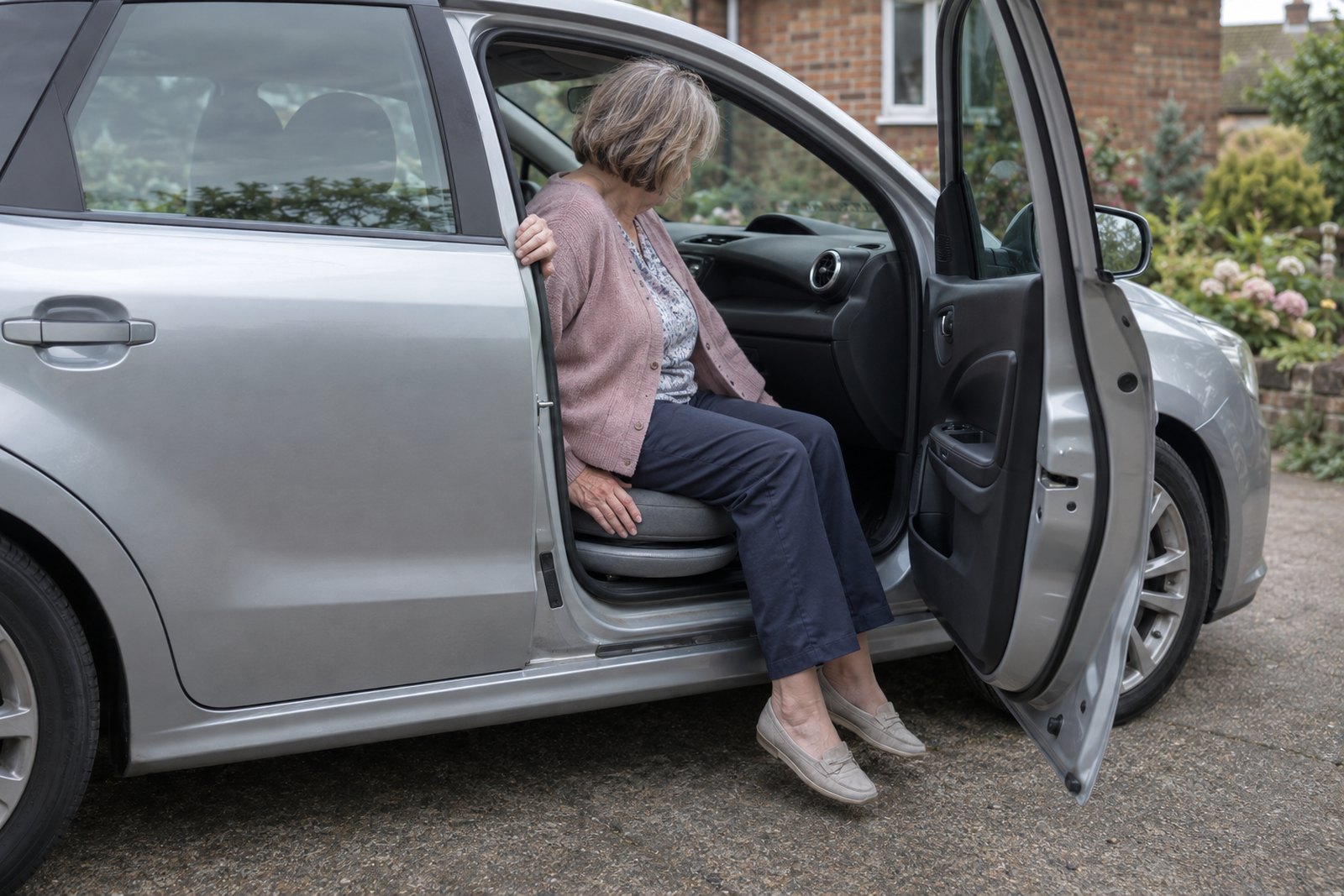
If getting in and out of a car has become a struggle, the answer is usually technique first and equipment second. Most people still try to step in one leg first, the way they always have, and end up balanced on one foot, folded in half, twisting and grabbing at the door. The easier way is to sit down backwards onto the seat, then swing your legs in. Getting out is the same in reverse: legs out, feet flat on the ground, then stand.
Once the method is right, a few simple car transfer aids can make a real difference: a swivel cushion to help you turn, a portable handle that slots into the car's door frame, a leg lifter strap, and for some people a transfer board or a powered swivel seat. This guide covers the technique step by step, what each aid does and who it suits, how to protect a carer's back, and who to see if it still is not working.
Why the car is so much harder than a chair
A car seat is low, the doorway is small and the seat sits further back than where you are standing. Getting in the old way means balancing on one leg, bending at the hip, ducking your head and twisting, all at the same moment. That is a lot to ask of a stiff hip, a sore back, a weak leg or a new joint. It is why people who manage the stairs perfectly well can still dread a trip in the car.
The backwards method takes most of that away. You lower yourself onto the seat the way you would sit in an armchair, and the twist happens once your weight is safely on the seat rather than on one foot.
The technique: getting in
Practise this in daylight, on a dry day, with someone beside you the first few times. The front passenger seat is usually easiest because it slides furthest back and the doorway is wider.
- Park in the right place. Flat ground, with enough room to open the door fully. Think about the kerb. If you stand on a high kerb, the seat ends up lower relative to you, which makes a low car harder. If the car is tall, standing on the kerb can help.
- Set the seat up before you start. Slide it right back and recline the backrest a little so there is more room for your head and body. Clear anything off the seat.
- Back up to the seat. Turn so your back is to the car and walk backwards until you feel the edge of the seat against the back of your legs. If you use a frame or stick, keep it with you until you are in position, then hand it to someone or lean it somewhere it will not fall.
- Find steady handholds. Use fixed parts of the car: the door frame, the back of the seat or the seat edge. Do not hold the door itself, which can swing, and do not lean on the glovebox or a door pocket.
- Duck and sit. Bend your head down as you lower yourself, so you do not catch it on the roof. Sit down gently, then shuffle back as far into the seat as you can.
- Swing your legs in. Turn to face forwards, leaning back slightly, and bring your legs in, together if you can. If one leg will not cooperate, help it with your hands or a leg lifter.
- Get comfortable and belted in. Bring the backrest up to a normal upright position for the journey, move the seat forward only as far as is comfortable, and fasten your seat belt.
The plastic bag trick
Fabric seats grip your clothes, which makes the turn hard work. Sitting on a smooth plastic carrier bag reduces the friction so you slide round instead of fighting the seat. It costs nothing and works surprisingly well.
The catch: pull the bag out from under you once you are facing forwards and before the car moves. A slippery surface under you is the last thing you want if the car brakes sharply. Slip it back under before you turn to get out.
The technique: getting out
- Wait until the car is parked somewhere flat, the engine is off and the handbrake is on before the door is opened.
- Undo your seat belt, slide the seat back and recline it a little if that helps.
- Turn and swing your legs out until both feet are flat on the ground.
- Shuffle forward to the edge of the seat, feet slightly apart and tucked a little under you.
- Lean forward, nose over toes, and push up with one hand on the seat and the other on the door frame. Duck your head as you rise.
- Stand still for a moment before you walk. Many people feel a bit light-headed after sitting, especially after a long journey. Get hold of your walking aid before you step away.
If standing up from the car is the hardest part, it is often the same problem as getting up from a low chair, and the same principles apply: get to the edge, feet back, lean forward, push from your hands.
Swivel seats and swivel cushions
Swivel cushions
A swivel cushion for a car is two flat discs joined in the middle, so the top one turns on the bottom one. You sit on it and it rotates with you as you bring your legs in, rather than you having to twist against the seat. Some are thin and firm, others padded.
They suit people who can sit down and stand up reasonably well but find the turn difficult or painful. A few things to check:
- Height. A cushion raises you. That can make sitting down and standing up easier, but it also reduces headroom, which matters if you are tall or the car is low.
- Sitting centrally. Land in the middle of the cushion. Sitting on the edge can make it tip or slide.
- Whether it stays in for the journey. Read the instructions. Some are designed to stay in place; with others it is sensible to remove it. Also check your car handbook, as some front passenger seats have sensors linked to the airbag, and anything that changes how you sit is worth checking first.
Powered swivel seats and Motability adaptations
A powered swivel seat replaces the car's own seat. It turns out through the doorway and, on some models, lowers down outside the car so you can sit at a comfortable height before being carried back in. They are fitted by specialist vehicle converters, are a significant expense and are not suitable for every car, so get an assessment before committing. If you lease a car through the Motability Scheme, some adaptations may be available as part of your agreement, so check with the scheme directly. For people who stay in their wheelchair to travel, a wheelchair accessible vehicle is a different route altogether.
Car door handle aids
A portable car handle is a small handle with a metal tip that slots into the door striker. That is the U-shaped catch on the car's body, inside the door frame, that the door latches onto when you shut it. It gives you a firm handhold at a sensible height to push up from when standing, or to steady yourself when sitting down.
They can be very useful, but they must be used exactly as designed:
- Check it fits your car's striker before you rely on it. Not every car is compatible.
- Check the weight limit in the instructions and stay within it.
- Use it in the way the instructions describe, usually pushing down on it as you rise, not swinging or hanging your weight off it.
- Always remove it before the door is closed. Never leave it in place, and never use it, while the car is moving.
Leg lifters, grab handles and other small aids
A leg lifter is a long strap with a stiffened loop at the end that goes round your foot. You pull the strap to lift a weak or stiff leg into the car, without bending forward. It is the same aid many people use for getting into bed after hip or knee surgery.
The grab handle above the car door is fine for steadying yourself, but it is not designed for hauling your whole body weight up or in. Add-on handles and straps are also available, some fitting around the head restraint posts. Follow their instructions closely, and avoid anything that attaches to the door itself, which can move as you pull.
Other small things that help: a firm wedge or flat cushion to raise a low seat, a seat belt reacher if twisting round to grab the belt is painful, and a towel over the sill on a muddy day so your legs slide in rather than drag. An occupational therapist can help you work out which of these are worth having; see our equipment and aids page for more on how that works.
Transfer boards for wheelchair users
If you cannot stand to transfer, a transfer board bridges the gap between wheelchair and car seat so you can slide across in a series of small shuffles. It usually means removing the wheelchair's armrest on the car side, lining the chair up close to the seat with the brakes on, and having the car seat as level with the wheelchair as possible. The gap and the height difference in a car are often more awkward than at home, so this is worth learning with a professional first. Our guide to transfer boards covers the technique in more detail. Getting the wheelchair into the car afterwards is its own problem, and there are hoists and storage systems designed for exactly that.
After a hip replacement
The car is one of the things people worry about most after hip surgery. Many hospital teams give specific advice, such as travelling in the front passenger seat pushed right back, using a firm cushion to raise the seat height, using the backwards method with the operated leg kept out in front, and keeping early journeys short. Precautions vary between surgeons and hospitals, and some people are given fewer restrictions than others, so follow what your own team told you.
Do not drive until your surgical team says you can and you could safely do an emergency stop. It is also wise to check with your insurer. There is more on this in our guide to life after a hip replacement.
Protecting a carer's back
Car transfers are a common way for family carers to hurt themselves. The space is cramped, you are bending and twisting, and it is tempting to just take the weight. Some ground rules:
- Do not lift the person. Guide, prompt and steady, but let them do the work, even if it takes longer.
- Do not let them put their arms round your neck. If they wobble, you both go.
- Get close, keep your feet apart and turn by moving your feet rather than twisting your back.
- Set the car up first: seat back, door fully open, bag in place, walking aid within reach.
- Give clear, simple instructions one step at a time, and agree what you will say before you move.
If you find you are taking more and more of their weight, that is the signal to get things reviewed, not to try harder. Our guide to safe moving and handling for family carers goes into this properly.
Where an occupational therapist fits
An occupational therapist looks at how you manage everyday tasks and what would make them easier and safer. For car transfers, a private occupational therapist visiting at home can watch you get in and out of your own car, on your own driveway or street, teach the technique, suggest which aids are worth trying, and show a family carer how to help without hurting themselves. They can also look at the bigger picture, such as getting from the front door to the car safely.
Some situations need someone else:
- Driving Mobility centres are a network of accredited centres across the UK that assess drivers and passengers in real vehicles. They are the right place for advice on driving with a disability, hand controls and other driver adaptations, powered swivel seats, wheelchair accessible vehicles and stowing a wheelchair. Some assessments are charged for and referral routes vary, so check with your nearest centre.
- A physiotherapist leads on strength, balance and joint movement if weakness or stiffness is the root problem.
- Your GP should know if things are getting steadily harder, or if you feel dizzy or faint when you stand.
- The DVLA needs to know about some medical conditions if you drive. Check the rules on GOV.UK.
If getting in or out of the car suddenly becomes much harder because of new weakness on one side, a drooping face or slurred speech, call 999. Those can be signs of a stroke.
Frequently asked questions
Is the front or back seat easier to get into?
For most people, the front passenger seat. It usually slides further back, the doorway is wider and there is more legroom. Rear doors on some cars are narrow and the seat cannot be moved, which makes the backwards method harder.
Can I use a swivel cushion on the driver's seat?
Be cautious. Anything that changes your height or lets you move on the seat can affect your driving position, your reach to the pedals and how the seat belt sits. Unless the manufacturer clearly states it is designed to stay in place while you drive, remove it before you set off, and if you need help to get in as a driver, a Driving Mobility centre can advise on safer options.
Are car door handle aids safe?
They are when they fit your car and are used as designed: slotted into the door striker, used within the weight limit, and removed before the door closes. Never use one while the car is moving, and do not use one on a car it does not fit properly.
Can I get a swivel seat on the NHS?
Generally, no. NHS and council equipment services mostly provide equipment for use in the home. Car aids are usually bought privately, and larger adaptations may be available through the Motability Scheme if you lease a car that way. Some people may be eligible for VAT relief on certain adaptations, so check GOV.UK before buying.
What should I do if someone gets stuck in the car?
Stay calm and do not try to haul them out. Recline the seat, slide it back, give them a rest, then try again one step at a time. If they are unwell, hurt or cannot be moved safely, call 999.
Should I tell the DVLA if getting in the car is difficult?
Difficulty getting in and out is not in itself something you report. But if you drive and have a medical condition that could affect your driving, you may have to tell the DVLA. Check the guidance on driving with a medical condition on GOV.UK, and ask your GP if you are unsure.
Next steps
If car transfers are getting harder, an assessment of how you manage now is usually the quickest way to find what will actually help. See our equipment and aids or home assessment pages, or current guide prices, and choose your area below.

Talk to an occupational therapist near you
This guide is general information. For advice about your own situation - or someone you look after - a local occupational therapist can visit you at home and see it for themselves.
Choose your area: