

Hip Dysplasia in Babies: Pavlik Harness and Spica Cast Care
By Mobile Occupational Therapist • 28 October 2026 • 13 min read
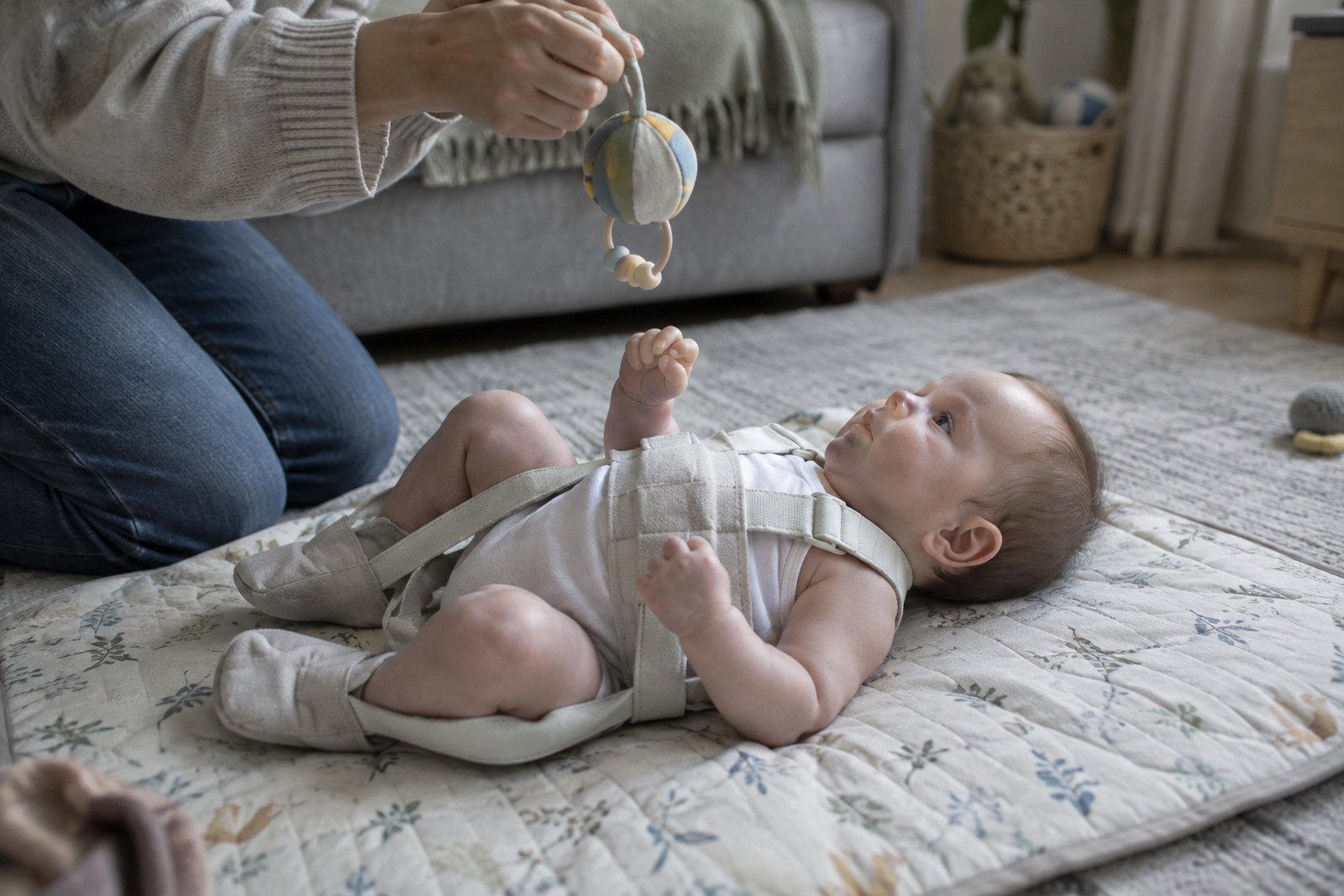
Hip dysplasia in babies, usually called developmental dysplasia of the hip or DDH, means the ball at the top of the thigh bone does not sit snugly in the socket of the pelvis. The socket may be too shallow, or the joint may be loose, so the ball can slip partly or fully out. It is usually not caused by anything you did. DDH often does not cause pain in a young baby, and when it is found early it often responds well to treatment.
Treatment for babies usually starts with a Pavlik harness, a soft fabric harness that holds the legs bent up and out so the hip can settle into the socket and grow properly. If that does not work, or the hip is found later, a baby may have a procedure under anaesthetic followed by a spica cast, a hard cast from the chest or waist down over the legs. Both are hard work for parents. This guide covers how DDH is picked up, and the practical side of nappies, washing, clothes, sleep, car seats and comfort, plus the warning signs that mean you should call the hospital team.
What DDH actually is
The hip is a ball and socket joint. In a baby it is still partly soft and still shaping itself. For the socket to deepen and form well, the ball needs to sit centrally inside it. In DDH it does not, so the socket can stay shallow and the joint unstable.
It ranges from mild looseness, which sometimes settles on its own, to a hip that is fully dislocated. It can affect one hip or both. Without treatment, DDH can lead to a limp, uneven leg lengths and early arthritis later in life, which is why it is screened for and taken seriously.
How hip dysplasia is picked up
The newborn and 6 to 8 week checks
In England, every baby is offered a physical examination within 72 hours of birth and again at around 6 to 8 weeks, usually by your GP. Part of this is a gentle hip check, moving the legs to check for any hip instability, such as a hip that feels like it is slipping in or out of the socket.
Ultrasound scans
Babies with certain risk factors are usually offered a hip ultrasound in the first few weeks even if the examination is normal. Common reasons include being breech late in pregnancy or at birth, and a close family history of hip problems in early childhood. A scan may also be arranged if the examination raises a concern. Ultrasound works well in young babies because their hips are mostly cartilage, which does not show on an X-ray. Older babies may have an X-ray instead.
Signs to mention at any age
Some cases are found later. Mention it to your GP or health visitor if you notice one leg looks shorter, the skin creases on the thighs or bottom look uneven, one leg does not open out as far when you change a nappy, or later, a limp or an unusual way of crawling or walking. These signs do not always mean DDH, but they are worth checking.
Caring for a baby in a Pavlik harness
The first rule is simple: follow your hospital team's instructions, not the internet. Teams differ in how they manage the harness, and they set it up for your baby's hips specifically. Harness treatment usually lasts several weeks to a few months, with regular clinic checks and often repeat scans.
Can the harness come off?
That is the team's decision, not yours. Some teams want it on all the time, day and night, including for nappy changes and washing. Others allow short periods off for a bath. Ask them directly and write the answer down. Do not loosen, tighten or move the straps, even if they look uneven. Many teams mark the strap positions so you can tell if anything has slipped. If it has, call them.
Nappy changing
You can change a nappy with the harness on. Lift the bottom by sliding a hand under it rather than pulling the legs up by the ankles, which works against the position the harness is holding. Some parents find it easier to tuck the nappy under the leg straps rather than over them, but check what your team prefers. Keep the nappy area clean and dry, and check the creases in the groin each time.
Washing
If the harness must stay on, you will be top and tail washing: a warm, damp cloth for the face, neck, folds and bottom, drying the skin carefully, especially in creases. Avoid lotions and powders under the straps unless the team has suggested something, as they can make the skin soggy or sore. If the harness gets badly soiled, ask the team about cleaning it or whether a spare is available.
Clothes
Most teams suggest a thin vest or bodysuit under the harness so the straps do not rub, with the leg straps over it. On top, clothes a size or two up are usually easiest. Loose dresses, gowns, wide sleepsuits with the feet cut off, and leg warmers or socks for warmth all work well. Avoid anything that squeezes the legs together.
Sleep
Put your baby to sleep on their back, as for any baby, in a clear cot with no pillows or padding around them. The harness should not change safe sleep advice. Use a lightweight blanket tucked in no higher than the shoulders, or a sleeping bag that fits securely around the neck and arms but still leaves enough room for the legs to stay apart. A fitted, narrow sleeping bag is not suitable. Our guide to safe sleeping spaces for disabled children has more on this.
Feeding and car seats
Feeding usually works fine with a little rearranging. Rugby-ball style holds can help with breastfeeding. Most babies in a harness fit into a normal rear-facing car seat, but check the legs are not forced together and ask the team if you are unsure.
Caring for a baby in a spica cast
A spica cast is heavier, stiffer and more demanding than a harness. It holds the hips in a set position while they heal, usually for a number of weeks, sometimes with a cast change partway through. The hospital will usually show you how to manage it before you go home. If they have not, ask for that before discharge.
Nappies and keeping the cast clean
This is the part parents worry about most, and with reason. A wet or soiled cast can make the skin sore and smell. A common method is a smaller nappy tucked carefully under the edges of the cast around the opening, with a larger nappy over the top to hold it in. Change nappies more often than usual, including during the night if the team suggests it. Some casts have a waterproof lining around the nappy area. Your team will tell you which method suits the cast your baby has.
Never push anything down inside the cast to scratch an itch or tidy up, and do not trim or pull at the padding. Keep the cast dry. That means sponge washing only, no baths. Wipe the outside of the cast with a barely damp cloth if needed.
Skin checks
Check the skin around every edge of the cast at least twice a day, using a torch if it helps: the chest or tummy edge, the groin, the back, and around the ankles and feet. Look for redness that does not fade, rubbing, blisters or broken skin. Run a finger gently around the edges to feel for crumbs, food or small toys, which find their way in surprisingly often.
Positioning
Babies in a spica cannot shift themselves, so change their position every few hours while awake: on their back, propped up a little with pillows behind, or lying on their tummy over a pillow so they can look around and play. Only use tummy time and propping when you are watching. For sleep, follow the team's advice on position and how to support the cast safely.
Car seats
A standard car seat may not fit a baby in a spica cast, because the legs are spread and fixed. Ask the hospital about this before the cast goes on if you can. Some hospitals or charities have loan seats designed for spica casts, or a team member who can check what your baby will travel in. Do not wedge a baby into a seat that does not fit, or remove padding or harness parts to make it work. Our guide to car seats for disabled children covers the wider picture.
Buggies, high chairs and carrying
Some pushchairs with a wide, flat or deeply reclining seat can take a spica cast, others cannot. Try before you rely on one, and ask the hospital whether they can lend or suggest something. A low, wide high chair or a supportive floor seat may work for feeds. Again, ask the team whether yours is suitable. Special needs pushchairs and buggies explains the options.
When you lift your baby, support the cast and the body together, never by the bar between the legs if there is one. Hold them close to your own body. A baby in a cast is heavier than you expect, and parents' backs suffer. Bend your knees, avoid twisting, and share lifting where you can.
Keeping your baby comfortable and playing
Babies in a harness or cast still need play, faces and things to look at. Treatment does not stop development, though some babies are slower to roll, sit or crawl while treated and catch up afterwards. Ideas that work well:
- Toys hung within reach when they lie on their back, so they reach and bat with both hands.
- Supervised tummy time, over a rolled towel or pillow if the cast makes lying flat awkward.
- Sitting propped facing you for songs, books and talking.
- Different textures to touch with hands, and water play on a tray kept well away from the cast so the cast stays completely dry.
- Lots of changes of scene, room to room, garden, window.
Our guide to sensory play for babies at home has more simple ideas. If your baby seems uncomfortable, unsettled or in pain beyond normal fussiness, contact the team rather than guessing at the cause.
Hip-healthy swaddling and carrying
Once treatment has finished, and for babies in general, it helps the hips to let the legs bend up and out freely. If you swaddle, wrap the upper body only, or leave the legs loose so they can bend at the hips and knees. Tight swaddling with the legs held straight and together is linked to hip problems.
With slings and carriers, look for ones that support the thighs from knee to knee, with the knees slightly higher than the bottom, in an M shape. Narrow-based carriers that leave the legs dangling straight down are less hip friendly. Ask your team when it is safe to use a carrier, especially just after a harness or cast comes off.
Warning signs: when to contact the team
Your hospital should give you a contact number. Contact them promptly if you notice:
- Red, sore, blistered or broken skin under the straps or around the cast.
- A cast that seems too tight, has cracked, gone soft or got wet inside.
- Swelling of the feet or toes.
- Toes that look pale, blue or dusky, feel cold, or do not pink up quickly when gently pressed.
- A bad smell or discharge from the cast.
- A baby in a harness who stops kicking or moving one or both legs.
- Constant crying you cannot settle.
Fever needs a quick response. A baby under 3 months with a temperature of 38C or higher needs urgent same day medical advice: call NHS 111 or get an urgent GP assessment (go to A&E if you cannot get urgent advice), and also contact the hospital team. If your baby is floppy, struggling to breathe, has a rash that does not fade when pressed, or you are frightened, call 999.
Where an occupational therapist fits
Let us be honest about this: the hospital orthopaedic team leads DDH treatment. Surgeons, nurses, plaster technicians and physiotherapists set up and monitor the harness or cast, and many families need nothing more. Physiotherapists often help with movement and walking after treatment ends.
Some hospitals have occupational therapists who advise on spica seating and equipment. Where that is not available, or you are struggling at home, a private occupational therapist visiting at home can help with practical problems: seating for feeds and play, positioning, adapting your routine and space so you are not lifting awkwardly, and finding suitable equipment types. After treatment, a paediatric occupational therapist can also look at play and development if your child seems slow to catch up with everyday skills. See our page on paediatric occupational therapy. An OT does not decide anything about the harness or cast itself. That stays with the hospital.
Frequently asked questions
Does a Pavlik harness hurt my baby?
Most babies settle into a harness within a few days and do not seem bothered by it. There can be some grumpiness at first while they get used to the new position. If your baby seems in pain or stops moving their legs, contact the team.
Can I take the Pavlik harness off for a bath?
Only if your hospital team has told you that you can. Some teams allow it, many do not. Never remove or adjust it without their say so.
Will my baby walk late because of DDH treatment?
Some babies are a little slower with milestones like sitting, crawling or walking during and after treatment, then catch up. Ask the team what to expect, and mention it to your health visitor or GP if your child still seems behind well after treatment ends.
How do I stop a spica cast smelling?
Frequent nappy changes, careful tucking of the inner nappy, keeping the cast dry and checking the edges for food or crumbs all help. A strong smell can also mean a skin problem underneath, so tell the team.
Can my baby go in a normal car seat in a spica cast?
Often not. Ask the hospital before the cast goes on about loan seats or which seats fit. Do not force a baby into a seat or alter a seat to make it fit.
Did I cause my baby's hip dysplasia?
No. DDH is linked to things like family history and position in the womb. Tight swaddling with straight legs can add risk, but you are not to blame for your baby's hips.
Next steps
If you would like practical help at home with seating, positioning or equipment during or after treatment, see our paediatric occupational therapy page or equipment and aids, check current guide prices, and choose your area below.

Talk to an occupational therapist near you
This guide is general information. For advice about your own situation - or someone you look after - a local occupational therapist can visit you at home and see it for themselves.
Choose your area: