

Special Needs Pushchairs and Buggies: What Parents Need to Know
By Mobile Occupational Therapist • 18 October 2026 • 14 min read
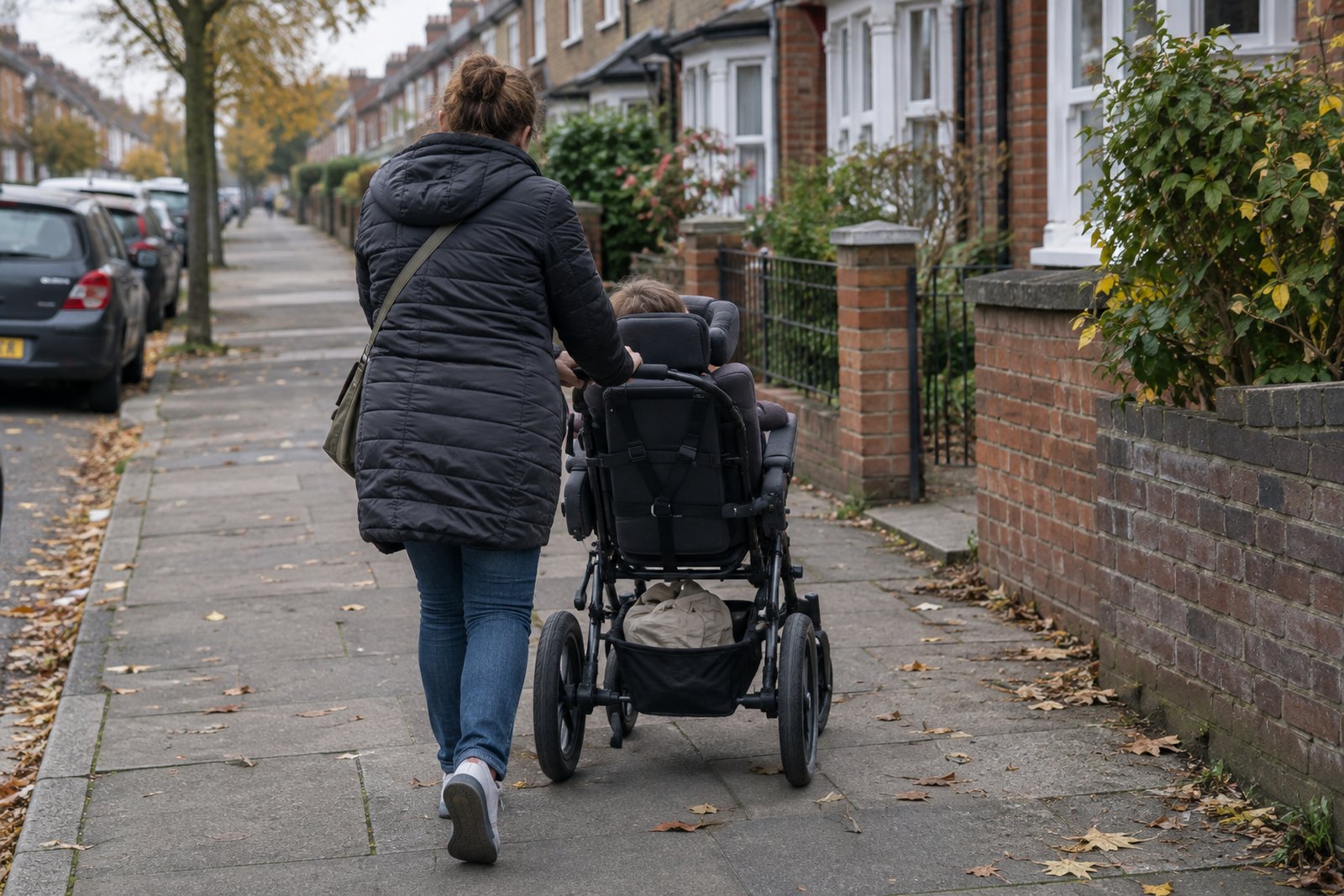
A special needs pushchair, often called a special needs buggy, is built for a child who has outgrown an ordinary pushchair or who needs more support to sit safely than a standard seat can give. They take heavier weights and have longer seats and higher backs. Many also have side supports, adjustable footplates, proper harnesses and a tilt so your child can rest. In the UK they are often provided free through the NHS wheelchair service, because a buggy can count as a child's wheelchair provision.
If your child is getting too big for their pushchair, slumps or slides down in it, can only walk short distances, or is simply not safe out of it, you are asking the right question. The usual route is a referral to your local wheelchair service from a health professional such as your GP, paediatrician, or your child's physiotherapist or occupational therapist. If the NHS cannot help, or you need something different, charities may help with the cost. This guide covers how to tell when a standard pushchair has stopped working, the main types, how families usually get one, and what to think about before you commit.
When a standard pushchair stops working
Most parents do not decide this on a particular day. It creeps up. The pushchair gets a bit tighter, the outings get a bit harder, and one day you realise you have been wedging rolled-up towels down the sides for months. These are the usual signs.
Size
Your child's legs hang well over the edge with nothing to rest their feet on. Their head is level with or above the top of the backrest. They are close to, or over, the maximum weight on the label or in the instructions. Ordinary pushchairs are designed and tested for younger children, and using one beyond its weight limit puts strain on the frame, the brakes and the harness.
Posture
Your child leans to one side, slides down so they are almost lying on their back, or their head flops forward or sideways. They may get uncomfortable or upset after a short time sitting. If you find yourself propping them up with cushions, towels or coats, that is a strong sign they need a seat that actually supports them. Talk to your child's physiotherapist, or your GP if they do not have one, about it.
Behaviour and safety
Not every child who needs a special needs buggy has a physical disability. Some children can walk perfectly well but have no sense of danger, run into roads, drop to the floor in shops, or become overwhelmed in busy places. Others have conditions that leave them exhausted after short walks. For these families a buggy can be the difference between getting out of the house and not. Whether the NHS will provide a buggy for this reason varies by area, because some wheelchair services focus mainly on physical mobility and posture, so ask your local service directly.
Your own body
Lifting a heavy child in and out of a low pushchair, folding it with one hand while holding them with the other, and pushing a frame that was never meant for their weight all add up. Back pain in parent carers is common and easy to dismiss. It counts as a reason to look at the equipment.
The main types of special needs buggy
The names vary between suppliers, but most fall into three broad groups.
Larger lightweight buggies
These look much like an ordinary folding buggy, only bigger and stronger. They suit children who sit reasonably well on their own but cannot walk far, tire easily, or need to be contained for safety. They are usually the lightest and easiest to fold, which matters if you use public transport or have a small boot. The trade-off is limited support: there is not much adjustment and little or no help for a child who slumps.
Postural support pushchairs
These have a more structured seat that can be adjusted to fit your child closely. Depending on the model, you may be able to change the seat depth, back height and width, and add side supports for the trunk, a head support, a pelvic positioning belt, a chest harness, a knee block or a pommel between the knees, and footplates that adjust for height and angle. They are heavier and bulkier, but for a child with low tone, high tone or poor trunk control they can make sitting comfortable and safe for far longer.
Tilt-in-space and recline
These two words are often used as if they mean the same thing. They do not.
- Tilt-in-space tips the whole seat backwards while keeping the angle between your child's back and thighs the same. This lets them rest, takes weight off their bottom and can help with head control, without changing their sitting position.
- Recline opens the angle between the back and the seat, so your child lies back more. This can be useful for a nap, but some children slide down or lose their position when reclined.
Some buggies offer one, some both. Which suits your child is a question for whoever does the seating assessment.
Other features to notice
Some systems have a seat unit that lifts off the frame and can sit on a different base indoors. Some face forward only, others can face you, which can matter for a child who is anxious or needs to see your face. Wheels range from small hard ones that fold neatly to larger air-filled or all-terrain tyres that cope better with grass, gravel and broken pavements. Think honestly about where you actually go.
How special needs buggies are usually provided
The NHS wheelchair service
For many families, the first stop is the NHS wheelchair service. A special needs buggy can be provided as your child's wheelchair provision, so you do not need to wait until your child is ready for a wheelchair to ask. A health professional usually makes the referral. The service will then assess your child and, if they meet local criteria, prescribe and supply a buggy, usually on loan, with repairs and reviews as your child grows. There is more on the referral and assessment process in our guide to NHS wheelchair services.
A few things are worth asking at the start:
- What the local eligibility criteria are, and whether safety or behaviour counts as well as physical need.
- Roughly how long the wait is for assessment and for delivery.
- How a buggy now affects getting a wheelchair later, as some services provide one main mobility item at a time.
- In England, whether a personal wheelchair budget is available, which may let you put the value of the NHS option towards a different model that suits your family better. Your local service can explain how this works where you live.
Your child's physiotherapist and occupational therapist
If your child already sees an NHS physiotherapist or occupational therapist, they can often refer to the wheelchair service and share what they know about your child's posture and daily life. Physiotherapists usually lead on posture and positioning. Occupational therapists tend to look at the wider picture: getting in and out, how the buggy fits into the day, school, feeding, sleep and the home. Both can help you explain your child's needs in a way the wheelchair service will act on.
Charities and other help with costs
If the NHS will not provide a buggy, or the one offered does not suit your family, charities may help. Family Fund gives grants to families on lower incomes who are raising a disabled or seriously ill child. Newlife provides specialist equipment for disabled children. Whizz-Kidz focuses on wheelchairs and mobility for young people. Contact, the charity for families with disabled children, runs a helpline and can point you to other grants, including smaller local trusts. What each charity funds and who qualifies changes over time, so check their websites before you apply.
Two other routes are worth knowing about. If your child gets the mobility component of Disability Living Allowance (or Child Disability Payment in Scotland), you can choose to spend it on mobility equipment. And equipment designed for disabled people, bought for their personal use, may be sold without VAT. Check the current rules for both on GOV.UK.
Try before you buy
A special needs buggy is a big purchase and an even bigger daily commitment. If at all possible, try one in the places you actually use it, not just in a showroom or clinic.
- Fold it yourself. Can you do it with one hand while your other hand holds your child? Can whoever else pushes it do it too?
- Lift it. Check the weight of the frame and of the seat unit separately. Lift it into your own boot, not a demonstration car.
- Measure your home. Front door, hallway, any steps or tight turns, and where it will live when it is not in use.
- Check the handle height for everyone who pushes it.
- Watch your child get in and out. Is the seat height workable for lifting, or for them to climb in if they can?
- Ask about growth. How much adjustment is left once it is set up for your child now?
- Ask about servicing and spare parts before you pay, not after something breaks.
Second-hand buggies can be good value, particularly simpler larger buggies. Postural support models are different. They were set up for another child, and a seat that fits badly can do more harm than good. If you buy one, have it checked and adjusted by someone qualified to do so.
Getting it in the car
For most families, your child travels in a suitable car seat and the buggy goes in the boot. If your child needs more support than a standard car seat gives, there are specialist car seats and harnesses, covered in our guide to car seats for disabled children.
Do not let your child travel sitting in the buggy in a moving vehicle unless the manufacturer confirms it has been crash-tested for that use and it is secured with the correct tie-downs and restraint. Most buggies are not. Make sure the folded buggy is secured in the boot too, so it cannot move in a sudden stop. If lifting the buggy and your child into the car is becoming unmanageable, that is worth raising with your child's therapists, as it affects what equipment will work long term.
Accessories that make a real difference
- Rain cover. Get one made for your model. Universal covers often leave gaps or rest on your child's face.
- Sun canopy or parasol. Many larger buggies come with small hoods that do not shade an older child.
- Footmuff or cosy toes for winter, especially for children who do not move much and get cold.
- Harnesses and belts. A five-point harness keeps your child in. A pelvic positioning belt holds their hips in the right place. A chest harness helps with trunk support. Use them every time, and have postural belts and supports set by your child's therapist or the wheelchair service.
- Tray for snacks, toys or a tablet, if your child can use one safely.
- Under-seat basket for shopping. Avoid hanging heavy bags on the handles, as a buggy can tip backwards, especially when your child gets out.
- Puncture-resistant tyres if you use air-filled wheels and cannot face a flat on the school run.
Seating assessment: what it is and why it matters
A seating assessment is how the wheelchair service works out what your child needs. The clinicians, often therapists and sometimes rehabilitation engineers, will look at how your child sits, their hips, pelvis and spine, their head control, their feet, and their skin if they sit for long periods. They will also ask about daily life: how long your child sits each day, how you get about, school, transport and home.
It helps to bring a short list of the problems you have, photos or a short video of your child in their current pushchair (especially if they slump later in the day), measurements of your boot and front door, and any letters from your child's other professionals. Be specific. "She slides down within ten minutes and I have to stop and lift her back" is more useful than "she isn't comfortable".
Growing out of it and moving to a wheelchair
A buggy does not have to be forever. Children move on when they reach the weight or size limit, when they need more support than the buggy can give, or when they are ready for more independence. Some children can learn to push themselves in a manual wheelchair. Some do well with a powered chair, and children can be assessed for one at a young age. Our guide to electric wheelchairs explains how that works.
Plenty of parents have mixed feelings about the move. A buggy can feel like a pushchair, and a wheelchair can feel like a label. That is normal. It can also help to remember that the right chair often gives a child more control over where they go, which is the point. Raise it at your child's wheelchair reviews rather than waiting for the buggy to fail.
Where an occupational therapist fits
To be honest about roles: the NHS wheelchair service assesses for and supplies the buggy, and your child's physiotherapist usually leads on posture. An occupational therapist does not replace either of them.
Where an occupational therapist helps is the rest of the day. That might mean looking at how your child gets in and out of the buggy and the car, how you manage the front step, where equipment is stored, how the buggy fits with feeding, toileting and school, and how sensory or behavioural needs affect trips out. A private occupational therapist visiting at home can write a report describing your child's needs, which may support a charity application, a request to the wheelchair service or an EHCP. They cannot order NHS equipment, and complex postural seating is specialist work, so a good therapist will tell you when someone else should lead. See our children's occupational therapy page for more.
If your child's posture is changing quickly, they seem to be in pain when sitting, they are losing skills they had, or you notice new weakness, see your GP promptly rather than waiting for a seating review. If your child has difficulty breathing or is suddenly very unwell, call 999.
Frequently asked questions
Can I get a special needs buggy on the NHS?
Often, yes. The NHS wheelchair service can provide a buggy as a child's wheelchair provision if they meet local criteria. Ask a health professional to refer you, and ask the service what their criteria and waiting times are.
Is a special needs buggy the same as a wheelchair?
Not quite. A buggy is pushed by an adult and usually folds more like a pushchair. A wheelchair may be pushed by the child, by an adult, or powered. But wheelchair services often treat a buggy as the child's wheelchair, which can affect what else they provide at the same time.
My child can walk. Can they still have a special needs pushchair?
Possibly. Children who tire quickly, have no sense of danger or cannot manage busy places may need one. Whether the NHS provides it for those reasons depends on your local service. If not, charities may be able to help.
Who can refer my child to the wheelchair service?
Usually a health professional, such as your GP, paediatrician, or your child's physiotherapist or occupational therapist. Some services accept other routes, so check with your local service.
Can my child stay in the buggy on school transport?
Only if the manufacturer confirms the buggy is crash-tested for travel and it is secured properly in a suitable vehicle. In most cases your child should transfer to a proper seat. Talk to the council's school transport team about your child's needs.
Should I buy a second-hand special needs buggy?
A simple larger buggy bought second-hand can be fine if it is in good condition. For a postural support buggy, have it checked and set up for your child by someone qualified, and make sure spare parts are still available.
Next steps
If you want help working out what your child needs day to day, or a report to support an application, see our equipment and aids page, or current guide prices, and choose your area below.

Talk to an occupational therapist near you
This guide is general information. For advice about your own situation - or someone you look after - a local occupational therapist can visit you at home and see it for themselves.
Choose your area: