

Baby Sensory Ideas at Home: Simple Sensory Play by Age
By Mobile Occupational Therapist • 17 October 2026 • 13 min read
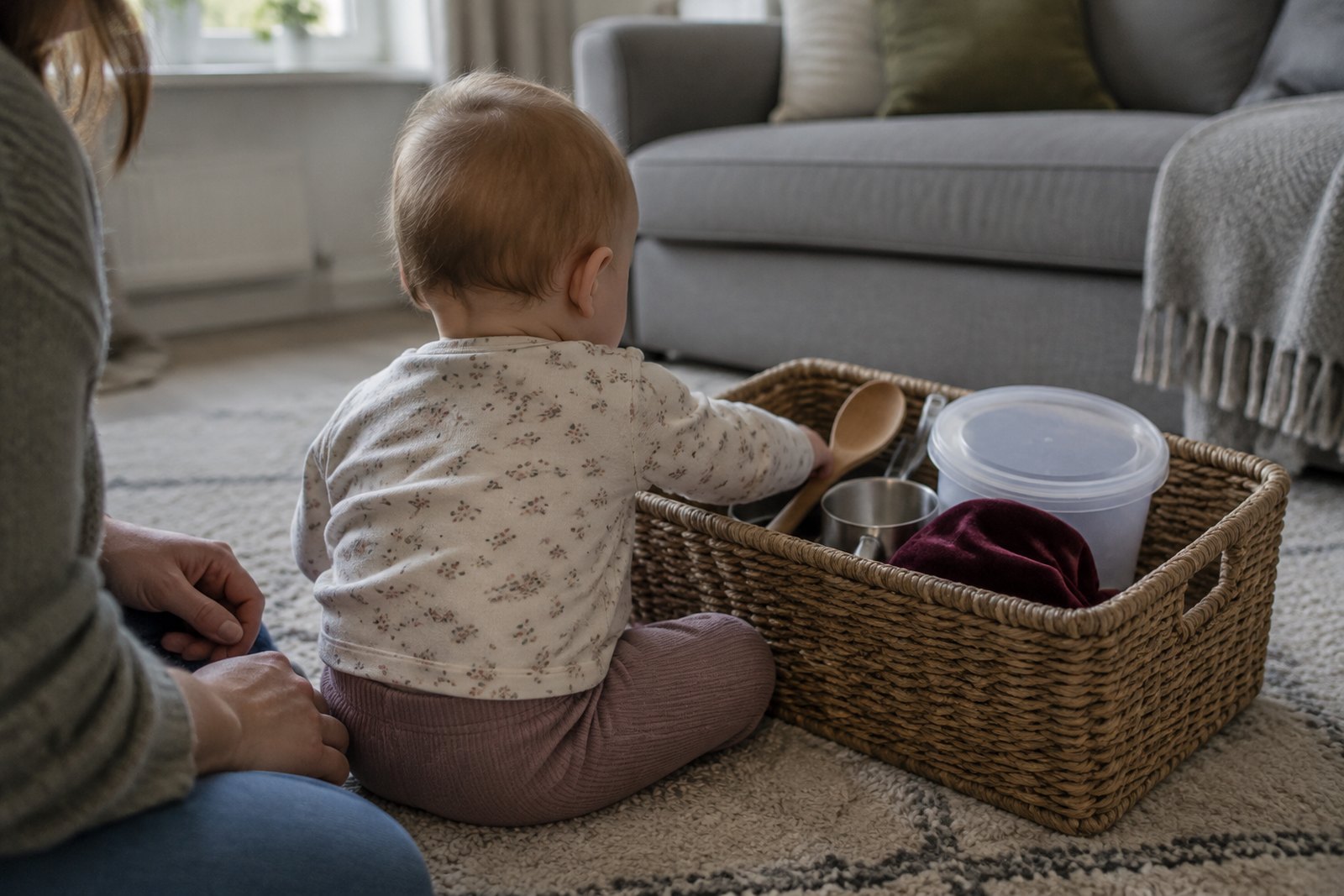
Sensory play for babies just means giving your baby things to look at, listen to, touch, mouth and move with, and letting them explore at their own pace. You do not need to buy anything or sign up for anything. Your face, your voice, a wooden spoon, a bit of fabric and a bath are enough. A baby's brain learns by taking in the world through the senses, and ordinary family life already does most of the work.
This article covers what sensory play actually does, simple ideas you can try at home by age from newborn to around 12 months, the safety rules that matter most, how to tell when your baby has had enough, and when it is worth a word with your health visitor. It is about sensory play in general, not about any particular class or company.
What sensory play actually does
Babies are not born knowing what things are. They find out. A rattle is hard, cold, noisy and tastes of plastic. Your jumper is soft and smells of you. Being lifted makes their tummy swoop. Each of these experiences helps the brain sort out information from the eyes, ears, skin, mouth, muscles and the balance system in the inner ear.
There are more senses than the five you learned at school. Body awareness (knowing where your arms and legs are without looking) and balance are two big ones for babies, and they develop through being held, rocked, rolled and given time on the floor. If you want the fuller picture, our guide to the 8 sensory systems explains each one in plain terms.
Sensory play also does something less obvious: it is a way of being together. A baby who is calm and close to a familiar adult is in the best state to learn. That is why the most valuable sensory experience for a young baby is usually a person, not a toy.
Newborn to 3 months: faces, voices and contrast
Newborns can see, but not far and not sharply. They focus best on things fairly close to their face, roughly the distance from your arms to your face when feeding. Strong contrasts like black and white are easier for them to pick out than soft pastels.
- Your face. Hold your baby close and let them look at you. Pull slow expressions. Stick your tongue out and wait. Some babies will try to copy you, given time.
- High-contrast pictures. Draw thick black shapes, stripes or a simple face on white card and prop it at the side of the changing mat or play mat. Swap it every few days.
- Talking and singing. Narrate what you are doing. Sing the same few songs over and over. Repetition is a feature, not a flaw, for babies.
- Touch. Skin-to-skin contact, gentle stroking of arms and legs during changes, and being held against different fabrics all count.
- Gentle movement. Rocking, swaying and walking round the house while holding your baby give the balance system something to work with.
Tummy time, awake and supervised
The NHS advises that babies always sleep on their backs. Tummy time is different: it is for when your baby is awake and you are right there watching. It helps build the neck, shoulder and back strength needed later for rolling, sitting and crawling, and it shows your baby the world from a new angle.
Start with very short spells, a minute or two, a few times a day. Lying your baby on your chest while you recline counts. If they protest, that is common. Try getting down on the floor at their eye level, putting a high-contrast card or an unbreakable baby mirror in front of them, or doing it after a nappy change rather than straight after a feed. Never leave a baby on their tummy if you are going to fall asleep or leave the room. If you start to feel sleepy while your baby is on your chest, especially on a sofa or armchair, put them down on their back in their own cot or Moses basket.
3 to 6 months: reaching, grabbing and mouthing
Around this stage many babies start reaching for things, bringing their hands together and putting everything in their mouth. Mouthing is how babies explore. It is normal and useful, which is exactly why safety matters so much from here on.
- Different textures. Offer large, safe things to hold: a soft cloth, a crinkly fabric toy, a silicone teether, a wooden ring that is too big to fit in the mouth.
- Sounds they can make. A rattle, or a sealed plastic bottle with a few large dried items inside and the lid glued shut. Show them that shaking it makes a noise.
- Kicking and feeling. Let your baby kick against your hands, or lie on a play mat with bare feet so they can feel the floor.
- Gentle wind and light. Sitting by a window to watch leaves move, or feeling a breeze in the garden, is sensory play too.
- Mirror play. An unbreakable baby mirror on the floor during tummy time keeps many babies interested for longer.
6 to 9 months: sitting, exploring and messy play
Once your baby can sit with some support and is starting solid food, the options open up. Many babies at this stage love banging things together, dropping things and watching what happens.
Treasure baskets
A treasure basket is simply a low, sturdy basket or box filled with everyday objects of different materials for your baby to explore while sitting. The point is variety: heavy and light, cold and warm, rough and smooth, noisy and quiet. Sit nearby, let your baby choose, and resist the urge to direct.
Safe ideas include:
- a wooden spoon
- a small metal saucepan or metal measuring cups
- a large, clean lidded plastic container
- a large square of fabric with no loose threads, such as velvet, cotton or a knitted square
- a large, firm ball too big to fit in the mouth
- a chunky wooden or silicone ring
Check every item each time for cracks, splinters, peeling paint, loose parts or anything that has started to come apart. Avoid anything small enough to swallow, anything with a cord or string, glass, and natural items that can break into pieces.
Messy and food play
Once your baby is eating solids, mealtimes are sensory play whether you plan it or not. Letting them squish, smear and drop food is part of learning to eat. You can also offer a tray with a little plain yoghurt, mashed banana or cooked, cooled pasta to explore. Because anything you use will go in their mouth, only use food that is safe for your baby to eat at their age, prepared as you would for a meal. Our article on messy play and sensory bins has ideas for when your child is older, and advice if they hate getting messy.
Water play, with you right there
Bath time is the best water play there is: splashing, pouring from a cup, squeezing a cloth. A shallow tray of water on the kitchen floor with a cup and a spoon works too.
Babies can drown in a very small amount of water, quickly and without making a noise. Stay within arm's reach the whole time, with your eyes on your baby. If the doorbell or phone rings, take the baby with you or ignore it. Do not rely on a bath seat to keep them safe, and do not leave an older child in charge. Tip water out as soon as you have finished.
9 to 12 months: moving, pulling and cause and effect
As babies start crawling, pulling up and cruising, they get much of their sensory input from moving their own bodies. The most useful thing you can give them is safe floor space.
- Different surfaces. Let them crawl over carpet, a blanket, a rug and grass (checked first for anything they could pick up).
- Cushion mountains. Sofa cushions on the floor to crawl over and around build strength and balance. Stay close.
- Put in, take out. A large container and a few big objects to drop in and tip out. Endless fun, apparently.
- Cause and effect. Pots and a wooden spoon for drumming, a lid that bangs, a ball that rolls away when pushed.
- Songs with actions. Bouncing on your knee, rhymes with tickles and peekaboo all combine sound, touch and movement.
For more on how movement develops at this age and beyond, see our guide to gross motor skills and milestones.
Safety rules that matter most
Most sensory play ideas are harmless. A few hazards are serious enough to know by heart.
- Choking. A common rule of thumb is that anything small enough to fit inside a toilet roll tube is a choking risk for a baby. That includes coins, bottle tops, marbles, dried pulses, small bits of broken toys and pen lids. Learn baby choking first aid; the NHS has a clear guide.
- Button batteries. The small, flat, round batteries in remote controls, car keys, musical cards and some toys can cause severe internal burns very quickly if swallowed. Keep them and anything containing them well away. If you think your baby may have swallowed one, go to A&E straight away or call 999. Do not wait for symptoms.
- Magnets. Small, strong magnets from toys or fridge decorations can attract each other through the gut wall if more than one is swallowed. Treat a suspected swallow as an emergency and go to A&E.
- Water beads. Do not use water beads with babies or young children at all. They are a known swallowing danger because they can expand inside the body. UK safety authorities have warned about them.
- Cords and strings. Blind cords, ribbons, necklaces, long scarves and cords on mobiles or toys can strangle. Keep cots and play areas away from blind cords, and move mobiles out of reach once your baby can grab them.
- Balloons. Uninflated or burst balloons can block a baby's airway. Keep them away.
- Homemade sensory bottles. Glue the lid shut, check for leaks and cracks, and supervise.
Signs your baby has had enough
Babies can only take in so much before it tips from interesting into too much. Overstimulation is not a disaster, but learning your baby's signals helps everyone. Common signs include:
- turning their head or eyes away, or refusing to look at you
- fussing, frowning, then crying that is hard to settle
- arching their back or stiffening
- jerky, flailing arms and legs, or spread-out fingers
- yawning, hiccups or going red
- suddenly falling asleep, which can be a way of shutting the world out
When you see these, take things down a notch. Move somewhere quieter and dimmer, stop talking so much, hold your baby close and let them recover. Busy days with lots of visitors, noise and handling can do this as much as any activity. Less is often more.
When to talk to your health visitor
Every baby develops at their own pace and the range of normal is wide. Your health visitor or GP is the right first contact if you have a worry. Bring your baby's red book. It is worth asking if your baby:
- does not seem to startle at loud noises, or does not turn towards voices and sounds as they get older (even if they passed the newborn hearing screen)
- feels very floppy, like a rag doll, or very stiff and hard to bend
- has ongoing feeding problems, such as struggling to latch or suck, coughing or choking often during feeds, or poor weight gain
- does not seem to look at faces or follow things with their eyes
- uses one side of their body much more than the other
- stops doing something they could do before
- seems to react very strongly and consistently to touch, sound or movement in a way that worries you
If your baby is suddenly floppy, unresponsive, having a fit, struggling to breathe or seems seriously unwell, call 999. If you are worried but it is not an emergency, call NHS 111 or your GP.
Where an occupational therapist fits
Honestly, most babies do not need an occupational therapist. Everyday play, a watchful parent and routine checks with the health visitor cover it. If there is a concern about a baby, the people who usually lead are the health visitor and GP first, then a paediatrician, a physiotherapist for movement and muscle tone, a speech and language therapist for feeding and swallowing difficulties, and audiology for hearing.
Occupational therapists do sometimes work with babies, usually those born very early, babies with a known condition such as cerebral palsy or a genetic syndrome, or babies who need specialist seating, positioning or equipment. They often work as part of an NHS team. A private occupational therapist visiting at home is more often involved once a child is a toddler or older, for example when sensory differences are affecting sleep, eating, dressing or nursery. If that sounds like your older child, our guide to sensory processing difficulties in children is a good next read, and our paediatric occupational therapy page explains what a home visit involves.
Frequently asked questions
Do I need to take my baby to a sensory class?
No. Classes can be a lovely way to get out and meet other parents, and that matters, but your baby will not miss out developmentally without one. Talking, singing, holding, floor time and ordinary household objects give your baby everything they need.
How long should sensory play last?
As long as your baby is interested, which for young babies may be a couple of minutes. Follow their lead. When they look away, fuss or lose interest, stop. Short and often beats long and planned.
Are light-up toys and baby videos good sensory play?
They are not needed. Bright, fast-moving screens and flashing toys can be a lot for a young baby, and they cannot respond the way you can. Real faces, real voices and objects your baby can touch and mouth are far more useful.
Can I use rice or dried pasta for sensory play?
Not for babies who are still mouthing everything, which is most babies under one. Uncooked grains and dried pulses are choking risks. Cooked, cooled pasta or other safe foods your baby already eats are a better choice, with you sitting alongside.
My baby screams during tummy time. Should I stop?
Many babies dislike it at first. Try shorter spells, tummy time on your chest, getting down to their level, or rolling up a small towel under their chest while you supervise. If your baby still cannot lift their head at all over time, always turns their head to one side, or seems very floppy or stiff, mention it to your health visitor.
Can sensory play affect sleep?
A lot of stimulation late in the day can make some babies harder to settle. Keep the evenings calm and quiet, with dim light, gentle voices and a predictable routine, and save the noisy, splashy play for earlier.
Next steps
Most babies just need you, some floor space and a few safe things to explore. If your child is older and sensory differences are making daily life hard, see our paediatric occupational therapy page, or current guide prices, and choose your area below.
Talk to an occupational therapist near you
This guide is general information. For advice about your own situation - or someone you look after - a local occupational therapist can visit you at home and see it for themselves.
Choose your area: