

Hip Arthritis at Home: Daily Life, Equipment and What Helps
By Mobile Occupational Therapist • 8 October 2026 • 13 min read
Hip arthritis, usually osteoarthritis, makes the hip stiff and sore. The jobs it spoils are oddly specific: putting your socks on, getting out of a low chair, climbing into the car, stepping into the bath, lying on your side at night. Most of those jobs can be made easier, often cheaply, and the treatment national guidance puts first is not a tablet or an operation. It is staying active and doing the right kind of exercise, with sensible pain relief agreed with your GP or pharmacist alongside it.
This guide covers what helps in general terms, then works through the parts of daily life that hip arthritis gets in the way of, with the equipment and techniques that make a real difference. It also says plainly where an occupational therapist fits, and where a GP or physiotherapist is the right person instead.
What actually helps hip arthritis
NICE guidance on osteoarthritis is fairly clear about the basics. The core of treatment is information about the condition, exercise that suits you, and help with weight if you are carrying extra. Pain relief is there to support those things, not replace them. None of this is glamorous, and if you were hoping for a single fix it can feel like being told to eat your greens. But it is what the evidence supports.
Keep moving, even when it aches
A stiff hip gets stiffer if you rest it all the time, and the muscles around it weaken, which puts more load on the joint. Exercise that strengthens the muscles around the hip and keeps the joint moving tends to help pain and function. Some aching during and after exercise is normal and does not mean you are damaging the joint. Pain that is much worse the next day usually means you did too much, so do a bit less next time rather than stopping altogether.
Walking in shorter, more frequent bouts, swimming, water exercise and cycling on a static bike are all common choices. A physiotherapist is the right person to set you a specific exercise programme, and many NHS areas let you refer yourself to physiotherapy without seeing your GP first. Your GP surgery or local NHS website will tell you if that applies where you live.
Weight, if it applies to you
Your hip carries your body weight with every step. If you are overweight, losing some weight can ease the load on the joint. If this does not apply to you, skip it. If it does, your GP can tell you what local support is available.
Pain relief
Pain relief for arthritis is not one size fits all, and what is suitable depends on your other health conditions and medicines. Talk to your GP or a pharmacist rather than working it out alone, and do not change or combine medicines without advice. Many people also find a warm pack on the hip helps with stiffness, especially in the morning. Wrap it so it is not directly on the skin, and take extra care if you have reduced feeling.
When to get help quickly
- Call 999 if you have fallen and cannot get up or put weight on the leg, or the leg looks shorter or turned outwards. That can be a broken hip.
- Get same-day advice from your GP or NHS 111 if a hip becomes hot, red and swollen, or you have hip pain with a fever or feel generally unwell.
- See your GP if the pain is getting steadily worse, wakes you most nights, comes with unexplained weight loss, or you are not sure it is arthritis at all.
Hip pain in a child or teenager, especially with a limp, always needs checking by a doctor. It is not something to manage at home.
Socks, shoes and getting dressed
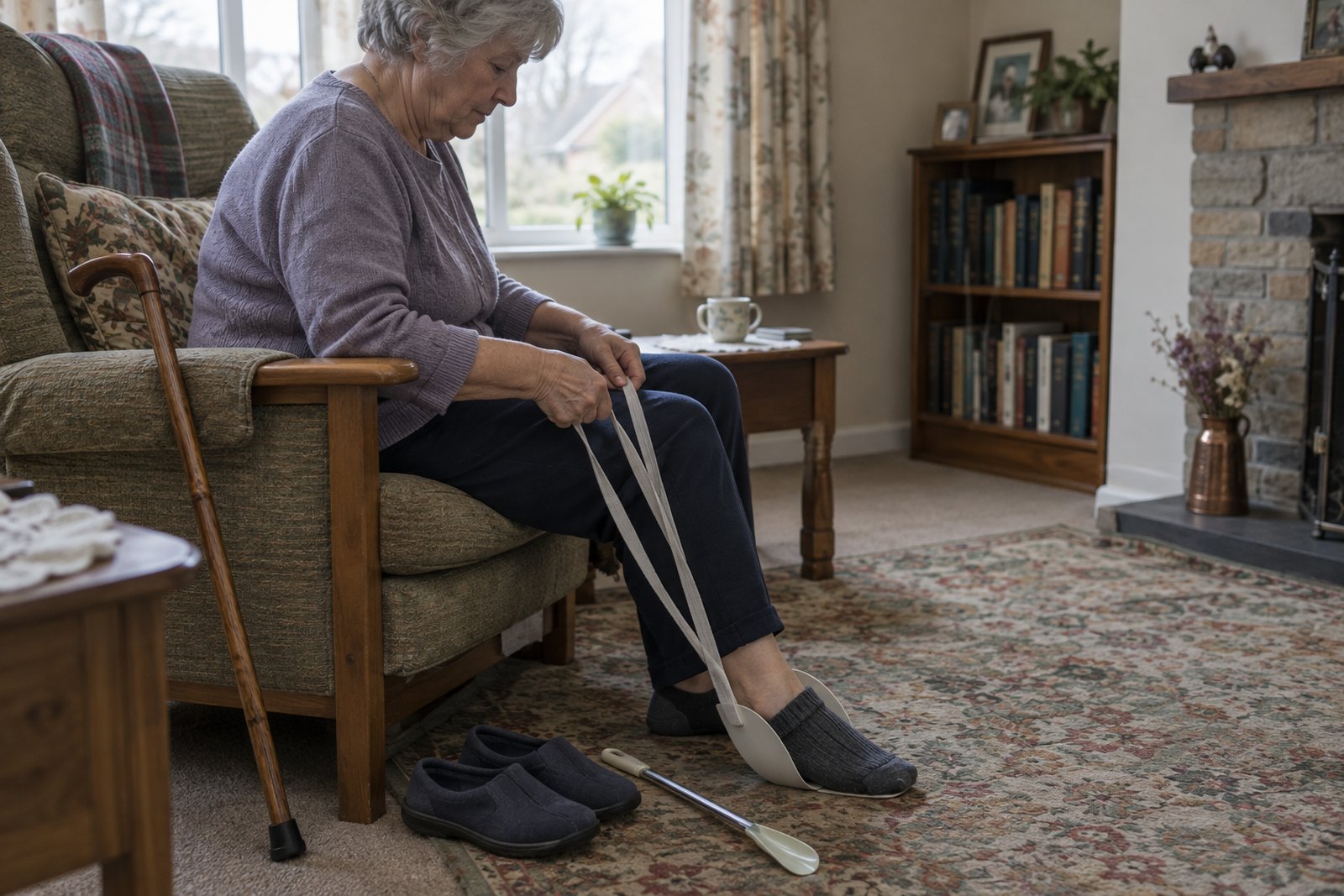
This is usually the first thing people notice. Reaching your feet needs a lot of bend at the hip, and an arthritic hip simply will not go that far. There is no shame in using a gadget for it. Most people wish they had done it sooner.
- Sock aid. A flexible plastic or fabric shell with two long cords. You stretch the sock over the shell, drop it to the floor, slide your foot in and pull the cords. It takes a few goes to get the knack. Thinner socks without tight tops are much easier.
- Long-handled shoehorn. Lets you ease your heel into a shoe without bending.
- Elastic laces or slip-on shoes with a firm back. Avoid backless slippers and mules, which are a trip hazard.
- Dress sitting down. Sit on a firm chair or the edge of the bed rather than balancing on one leg.
- Painful leg first. When putting on trousers, underwear or tights, put the sore leg in first, and take it out last.
A reacher or grabber helps you hook trousers up from the floor and pick up anything you drop. Our guide to dressing aids and easier ways to get dressed goes into more detail on each of these.
Chairs, beds and toilets: height is everything
Getting up from anything low is hard work for a painful hip. The simplest rule of thumb is that when you sit, your hips should be level with or slightly higher than your knees, and your feet should rest flat on the floor. Much modern furniture, especially soft sofas, is lower than that.
Chairs
A firm seat with sturdy armrests is far easier to get out of than a squashy sofa. To stand, shuffle forward to the edge of the seat, put your stronger foot slightly back, lean forward "nose over toes" and push up through the armrests. Do not pull yourself up on a walking frame or a table that might move.
Beds
If your bed is low, sitting on the edge feels like being folded in half. If it is too high, your feet dangle and getting off becomes a slide. Furniture raisers can lift a bed, chair or settee by a set amount, but they must be the right type for the furniture legs and fitted securely. Our guide to chair raisers, bed raisers and furniture raisers explains what to check before you buy.
Toilets
Toilets are often lower than ideal, and there is nothing to push up on. A raised toilet seat, a toilet frame with armrests, or a well placed grab rail can make this much easier. Raised seats come in different heights and fixing types, and the wrong one can be wobbly, so it is worth getting the height checked rather than guessing.
Getting in and out of the car
Climbing into a car leg first means twisting and bending the hip at an awkward angle. There is an easier way.
- Move the seat right back and recline the backrest slightly before you start.
- Park away from the kerb if you can, so you get in from road level rather than stepping down.
- Stand with your back to the seat, hold something stable (not the door, which swings), and sit down onto the seat.
- Lean back a little and swing both legs in together, keeping your knees together.
- To get out, reverse the process: legs out together, feet on the ground, then stand.
A swivel cushion on the seat can make turning easier. Our guide to getting in and out of a car covers swivel cushions, handles and other options. If you drive, check your hip still lets you do an emergency stop comfortably. The DVLA website on GOV.UK explains when you must tell them about a medical condition.
Baths and showers
Stepping over the side of a bath and lowering yourself to the bottom is one of the hardest things to do with hip arthritis, and getting out again is worse. Please do not keep doing it if it already feels risky.
A bath board sits across the top of the bath. You sit on it from the side, then lift your legs over one at a time and wash sitting down, usually with a shower attachment. It suits many people, but not everyone: you need to be able to lift your legs over the bath side and sit steadily without support. Read our guide to bath boards and when they are not safe before buying one. Other options include a bath lift that lowers you into the water, a shower stool in a walk-in shower, and grab rails. Long-handled sponges help you reach your lower legs and feet.
Stairs
Use a rail every time, and a second rail on the other side if you can have one fitted. The old saying works: up with the good, down with the bad. Going up, step up with your stronger leg first, then bring the painful leg and any stick up to join it. Coming down, lead with the painful leg and the stick, then bring the good leg down. One step at a time is fine.
Keep stairs clear of piles of things waiting to go up, and make sure the lighting is good at the top and bottom. If you are carrying things, a small bag over your shoulder keeps a hand free for the rail.
Walking aids, and which hand
A walking stick can take a noticeable amount of load off a painful hip, but only if it is used properly. Hold the stick in the hand opposite the painful hip. So if your right hip hurts, the stick goes in your left hand, and moves forward at the same time as your right leg. It feels wrong at first and then becomes natural.
Height matters. Stand up straight with your arms by your sides: the handle should be roughly level with the crease of your wrist. Too long or too short and you will lean, which brings its own aches. Check the rubber ferrule on the bottom regularly and replace it when worn. Our guide to walking sticks, the right height and which type covers this step by step. If you find you need a stick in each hand or are leaning heavily, it is worth getting assessed for something more supportive.
Sleeping, and sex
Lying on the painful hip often hurts, and lying on the good side can pull the sore one. Many people find it easier on their back, or on their good side with a pillow between their knees to keep the hips level. A mattress that is too soft lets you sink and makes turning over hard work. Getting in and out of bed with your knees together, using your arms to push, is usually more comfortable than twisting.
Hip arthritis can make sex painful or awkward, and pillows for support plus positions where the painful hip is not bearing weight or being pushed wide often help; it is completely fine to ask your GP or physiotherapist about it.
Around the house
- Reaching low things. Move everyday items to between waist and shoulder height. A grabber saves a lot of bending.
- Kitchen. A high perching stool lets you prepare food or wash up without standing for long.
- Toenails. If you cannot reach your feet safely, ask about a podiatrist rather than straining. This matters more if you have diabetes or poor circulation.
- Pacing. Split heavy jobs like hoovering or changing the bed into smaller chunks with rests in between.
When surgery comes up
If pain and stiffness are seriously affecting your life despite these measures, your GP can talk to you about referral to an orthopaedic surgeon, and if you do go on to have a hip replacement, our guide to life after a hip replacement covers the equipment and practical changes that help.
Where an occupational therapist fits
Being clear about roles saves you time. Your GP diagnoses the problem, manages pain relief and decides on referrals. A physiotherapist leads on exercise, strength and walking. An occupational therapist looks at the everyday tasks that have become difficult and how to make them possible again.
In practice, an occupational therapist visiting you at home can watch how you get out of your chair, onto the toilet, into the bath and up the stairs, measure your furniture against your body, and recommend the right equipment at the right height. They can teach easier ways of doing things, suggest adaptations such as rails or a level access shower, and write reports if you are applying for funding or benefits.
Through your local council, you can ask the adult social care team for an occupational therapy assessment, and your GP can also refer you to NHS community services where available. Equipment such as raised toilet seats, furniture raisers and bath boards is often loaned free through the local community equipment service. Waits vary by area. If you would rather move faster, or want a more detailed look at your whole home, a private occupational therapist visiting at home is an option. Check any therapist is registered with the HCPC.
Frequently asked questions
Is walking good for hip arthritis?
For most people, yes. Staying active is one of the main things that helps. Shorter, more frequent walks are often easier than one long one, and a walking stick in the opposite hand can ease the load. If walking makes the pain much worse for days afterwards, ask a physiotherapist to help you find the right amount.
Which hand should I hold my walking stick in?
The hand opposite the painful hip. If your left hip hurts, hold the stick in your right hand and move it forward with your left leg.
Can I get equipment for hip arthritis free?
Often, yes. Many councils lend basic equipment such as raised toilet seats, furniture raisers and bath boards through community equipment services after an assessment. Contact your council's adult social care team to ask. Small items such as sock aids and long shoehorns are cheap to buy, but larger items are worth having assessed first.
What is the best sleeping position with hip arthritis?
There is no single best position. Many people find lying on their back, or on the good side with a pillow between the knees, the most comfortable. Avoid lying directly on the painful hip if it hurts.
How do I know it is my hip and not my back?
Hip arthritis often causes pain in the groin, the front of the thigh and sometimes the knee, while pain on the outer side of the hip or the buttock can come from other causes, including the back. You cannot reliably tell at home. See your GP for a proper assessment.
Does hip arthritis always mean I will need a replacement?
No. Many people manage for years with exercise, pain relief, equipment and changes to how they do things. A replacement is considered when symptoms seriously affect daily life despite those measures, and that is a decision to make with your GP and surgeon.
Next steps
If daily tasks at home have become a struggle with hip arthritis, an occupational therapist can help you find the right equipment and easier ways of doing things. See our equipment and aids or home assessment pages, or current guide prices, and choose your area below.

Talk to an occupational therapist near you
This guide is general information. For advice about your own situation - or someone you look after - a local occupational therapist can visit you at home and see it for themselves.
Choose your area: