

Chair Raisers, Bed Raisers and Furniture Raisers: An OT's Guide
By Mobile Occupational Therapist • 29 September 2026 • 12 min read
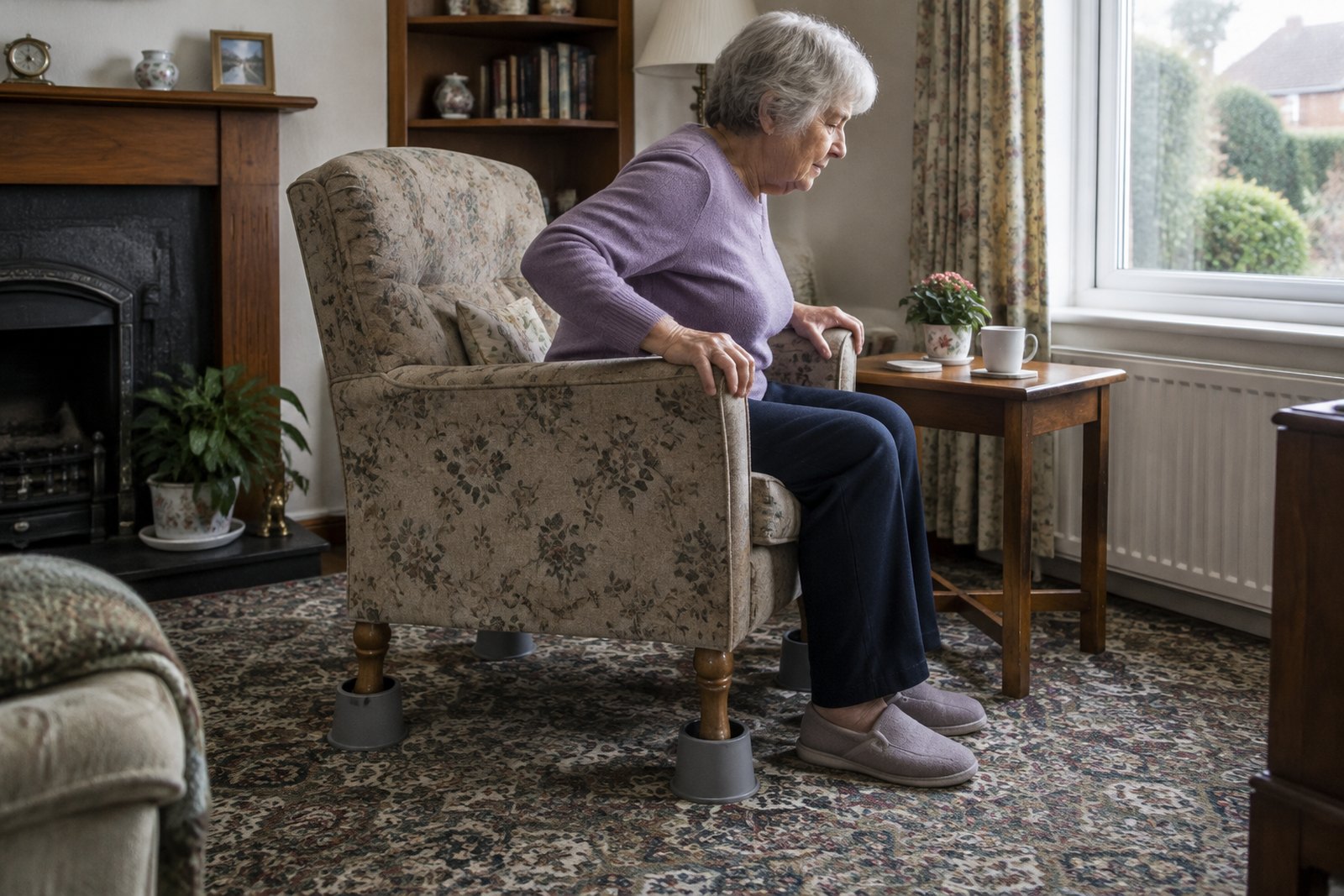
Chair raisers and bed raisers lift a piece of furniture by a few inches so that sitting down and standing up take less effort. If you, or someone you look after, rocks back and forth three times to get out of an armchair, or perches on the edge of the bed and struggles to push up, a raiser may well be the simplest fix in the house. They are quick to fit, not expensive to buy, and in many areas they are lent free by the council's community equipment service after an assessment.
They are also easy to get wrong. Raise a chair too far and feet dangle, thighs get squashed and the person slides forward. Put raisers under the wrong kind of furniture and it can tip. This guide explains how to work out the right height, which type of raiser suits which furniture, the safety rules that matter, and when a different answer would work better.
Why seat and bed height matter so much
Standing up from a seat is one of the hardest things most of us do all day, we just do not notice until it becomes difficult. The lower the seat, the further your hips and knees have to bend, and the more work your thigh and buttock muscles have to do to lift you. Stiff hips, painful knees, weak legs, a recent operation or plain tiredness all make that harder.
A few centimetres can make a surprising difference. Raising the seat means you start the movement from a position that is already partly upright, so the muscles have less to do and the joints bend less. It also makes sitting down more controlled, rather than the familiar last-minute drop into the chair that is hard on backs and risky for anyone with fragile bones.
Furniture rarely helps. Sofas are often low and deep. Armchair cushions sag over the years so a chair that was fine when it was bought ends up much lower in practice. Beds vary wildly, and a new mattress or topper can change the height overnight.
How to work out the right height
The general rule is simple: when you sit, your hips should be slightly higher than your knees, with your feet flat on the floor. That position gives your legs the best mechanical advantage for standing, while keeping you stable and comfortable once you are sitting.
Measuring for a chair
- Wear the shoes or slippers you usually wear indoors. They change the measurement.
- Sit on a firm chair where your feet are flat and your knees are bent at roughly a right angle. Ask someone to measure from the floor to the crease at the back of your knee. That is roughly the lowest seat height that suits you.
- A seat a little higher than that will put your hips slightly above your knees. Not a lot higher. The aim is to make standing easier, not to perch.
- Now measure the chair you want to raise, from the floor to the top of the front edge of the seat, ideally while someone is sitting in it so the cushion is squashed as it would be in use.
- The difference between the two is roughly how much raise you need.
Also check the seat depth. If the front edge of the seat presses into the back of your knees, raising the chair will make that worse, and a different chair may be the better answer.
Signs a chair is now too high
- Feet do not rest flat, or only the toes touch the floor.
- Pressure or numbness under the thighs or behind the knees.
- Sliding forward in the seat, or feeling you have to brace to stay put.
- Feeling you might tip forward when you go to sit down.
- Difficulty shuffling back far enough to use the backrest.
Measuring for a bed
The same idea applies: sitting on the edge of the mattress, feet flat, hips level with or slightly above the knees. Measure with someone sitting on the edge so the mattress is compressed. Remember that a pressure-relieving mattress or overlay can add height, so if one is coming, find out before you raise the bed.
The main types of raiser
Screw-in leg extensions
Some chairs and beds have legs that screw into the frame on a threaded bolt. Screw-in extensions either fit between the leg and the frame or replace the leg with a longer one. They look neat and are hard to knock out of place. The catch is that they only suit furniture with removable screw-in legs, the thread has to match, and fitting usually means turning the furniture over, which is a two-person job.
Cup or block raisers
These are the most common type. Each one is a solid block, usually plastic, with a recess on top that the leg sits in. They come in different heights, and some can be adjusted or stacked as part of a designed system. They suit furniture with straight, sturdy legs that fit snugly in the recess. Round and square recesses are both available, and the size matters: a leg rattling around in a cup that is too big is not safe.
Frame raisers
A frame raiser is a metal frame that the whole chair or bed sits on, usually with adjustable legs. They are used where furniture has no legs, very short stubby feet, or legs that are too wide or splayed for cups. They are bulkier and can take up floor space, so check that the frame does not stick out where someone could trip over it.
Which raiser suits which furniture
- Armchair or fireside chair with four straight legs: usually suits cup raisers or screw-in extensions.
- Chair with a fabric skirt to the floor or no visible legs: may suit a frame raiser, or may simply not be suitable. Do not try to wedge blocks under the base.
- Sofa: possible, but every leg must be raised, including any centre legs hidden underneath. Sofas are heavy, so fitting needs care.
- Bed with legs: usually suits cup raisers designed for beds.
- Divan bed on castors: the castors normally need to come off before raisers can be used. If the base is not designed for that, raisers are not the answer.
- Recliners, riser recliners, rocking chairs, swivel chairs and gliders: no. See the safety rules below.
- Electric adjustable or profiling beds: no. These already have height adjustment and should not be put on raisers.
The safety rules that matter
- Never use raisers on furniture with castors or wheels. A wheel sitting in a cup can roll out, and the furniture can shift just as someone is sitting down.
- Never use raisers under a recliner or riser recliner. The weight moves as the chair reclines or tilts, and lifting the whole chair changes how stable it is. A riser recliner already tilts you forward to stand. Raise it further and it can tip forward, or throw the user off balance. If a riser recliner is too low, that is a conversation about a different chair.
- Check every leg. All legs must be raised by exactly the same amount, and every leg must sit fully and squarely in its raiser. If the furniture rocks at all, stop and sort it out.
- Check the furniture itself. Loose legs, wobbly joints or cracked frames are made worse, not better, by raising.
- Check the weight limit. Raisers have a stated maximum load. It needs to cover the person and the furniture.
- Look at the floor. Raisers need a firm, level surface. Deep carpet can let them sink unevenly, and they should never sit on the edge of a rug.
- Recheck regularly. After vacuuming, moving furniture or a carer shifting the bed, look again. Never drag furniture with raisers fitted.
- Think about knock-on effects. A higher chair may mean the footstool, side table or call bell is now in the wrong place.
Bed raisers: carers' backs versus getting into bed
Bed height is where two needs often pull in opposite directions. A higher bed is far kinder to a carer who is helping someone wash, dress, roll or change position, and to anyone changing the sheets. Bending over a low bed day after day is a common route to a bad back.
But a bed that suits the carer may be too high for the person who has to get in and out of it, especially at night when they are on their own. If their feet do not reach the floor when they sit on the edge, they end up climbing in or sliding out, which is exactly how falls happen. A higher bed also means a longer drop for anyone who rolls out in their sleep.
Sometimes a compromise height works. Often the honest answer is that a fixed height cannot do both jobs, and a bed whose height can be changed is needed. Our guide to profiling beds explains how these work. If someone is at risk of falling out of bed, get professional advice before raising it at all.
Alternatives to raisers
Raisers are one answer, not the only one. Depending on the problem, these may work better:
- A chair that is the right height to begin with. If the chair is worn out, too deep or too soft, raising it just lifts the problem. Our guide to choosing the right chair covers what to look for.
- A firm cushion. Fine as a quick fix, but cushions slip, compress over time and make the armrests relatively lower. Do not stack cushions, and do not put one on top of a pressure-relieving cushion.
- Better technique. Shuffle to the front of the seat, put your feet back under you, lean forward so your nose is over your toes, and push up from the armrests. This alone helps a lot of people.
- Good armrests. Firm armrests that reach forward to the front of the seat give you something to push from. Chairs without them are much harder to get out of.
- Help for getting into bed. If the problem is lifting the legs rather than the height, leg lifters and bed levers may be the real fix.
- Strength and balance work. A physiotherapist can help build the leg strength that makes standing easier in every chair, not just one.
Getting raisers free through community equipment services
In many areas, chair and bed raisers are among the items lent out through the council's community equipment service. Usually you need an assessment first, from a council occupational therapist or an NHS professional such as a community physiotherapist or the hospital team before discharge. To ask, contact your council's adult social care team and request a needs assessment. The equipment is lent free and returned when it is no longer needed.
How it works, and how long it takes, varies between councils, so check locally. Our guide to community equipment services explains the process. Raisers can also be bought privately, but the measuring and the furniture check are the parts people tend to get wrong, so it is worth getting advice either way.
Where an occupational therapist fits
An occupational therapist looks at how you actually get up and down, not just at the furniture. They will watch you stand from your usual chair and bed, measure you and the furniture, check whether it is safe to raise, and work out the right height and type of raiser. They will also look at the rest of the picture: the toilet, the bath, getting out of the car, and whether technique, a different chair or other equipment and aids would help more. A private occupational therapist visiting at home can do this if you would rather not wait, or if you have been told you do not meet the council's criteria for equipment or support.
Other professionals lead in some situations:
- See your GP if difficulty standing has come on suddenly or got worse quickly, if you feel dizzy, light-headed or black out when you stand, or if there is new pain or swelling.
- A physiotherapist is the right person for building leg strength and balance, and for recovery after joint surgery.
- Call 999 if there is sudden weakness on one side, a drooping face or slurred speech. These can be signs of a stroke.
- Call NHS 111 if you are worried and not sure where to turn.
Frequently asked questions
Can I put raisers under a riser recliner?
No. Riser recliners and ordinary recliners should never go on raisers, because the moving mechanism changes how the weight is spread and the chair can tip. If the chair is too low, it needs a different solution, often a different chair.
How high should a chair be raised?
Enough that your hips sit slightly above your knees with your feet flat on the floor. For most people that means a modest raise, not a dramatic one. Measure first rather than guessing, and check the signs of a chair that is too high.
Are chair raisers free on the NHS?
Often, yes, through the council's community equipment service after an assessment by a council occupational therapist or an NHS professional. Arrangements vary between areas, so ask your council's adult social care team.
Can I raise a bed that has castors?
Not with the castors on. Some beds allow the castors to be removed and replaced with legs or feet that suit raisers. If yours does not, raisers are not safe and another option is needed.
Will a firm cushion do the same job?
Sometimes, as a short-term fix. But cushions slide, flatten and make the armrests lower relative to you. A cushion should never be added on top of a pressure-relieving cushion without advice.
Mum struggles to stand from every chair. Is it the chair or her?
Often both. Raisers can help, but if the difficulty has crept up gradually it is worth a GP check and possibly physiotherapy. If it has come on suddenly, see the GP promptly.
Next steps
See our home assessment page, or current guide prices, and choose your area below.

Talk to an occupational therapist near you
This guide is general information. For advice about your own situation - or someone you look after - a local occupational therapist can visit you at home and see it for themselves.
Choose your area: