

Walking Sticks: The Right Height, How to Use One and Which Type
By Mobile Occupational Therapist • 29 September 2026 • 13 min read
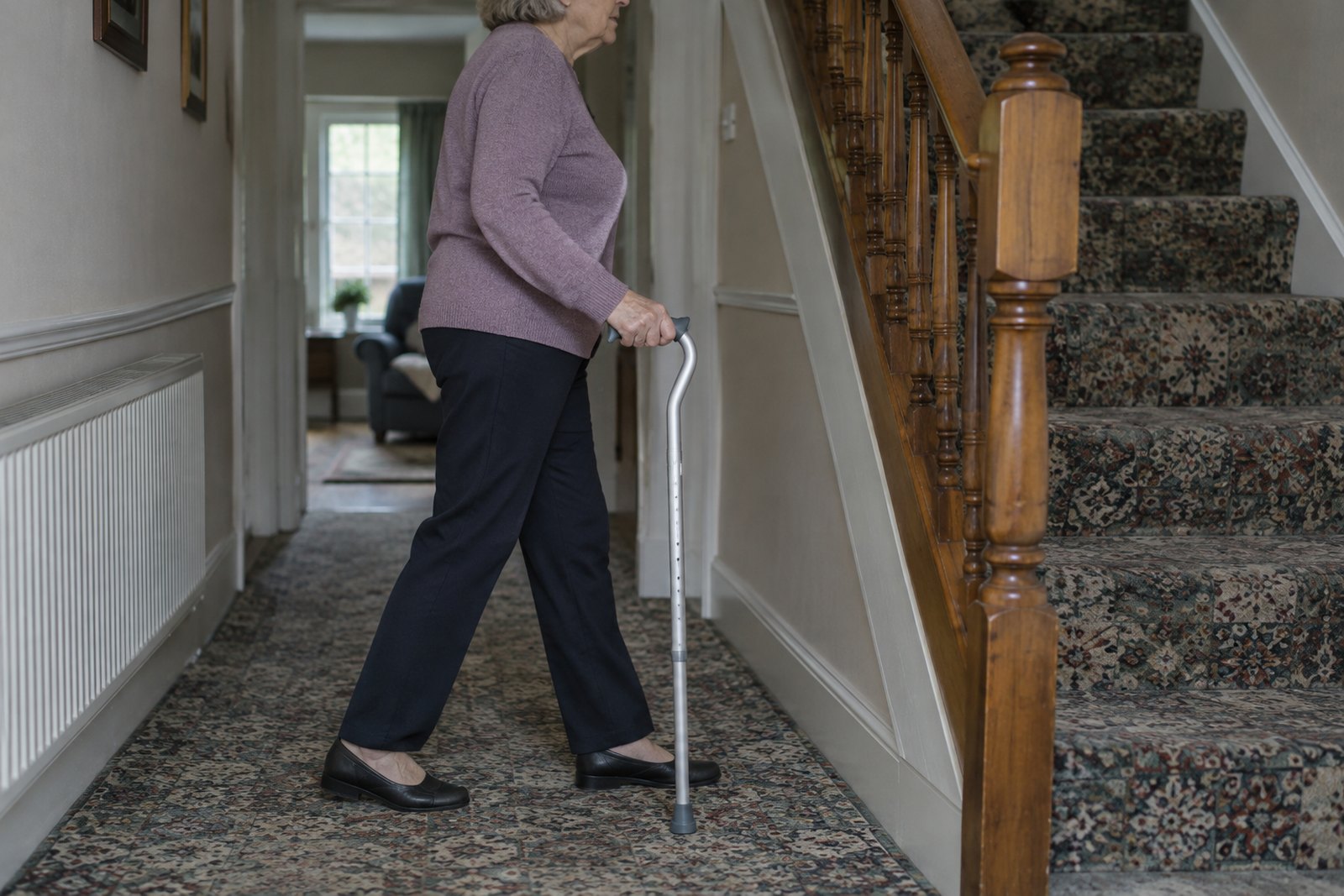
A walking stick is the right height when the handle sits level with the crease of your wrist. Check this standing up straight, arms hanging loosely by your sides, in the shoes you usually wear. When you then hold the handle, your elbow should have a slight, comfortable bend. Too long and the stick pushes your shoulder up. Too short and it pulls you into a stoop.
Hold the stick in the hand opposite your weaker or more painful leg, and move it forward at the same time as that leg. That is most of it. The rest of this page covers stairs, the different types of stick and handle, the small rubber tip that does more work than anything else, and the point where a stick stops being the right answer. Frames and wheeled walkers have their own guide: walking frames and wheeled walkers.
Setting the right walking stick height
Plenty of people are using a stick that belonged to someone else, was bought in a hurry, or was set up once and never checked again. Getting the height right takes five minutes and makes a real difference to your back, shoulder and balance.
- Put on the shoes you wear most days. A thick-soled trainer and a thin slipper can change the height you need.
- Stand up as straight as you comfortably can, on a level floor, near something steady in case you wobble.
- Let both arms hang loosely by your sides.
- Have someone stand the stick upright beside you, tip on the floor, roughly by the side of your foot.
- The top of the handle should line up with the crease on the inside of your wrist.
- Hold the handle. Your elbow should bend slightly, not lock straight and not bend sharply.
Adjusting a metal stick
Most adjustable sticks have a sprung button that pops through a row of holes. Press it in, slide the shaft to the right hole, and make sure the button clicks all the way through and the stick does not slip when you lean on it. A button only half through is a fall waiting to happen.
Cutting a wooden stick
Wooden sticks come long and are cut to size. Measure from the floor to your wrist crease, then pull off the rubber tip, cut the shaft from the bottom end, and push the tip back on firmly. Measure twice and cut a little long if you are unsure, because you can always take more off but you cannot put it back. If you are not confident, ask a physiotherapist or a mobility shop to do it.
Signs the height is wrong
- Your shoulder rises or aches on the stick side: probably too long.
- You find yourself leaning or bending forward to reach it: probably too short.
- Your wrist hurts or bends back sharply: the height or the handle may be wrong.
- You hold the stick partway down the shaft rather than by the handle.
Which hand to hold a walking stick in
Hold it in the hand opposite your weaker, stiffer or more painful leg. So if your left knee is the problem, the stick goes in your right hand.
This feels wrong to many people at first. The instinct is to put the stick on the sore side, as if propping it up. But holding it on the opposite side matches the natural way your arms swing as you walk, takes weight off the weaker leg, and keeps you upright instead of leaning towards the painful side.
There are exceptions. If the arm on that side is weak, painful or injured, for example after a stroke or a shoulder problem, the usual rule may not work for you. If both legs are much the same and you use a stick for general balance, many people find it easiest in the hand they use less, which leaves the stronger hand free for doors and rails. A physiotherapist can confirm what suits you.
How to use a walking stick when you walk
The basic pattern is simple: the stick and the weaker leg move together, then the stronger leg steps through.
- Stand tall with the stick slightly to the side of your stronger foot, not out in front.
- Move the stick and your weaker leg forward together, a short step.
- Put weight through both the stick and the weaker leg.
- Step your stronger leg forward, level with or just past them.
- Repeat. Keep the steps short and even.
A few things that help:
- Keep the stick close. Planting it far out to the side or far in front makes you lean and is less stable, not more.
- Look ahead, not at your feet. Glance down for obstacles, then look up again.
- Turn with small steps. Do not pivot round on the stick.
- Do not pull up on it. When getting out of a chair, push up from the armrests first, get your balance, then take hold of the stick. A stick is not stable enough to haul yourself up on.
- Park it sensibly. A stick leaned against a table tends to slide to the floor, and bending to pick it up is a common way to wobble. A clip-on holder or a hook-shaped handle over a chair back keeps it within reach.
- Plan for carrying. You have lost a hand. A bag worn across your body, a pocket or a small backpack works better than something dangling from the stick hand.
Using a walking stick on stairs
The phrase physiotherapists use is up with the good, down with the bad. Your stronger leg leads going up, because it does the lifting. Your weaker leg leads going down, with the stick, because the stronger leg does the controlled lowering.
Going up
- Hold the rail if there is one.
- Step up with your stronger leg.
- Bring your weaker leg and the stick up to the same step.
- One step at a time. Pause if you need to.
Going down
- Hold the rail if there is one.
- Put the stick down onto the step below, then step down with your weaker leg.
- Bring your stronger leg down to the same step.
Rail on one side, stick in the other hand
If there is a rail, use it. Hold the rail with one hand and the stick in the other, whichever side that puts the stick. Many people find stairs much steadier with a rail on both sides, and a second banister is often a simple job. Our guide to stair rails and second banisters explains the options. If juggling a stick on the stairs feels unsafe, some people keep a stick at the top and another at the bottom so they can use both hands on rails. Ask a physiotherapist to watch you on your own stairs if you are unsure.
Types of walking stick
Wooden sticks
Traditional, strong and often good-looking. They are fixed length once cut, so they suit people whose needs are settled. They can be heavier than metal, and a wooden stick that has been in the family for decades may be the wrong height for you.
Adjustable metal sticks
Usually aluminium, light and adjustable with a push button. A sensible first stick, because you can fine-tune the height and change it if your shoes or needs change.
Folding sticks
These fold into sections joined by an internal cord, so they fit in a bag. Handy if you only need a stick sometimes, for longer walks or uneven ground. Check that every joint locks fully before you put weight on it, and replace the stick if the joints become loose. They are generally not the first choice if you rely on a stick all day.
Tripod and quad sticks
These have three or four small feet at the base and stand up on their own. They give a wider base, which some people find reassuring, particularly after a stroke. But they are only stable when all the feet are flat on the ground. On slopes, kerbs and uneven paths they can rock, and on stairs the base may not fit the step. They are not a halfway house to a walking frame, and are best used after a physiotherapist has assessed you.
Seat sticks
A stick that unfolds into a small perch seat. Useful for people who can walk but need to stop and rest, for example in queues. They are not designed as a walking aid for regular support.
Handles, and handles for arthritis
- Crook handle: the classic curve. Easy to hang up, but your weight sits off-centre and it can be uncomfortable to grip for long.
- Offset or swan neck handle: the shaft bends so your hand sits directly over the line of the stick. Often more stable.
- Derby or wide handles: a broader shape that spreads pressure across the palm.
- Anatomical or moulded handles: shaped to the palm, made specifically for the right or left hand. Often recommended for arthritis in the hands or wrists, because they spread load and reduce how hard you need to grip.
- Padded or foam grips: softer and thicker, easier on stiff or painful fingers.
If your hands are painful, the handle matters as much as the height. An occupational therapist can look at grip and joint protection, and our equipment and aids page explains how that kind of advice works.
The rubber ferrule: check it, replace it
The ferrule is the rubber tip on the bottom of the stick. It is what stops the stick skidding, and it wears out quietly. A worn ferrule on a wet floor or shiny pavement can let the stick shoot out from under you.
Check it regularly. Replace it if:
- the tread on the bottom is worn smooth
- the rubber is cracked, split or hardened
- it has worn unevenly so it no longer sits flat
- you can see or feel the metal or wood of the shaft through it
- it is loose and twists or pulls off easily
Replacement ferrules are cheap and sold by pharmacies and mobility shops. They come in sizes to match the width of the shaft, so measure the bottom of the stick or take it with you. Push the new one on firmly so the shaft sits right at the bottom of it.
For icy weather you can get an ice grip, a small spiked attachment that clips around the ferrule, but flip it up or take it off as soon as you are indoors because metal spikes slide on hard floors.
When a walking stick is not enough
A stick gives a little support and a lot of reassurance. It does not hold you up if your balance goes. Signs you may need something more:
- you put a lot of weight through the stick, or your arm aches from it
- you hold on to furniture and walls as well as using the stick
- you have had a fall or near-miss while using it
- you need two sticks, or a stick plus someone's arm
- you get tired or breathless and need to stop and sit
A frame or a wheeled walker may be safer. Our guide to rollators and how to use them safely covers wheeled walkers in detail, and falls at home: practical prevention covers the house itself.
Some changes need a doctor rather than a different stick. If you notice sudden weakness in an arm or leg, a drooping face or slurred speech, call 999. If your walking has got worse quickly, you feel dizzy or faint, or you have had unexplained falls, contact your GP or call NHS 111. If you have a painful, swollen calf, especially after surgery, illness or a long period of sitting, get urgent advice from NHS 111 the same day, and call 999 if you also feel breathless or have chest pain.
Get assessed by a physiotherapist
Physiotherapists are the professionals who lead on walking aids. They assess your strength, balance and walking pattern, decide whether a stick is right and which type, set it up, and teach you to use it, including on stairs. They can also give you exercises that may mean you lean on the stick less over time.
In many areas you can refer yourself to NHS physiotherapy; otherwise ask your GP. Whether the NHS provides the stick itself varies by area, so ask. If you are not sure who does what, our guide on occupational therapists and physiotherapists explains the difference.
Where an occupational therapist fits
An occupational therapist is not usually the person to retrain your walking. That is physiotherapy. Where an occupational therapist helps is everything around the walking: getting through your day at home with a stick in one hand.
A private occupational therapist visiting at home can look at how you manage your own stairs and whether a second rail would help, how you carry a cup of tea or a plate when one hand is busy, whether chairs, the bed and the toilet are a height you can get up from, where rugs, steps and thresholds catch you out, and how you manage in the bathroom, where a stick is often not much use. They can also look at hand-friendly handles and grips if arthritis makes holding the stick painful. A home assessment pulls all of that together. If the stick itself or your walking is the worry, start with a physiotherapist.
Frequently asked questions
Should I hold my walking stick on my good side or bad side?
Usually on the good side, in the hand opposite your weaker or painful leg. The stick and the weaker leg then move forward together. If your arm on that side is also weak or painful, ask a physiotherapist what works for you.
How do I know if my walking stick is too long or too short?
With your arms by your sides, the handle should line up with your wrist crease, and your elbow should bend slightly when you hold it. If your shoulder hunches, it is likely too long. If you stoop or lean towards it, it is likely too short.
Should I use one walking stick or two?
Two sticks give more support and a more even walking pattern, but leave you no free hand. Needing two can also be a sign a frame or walker would be safer. This is a good question to take to a physiotherapist.
How often should I replace the rubber tip?
There is no fixed timescale. It depends how much you walk and on what surfaces. Check it regularly and replace it once the tread is smooth, the rubber is cracked or hard, or the shaft is starting to show through.
Can I get a walking stick on the NHS?
Sometimes. If an NHS physiotherapist assesses you, they may supply one, though this varies by area. Many people buy their own, which is fine as long as it is set to the right height and you know how to use it.
Can I use a tripod or quad stick on the stairs?
Often not easily, because the base may not sit flat on the step and can tip. Only use one on stairs if a physiotherapist has shown you how. Otherwise use the rails and a single-point stick, or keep a stick at the top and bottom.
Next steps
If walking with a stick is fine but managing at home is getting harder, see our independence for older people page or equipment and aids, check current guide prices, and choose your area below.

Talk to an occupational therapist near you
This guide is general information. For advice about your own situation - or someone you look after - a local occupational therapist can visit you at home and see it for themselves.
Choose your area: