

Bath Boards: Who They Suit, How to Use One and When Not To
By Mobile Occupational Therapist • 28 September 2026 • 14 min read
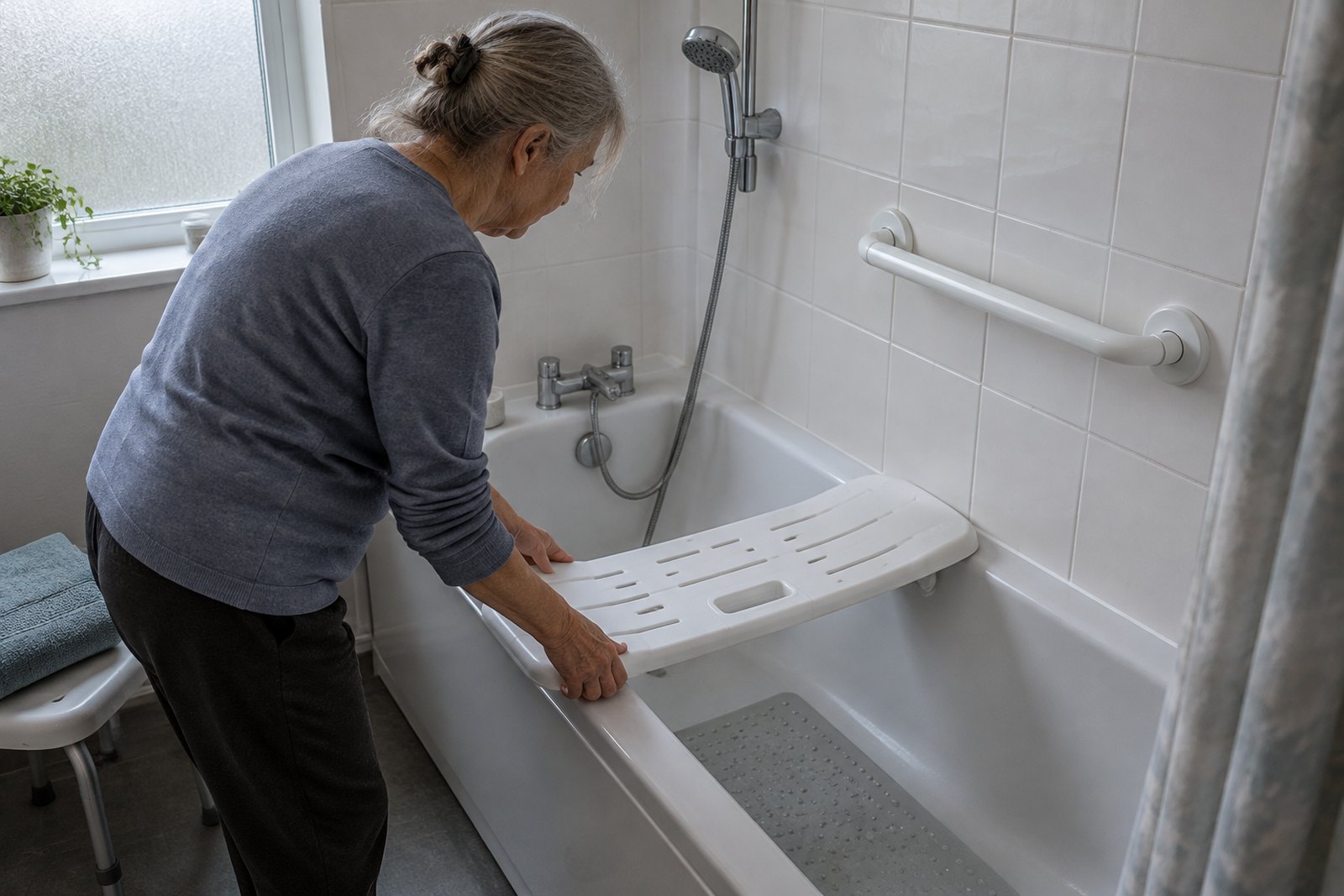
A bath board is a sturdy board, usually moulded plastic, that rests across the top of the bath from one rim to the other. You sit on it from outside the bath, swing your legs over into the empty bath, and wash under a hand-held shower while staying seated. You do not get down into the water. That is the whole idea, and for the right person it is one of the simplest and cheapest pieces of bathing equipment there is.
It suits someone who can sit steadily without holding on, can lift each leg over the side of the bath (with a hand under the knee if needed), and has a shower over the bath or can have one fitted. It does not suit someone with poor sitting balance, someone who cannot get their legs over the rim, or anyone who will be tempted to stand up on it or in the bath. If that sounds like the person you are worried about, read on before you buy one. The wrong board, in the wrong bath, for the wrong person, is a fall waiting to happen.
What a bath board actually is
Most bath boards look much the same. There is a flat seat, often with slots or holes so water drains through rather than pooling under you. Many have a moulded handle in the middle to hold while you shuffle across, and some have a cut-out at the front to make washing easier. A few have a soft padded top, which helps if sitting on hard plastic is uncomfortable.
Underneath are the important bits: two brackets or grips, one near each end. When the board is in place, these sit just inside the bath, against the inner wall on each side, and stop the board sliding sideways. On most boards they slide or screw to adjust, so the same board can fit baths of slightly different widths. Boards also come in different lengths, so you choose one to match your bath.
You may also see a bath seat. This is different. A bath seat hangs lower down inside the bath, often suspended from the rims or standing on the bath floor, so you lower yourself further down. It needs more strength and balance to get on and off, and many people find a board easier. If you are not sure which is which, it is worth asking before you buy.
Who a bath board suits
A bath board tends to work well for someone who:
- can sit on a stool or the edge of a bed without holding on, and stay steady while reaching and washing
- can stand from a seat at roughly bath height, perhaps with a rail to push on
- can lift each leg over the side of the bath, even if it takes a hand to help
- has a shower over the bath, or a mixer tap with a shower handset
- is happy to shower rather than soak
- is within the weight limit of the board
- understands, and will remember, that the board is for sitting on, not standing on
This is often someone whose problem is getting down into and up out of a bath, rather than staying upright once seated. Stiff hips and knees, arthritis, general weakness after illness and mild balance problems are common reasons. For a wider look at the options, see our guide to bath and shower aids for older adults.
Who it does not suit
Be honest with yourself here. A bath board is probably the wrong choice if:
- Sitting balance is poor. A bath board has no back and no sides. If someone sways, slumps or grabs for support when sitting on a stool, they can topple backwards into the bath or forwards onto the floor.
- The legs will not go over the rim. Some people can sit perfectly well but cannot lift a leg high enough, or the bath side is simply too tall for them.
- There are dizzy spells, blackouts or seizures. Warm water and steam can make light-headedness worse. Speak to the GP about the cause first, and think hard about whether showering alone on a perch above a hard bath is safe.
- Memory or judgement is affected. Someone living with dementia may forget the board is there, try to stand on it, or run a bath and climb down into it.
- They have recently had a hip replacement or other surgery. Getting legs over a bath can involve bending and twisting that the surgical team may have asked you to avoid. Follow the advice from the hospital, and ask them before using one.
- Skin is fragile. Sitting on hard plastic for a long, slow wash can put pressure on the skin over the bottom. A padded board or a shorter shower may help, but mention any skin concerns to the GP or district nurse.
- They really want a soak. A bath board will not give them one. People quietly stop using equipment that does not give them what they want.
Getting the fit right
Measure the bath
Before buying, measure two things across the middle of the bath, where the board will sit. First, the outside width from the outer edge of one rim to the outer edge of the other. Second, the inside width, where the brackets will rest against the inner walls. The board needs to be long enough to sit securely on both rims, and the brackets need to adjust to fit snugly inside. Check the manufacturer's sizing guidance against your measurements, not a rough guess.
Check the bath itself
Not every bath can take a board. Look at:
- The rims. They need to be flat and wide enough to take the board on both sides. Curved roll-top edges, sloping rims and very narrow edges can let a board rock or slip.
- The shape. Corner baths, tapered baths and unusually shaped baths often do not suit a standard board.
- How solid the bath is. Some thin acrylic baths flex when weight comes onto the rim. If the side bends when you press on it, get advice before relying on it.
- What is in the way. Fixed shower screens, taps or handles in the middle of the long side and built-in grips can all stop the board sitting where it needs to.
Weight limits
Every bath board has a maximum user weight, shown on a label or in the instructions. They vary between models, and heavier-duty boards exist. Do not guess. Remember that sitting down heavily or dropping the last few inches puts more force through the board than sitting still, so do not choose a board where the person is right at the limit.
The brackets
Adjust the brackets so they sit firmly against the inside of the bath on both sides, with no room for the board to shift. Tighten any fixings. Then check them before every use, and always after the board has been lifted off for cleaning. A board that slides even slightly is not safe.
How to use a bath board, step by step
This is a general description. Bodies differ, and an occupational therapist may teach a different order or technique that suits a particular person better.
- Get ready first. Make sure the bath is empty, the non-slip mat is in place, and the towel, soap and sponge are within reach. Run the shower and check the temperature before you sit down, then set the handset where you can reach it.
- Back up to the bath. Stand with your back to the bath, at the middle of its long side, until you can feel the side against the backs of your legs.
- Sit down on the board. Reach back for the board, its handle or a grab rail, and lower yourself gently onto the outer edge. Do not drop.
- Shuffle back. Slide back towards the middle of the board so you are sitting securely, not perched on the edge.
- Bring your legs over one at a time. Lift one leg over the rim into the bath, using your hand under the knee if needed, then the other. Turn your body so you are facing along the bath.
- Wash sitting down. Keep your feet on the mat in the bath and stay seated throughout. A long-handled sponge saves leaning forward for feet and lower legs.
- Dry before you get out. Turn off the water and dry yourself, especially your feet, while still sitting.
- Reverse the steps. Lift each leg back over the rim, shuffle to the outer edge, put your feet flat on a dry floor, and stand using a rail to push up.
Never stand on the board, never kneel on it, and never use it as a step into or out of the bath. Do not fill the bath and try to lower yourself from the board into the water.
What to pair it with
A bath board on its own is only part of the answer. It works far better with:
- A grab rail. A securely fixed rail on the wall beside the bath gives something solid to hold while sitting, shuffling and standing. It must be fixed properly into a sound wall. Towel rails, soap dishes and the shower screen are not grab rails. Our guide to grab rails and what not to grab explains where they usually go.
- A non-slip mat in the bath. Your feet will be on the bath floor while you wash, and wet enamel or acrylic is slippery.
- A dry, non-slip surface outside the bath. Wet tiles or lino when you stand up are a common cause of falls.
- A hand-held shower. A fixed overhead shower is hard to use sitting down. A handset on a hose, ideally on an adjustable rail you can reach from the board, makes washing much easier.
- Temperature control. A thermostatic shower or mixer reduces the risk of sudden scalding if someone else uses water elsewhere in the house. This matters more for anyone with reduced feeling in their skin.
- A warm room. Sitting still while wet gets cold quickly. A warm bathroom makes people less likely to rush.
Bath board, bath lift or level-access shower?
Bath board
Simple, portable, no installation, and often available on loan. You shower rather than bathe, and you need decent sitting balance and enough leg movement to get over the rim.
Bath lift
A powered seat that sits in the bath and lowers you down into the water, then raises you back up to rim level. It suits someone who really wants a soak and can still swing their legs over the side at the top. It still needs reasonable sitting balance, and the battery needs charging. Our honest guide to walk-in baths and bath lifts covers the trade-offs.
Level-access shower or wet room
If the bath side has become the obstacle, or will soon be, removing it may be the real answer. A level-access shower lets someone walk or wheel straight in, often using a fixed or wall-mounted shower seat. It is a bigger job, but for people whose needs are increasing it can be the option that lasts. Councils can sometimes help through a Disabled Facilities Grant. See our guide to wet rooms and level-access showers.
Where to get one, and why an assessment matters
Bath boards are widely sold, and they are not expensive. But many people get one through their council. If you contact adult social care and ask for a needs assessment, an occupational therapist or trained assessor may visit, and if a board is right it can often be provided on loan through the local community equipment service. Our guide to borrowing equipment through community equipment services explains how that works. Waits vary by area.
Why bother with an assessment for something so simple? Because the question is not really which board to buy. It is whether this person can safely get on, wash and get off, in this bath, in this bathroom, and whether that will still be true in six months. People buy a board, find it does not fit, or find they cannot get their legs over, and the board ends up behind the door. Or worse, it is used when it should not be.
Where an occupational therapist fits
An occupational therapist looks at the whole task of washing, not just the equipment. On a home visit they can watch how someone sits, stands and lifts their legs, measure the bath and the person, check whether the bath and walls will take a board and a rail, and look at the rest of the routine, such as undressing, drying and getting back to the bedroom. If a bath board is not the answer, they can say so and suggest what is, from a different seat to a bath lift to a level-access shower. A private occupational therapist visiting at home can also put recommendations in writing. If you later apply to the council for adaptations, the council will usually still carry out its own assessment, but a written report can be useful background. Our equipment and aids page explains more.
An occupational therapist is not always the first person to see. If someone has started falling, feeling dizzy or getting weaker without a clear reason, see the GP first. A physiotherapist leads on building strength and balance. After an operation, follow the hospital team's advice about what movements are safe. If someone has fallen and is hurt, cannot get up, or has hit their head and seems unwell, call 999.
Frequently asked questions
Can I sit in the bath water with a bath board?
No. A bath board keeps you sitting above the bath, at rim height. You wash with a hand-held shower. If you want to be lowered into the water, look at a bath lift instead.
Will a bath board fit any bath?
Not every bath. Standard straight-sided baths with flat rims usually take one. Corner baths, tapered baths, roll-top baths with curved edges and baths with taps or fixed screens in the way may not. Measure carefully and check the manufacturer's sizing before buying.
Can I get a bath board free?
Often, yes, on loan from the council's community equipment service after an assessment. Contact your council's adult social care team and ask for a needs assessment. Rules and waits vary, so check with your own council.
Is a bath board safe after a hip replacement?
It depends on the advice you have been given. Getting legs over a bath can involve bending and twisting that may be restricted for a while. Ask the hospital team or your GP before using one, and follow any written precautions you were given.
What is the difference between a bath board and a bath seat?
A bath board rests across the top of the bath at rim height. A bath seat sits lower down inside the bath, so you have further to lower yourself and further to rise. Many people find a board easier and safer, but an occupational therapist can advise which suits.
How do I know if the board is still safe to use?
Before each use, check the brackets are tight against both sides of the bath and the board does not move when you press on it. Look for cracks, warping or loose fixings. If anything is damaged or wobbly, stop using it and replace it or contact whoever supplied it.
Next steps
If you are not sure a bath board is right, or the bath itself is becoming the problem, see our home assessment page or equipment and aids page, check current guide prices, and choose your area below.
Talk to an occupational therapist near you
This guide is general information. For advice about your own situation - or someone you look after - a local occupational therapist can visit you at home and see it for themselves.
Choose your area: