

Global Developmental Delay: What It Means and What Helps at Home
By Mobile Occupational Therapist • 7 October 2026 • 14 min read
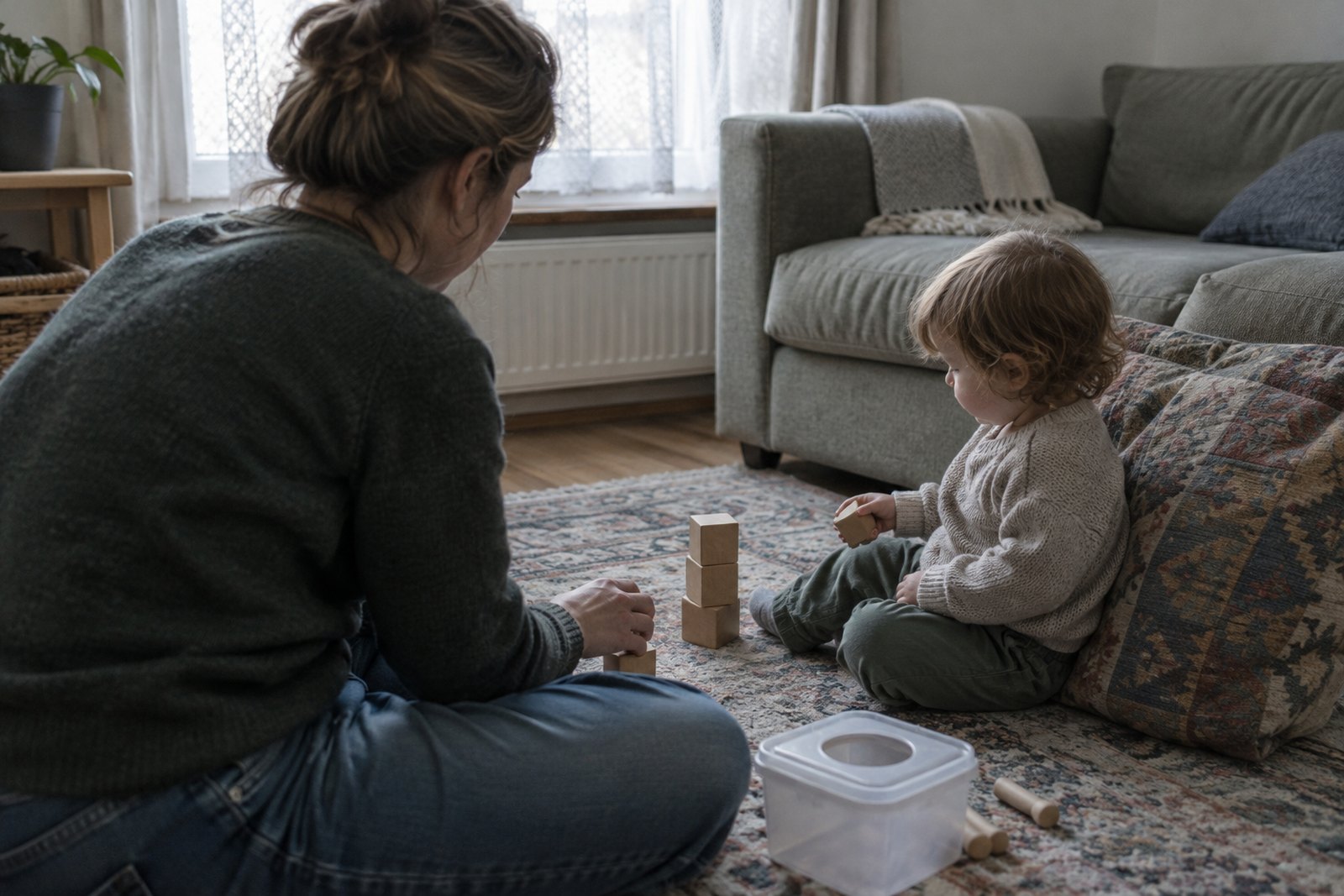
Global developmental delay, often shortened to GDD, means that a child under five is noticeably behind what is expected for their age in two or more areas of development. Those areas are things like moving, using their hands, talking and understanding, playing and getting on with people, and everyday skills such as feeding. It describes what is happening. It does not, on its own, tell you why.
If a health visitor, GP or paediatrician has just used the term about your child, you probably have a head full of questions and not many answers. That is normal. This guide explains what the label means, how assessment usually works in the UK, who you are likely to meet, and what you can do at home this week that genuinely helps. It will not tell you how your child will turn out, because nobody honestly can at this stage, and anyone who claims to should be treated with caution.
What global developmental delay actually means
The areas of development
Professionals usually think about development in a handful of areas, sometimes called domains:
- Gross motor - big movements such as rolling, sitting, crawling, walking, climbing and running.
- Fine motor - using hands and fingers to grasp, pass toys between hands, pick up small things, scribble and stack.
- Speech, language and communication - understanding words, babbling, pointing, gesturing, talking.
- Cognition - thinking, problem solving, play, remembering and learning.
- Social, emotional and self-care - interacting with people, sharing attention, and early skills like finger feeding, drinking from a cup and helping with dressing.
Plenty of children are a bit behind in one area and catch up without fuss. GDD is used when the delay is significant and affects more than one area at once. You may hear more detail about this on our developmental delay page.
A description, not a cause
This is the bit that confuses most parents. GDD is not a condition in the way that, say, asthma is. It is a description of a pattern. Some children with GDD turn out to have an identifiable cause, such as a genetic difference, a problem around birth, or another medical condition. Many do not have a cause found, even after testing. Both situations are common, and not finding a cause does not mean the doctors have missed something or that the delay is not real.
How GDD is usually picked up and assessed in the UK
Health visitor, GP and nursery
In England, health visitors offer development reviews in the early years, including one around the age of two to two and a half. Questionnaires used at these reviews often flag a child who is behind in several areas. Sometimes a parent raises it first, or a nursery key person notices. Trust your instinct here. If you are worried, you do not need to wait for a scheduled review; you can ask your health visitor or GP to look at your child's development at any point.
The usual next step is a referral to a community paediatrician, a children's doctor who specialises in development rather than hospital emergencies. Waiting times vary a great deal by area, so it is worth asking your GP or health visitor what the local wait is and what support you can access in the meantime.
The paediatrician and child development team
Many areas have a child development centre or child development team. This brings together a paediatrician with therapists and sometimes a clinical psychologist or specialist health visitor. At the first appointment you can expect a lot of questions: pregnancy and birth, early months, family history, sleep, eating, and what your child can and cannot do now. The doctor will usually examine your child and watch them play.
It helps to bring:
- Your child's red book (personal child health record), if you have one.
- A short list of what they can do, roughly when skills appeared, and anything they used to do but have stopped doing.
- A few short videos on your phone of things that are hard to show in a clinic, such as how they move at home or how they play.
- Any letters from nursery, health visitor or other professionals.
Tests to look for a cause
Depending on your child, the paediatrician may suggest tests. These might include a hearing test and a vision check, because a child who cannot hear or see well will struggle to develop in other areas. Blood tests are common and may include genetic testing. Some children are offered other investigations such as a brain scan, but only when there is a reason to. It is fine to ask what each test is for, what it might show, and what happens if it comes back normal. Genetic results in particular can take some time.
Why the label may change
GDD is often a holding description. Young children are hard to assess precisely, and how they develop over the next few years tells professionals a great deal. Some children catch up in some areas. Some later receive a more specific diagnosis, such as autism, cerebral palsy, a genetic syndrome or a learning disability. Others keep a broader description as they get older. As children reach school age, assessments become more reliable and the language professionals use may change.
This uncertainty is hard to live with. It can help to treat the label as a door that opens services rather than a verdict. Your child is the same child they were before the appointment.
Who might be involved
Not every child sees everyone on this list. Who gets involved depends on where the delays are and what is available locally.
- Physiotherapist - leads on gross motor skills: sitting balance, standing, walking, muscle tone and posture. If your child is not yet walking, this is usually the key therapist.
- Speech and language therapist - leads on understanding, communication and talking, and also on eating, drinking and swallowing difficulties. If your child coughs or chokes when eating, ask for this referral.
- Occupational therapist - helps with hand skills, play, self-care such as feeding and dressing, sensory differences, seating and equipment. More on this below.
- Portage - a home-visiting early education service for pre-school children with additional needs, offered by many councils. A Portage worker helps you break skills into small steps and build them into play. Ask your health visitor or council whether it runs locally.
- Early years setting - nurseries, pre-schools and childminders in England should provide SEN support, with a special educational needs coordinator (SENCO) helping plan what your child needs.
- Education, health and care plan - if your child needs more help than a setting can normally provide, you can ask the council for an EHC needs assessment. Our guide to the EHCP process explains how it works.
Your council's local offer, and its SEND information, advice and support service, can tell you what is available in your area. Rules for SEND support differ in Scotland, Wales and Northern Ireland, so check with your local council if you live outside England.
What helps at home: everyday play and routines
You do not need special equipment or an hour of structured therapy every day. Most of what helps young children develop happens in ordinary moments: nappy changes, meals, bath time, getting dressed, playing on the floor. The trick is to notice where your child is now and aim just one small step ahead.
Follow their lead, one step ahead
Watch what your child is interested in and join in, rather than steering them to the toy you think they should use. If they like banging a spoon, bang a spoon with them, then try banging on a pan, then a box, then stop and wait to see if they want more. Waiting is underrated. Leaving a pause of several seconds gives a child time to respond, reach, look or make a sound.
Talking and communication
- Get down to their eye level and face them.
- Use short phrases, one or two words longer than they use. If they say nothing yet, name what they are looking at: "Ball. Big ball."
- Comment more than you question. "You are pouring" works better than "What are you doing?"
- Songs and rhymes with actions are repetitive in exactly the way young brains like.
- Turn the television and background noise off during play when you can.
Movement
Give plenty of floor time, including tummy time for babies and toddlers who are not yet crawling, but only when they are awake and you are watching them. Put toys slightly out of reach so they have a reason to move. Cushions, a low sofa and a folded duvet make an obstacle course for climbing and crawling. If a physiotherapist has given you specific positions or exercises, those come first. Our guide to gross motor skills has more ideas by age.
Hands
Hand skills grow from a stable body, so a child who is well supported in sitting will usually use their hands better. Try:
- Posting games: dropping pegs, lids or balls into a container with a hole. Use items too big to fit in your child's mouth and stay with them, as many children with GDD still put things in their mouths.
- Stacking cups or bricks, starting with two.
- Pulling things out: scarves from a tissue box, toys from a bag.
- Squashing and squeezing play dough, wet sponges in the bath, or cooked pasta.
- Finger feeding with small soft pieces, if it is safe for your child to manage them.
There are more suggestions in our guide to fine motor skills activities.
Routines: feeding, dressing, bath and bed
Predictable daily routines help children understand what is coming, which often means less distress and more joining in. A few practical points:
- Let them do the last step. You pull the sock almost off; they pull the final bit. You put the spoon in the yoghurt; they bring it to their mouth. Finishing a task feels like success.
- Use the same words each time. "Arms up" for a jumper, "all done" at the end of a meal.
- Support sitting at meals. Feet flat on something, hips back in the seat, table at around tummy height. Children eat and use their hands better when they are not working hard to stay upright.
- Show what is next. Holding up the bath towel or the cup before the activity gives a clue that many children understand before words.
Little and often beats long sessions. Five minutes of joined-up play several times a day is more realistic, and probably more useful, than a big daily effort that leaves you both frazzled.
Looking after yourself
Hearing that your child is delayed can bring up grief, worry, guilt, relief that someone finally listened, or all of these in the same afternoon. Many parents quietly wonder whether they caused it. In most cases, nothing a parent did or did not do is the reason, and if you have worries about a possible cause, your paediatrician is the right person to talk them through with.
Some things that help in practice:
- Keep one folder. Paper or digital, with every letter, report and name. You will be asked to repeat your story many times, and it saves your energy.
- Talk to other parents. Contact, the national charity for families with disabled children, runs a helpline and has information on benefits, education and local groups. It does not matter whether your child has a diagnosis.
- Check money and entitlements. Disability Living Allowance for children is based on care and mobility needs, not on having a diagnosis. Check the rules on GOV.UK or with Contact before you apply.
- Ask about a parent carer needs assessment from your council, which looks at what support you need as a carer.
- Speak to your GP if you are not sleeping, feel low most days or are struggling to cope. Your health matters to your child too.
When to get help quickly
Most developmental concerns are worked through over weeks and months. A few things should not wait. See your GP promptly, or call NHS 111, if your child starts losing skills they already had, such as words, walking or using their hands. Call 999 if your child has a seizure lasting more than five minutes, has difficulty breathing, or you cannot wake them properly. Call 999 if your child has a fit for the first time, even if they seem to recover. If they have an unexplained episode of staring or floppiness for the first time, get urgent advice from your GP or NHS 111.
Where an occupational therapist fits
An occupational therapist looks at the everyday things your child needs and wants to do, and what is getting in the way. For a young child with GDD, that usually means play, hand skills, feeding and drinking with utensils and cups, dressing, sleep routines, sensory reactions such as hating certain textures or noise, and sitting well enough to play and eat. An occupational therapist can also advise on supportive seating, equipment for bathing, and setting up the home so your child can join in safely.
On the NHS, children's occupational therapy is usually accessed through the child development team or a referral from your paediatrician or GP. A private occupational therapist visiting at home can assess your child in their own surroundings, give you a practical programme of play and routines, and write reports that can support nursery planning or an EHC needs assessment. See our paediatric occupational therapy page for what this involves.
To be clear about limits: an occupational therapist does not diagnose GDD or its cause, which is the paediatrician's job. Walking and muscle tone are led by physiotherapy. Talking, understanding and swallowing are led by speech and language therapy. Private input works best alongside NHS care, not instead of it, so keep your child's referrals going.
Frequently asked questions
Is global developmental delay the same as a learning disability?
Not exactly. GDD is used for children under five because it is hard to assess learning reliably at that age. Some children with GDD are later described as having a learning disability and some are not. Your paediatrician can explain how they expect to review your child over time.
Will my child catch up?
Nobody can answer this with certainty early on, and every child is different. Some children make big strides, others continue to need support. How your child progresses over the next few years, with good support, gives far more information than any single appointment.
What does GDD stand for in a letter?
GDD stands for global developmental delay. You may also see words like "domains" or "milestones" in reports. If a letter is unclear, ask the professional who wrote it to explain; that is a reasonable request.
Do we need a diagnosis to get help?
No. Early years SEN support, Portage, therapy referrals, Disability Living Allowance and EHC needs assessments are all based on needs rather than a named diagnosis. A diagnosis can help explain needs, but you should not be told to wait for one before support starts.
Should I buy special toys or equipment?
Usually not at first. Ordinary household things, simple toys and your time do most of the work. If your child has trouble sitting, bathing or feeding safely, ask a therapist before buying equipment, as the right type and fit matter.
Can nursery help with GDD?
Yes. In England, early years settings should offer SEN support with a SENCO. Share reports and therapy advice with nursery so everyone is working on the same goals, and ask for regular reviews.
Next steps
If you would like practical help with play, feeding, dressing or seating at home, see our paediatric occupational therapy page, or current guide prices, and choose your area below.

Talk to an occupational therapist near you
This guide is general information. For advice about your own situation - or someone you look after - a local occupational therapist can visit you at home and see it for themselves.
Choose your area: