

Fidget Tools at School: Movement Breaks and Tools That Help
By Mobile Occupational Therapist • 5 October 2026 • 14 min read
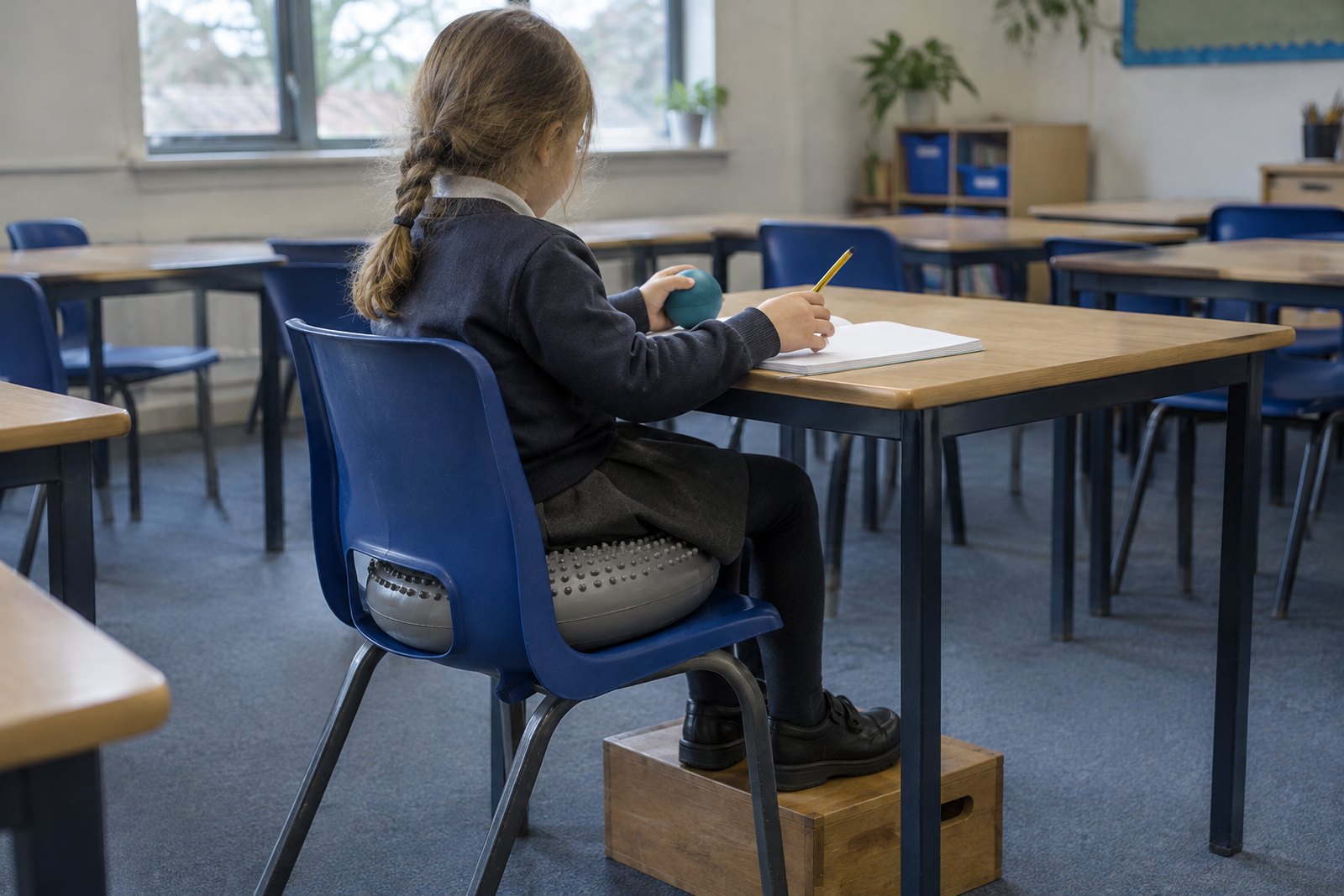
If your child can't sit still at school, the movement is often not naughtiness. For many children, wriggling, tapping, rocking and getting up are how their body keeps their brain switched on. Tell them to stop, and they spend all their effort on keeping still, with very little left over for the lesson.
What usually helps is not less movement but planned movement. That means short movement breaks, a classroom job or two, seating that lets them shift without falling off, a quiet fidget tool with clear rules, and some hard physical work before the tasks they find most demanding. All of this works best when you, the class teacher and the school's SENCo agree it together. If a sensible plan has been tried for a while and your child is still struggling, that is the point to ask for an occupational therapy assessment.
Why some children need to move to concentrate
Adults fidget too. We click pens, jiggle a foot in meetings, pace while on the phone. Children who move a lot are often doing the same thing, just more, and with less ability to hide it. There are a few common reasons.
ADHD
Many children with ADHD find it genuinely hard to stay alert when a task is slow, quiet or repetitive. Movement gives the brain extra stimulation, and for some children small amounts of fidgeting actually help them listen. Asking them to sit perfectly still can make attention worse, not better. Our guide to occupational therapy and ADHD covers the wider picture at home and school.
Sensory seeking
Some children seem to need more movement, pressure and touch than others to feel settled. They crash into things, lean on people, chew sleeves, swing on chairs and never seem to tire. This is often called sensory seeking, and it is not the same as poor behaviour. You can read more in sensory seeking behaviour in children.
Low muscle tone and posture
Some children wriggle because sitting upright is hard work. If their core muscles tire quickly, they slump, prop their head on a hand, slide down the chair, hook their feet round the legs or keep changing position to get comfortable. It looks like restlessness. It is often fatigue. Our article on low muscle tone in children explains what this looks like day to day.
Other reasons worth ruling out
Not all fidgeting is about attention or sensory needs. It is worth asking yourself, and the school, a few plain questions:
- Is your child getting enough sleep? Tired children often move more, not less. Loud snoring or pauses in breathing at night are worth mentioning to your GP.
- Can they see the board and hear the teacher? A sight test at an optician and a hearing check via your GP are simple to arrange.
- Is the work at the right level? Children who are lost, or bored because it is too easy, both tend to fidget.
- Are they anxious, hungry, thirsty or uncomfortable? Itchy uniform labels and shoes that pinch can be enough.
None of these questions are about labelling your child. They are about finding the cause before choosing the fix.
Movement breaks that actually work in a classroom
A movement break is a short, planned chance to move, ideally given before your child reaches the point of falling off their chair rather than after. The best ones are quick, purposeful and do not single the child out.
Timing matters more than length
A minute or two of movement at the right moment usually beats a long break at the wrong one. Good times are often just before a long sitting task, halfway through a lesson that runs on, and straight after a transition such as coming in from lunch. Many teachers already build whole class movement into the day, which helps because nobody stands out.
Classroom jobs
A job gives a child a reason to get up that looks normal to everyone else. It also gives them responsibility, which many restless children enjoy. Useful jobs include:
- Taking the register or a message to the office.
- Carrying a pile of books or a box of equipment to another room.
- Handing out and collecting worksheets or exercise books.
- Wiping tables or the whiteboard.
- Stacking or putting out chairs.
- Carrying the PE equipment out to the hall or playground.
The jobs that involve carrying, pushing or lifting have a bonus: they double as heavy work, which is covered below.
Do not take movement away as a punishment
This is the one to raise gently with school if it is happening. Keeping a restless child in at playtime because they could not sit still in maths tends to make the afternoon worse. The child who most needs to run about is the one losing the chance. Most schools will understand this once it is put plainly.
Seating options that let a child move safely
Before buying anything, look at the basics. A surprising amount of wriggling comes from a chair that does not fit.
Get the fit right first
- Feet flat. If your child's feet dangle, they will hook them round the chair legs or slide forward. A sturdy box or footrest under the desk can fix this in a day.
- Desk height. The desk should sit roughly at elbow height when seated. Too high and shoulders hunch, too low and they slump.
- Chair size. Classrooms often have one size of chair for a whole year group, and children vary a lot. Ask whether a smaller or larger chair is available.
Wobble cushions
An inflated cushion on the chair seat lets a child make small movements while staying seated. For some children it is a real help. For others it becomes something to bounce on, or it makes sitting harder if their balance or core strength is poor. Our honest guide to wobble cushions goes into who they suit and how to trial one fairly.
Standing and changing position
Some children work better standing. A raised surface at the side or back of the room, used for some tasks, can let them shift weight and move their legs without disturbing anyone. Other options teachers use include:
- A stretchy exercise band tied round the front legs of the chair, so the child can push and bounce their feet against it quietly.
- Kneeling on the chair for short tasks, if it is stable and the teacher is happy with it.
- Lying on their tummy on the floor for reading, which gives the body plenty of support.
- For carpet time, sitting at the edge, against a wall or furniture, or on a small cushion that marks their space.
Rocking back on two chair legs is the one to discourage, because it can end in a nasty fall. If your child does it constantly, that is useful information. It often means they are seeking movement and need a safer outlet.
Fidget tools that do not distract others
A good fidget tool keeps the hands busy so the head can listen. A bad one becomes the activity, or distracts the whole table. The difference is mostly about the type of tool and the rules around it.
What makes a good classroom fidget
- Silent. No clicking, popping or rattling.
- Works in one hand, without looking. If your child has to watch it, it is competing with the teacher.
- Small and dull enough not to be a toy. Bright, collectable or trendy items attract other children.
- Hard to throw or take apart.
Types that often work include a squeezable soft ball, a twistable chain of plastic links, a lump of reusable therapy putty, a strip of textured hook-and-loop fabric stuck under the desk, a stretchy band round the wrist or pencil, a smooth worry stone, or a small piece of fabric with a zip to run up and down.
Things that usually cause problems in class include spinners, popping toys, anything that lights up or makes noise, and anything with small loose parts or magnets.
Rules for use
Rules turn a fidget from a toy into a tool. Agree them with the teacher and your child before the first day, keep them short and use the same words at home and school. For example:
- It stays in my hand or under the desk.
- My eyes stay on the teacher or my work.
- It is mine. I do not share it or swap it.
- If it gets thrown or becomes a game, it goes in the box for now and I try again later.
- It lives in the same place every day.
The consequence in rule four should be short and calm, not a punishment. The point is to learn to use it, not to lose it.
Give it a fair trial of a few weeks, then ask the teacher honestly: is it helping? Some children need two or three different tools tried before one fits. Some do better with no fidget at all and more movement breaks instead. Both answers are fine.
Heavy work before demanding tasks
Heavy work means activities where muscles push, pull, lift or carry against resistance. Many children, especially sensory seekers, seem calmer and more organised after it, although the research evidence is still limited and it does not suit every child. It is worth trying because it is simple and costs nothing.
At school
- Carrying books, crates or the register bag.
- Stacking chairs or moving tables at the end of the day.
- Wall push-ups: hands flat on the wall, bend and straighten the arms.
- Chair push-ups: hands on the seat either side, push to lift the bottom slightly.
- Pushing a loaded trolley or wiping a large whiteboard.
- Climbing equipment, monkey bars or tug of war at playtime.
The trick is timing. Five minutes of heavy work just before phonics, writing or maths often helps more than the same five minutes at a random point in the day. Some schools run short morning movement sessions for a small group of children to help them arrive ready to learn.
At home, before school
Walking or scooting to school while carrying their own bag, a few minutes on a climbing frame, helping carry the shopping or pulling a sibling on a sledge all count. If mornings are a battle, a short burst of heavy work before shoes and coats can take the edge off.
Working with the teacher and the SENCo
Teachers see your child in a room of thirty. You see them at home. Both views matter, and the plan works best when you share them.
Start with the class teacher
Ask for a short meeting. Go in curious rather than defensive. Useful questions:
- When is the movement worst, and when is it best?
- Is it affecting their learning, their friendships, or mainly the teacher's patience?
- What has already been tried, and for how long?
Then share what helps at home. A plain written note of a few things that work is often welcomed.
Bring in the SENCo if it is not improving
Every mainstream school in England has a special educational needs coordinator. If your child needs more than ordinary good teaching, the school can put them on SEN support, which follows a cycle of assessing, planning, trying and reviewing. A diagnosis is not needed to start this. Our guide to SEN support in school explains how to make that cycle actually work. The SEND Code of Practice on GOV.UK sets out what schools must do.
Agree something small and specific
A good plan names two or three strategies, who does them, and when you will check if they are working. "Movement break before writing, fidget putty with agreed rules, footrest under the desk, review in half a term" is much more useful than "support with focus". Ask that the plan is written down.
Please do not send a fidget into school without talking to the teacher first. Even a perfect tool will be confiscated if nobody knows why it is there.
Where an occupational therapist fits
An occupational therapist looks at how a child manages the everyday jobs of their day, which at school means sitting, listening, writing, moving around the classroom, eating lunch and getting changed for PE. They are a good fit when movement is part of a wider picture.
It may be worth asking for an assessment if:
- A sensible plan has been in place for a good while and your child is still struggling.
- They also seem clumsy, tire quickly, fall off chairs, or find handwriting, scissors or dressing hard.
- Their reactions to noise, touch or movement seem extreme, or they seek movement constantly.
- The school is unsure what to try next, or you need a report to support SEN support or an EHCP request.
An occupational therapist can observe your child in class, look at seating, posture, motor skills and sensory processing, and write specific, practical recommendations the school can use. A private occupational therapist visiting at home can often visit school too, with the school's agreement. See our children's occupational therapy page for more on what that involves.
An occupational therapist is not always the right first step, and is not the person who diagnoses ADHD or autism. Be clear about who leads:
- ADHD or autism assessment: start with your GP or the school, who can refer to a paediatrician or children's mental health service.
- Vision: an optician. Sight tests are free on the NHS for children under 16.
- Hearing, sleep problems, pain or tiredness that seems unusual: your GP.
- Joint pain, frequent injuries or walking problems: your GP, who may refer to a physiotherapist.
- Difficulty understanding instructions or language: a speech and language therapist, often via school or GP.
- Worry, low mood or panic: your GP or the school's mental health support.
If your child suddenly changes, for example new clumsiness, headaches, loss of skills they had, or unusual episodes of staring or jerking, see your GP promptly or call NHS 111 for advice.
Frequently asked questions
Should the teacher let my child use a fidget toy in class?
It depends on the tool and the rules. A quiet tool used under agreed rules is very different from a noisy toy that circulates the table. Ask for a fair trial of a few weeks with clear rules, then review it together.
Are fidget spinners good for children with ADHD?
In a classroom, usually not. They need watching, they are noisy and they attract other children. Silent tools that work in one hand without looking tend to suit lessons far better.
Won't movement breaks just make my child more hyper?
Usually the opposite, if the break is short and purposeful. Heavy work such as carrying or pushing tends to settle children. Wild running games with no structure can wind some children up, so watch what happens afterwards and adjust.
Does my child need a diagnosis to get help at school?
No. In England, SEN support is based on need, not diagnosis. If your child's movement is affecting their learning, the school can put a plan in place now while any assessment is pending.
Can an occupational therapist come into school?
NHS children's occupational therapy services sometimes visit schools, depending on the local service and referral route. A private occupational therapist can usually observe in school if the school agrees, which gives a much truer picture than a clinic room.
My child is fine at home but can't sit still at school. Why?
Home usually allows far more movement, breaks and choice. School asks for long stretches of sitting and listening in a busy, noisy room. Many children only struggle when those demands pile up, which is why the school's view is so important.
Next steps
If your child's restlessness is getting in the way of learning and the school's plan is not quite working, an assessment can help everyone see what is going on. See our children's occupational therapy and sensory needs pages, or current guide prices, and choose your area below.

Talk to an occupational therapist near you
This guide is general information. For advice about your own situation - or someone you look after - a local occupational therapist can visit you at home and see it for themselves.
Choose your area: