

Down Syndrome Fine Motor Skills and Self Care: A Parent's Guide
By Mobile Occupational Therapist • 24 October 2026 • 13 min read
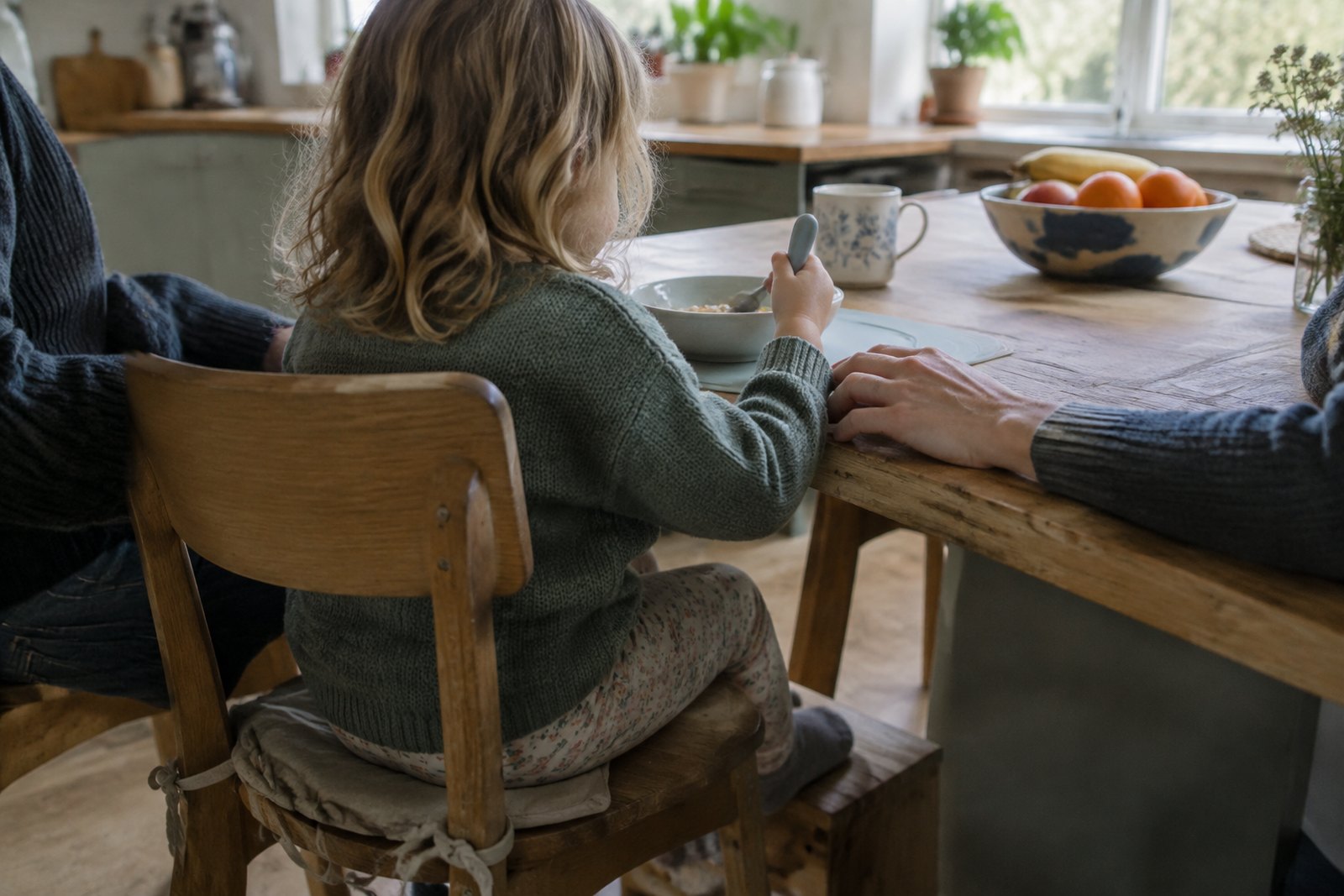
Children with Down syndrome (often called Down's syndrome in the UK) learn the same everyday skills as other children: feeding themselves, getting dressed, using the toilet, holding a pencil. Most get there. It usually takes longer, and the route is a little different. The reasons are mostly physical. Lower muscle tone, looser joints and smaller hands with shorter fingers make fine motor tasks harder work, and many children need more repetition and more time to learn each new step.
The encouraging part is that all of this is very teachable. Good seating, easier clothes and tools, tasks broken into small steps and practice that is little and often make a real difference. Many children with Down syndrome are sociable, love to copy and learn well by watching, and those are genuine strengths to build on. An occupational therapist can help when you are stuck on a particular skill, but most of the progress happens at your kitchen table, in the bathroom and on the bedroom floor.
Why everyday skills can take longer
It helps to know what is going on underneath, because it changes how you help.
Low muscle tone
Most children with Down syndrome have hypotonia, or low muscle tone. Muscles feel softer at rest and it takes more effort to hold a position. A child who is working hard just to sit upright has less left over for the fiddly job in front of them. You may see slumping at the table, leaning on one elbow, propping the head on a hand or tiring quickly. Our guide to low muscle tone in children explains this in more detail.
Loose joints
Ligaments are often more lax, so fingers, wrists, ankles and knees can move further than usual. In the hand, this can mean the small finger joints bend backwards or collapse when your child presses, which makes a steady pencil grip, pinching a button or squeezing a toothpaste tube harder. It is part of the condition, not something you have caused or failed to fix.
Smaller hands and shorter fingers
Many children have broader hands, shorter fingers and a thumb that sits a little lower on the hand. Cutlery, scissors and pencils designed for typical hands can simply be the wrong size. Chunkier handles, smaller scissors and short pencils often suit much better.
Other things worth checking
Eyesight and hearing problems are more common in children with Down syndrome, and both affect how easily a child picks up new skills. If your child seems to be struggling more than you would expect, ask whether their vision and hearing checks are up to date. Many children also learn best visually, so showing a task usually works better than explaining it.
Start with posture and support
Before any fine motor task, look at how your child is sitting. It is the easiest change you can make and it often helps more than anything else.
- Feet flat on the floor, or on a firm box or step. Dangling feet make the whole body less stable.
- Hips and knees roughly at right angles, bottom right at the back of the seat.
- Table at about elbow height with the arms relaxed. A firm cushion on the chair or a lower table can sort this out.
- Forearms resting on the table, which gives the hands a steady base to work from.
Build strength through play rather than formal exercise. Crawling through tunnels, wheelbarrow walking, pushing a laundry basket full of toys, lying on the tummy to play, climbing at the park and carrying the shopping bag in from the car all help. Strong shoulders and a steady trunk give the hands something to work from. A physiotherapist leads on gross motor development such as sitting, walking and balance, and can advise on what suits your child.
Feeding and using cutlery
Mealtimes combine hand skills, mouth skills, sitting and attention, so it is no surprise they can be slow going. Some practical ideas:
- Start with finger foods and a spoon. Use thicker foods that cling to the spoon, such as yoghurt, porridge or mashed potato, before moving on to runny soup.
- Try spoons and forks with short, chunky handles that fill a small palm. A shallow spoon bowl is easier to clear with the lips.
- A bowl with high sides or a plate with a raised edge gives your child something to push food against. A non-slip mat underneath stops it chasing round the table.
- Offer small amounts in an open cup or a cup with a cut-out rim as well as a beaker. A speech and language therapist can tell you which suits your child.
- Use hand-over-hand help at first, then move your hand back to the wrist, then the elbow, as your child takes on more of the movement.
Knife skills come later for most children. Start with spreading soft butter on toast, then cutting soft foods such as banana, pancake or cooked pasta.
When to get help: if your child often coughs, chokes or gags at meals, has a wet or gurgly voice after drinking, has frequent chest infections, or you are worried about weight or how little they eat, speak to your GP or paediatrician and ask about a speech and language therapy referral. Speech and language therapists lead on chewing and swallowing. An occupational therapist can help with seating, cutlery and the sensory side of eating. If your child is choking and cannot breathe, call 999.
Dressing
Dressing is a long chain of small steps, and it calls on balance, body awareness and finger strength all at once. A few changes make it far more manageable.
- Sit down to dress. Sitting on the floor with their back against a wall, or on a low stool, takes balance out of the equation.
- Teach undressing first. Taking things off is easier than putting them on and gives early success.
- Use backward chaining. You do every step except the last one. For a sock, you pull it over the heel and your child pulls it up. Once that is reliable, leave the last two steps. Your child always finishes the job and gets the "I did it" moment.
- Choose easier clothes. Elasticated waists, wide necks, slightly roomy fits, shoes with touch-and-close straps, bigger buttons and loops or rings on zips all help.
- Add visual cues. A simple picture sequence on the wall, a mark or picture inside the back of a top, and clothes laid out in the order they go on.
Our guide to teaching children to dress themselves walks through the stages. Expect your child to move through them at their own pace, and measure progress against where they were last term, not against classmates.
Pre-writing, drawing and handwriting
Handwriting rests on a lot of earlier skills: a steady trunk, strong shoulders, a stable wrist and fingers that can move separately from each other. Rushing to letters before these are in place tends to end in frustration on both sides.
Building hand strength through play
- Play dough or therapy putty: rolling, squeezing, pinching and hiding small objects to dig out.
- Posting coins or buttons into a slot in a box lid. Supervise closely with small objects.
- Pegs on the edge of a box, tongs to move pom-poms, tearing paper, peeling and placing stickers.
- Working on an upright surface, such as an easel, paper taped to the wall or the window with washable chalk pens. This naturally brings the wrist into a good position.
Pre-writing shapes
Children usually learn to copy lines and shapes in a rough order: a straight line down, a line across, a circle, a cross, a square, then diagonal lines and a triangle. Practise them big and messy first, in shaving foam, sand, finger paint or with a wet paintbrush on a fence, before shrinking down to paper.
Pencils, grips and alternatives
Short, chunky crayons, or ordinary crayons snapped in half, encourage a fingertip grip. Triangular pencils, soft pencil grips and a sloped writing surface help some children. Do not force a textbook grip if your child has one that is comfortable and works. Our guide to fine motor skills activities by age has more ideas. As children get older, typing or using a tablet alongside handwriting can be a sensible way to get their ideas down, and this is worth discussing with school.
Toileting
Many children with Down syndrome are toilet trained later than their peers, and that is fine. Look for signs of readiness: staying dry for an hour or two, noticing a wet or dirty nappy, or showing interest when others use the toilet.
- Make it stable. A child seat insert and a footstool so feet are flat. A child who feels wobbly cannot relax enough to go.
- Build a routine. Short, relaxed sits at regular times, such as after meals and drinks.
- Show the steps. A picture sequence by the toilet, including pulling clothes down, wiping, flushing and handwashing.
- Keep clothes simple. Elasticated trousers that come down in one easy pull.
Constipation is common in children with Down syndrome and makes toilet training much harder. If your child has hard stools, strains, finds pooing painful or soils, speak to your GP. Our guide to toilet training a child with additional needs covers the process step by step.
Play, independence and strengths to build on
Children with Down syndrome often learn well by copying, enjoy routine, respond warmly to praise and are motivated by the people around them. Use all of that.
- Give real jobs: putting socks in the wash basket, laying spoons on the table, watering plants, unpacking the shopping.
- Let siblings and friends model a task. Many children will copy a brother or sister before they will copy a parent.
- Use a simple picture timetable for the morning or bedtime routine.
- Wait before you help. Counting slowly to ten in your head gives your child time to try, which is often all they needed.
- Praise the effort and the specific step: "you pulled your sock right up" lands better than "good job".
Everything takes longer when your child does it. On a rushed school morning that is not always possible, so pick one or two skills to practise properly at calmer times, such as weekends, and help freely with the rest.
Neck instability: a caution about trampolines and some sports
Some people with Down syndrome have looser ligaments at the top of the neck, sometimes called atlantoaxial instability. Rarely, this can put pressure on the spinal cord. Advice on screening has changed over the years, so ask your child's paediatrician or GP what applies to your child now.
Before your child starts trampolining, gymnastics, diving, contact sports or anything involving somersaults, headstands or a lot of strain on the neck, talk to their doctor. Some clubs and sports bodies have their own rules too. This does not mean your child should avoid being active. Swimming, walking, dancing, the park and many sports are good for strength and confidence.
Know the warning signs: neck pain or stiffness, a new head tilt, changes in walking or more frequent falls, new weakness or clumsiness in the hands, or changes in bladder or bowel control. If you notice any of these, get medical advice the same day from your GP or NHS 111. If symptoms come on suddenly or after a fall or injury, call 999 and try to keep your child's head and neck still.
Support at school
In England, many children with Down syndrome have an Education, Health and Care Plan (EHCP), and others are supported through SEN support in school. If you think your child needs more help than school can give from its own resources, you can ask your local council for an EHC needs assessment. Wales, Scotland and Northern Ireland use different systems and names, so check with your local council or education authority.
Practical things worth asking school about include:
- A chair and table at the right height, with a footrest if needed.
- A sloped writing board, chunkier pencils and easier scissors.
- Extra time and simple clothing for getting changed for PE.
- A toileting plan agreed with you, including who helps and how.
- Visual timetables and step-by-step picture prompts.
- Typing or other ways to record work alongside handwriting.
Occupational therapy advice can be written into an EHCP, which makes it clearer what school should provide.
Where an occupational therapist fits
An occupational therapist looks at the everyday things your child needs and wants to do: eating, dressing, washing, toileting, playing and managing at school. A children's occupational therapist can:
- Watch your child doing real tasks and work out exactly which part is getting in the way.
- Advise on seating, positioning and set-up at home and school.
- Break skills into small steps and show you how to teach them.
- Recommend equipment such as adapted cutlery, toilet seats, steps and writing aids.
- Write reports that can support school planning or an EHCP.
NHS children's occupational therapy is usually reached through your GP, paediatrician, health visitor or school, and waiting times vary by area. Some families also use a private occupational therapist who visits at home. If you go private, check the therapist is registered with the HCPC.
Occupational therapy is one part of the team. Your paediatrician leads on your child's health, including heart, thyroid and neck checks. A physiotherapist leads on walking, balance and gross motor skills. A speech and language therapist leads on communication, chewing and swallowing. Vision and hearing services look after eyes and ears. The Down's Syndrome Association offers information and support for families.
Frequently asked questions
At what age will my child with Down syndrome feed or dress themselves?
There is no fixed timetable. Children with Down syndrome usually reach these skills later than other children, and the range between individual children is wide. It is more useful to compare your child with where they were a few months ago than with a chart.
Does every child with Down syndrome need occupational therapy?
Not necessarily. Many families manage well with good general advice. Occupational therapy is most useful when your child is stuck on a skill, when seating or equipment is a question, or when school needs clear recommendations.
Will adapted cutlery or easy clothes stop my child learning the harder way?
Usually not. The right tool lets your child succeed now, which builds confidence and practice. Many children move on to standard cutlery or fastenings later, and some keep the easier version because it works. Both are fine.
Is it safe for my child to go on a trampoline?
Ask your child's paediatrician or GP first, because of the possibility of neck instability. They can advise on trampolines, trampoline parks, gymnastics and similar activities for your child specifically.
Should my child learn to type instead of write by hand?
Often the answer is both. Handwriting is still worth practising, but typing or a tablet can let your child show what they know without being held back by slow or tiring writing. School can help decide the balance.
Can an occupational therapist help with an EHCP?
Yes. An occupational therapy report can describe your child's everyday needs and recommend specific support, equipment and adjustments, which can then be considered as part of the plan.
Next steps
See our children's occupational therapy page, or current guide prices, and choose your area below.

Talk to an occupational therapist near you
This guide is general information. For advice about your own situation - or someone you look after - a local occupational therapist can visit you at home and see it for themselves.
Choose your area: