

Toilet Training a Child With Autism or Additional Needs
By Mobile Occupational Therapist • 2 October 2026 • 14 min read
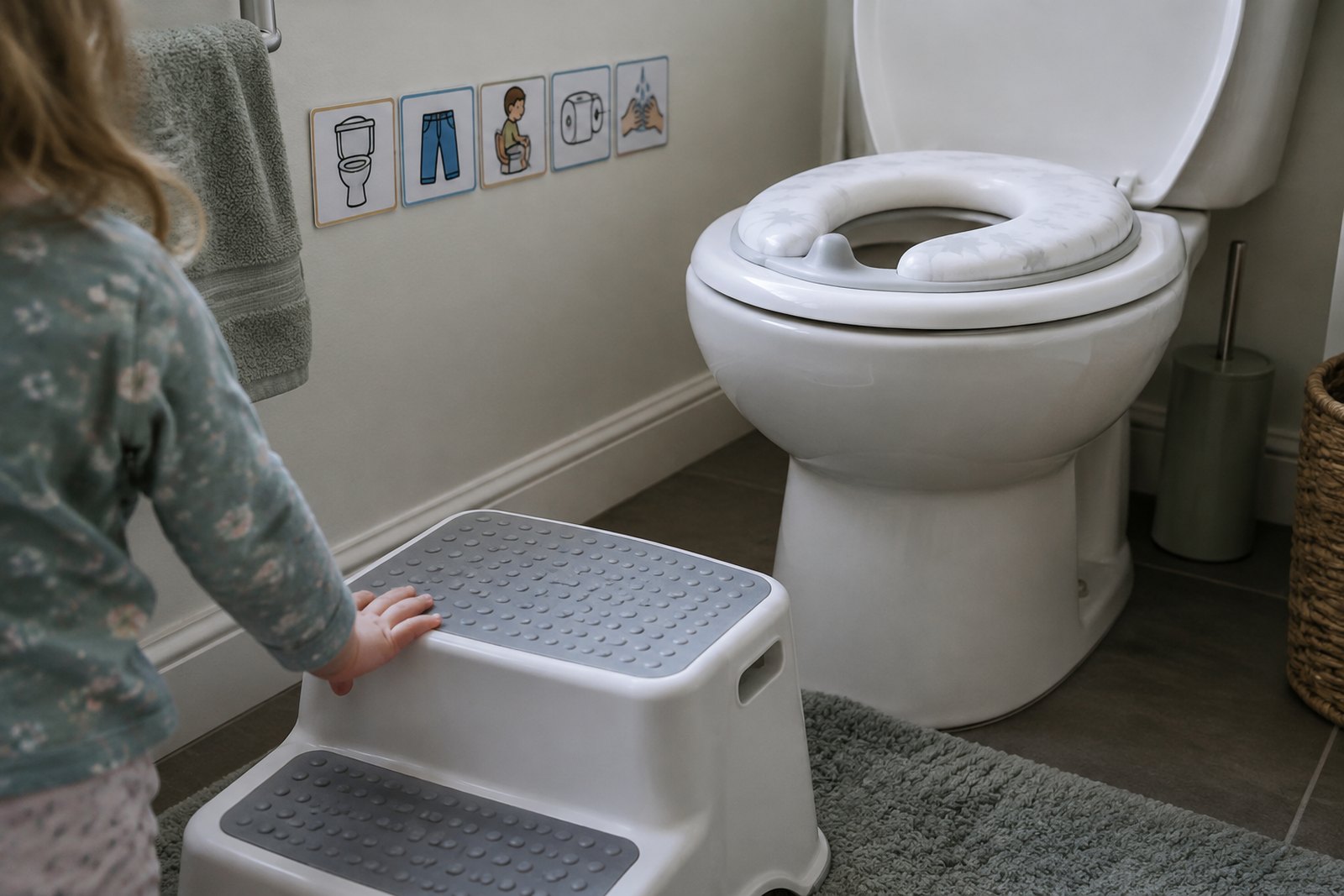
Toilet training a child with autism or additional needs usually works, but it rarely works on the timetable in the leaflets. Age is a poor guide. What matters more is whether your child's body is ready, whether they understand what is being asked of them, and whether the bathroom itself feels bearable. For many autistic children the toilet is loud, cold, echoey and smelly, and they may not feel the signal that they need to go until it is already happening.
So the short answer is this. Look for readiness signs rather than birthdays. Fix the sensory problems before you push. Make the routine visual and the same every time. Get any constipation treated through your GP first, because it quietly derails more toilet training than anything else. And expect it to take longer than it did for other children you know. Taking longer is not failing. Free help exists through NHS children's continence services, and ERIC, the children's bowel and bladder charity, has advice written for exactly this situation.
Is your child ready? Signs that matter more than age
Most toilet training advice assumes a child who talks, copies other children and wants to be like the big kids. Yours may do none of that and still be ready. These are the signs worth looking for:
- Dry spells. The nappy stays dry for an hour or more at a time. This tells you the bladder is starting to hold and empty properly rather than dribbling.
- Predictable poos. They tend to happen at similar times of day, often after a meal.
- Some awareness. Going quiet, hiding behind the sofa, standing still, pulling at the nappy, or getting upset when wet or soiled. Hiding to poo is a very good sign. It means your child knows something is happening.
- Sitting tolerance. They can sit for a minute or two, even if it is with a favourite toy.
- A way to communicate. Not necessarily words. A sign, a gesture, a picture card or leading you by the hand all count.
- Following a simple routine they already know, such as the steps of getting ready for bed.
You do not need every box ticked. If you are unsure, keep a simple diary for a week or two. Check the nappy at regular times through the day and note whether it is dry, wet or dirty. Patterns appear quickly, and the diary is exactly what a continence nurse or occupational therapist will want to see later. If your child is never dry for more than a few minutes, mention it to your GP or health visitor, because that is worth checking in its own right.
Sensory barriers: why the bathroom can feel like a hostile place
A child who screams at the bathroom door is often not being difficult. They may be reacting sensibly to a room that genuinely hurts. Work out which part bothers them and you can usually do something about it.
Noise and echo
Hard tiles and a small room make every sound bounce. The flush is sudden and loud, and an extractor fan or hand dryer can be worse. Try not flushing until your child has left the room, or letting them press the flush from the doorway once they are ready, so they are in control of when it happens. A soft bath mat, towels on the rail and a fabric blind all reduce echo. Some children cope better with ear defenders on for bathroom trips at first.
Cold, hard and wobbly
A cold seat on bare skin is a shock. A padded or fabric-covered seat reducer helps, as does warming the room first. The bigger issue is often the feeling of falling. An adult toilet seat is a large hole, and a child whose feet dangle feels unstable. That fear alone can stop them relaxing enough to wee or poo. Solid foot support (more on that below) makes a real difference.
Smell and light
Strongly scented cleaning products, air fresheners and bleach can be overwhelming. Switch to unscented where you can and air the room. Bright overhead lights and flickering bulbs bother some children. A softer lamp or leaving the door ajar to let in landing light may help.
Interoception: not feeling the need to go
Interoception is the sense that tells you what is happening inside your body: hunger, thirst, a full bladder. Many autistic children and children with developmental differences have muted or confusing signals. They genuinely do not feel the need to wee until it is too late. This is why timed toilet trips matter more than asking "do you need the toilet?", which your child may honestly answer no to. You can also help build body awareness by naming sensations out loud during the day ("your tummy is making noises, I wonder if it is hungry") and noticing the signs you see before an accident. Some children also benefit from wider sensory support across the day; our guide to a sensory diet at home explains how that works.
Making the toilet physically comfortable
For both wees and poos, a stable position is half the battle.
- Feet flat on something solid. A sturdy step stool in front of the toilet, wide enough for both feet. For poos, knees slightly higher than hips is the easiest position for the body to empty.
- A seat reducer that fits your toilet firmly and does not slide. Some come with built-in steps and handles, which suit children who like to climb up independently.
- Potty or toilet? Many autistic children struggle with change, so learning on a potty and then switching to the toilet means two lots of learning. Going straight to the toilet often works better. If your child prefers a potty, keep it in the bathroom so the place stays the same.
- Extra support. Children with low muscle tone, poor balance or physical disabilities may need a specialist toilet seat with a backrest, side supports or a strap. These are not something to guess at. An occupational therapist can assess what is needed, and they are sometimes available through children's community equipment services.
Visual schedules and a routine that never changes
Words disappear. Pictures stay. A visual schedule breaks toileting into small steps your child can see: pants down, sit, wee or poo, wipe, pants up, flush, wash hands. Photos of your own bathroom often work better than cartoons. Stick the strip at your child's eye level where they sit. For some children a simple "now and next" card is enough: now toilet, next favourite snack.
Then make the routine boringly consistent:
- Sit at set times, not just when asked. On waking, after each meal and drink, before going out and before bed are common times. After meals is especially useful for poos because the gut naturally gets moving then.
- Keep sits short. A few minutes, timed with a sand timer or a short song. Long sits become a battle.
- Use the same few words every time. Everyone in the family, and nursery or school, should use the same words for wee, poo and toilet.
- Reward immediately and specifically. A sticker, a bubble, a minute of a favourite thing, given straight away. Praise sitting at first, not just success.
- Stay neutral about accidents. Clean up calmly, involve your child in the steps, say nothing much. Big reactions, good or bad, can make some children anxious or turn accidents into an interesting game.
Showing helps too. Letting your child see a parent or sibling use the toilet, or using a doll or a social story about the routine, gives them a model to copy.
Clothing that helps rather than hinders
Once you start daytime training, most continence specialists suggest moving to pants during the day. Pull-ups feel very like nappies, so your child may not notice the difference between wet and dry, which is the whole point. Choose loose trousers with elastic waists and no buttons, zips or belts, so getting undressed takes seconds.
Sensory sensitivities can get in the way here. Some children hate the feel of pants, or tight elastic, or seams. Try different fabrics, seam-free styles or slightly larger sizes. A child who hates being wet may train faster in pants. A child who does not notice wetness at all may need more frequent timed trips while their body awareness catches up.
Constipation: the hidden barrier
Constipation is common in all children and especially common in autistic children and those with developmental delay, partly because of restricted diets, low fluid intake and holding on. It is the single most overlooked reason toilet training stalls.
Signs to look out for include pooing fewer than three times a week, hard or very large poos, straining or pain, tummy ache, poor appetite, and children who stand on tiptoe, cross their legs or hide to hold poo in. One sign confuses many parents: soiling with loose or runny poo. This can be overflow, where liquid poo leaks around a hard blockage. It looks like diarrhoea but is actually constipation.
A child who is constipated finds pooing painful, so they hold on, which makes the next poo harder, and the cycle tightens. No amount of reward charts will fix this. Book a GP appointment. Constipation in children usually needs proper treatment and a plan, and NICE has guidance for doctors on this. Follow the plan your GP gives you and go back if it is not working. Diet and drinks matter, but on their own they are rarely enough once constipation is established, and selective eating is not something you can simply override.
Get medical help the same day through your GP or NHS 111 if your child has severe tummy pain, a swollen tummy, is vomiting, has blood in their poo or seems unwell. Call 999 if they are seriously unwell.
Managing nursery and school
Talk to nursery or school early, ideally before term starts. Ask for a written toileting or intimate care plan that sets out:
- Your child's timed toilet trips and who will prompt them.
- The same visual schedule and words you use at home.
- Which toilet they use (a quieter or accessible toilet is often easier than a noisy shared block).
- Spare clothes, wipes and where they are kept.
- Permission to go whenever they need to, without asking in front of the class.
- How accidents are handled discreetly.
A school should not refuse your child a place, or expect you to come in to change them, simply because they are not yet toilet trained. For a disabled child this is likely to be discrimination under the Equality Act 2010 in England, Scotland and Wales, or under equivalent disability discrimination law in Northern Ireland. ERIC and the charity Contact both explain your child's rights in more detail. If toileting is one of several significant needs at school, it may belong in an Education, Health and Care plan; our guide to EHCPs and what an occupational therapy report adds explains the process in England.
Night-time
Night dryness is a separate skill controlled by different body signals, and it usually comes later than daytime dryness. Keep using nappies or pull-ups at night while you work on days. There is no need to wake your child or restrict drinks in the evening without advice.
Bedwetting is common in young children and is not usually treated as a concern in the early years. If your child is over five and still wet most nights, or was dry and has started wetting again, speak to your GP or school nurse. Treatment options exist, and constipation is often part of the picture at night too.
When it takes longer, and the help that is free
Some children train within weeks. Some take years. Some will need ongoing support. All of that is normal for children with additional needs. If progress has stalled, take a break of a few weeks rather than grinding on, then restart with one small change.
NHS children's continence services (sometimes called bladder and bowel services) can assess your child, support toilet training and, in many areas, supply nappies or pads free once a child reaches a certain age and is not yet toilet trained. Criteria and ages vary by area. You can usually be referred through your health visitor, school nurse, GP or paediatrician. Our guide to free incontinence pads and NHS continence services explains how to ask. Getting products does not mean giving up on training. Keep the routine going alongside them.
ERIC has a helpline, information for parents of children with additional needs, and guidance you can share with school. It is a good first stop when you feel stuck.
Where an occupational therapist fits
An occupational therapist looks at the practical and sensory side of toileting. A private occupational therapist visiting at home can:
- Assess the sensory barriers in your bathroom and suggest specific changes.
- Check sitting balance, posture and foot support, and recommend the right seat reducer, step or specialist toilet seat.
- Work on the motor skills involved: pulling clothes up and down, wiping, washing hands.
- Build visual supports and a routine that suits how your child thinks.
- Write a report that school, the continence service or an EHCP assessment can use.
Our guide to occupational therapy for autistic children explains what a typical assessment looks like.
Be clear about the limits. An occupational therapist does not treat constipation, bladder problems or bedwetting; that is your GP, paediatrician and the continence nurse. A speech and language therapist is the right person if your child needs a communication system to tell you they need the toilet. A physiotherapist may lead if posture or muscle tone needs therapy rather than equipment. The best results come when these people share the same plan.
Frequently asked questions
At what age should an autistic child be toilet trained?
There is no fixed age. Readiness signs matter far more than birthdays, and many children with additional needs train later than their peers. If your child is older and showing no signs at all, talk to your health visitor, school nurse or GP about a continence referral.
Should we use a potty or go straight to the toilet?
Many autistic children do better going straight to the toilet, because it avoids learning one routine and then switching. Make it comfortable with a seat reducer and a solid step. If a potty works better for your child, keep it in the bathroom.
My child will only poo in a nappy. What can I do?
This is very common. Rule out constipation with your GP first. Then move in small steps: pooing in the nappy in the bathroom, then sitting on the toilet wearing the nappy, then loosening it, then cutting a hole in it, so the change happens gradually. ERIC has detailed advice on this.
Can school refuse my child because they are not toilet trained?
A school should not refuse a place or require you to come in to change your child simply because they are not toilet trained. This is likely to be disability discrimination. Ask for a toileting plan, and contact ERIC or Contact for guidance if you hit resistance.
Do I need a diagnosis to get help?
No. Continence services and occupational therapists work with the difficulties your child has, whether or not there is a formal diagnosis. A diary of wees, poos and accidents is more useful at a first appointment than a diagnosis letter.
How long will it take?
Honestly, nobody can tell you. It depends on your child's readiness, sensory needs, constipation and how consistent the routine can be across home and school. Progress is often uneven, with good weeks and setbacks. Measure it against where your child was a few months ago, not against other children.
Next steps
If toileting is stuck and you would like practical help at home, see our children's occupational therapy page, or current guide prices, and choose your area below.

Talk to an occupational therapist near you
This guide is general information. For advice about your own situation - or someone you look after - a local occupational therapist can visit you at home and see it for themselves.
Choose your area: