

Electric Wheelchairs: How to Choose One and How to Get One
By Mobile Occupational Therapist • 7 October 2026 • 13 min read
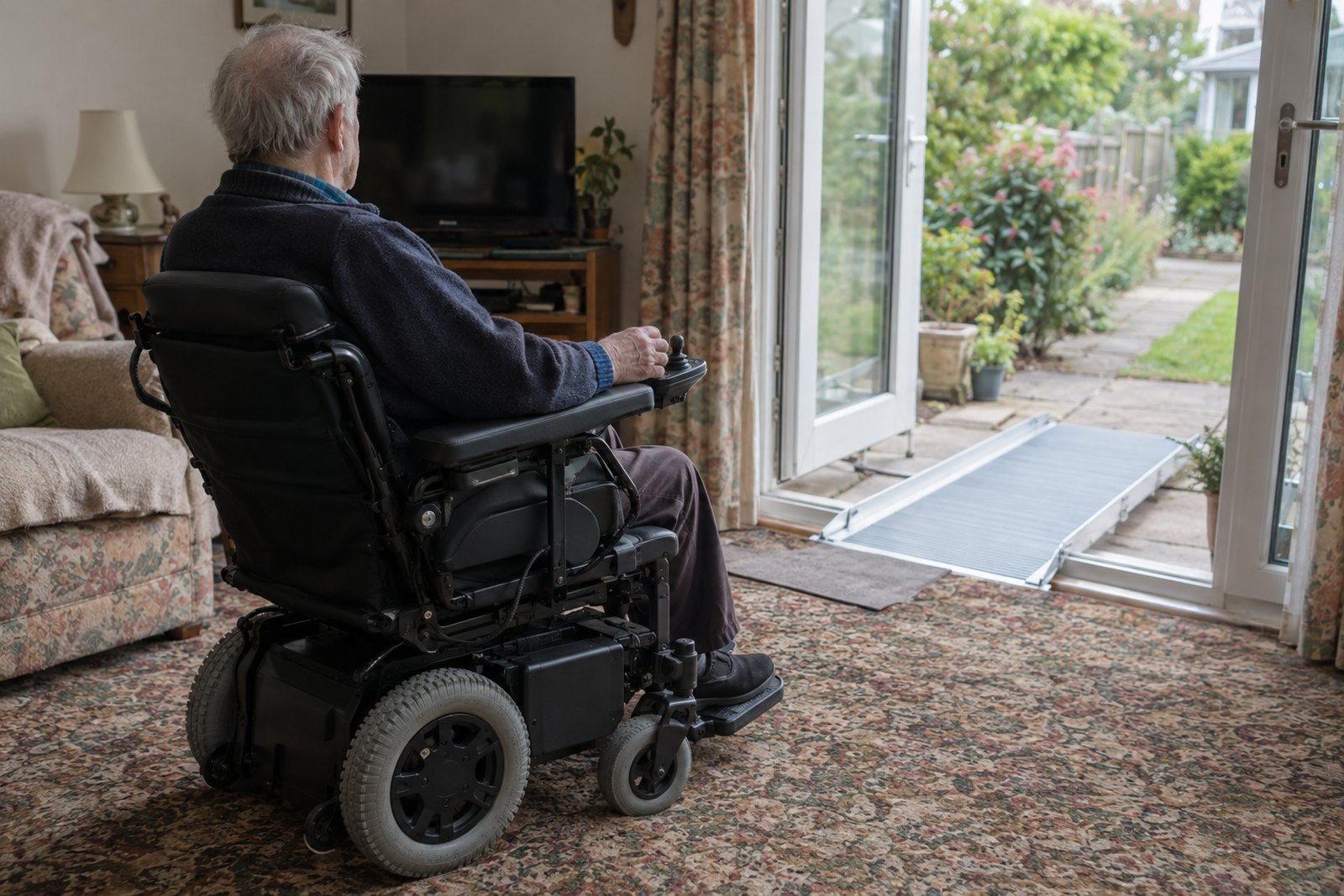
An electric wheelchair, also called a powered wheelchair or powerchair, is a wheelchair driven by batteries and motors and usually steered with a joystick. It suits people who need a wheelchair but cannot push themselves, or cannot push themselves far, because of weak arms, pain, breathlessness, fatigue or a condition that gets worse with effort. You can get one through your local NHS wheelchair service if you meet their criteria, or you can buy one privately.
The short answer to "which one?" is: get assessed before you spend money. The right chair depends far more on your body, your home, your car and where you actually want to go than on anything in a brochure. A powerchair that is too wide for your doorways, too heavy for your boot or wrong for your posture is an expensive thing to park in the hall. This guide explains the types, the road rules, the NHS route, personal wheelchair budgets, and what to check if you buy privately.
The different types, in plain English
Powered wheelchairs and powerchairs
These are the same thing under different names. Within that, there is a wide range:
- Folding or lightweight travel chairs. Smaller frames that fold, often with removable batteries. Handy for car boots and holidays, but they usually have less range, less comfortable seating and struggle more on rough ground and kerbs.
- Standard indoor and outdoor chairs. Rigid frames that do not fold. More stable, more comfortable for long days, better batteries. Heavier and bigger.
- Outdoor chairs with suspension. Built for longer distances, grass and uneven paths. Often too large to be easy indoors.
- Complex powerchairs. Chairs with powered tilt-in-space, recline, seat raise, elevating legrests or alternative controls such as head, chin or switch controls for people who cannot use a hand joystick.
Where the drive wheels sit matters too. Front, mid and rear wheel drive chairs turn and climb differently. Mid wheel drive chairs tend to turn tightly, which helps indoors; others may feel more stable on slopes or kerbs. Do not choose on paper. Drive them.
Attendant-controlled chairs and power packs
Some powered chairs have a second control on the push handles, so a carer can drive when the user is tired or unwell. That is called dual or attendant control.
A power pack is different. It is a motor unit fitted to an ordinary manual wheelchair so the person pushing does far less work, controlled from a small unit on the handles. The person sitting in the chair does not drive. Power packs are often the answer when a husband, wife or adult child is wearing themselves out pushing up hills, or when the carer is older and has their own health problems. There are also power-assist wheels for people who can self-propel but run out of energy, which add a boost each time they push.
Mobility scooters
A scooter is steered with handlebars on a column, called a tiller. To use one safely you need to sit upright without support, use both arms to steer, and get on and off fairly easily. Scooters are mostly outdoor vehicles. They need a lot of room to turn and are rarely practical inside a typical home. If you have good sitting balance and only struggle with walking distance outdoors, a scooter may suit you better. Our honest guide to mobility scooters covers that choice in detail.
Class 2 and class 3: the rules in general terms
The law groups powered wheelchairs and scooters into classes. GOV.UK sets out the rules, and you should check the current page before buying, but in general terms:
- Class 2 chairs and scooters are for pavements and indoor use, with a maximum speed of 4mph. Most indoor and outdoor powerchairs are class 2.
- Class 3 vehicles can do up to 4mph on pavements and up to 8mph on the road. They must be registered with the DVLA, have equipment such as lights, indicators and a horn, and the driver must be at least 14.
You do not need a driving licence for either class. Insurance is not a legal requirement, but it is strongly advised, especially for third-party cover in case you hit someone or damage property. GOV.UK also explains where you cannot drive, such as motorways, and gives an eyesight guideline. If you are not sure you can see well enough, get your eyes tested before you take to the pavement.
Who an electric wheelchair suits
Powered chairs tend to help people who:
- cannot push a manual wheelchair at all, or not far enough to be useful
- have weakness, pain or limited movement in the arms or shoulders, for example after a stroke, or with arthritis, MS, motor neurone disease or cerebral palsy
- have fatigue or breathlessness that means pushing themselves uses up the energy needed for everything else, such as with COPD, heart failure or long COVID
- want to get around on their own rather than relying on someone to push them
To drive one safely, you also need to be able to learn the controls, judge gaps and distances, notice hazards like pedestrians and dropped kerbs, and stop in time. Problems with vision, memory, attention or judgement do not automatically rule someone out. Alternative controls, attendant controls, slower speed settings and practice can all help. But they need to be assessed honestly. If thinking or eyesight has changed recently, see your GP or optician first, because the cause matters.
Getting one through the NHS wheelchair service
Every area of the UK has an NHS wheelchair service. Referral usually comes from your GP, a physiotherapist, an occupational therapist or a community nurse, and some services accept self-referral. Our guide to NHS wheelchair services walks through the process step by step.
Each service sets its own eligibility criteria, so ask for them in writing. In general, powered chairs are offered to people who:
- have a long-term need for a wheelchair
- cannot self-propel a manual chair effectively
- are assessed as able to use a powered chair safely
Assessment is usually for indoor use first. Outdoor use is often assessed separately, and some services are more limited in what they provide for outdoor-only needs. Expect questions about your daily life, a look at your posture and seating, and a driving assessment, sometimes in clinic and sometimes at home. Someone may check your home access before a chair is issued.
An NHS chair is on loan. The service usually arranges repairs and maintenance through an approved repairer, which takes a lot of worry off your hands. If your needs change, ask to be reviewed rather than struggling on.
Personal wheelchair budgets
In England, if you are eligible for an NHS wheelchair, you have a right to a personal wheelchair budget. In plain terms, this is the value of the chair the NHS would provide for your assessed need. Depending on local arrangements, you can usually let the service provide the chair as normal, or put the budget towards a chair from another supplier, sometimes adding your own money for features beyond your assessed need. If you go outside the standard route, ask clearly who pays for repairs, servicing and replacement batteries. Arrangements in Scotland, Wales and Northern Ireland differ, so ask your local service what applies.
Buying privately: what to check
Plenty of people buy their own powerchair, either because they do not meet NHS criteria, want a different type, or need it sooner. That is a reasonable choice. It just pays to be fussy.
Trial it where you will use it
Ask for a home demonstration and drive it through your actual doorways, round your hall corner, into the bathroom and out of the front door. Try a slope and a dropped kerb. Sit in it for at least half an hour, because a seat that feels fine for five minutes can hurt after an afternoon. Take someone with you who will ask the awkward questions.
Weight, folding and car transport
"Folding" does not mean light. Ask the weight of the chair with and without batteries, and who will be lifting it. Many carers cannot safely lift even a lightweight chair into a boot. Options include a boot hoist, a ramp into a larger vehicle, or a wheelchair accessible vehicle. Check whether the folded chair actually fits your boot with the parcel shelf in. If you will drive yourself and need help transferring into the car, an accredited mobility centre can advise.
Charging and range
Ask where the chair will be charged and whether you need to remove the battery to do it. You need a safe spot near a socket, out of hallways and escape routes. Range figures are usually measured in ideal conditions. Hills, cold weather, heavier users and rough ground all cut it. Plan your usual trips with a margin. If you plan to fly, check the airline's battery rules well before travelling.
Servicing, repairs and insurance
A broken powerchair can leave you stuck indoors. Before you buy, ask: who services it, how often, what it costs, how quickly they come out to repairs, and whether a loan chair is available. Check the warranty, especially on batteries and the controller. Arrange insurance that covers theft, accidental damage, breakdown and third-party liability.
Money
If you have a long-term illness or disability, you may not have to pay VAT on a powered wheelchair. Our guide to VAT relief on disability equipment explains who qualifies. If you get the higher rate of a mobility benefit such as the enhanced mobility component of PIP, you may be able to lease a powered chair or scooter through the national lease scheme that uses that benefit, and GOV.UK explains how. If you need the chair for work, Access to Work may help. Some charities and grant-givers also help with costs.
Second-hand chairs
Used chairs can be good value, but a chair set up for someone else may not fit you, and batteries age even when unused. Ask for its service history, have it checked by a qualified repairer, and budget for new batteries.
Seating and pressure: the bit people skip
People often choose a powerchair for its wheels and forget they will sit in it for hours. Seat width, seat depth, back height, footplate height and armrest position all affect comfort, posture and how well you can reach things. A seat that is too deep pushes you into a slump; footplates set too high put pressure on your bottom.
Anyone who sits for long periods and cannot easily shift their weight is at risk of pressure sores. The cushion matters as much as the chair. Read our guide to wheelchair cushions and preventing pressure sores, and check your skin daily. Powered tilt can help some people relieve pressure through the day. If you have complex postural needs, such as a spine that curves or a body that slides or leans, specialist seating from the NHS wheelchair service is usually the right route.
Will it work in your home?
Before buying, walk round with a tape measure:
- Doorways. Measure the clear gap with the door fully open, not the frame. Allow room for hands and elbows beyond the chair's overall width.
- Turning space. Where will you turn round? Tight halls and corners into rooms catch out more people than narrow doors.
- Thresholds and steps. Even a small lip at a back door can stop a chair. Our guide to ramps, rails and thresholds explains the options.
- Where it lives. You need somewhere to park and charge it that does not block an exit.
- Flats. Check the lift is big enough and that communal doors can be opened from a chair.
If your home needs changes such as door widening, ramps or a level access shower, an occupational therapy assessment is usually the starting point, and it can support a Disabled Facilities Grant application. See our home adaptations page.
Where an occupational therapist fits
NHS wheelchair services are staffed by a mix of occupational therapists, physiotherapists and rehabilitation engineers, and they lead NHS provision. A private occupational therapist cannot issue an NHS chair.
What a private occupational therapist visiting at home can do is look at the whole picture: how you get in and out of bed, chairs and the toilet, how far you need to go each day, whether your home will take a powerchair, and what adaptations might be needed. They can advise on the type of chair likely to suit before you visit showrooms, check transfers in and out of a chair, and write reports to support grant applications or council requests. Powered mobility and seating are specialist areas, so ask an occupational therapist about their experience with them before booking.
Other people lead elsewhere. A physiotherapist is the right person for strength, walking and balance. Your GP should see any new or worsening weakness, pain or breathlessness. Complex postural seating normally sits with the wheelchair service. And sudden weakness on one side, slurred speech or a drooping face means call 999.
Frequently asked questions
Is an electric wheelchair the same as a powered wheelchair?
Yes. Electric wheelchair, powered wheelchair and powerchair all mean a wheelchair driven by battery-powered motors. A power pack fitted to a manual chair is different, because a carer controls it.
Can I get an electric wheelchair free on the NHS?
Possibly. NHS wheelchair services provide powered chairs on loan to people who meet their local criteria, usually a long-term need, an inability to self-propel, and being able to drive one safely. Ask your GP or therapist for a referral, or check whether your local service accepts self-referral.
Do I need a licence or insurance?
You do not need a licence. Class 3 vehicles must be registered with the DVLA. Insurance is not a legal requirement but is strongly recommended. Check GOV.UK for the current rules.
Should I get a scooter or a powered wheelchair?
If you need to use it indoors, cannot sit upright unsupported, or have weakness in one or both arms, a powered wheelchair is usually more suitable. Scooters suit people with good sitting balance and arm strength who mainly struggle with outdoor distance.
Can I travel in a car or taxi sitting in my powered wheelchair?
Only if the chair is designed and crash-tested for travelling occupied, and it is secured with proper restraints and you wear a suitable seatbelt. Many chairs are not. Ask the supplier or wheelchair service, and transfer to a vehicle seat if you can.
Can I buy one second-hand?
You can, but it may not fit you, and batteries wear out. Have it checked by a qualified repairer, ask for its service history, and make sure the seat suits your body before you pay.
Next steps
A powerchair is a big decision, and getting the home and seating right first saves money and frustration. See our equipment and aids and home assessment pages, or current guide prices, and choose your area below.

Talk to an occupational therapist near you
This guide is general information. For advice about your own situation - or someone you look after - a local occupational therapist can visit you at home and see it for themselves.
Choose your area: