

Dosette Boxes, Blister Packs and Managing Medicines at Home
By Mobile Occupational Therapist • 3 September 2026 • 9 min read
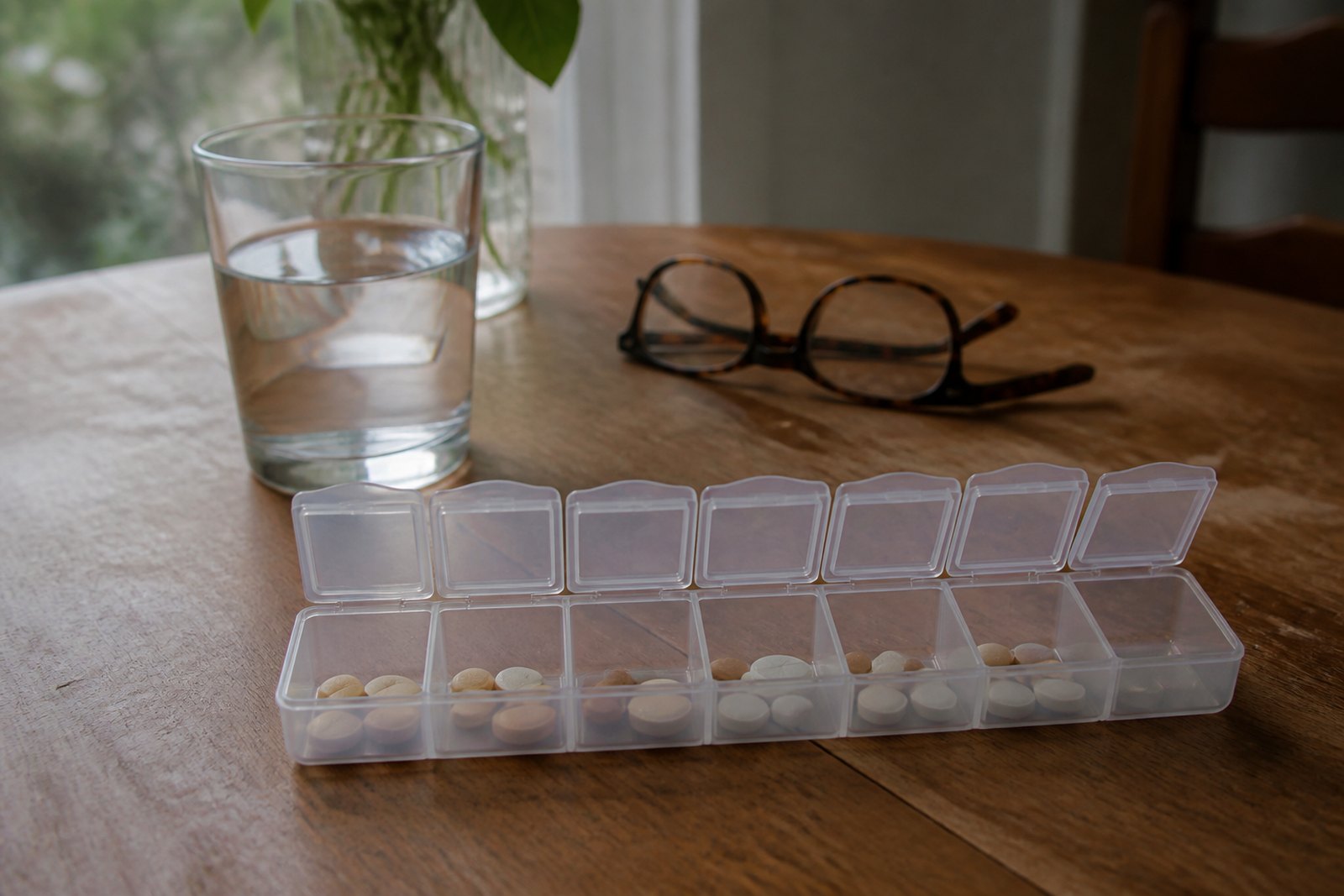
A dosette box is a tray divided into compartments - usually one row for each day of the week and one column for each time of day - so that a week's tablets can be laid out in advance and taken at a glance. If you are juggling several medicines at different times, or you keep losing track of whether you have taken this morning's dose, a dosette box or a pharmacy-filled blister pack often solves the problem outright. This guide explains the difference between the two, how to ask your pharmacy about one, what an automatic pill dispenser adds, and one thing that matters more than any of it: if doses are regularly being missed or doubled, that is a conversation with the GP or pharmacist, not just a piece of equipment to buy.
Dosette boxes and blister packs: what is the difference?
The words get used interchangeably, but there are really two different things.
- A dosette box you fill yourself. A reusable plastic tray with lidded compartments, bought from a pharmacy or online. You, or a family member, transfer tablets from their original packets into the right slots once a week. Cheap, flexible, and entirely under your control - which is also its weakness, because the person filling it has to get it right every time.
- A pharmacy-filled blister pack. Sometimes called a monitored dosage system. The pharmacy dispenses your medicines into sealed foil-and-plastic compartments, labelled with the day and time, and you push each dose through the foil. Nobody handles loose tablets at home, and each compartment is printed with what should be in it.
The sealed pack removes the filling error, which is the main reason clinicians favour it where someone is genuinely struggling. The self-filled box gives more flexibility - it copes better with medicines that cannot be removed from their original packaging, and with doses that change often.
How to ask your pharmacy, and why it is not automatic
Blister packs are not something you simply order. A pharmacy will normally assess whether you need one, and provision follows that assessment of need rather than preference alone. It is at the pharmacy's discretion, and there are good reasons for that: filling packs takes significant pharmacist time, and taking medicines out of the manufacturer's packaging genuinely changes how some of them behave.
The way to start is to speak to your community pharmacist directly and describe what is actually going wrong. Are doses being missed? Is the person unsure whether they have taken them? Are there so many boxes that the routine has become unmanageable? Can they physically open the packets? A pharmacist hearing a clear description of the difficulty can suggest the right answer, which might be a blister pack, might be a simpler medicines review to cut the number of items, or might be reminder alarms.
Ask your GP practice too. Many practices run structured medication reviews, and a review often finds that two or three items can be stopped, combined or moved to once-daily - which can make the whole problem disappear without any equipment at all. That is worth trying before you buy anything.
The safety rule that matters most
Please do not change, stop or reorganise prescribed medicines on your own initiative. That includes moving tablets out of their original packaging into a dosette box without checking first.
It sounds cautious to the point of fussiness, but there are real reasons. Some medicines absorb moisture and degrade once out of their foil. Some are light-sensitive. Some must not be crushed, split or removed from a special container. Some are dispensed weekly on purpose. And once tablets are loose in a tray, the label, the expiry date and the patient information leaflet are no longer attached to them - so if someone else has to take over, or a paramedic needs to know what has been taken, the information is gone.
So: ask a pharmacist before decanting anything, keep original packaging and labels, and never adjust doses yourself. If a medicine seems to be causing a problem, that is a call to the GP or the pharmacist, not a reason to quietly skip it.
Automatic pill dispensers with alarms
An automatic pill dispenser is a step beyond a dosette box. It is a lockable carousel or tray, filled in advance, which sounds an alarm at each dose time and only releases the compartment that is due. Once the dose is taken, or the time window passes, the lid rotates on and the remaining medicines stay locked away.
Two features make them useful. The alarm prompts someone who would otherwise forget, and the locked lid prevents double-dosing - a person who cannot remember taking their tablets physically cannot take tomorrow's today. Some models can alert a family member or a monitoring service if a dose is not taken.
They suit a specific group: someone with mild to moderate memory difficulties who can still respond to a prompt and manage the physical act of taking a tablet, but who cannot reliably keep track of time and sequence. They are less useful for someone who no longer understands what the alarm means, or who cannot get to the device - at that point the honest answer is usually carer support rather than a gadget. They also need somebody reliable to fill and reset them, which is often a district nurse, a family member or a care worker. Our guide to assistive technology at home puts dispensers in the context of the wider range of equipment available.
Simpler options are worth trying first. A phone or smart speaker alarm labelled with the medicine name, a wall chart ticked off after each dose, or a simple habit of taking morning tablets with breakfast solves a great many cases at no cost.
When arthritis makes blister packs hard to open
This one comes up on almost every home visit. Standard blister packs and child-resistant bottles need a pinch grip and a push force that painful, weak or stiff hands cannot produce. People end up attacking foil with scissors, a knife or their teeth, tablets ping across the kitchen floor, and doses get missed for entirely mechanical reasons that nobody has asked about.
- Ask for non-child-resistant lids. Pharmacies can usually supply plain screw caps instead of push-and-turn ones where there are no children in the house. You only have to ask, and most people never do.
- Ask about the container. A pharmacist may be able to dispense in a form that is easier to handle, or advise whether a particular tablet can be moved to a different container.
- Try a pill popper. Small devices that press a tablet out of a blister without needing thumb strength, available cheaply from pharmacies.
- Check the dosette box lids. Some have tiny, tight flip-lids; others open with a whole-hand push. If someone will use one daily, it is worth handling a few before buying.
- Look at the wider hand problem. Difficulty with tablets rarely arrives alone - it usually comes with jars, taps and buttons.
If painful or weak hands are the underlying issue, our guides to occupational therapy for arthritis, hand therapy at home and kitchen aids for everyday tasks cover the same problem across the rest of the day, and an OT can look at grip, joint protection and the small tools that help.
When missed doses are not an equipment problem
Here is the honest bit. If someone is regularly missing doses, taking them twice, or getting confused about which pack is which, a dosette box may not be the answer - and buying one can hide the problem for a while rather than solve it.
Regular errors usually point to one of three things: too many medicines, a change in memory or thinking, or a physical difficulty nobody has noticed. Each of those needs a different response, and all of them start with a conversation with the GP or pharmacist rather than a purchase. A medication review can simplify the regime. A memory assessment can explain the pattern. An occupational therapy assessment can identify whether the problem is memory, dexterity, vision, routine or the layout of the kitchen. It is genuinely common for the fix to be free.
Medicines are also a routine part of what we look at when someone is coming home from hospital, because that is the moment when a regime often changes completely and the old habits no longer match the new tablets.
Frequently asked questions
Can I get a dosette box on the NHS?
Community pharmacies can provide medicines in blister packs, but it follows an assessment of need and is at the pharmacy's discretion rather than being available on request. Speak to your pharmacist about the difficulties you are having and ask what they can offer. If they cannot help, a self-filled dosette box from any pharmacy is inexpensive - but check with the pharmacist first about which of your medicines can safely be decanted.
Is it safe to put all my tablets in a dosette box?
Not all of them. Some medicines must stay in their original packaging because of moisture, light, or the way they are formulated, and some should not be handled loose at all. Take your full list to your pharmacist and ask which items are suitable before you fill anything. Keep the original boxes and labels either way.
What is the best pill dispenser for someone with dementia?
It depends entirely on where they are. Early on, an alarmed dispenser with a locked lid can maintain independence for a long time. Later, when an alarm no longer means anything to the person, no device will bridge the gap and the answer is a person - family, carers or district nursing - administering medicines. An honest assessment of what the person can still do is more useful than a product comparison, and a GP, pharmacist or occupational therapist can help you judge it.
Next steps
If medicines are becoming hard to manage, start with your pharmacist and GP - a medication review and a conversation about packaging costs nothing and solves a surprising number of cases. Where the difficulty is really about hands, memory, routine or how the home is set up, an occupational therapist can look at the whole picture and suggest practical changes: see our home assessments, our equipment and daily living aids service, and our guide to everyday equipment in plain English. When you are ready, have a look at the areas we cover and our prices.
Talk to an occupational therapist near you
This guide is general information. For advice about your own situation - or someone you look after - a local occupational therapist can visit you at home and see it for themselves.
Choose your area: