

Cooking With Sight Loss: Tools and Techniques That Help
By Mobile Occupational Therapist • 14 October 2026 • 14 min read
Yes, you can keep cooking with sight loss, and plenty of people who are registered blind cook every day. What changes is how you do it. You lean more on a kitchen that never moves, strong colour contrast, good light, touch, sound and smell, plus a handful of simple pieces of equipment. Most of it costs very little, and some of it costs nothing at all.
The most useful help is often free. Your council has a sensory team (sometimes called the visual impairment team) with rehabilitation officers who visit you at home and teach safe ways to chop, pour, use the hob and label food. This guide covers what they are likely to show you, what you can start doing today, and where an occupational therapist fits in.
One thing first. If your sight has got worse suddenly, or you have lost vision in one or both eyes without warning, do not wait for a kitchen fix: call 999 or go to A&E. If the change has been gradual, see an optician or your GP, because some causes can be treated or slowed.
Start with order: a kitchen that stays the same
The single biggest change is not a gadget. It is putting everything in the same place, every time, so your hands can find things without your eyes. Sighted people get away with a messy kitchen because they can scan it. You cannot, so the kitchen has to do the remembering for you.
- Give everything a home. Tins on one shelf, jars on another, spices in a set order. Herbs and spices are easier in alphabetical order or grouped by what you cook with them.
- Put things back immediately. Not on the side to tidy later. Back where they came from.
- Keep frequently used items at the front and at waist to shoulder height, so you are not reaching into the back of high cupboards or kneeling on the floor.
- Close every door and drawer. An open cupboard door at head height is easy to walk into and is a common cause of knocks and cuts for people with sight loss.
- Keep a clear working area. One stretch of worktop that is always empty, where you prepare food. Less clutter means fewer things to knock over.
- Work on a tray. A rimmed tray holds everything for one task together and catches spills, so you are not chasing a rolling onion across the counter.
The hard part is usually other people. A partner who puts the pasta back in a different cupboard, or a grown-up child who has a helpful tidy, can undo a week of good habits. It is worth saying plainly to everyone in the house: if you move it, put it back exactly where it was.
Contrast: making things stand out
Many people with sight loss still have some useful vision, and contrast is how you get the most out of it. A white plate on a white worktop disappears. The same plate on a dark placemat is easy to find.
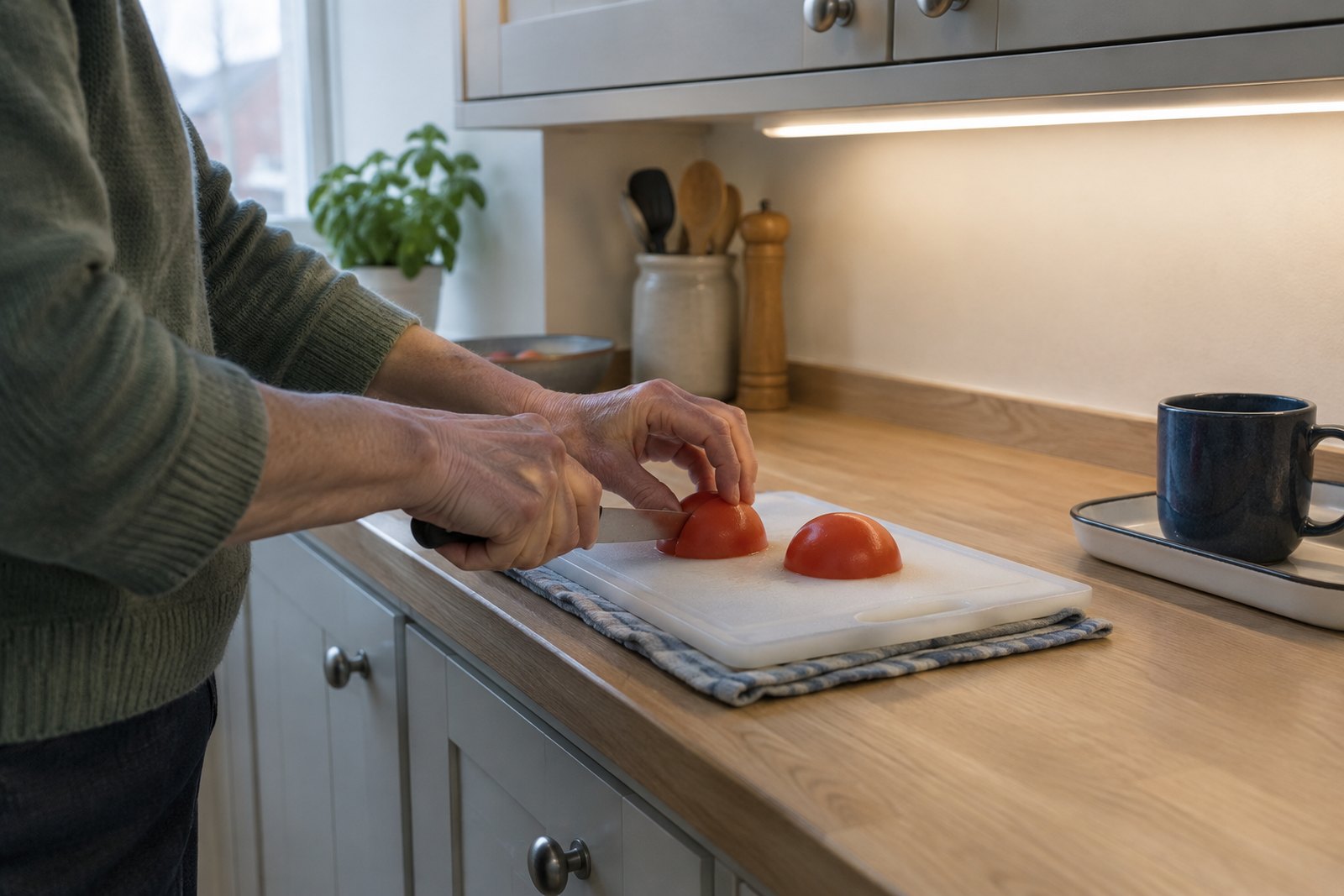
- Use two chopping boards: a dark one for pale food such as onions, potatoes, cauliflower and chicken, and a light one for dark food such as tomatoes, aubergines, red peppers and mushrooms.
- Use contrasting cups: a dark mug shows milk clearly; a pale mug shows tea or coffee.
- Put brightly coloured tape along the edges of shelves, around light switches and sockets, on cupboard handles and on the edge of any step into the kitchen.
- Choose utensils in a colour that stands out against your worktop, such as a bright handled peeler or spatula on a pale counter.
- Use a dark or bright placemat under pale bowls and plates when serving up.
Our guide to lighting and colour contrast goes into this room by room if you want to carry the idea through the rest of the house.
Lighting where you actually work
A single ceiling light behind you casts your own shadow straight onto the chopping board. What helps is light right where your hands are.
- Under-cupboard lights along the worktop are the most useful change for most people. Plug-in and battery strip lights exist if you cannot do any wiring.
- A small adjustable task lamp next to your preparation area, kept away from the hob and sink.
- Battery lights inside cupboards, including ones that come on when the door opens.
- Watch for glare. Shiny worktops and glossy tiles can bounce light into your eyes, which for some eye conditions is worse than dim light. A matt surface or a cloth under your board can help.
- Keep the light even. Moving from a bright worktop into a dark corner can leave your eyes struggling to adjust.
People differ a lot here. Some eye conditions need bright light, others are made worse by it. A low vision clinic or rehabilitation officer can advise on what suits your eyes, and our guide to low vision aids and living with sight loss at home covers magnifiers and lighting in more depth.
The hob and oven: marking dials and handling heat
Tactile markers on dials
Small raised stick-on dots, often called bump-ons, let you feel where a setting is. You do not need to mark everything. Most people mark the off position, a medium setting, and the setting they use most for the oven. On a touch control hob or oven with a flat panel, a dot on each key button turns a smooth panel into something you can find by feel. You can do the same on the microwave, washing machine and kettle base.
Pans on the hob
- Place the pan before you turn the heat on. Feel the ring with the pan base while it is cold, so the pan sits centrally.
- Turn handles inwards, away from the edge, but not over another ring.
- Use a pan with a long handle and a helper handle on the opposite side, so you can hold it with two hands.
- Stir with a long wooden or silicone spoon and keep your other hand on the handle, so you always know where the pan is.
- Put the lid on when you can. It cuts spitting and steam.
Gas flames can be very hard to see, and loose sleeves can catch. Wear close-fitting or rolled-up sleeves. If you are choosing a new hob, many people with sight loss find induction easier because it only heats when a pan is on it, but the glass still gets hot from the pan, so treat it as hot after use.
Oven gloves and long gauntlets
Standard short oven gloves leave your wrists and forearms exposed to the oven door and the top shelf. Long oven gauntlets, which reach towards the elbow, protect the whole forearm and are worth having. Avoid using a tea towel: it slips, it can dangle onto the hob, and a damp one passes heat straight through.
Set the shelves where you want them while the oven is cold. When taking food out, pull the shelf towards you rather than reaching into the oven, and stand slightly to the side as you open the door so the first rush of heat does not hit your face. An oven shelf puller, a simple hooked tool, saves your hands going near the heat at all.
Chopping safely
Rehabilitation officers teach chopping in a set way, because it works. These are the basics.
- Steady the board. A damp cloth or a piece of non-slip matting underneath stops it sliding. Our guide to non-slip matting explains the options.
- Find the knife by its handle. Always put it down in the same spot, at the top of the board with the blade facing away from you. Never drop a knife into washing-up water.
- Check which way the blade faces by running a finger along the blunt spine, not the edge.
- Make round food flat. Cut a potato or onion in half first and lay it flat side down, so it cannot roll.
- Use the claw grip. Curl your fingertips under, so your knuckles face the blade. The flat side of the knife rests against your knuckles and they guide the cut. Move the claw back a little at a time.
- Use the bridge grip for cutting something in half: hold it with thumb and fingers either side, making an arch, and cut down through the gap under your hand.
- Keep your knives sharp. A blunt knife needs more force and is more likely to skid.
Cut-resistant gloves are available and some people like them while they build confidence. There is no shame in shortcuts either: frozen chopped onions, pre-cut vegetables and a hand-operated food chopper all mean less knife work.
Pouring and measuring
Pouring hot drinks
A full kettle is heavy, and lifting and aiming it is where many scalds happen. A kettle tipper holds the kettle in a cradle so you tilt it rather than lift it. Our guide to kettle tippers and jar openers explains who they suit. Other habits that help:
- Fill the kettle with only as much water as you need, using a jug if lifting it to the tap is awkward.
- Put your mug on a tray, and stand it in the same place every time.
- Touch the kettle spout against the rim of the mug before you start pouring, so you know where it is.
Liquid level indicators
A liquid level indicator is a small device that hooks over the rim of a cup. Two prongs hang inside, and when liquid reaches them it beeps or vibrates. Some give one signal when nearly full and another when full. They are cheap, simple and the main way to pour hot drinks without guessing. For cold drinks, a clean finger just inside the rim works perfectly well. Never test a hot drink that way.
Measuring and weighing
Talking kitchen scales read the weight aloud, and some also measure liquid. Measuring spoons can be bent at the neck so you dip and scoop rather than pour into them. Jugs with raised markings, or a jug where you have put a tactile dot at the levels you use most, make measuring liquids easier. For many everyday recipes, measuring by cups and spoons is simpler than weighing.
Microwaves, slow cookers and timers
A microwave is one of the safest ways to cook with sight loss, because the heat is enclosed and it switches itself off. Mark the buttons you use most with bump-ons, such as start, stop and add 30 seconds. Talking microwaves exist too. The risks are hot containers and steam, so use oven gloves to lift things out, peel film or lids away from you, and stir halfway through to avoid hot spots.
A slow cooker suits many people well: everything goes in one pot, you set it and walk away, and there is no open flame. Keep it in a fixed spot with the cable at the back, and lift the lid away from your face. The outside of the pot and the lid get hot.
Timing is the other half of cooking blind. Talking timers, timers with large raised markings, and voice assistants on a phone or smart speaker all work. For meat, a talking food thermometer tells you the temperature in the middle, which is far more reliable than looking. Use your other senses too: the change in sound when something is frying, the smell of toast just before it burns, and the feel of a vegetable with a fork.
Labelling food so you know what is in the tin
Tins of soup and tins of custard feel identical. Labelling solves this, and there are options for every level of vision.
- Large print labels written with a thick black marker on white or yellow card.
- Elastic bands or tactile dots using your own code, for example one band for beans, two for tomatoes.
- Braille labels, if you read braille.
- Voice labelling devices, which let you record a short spoken message onto a sticker and play it back by touching it.
- Smartphone apps that read printed text aloud, recognise barcodes, or connect you by video to a sighted volunteer who can read a label or use-by date for you.
In the freezer, use different shaped or sized containers for different foods, and keep a list on your phone or in large print on the fridge of what is in there.
Free help: the council sensory team and rehabilitation officers
Rehabilitation officers for visual impairment (sometimes called rehabilitation workers or vision rehabilitation specialists) are the specialists for this. They usually work for or on behalf of the council's adult social care team. They can teach kitchen skills, set up tactile markings with you, advise on lighting and equipment, and help with getting around safely outside. Children and young people are supported by habilitation specialists, often through the local authority or school.
To get help, contact your council's adult social care team and ask for the sensory or visual impairment team. You can usually refer yourself, and a family member can call on your behalf with your agreement. If you attend a hospital eye clinic, ask whether there is an eye clinic liaison officer; many clinics have one, and they can explain registration and make the referral. Councils keep a register of people who are sight impaired or severely sight impaired, but you do not usually need to be registered to ask for an assessment or rehabilitation support. Check with your council, and see RNIB for an explanation of registration and your options.
Where an occupational therapist fits
To be straightforward: if sight loss is the main issue, the rehabilitation officer leads on cooking skills, and the optician or low vision clinic leads on magnifiers and prescriptions. An occupational therapist is not a substitute for either.
Where an occupational therapist helps is when sight loss is one part of a bigger picture. That might be sight loss alongside arthritis in the hands, the after-effects of a stroke, memory problems, falls or low energy. An occupational therapist looks at how you manage the whole kitchen and the whole day: whether you can stand long enough to cook, whether a perching stool or trolley would help, whether the layout needs changing, and how to keep both hands free and safe. Our guide to accessible kitchens covers bigger adaptations, and an occupational therapist's assessment can support an application for council help with those.
A private occupational therapist visiting at home can do this assessment and write recommendations, which some people use while waiting for council services. See our sensory needs page for more on this kind of support.
Frequently asked questions
Can I still cook safely if I am registered blind?
Many people who are severely sight impaired cook every day. It takes practice, a consistent kitchen and the right techniques, which is exactly what a rehabilitation officer teaches. Start with simpler, lower risk tasks such as the microwave or slow cooker and build up.
Who teaches cooking skills to people with sight loss?
Rehabilitation officers for visual impairment, usually through your council's sensory team. Some sight loss charities also run courses or groups locally, and RNIB can tell you what is available.
Is a gas or induction hob better with sight loss?
Many people find induction easier, as there is no flame to catch sleeves and the ring only heats with a pan on it. Gas gives instant control some people prefer. If you have a touch control hob, put tactile dots on the key buttons. Whatever you use, treat the surface as hot after cooking.
How do I know when food is cooked if I cannot see it?
Use a talking timer, follow cooking times on the packet, and use sound, smell and touch. For meat, a talking food thermometer gives a reliable reading of the temperature in the centre; check food safety guidance for the right temperature.
Do I need to be registered sight impaired to get help?
Registration needs a certificate from a hospital eye consultant, but you do not usually need to be registered to be referred to the sensory team or to get an assessment. Ask your council directly.
How can family help without making things harder?
Put things back exactly where they belong, close cupboards and drawers, and ask before moving or tidying anything. Offer to read labels or use-by dates rather than taking over the cooking.
Next steps
If sight loss sits alongside other difficulties in the kitchen, see our sensory needs and home assessment pages, or current guide prices, and choose your area below.
Talk to an occupational therapist near you
This guide is general information. For advice about your own situation - or someone you look after - a local occupational therapist can visit you at home and see it for themselves.
Choose your area: