

Accessible Kitchens: Adaptations That Make Cooking Possible Again
By Mobile Occupational Therapist • 4 November 2026 • 14 min read
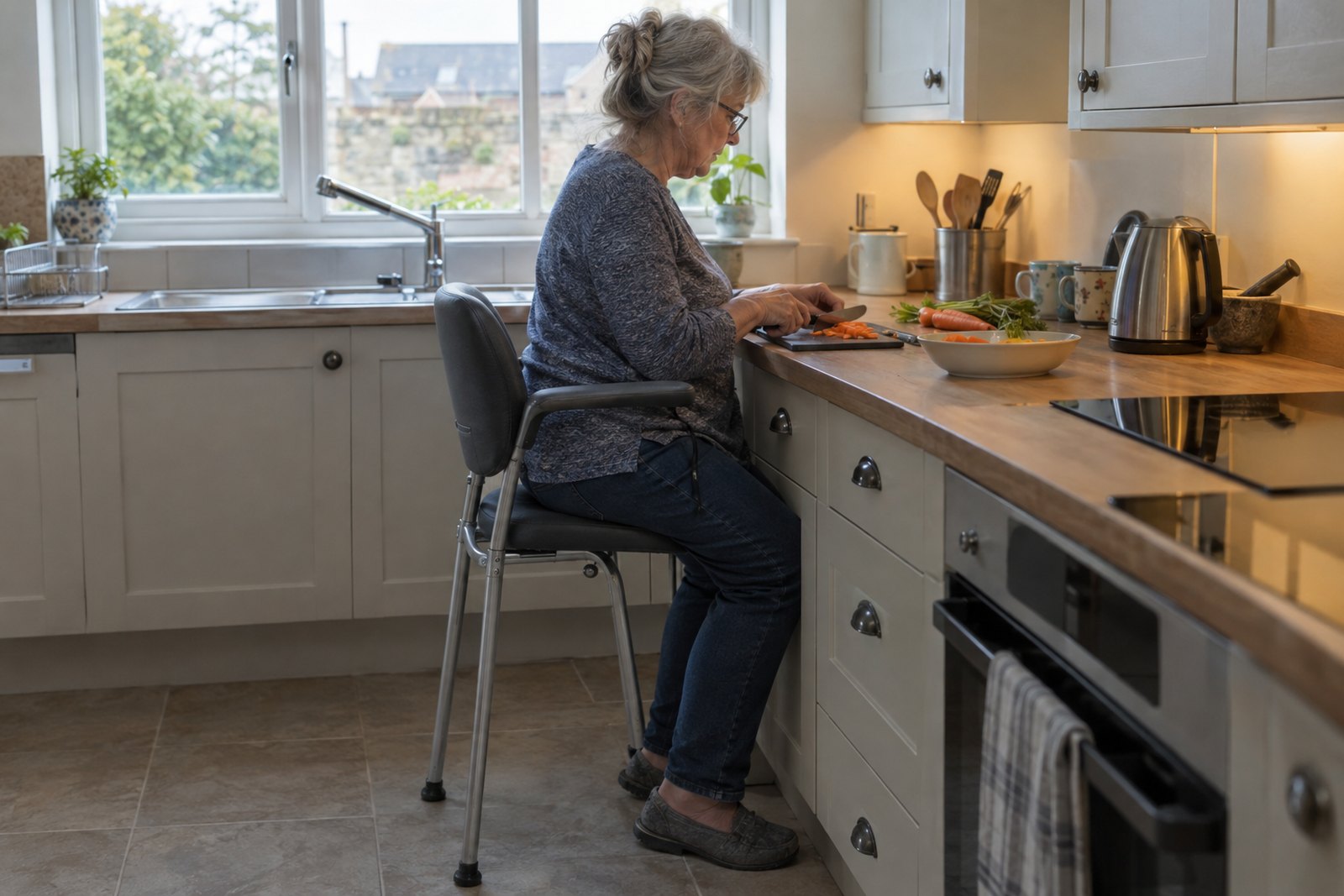
An accessible kitchen is one where you can reach what you need, move around safely and cook without pain, exhaustion or risk. For most people it does not start with knocking down walls. It starts with moving the things you use every day to between hip and shoulder height, sitting down to prepare food, and swapping a few awkward fittings for easier ones. For wheelchair users, or people whose condition is changing, it can go further: lowered or height-adjustable worktops, knee space under the sink and hob, and an oven you can open from the side.
The right answer depends on what is actually going wrong. Someone who can no longer stand for long needs something different from someone who cannot bend, grip, see clearly or remember whether the hob is on. This guide works from the small and cheap to the large and expensive, explains how funding such as the Disabled Facilities Grant works in general terms, and says why an occupational therapy assessment is worth having before you spend serious money.
First, work out what is actually hard
Before buying anything, spend one ordinary day noticing. Not what you assume is hard, but what actually is. Most kitchen problems fall into a handful of groups:
- Standing: your legs ache, you feel dizzy, or you have to sit down halfway through peeling potatoes.
- Reaching and bending: top cupboards, the oven, the bottom of the fridge, the back of a corner unit.
- Gripping and twisting: taps, jar lids, the kettle, tin openers, knobs on the cooker.
- Carrying: getting a hot drink or a plate from the worktop to the table while also holding a stick or frame.
- Seeing: dim corners, shadows on the worktop, dials you cannot read.
- Remembering: pans left on, the hob not switched off, meals started and forgotten.
- Tiring: breakfast is fine but there is nothing left by teatime.
Most people tick more than one. That is normal, and it is why a single gadget rarely fixes things. Write the list down. It will help you, and it will help anyone who comes to assess you.
Small changes you can make this week
Rearrange the storage
The most useful free change in most kitchens is this: move everything you use daily into the zone between hip and shoulder height, and close to where you use it. Mugs, tea, coffee and the kettle together. The two pans you actually cook with on the worktop or in a top drawer, not at the back of a low corner cupboard. Heavy things such as tins, bottles of oil and the slow cooker at worktop height, never above your head.
Things you use once a year can go high or low, or go to the charity shop. Be ruthless. A busy worktop is a nuisance, but a tidy worktop with everything in a cupboard you cannot reach is worse. Leaving daily items out is fine. And if your balance is unreliable, stop standing on a chair or a step to reach high cupboards. Empty them instead.
Sit down to prepare food
An ordinary kitchen chair at a standard worktop usually puts you too low to work comfortably. A perching stool holds you in a half-sitting position with your feet on the floor, so you can chop, wash up or stir at the worktop without standing the whole time. It needs setting to the right height for you and is not suitable for everyone, particularly if getting on and off it is unsteady. The kitchen table is a perfectly good alternative for preparing vegetables, buttering bread or mixing.
Stop carrying things
Carrying a hot drink while using a walking frame or stick is one of the hardest jobs in any kitchen, and one of the riskiest. A kitchen trolley or trolley walker lets you move plates, cups and food from worktop to table safely. Around the worktop itself, slide rather than lift: push pans along the surface, fill a pan on the hob using a jug rather than carrying it full from the sink, and lift cooked vegetables out with a slotted spoon or a basket insert rather than tipping a heavy pan into a colander.
Improve the lighting
A single ceiling light means you stand in your own shadow at the worktop. Lights fitted under the wall cupboards put light where your hands are. Brighter bulbs, a good light over the hob and sink, and strong contrast all help, especially for anyone with sight loss: a dark chopping board for light foods and a pale one for dark foods, a coloured mug against a pale worktop, and raised tactile dots on the dials you use most.
Try the simple aids
Some of the most effective kitchen equipment costs very little. A kettle tipper lets you pour without taking the weight of a full kettle. Jar openers, lightweight pans with two handles, an electric tin opener, a spiked chopping board for one-handed use and non-slip matting under bowls all remove strain. There is a fuller list in our guide to kitchen aids and mealtime independence.
Fittings a tradesperson can change
The next step up involves a plumber, electrician or joiner, but not a new kitchen.
- Lever taps: a single lever or long-handled taps that need only a quarter turn are far easier than round taps for anyone with arthritis, weak hands or a tremor. Ask the plumber about limiting the hot water temperature at the tap if scalding is a worry.
- Sockets and switches: moved forward or raised so you are not reaching over the worktop to the back wall, with larger rocker switches.
- Cupboard handles: long D-shaped handles you can hook a hand through, instead of small knobs.
- Drawers instead of cupboards: deep pull-out drawers in base units bring the contents to you rather than making you kneel and rummage.
- Pull-down shelves: a mechanism inside a wall cupboard lowers the shelf to worktop level so you can reach the contents, then lifts it back.
- Corner units: pull-out or carousel fittings so the back of the corner is no longer a black hole.
- Raised appliances: a plinth under the washing machine or dishwasher means less bending to load and unload.
Hobs, ovens and microwaves
Induction hobs
In general terms, an induction hob heats the pan rather than the glass, so the surface cools faster once the pan is removed, although it is still hot from the pan for a while. Many switch off when no pan is detected. The flat surface lets you slide pans on and off instead of lifting them, and it is easy to wipe clean. The downsides: you need pans that work with induction, some of which are heavy, and touch controls can be hard to use with low vision, reduced sensation in your fingers or a tremor. If you have a pacemaker or other implanted heart device, check with your cardiac team before using one.
Whatever the hob, controls at the front or side are safer than controls behind the pans, which mean reaching over heat.
Side-opening ovens
A standard oven door drops down, so you have to bend low and lean over a hot door to lift a heavy dish out. An oven built into a tall housing at around worktop height, with a door that opens to the side, lets you slide dishes straight out onto a pull-out shelf or worktop beside or beneath it. Think about which way the door opens: it should swing away from the side you approach from. The same thinking applies to the microwave. Lifting hot liquids down from above shoulder height is a common way to get scalded, so put it at worktop height.
A wheelchair accessible kitchen
This is where kitchen adaptations for disabled people become proper building work, and where planning matters most.
- Worktop height: standard worktops suit people who stand. A wheelchair user usually needs a lower section. If other people in the household cook too, height-adjustable sections, either wound by hand or powered, let the worktop go up and down.
- Knee space: clear space under the worktop, sink and hob so you can pull in close and work facing forwards. Without it you are working twisted sideways, which is tiring and much less safe with hot pans.
- Sink: a shallower bowl so your knees fit underneath, with the pipes insulated or boxed in so they cannot burn your legs. This matters even more if you have reduced feeling in your legs.
- A continuous run: worktop running between the sink, hob and oven means you can slide food and pans along instead of carrying them on your lap.
- Turning space: enough clear floor to turn your chair, and no tight corners where you have to do a three-point turn holding a pan.
- Storage: wall cupboards lowered or fitted with pull-down shelves, drawers in place of base cupboards, and a fridge you can open and reach into from your chair.
- Flooring: level, slip-resistant and without thresholds.
Do not rely on a generic standard height. Your seated height, knee clearance and reach in your own wheelchair are what count, and they should be measured. If your needs are likely to change, perhaps to a powered chair later, plan for that now rather than adapting twice. The same principles run through a good accessible bathroom, and it often makes sense to look at both together.
Safety when memory is a problem
For someone living with dementia, or with memory problems after a stroke or brain injury, the worry is usually the cooker. The answer is rarely to ban the kitchen. Making a cup of tea or a simple meal is often one of the last familiar skills, and taking it away can lead to boredom, distress and not eating. The aim is to keep the person cooking while reducing the danger.
- Cooker isolation switch: a switch that cuts the power to the cooker, which can be placed where a carer or family member controls it.
- Automatic shut-off devices: for electric cookers, devices that turn the power off after a set time or if heat builds up; for gas hobs, safety valves that cut the supply. These must be fitted by a qualified electrician or a registered gas engineer.
- Timers: a simple timer with a loud alarm, or a spoken reminder, kept next to the hob.
- Heat alarms: a heat alarm suits a kitchen better than a smoke alarm, which tends to go off during cooking and gets disconnected. Some can link to a telecare service.
- A home fire safety visit: many fire and rescue services offer these free. Contact your local service to ask.
- Simplify: picture or word labels on cupboards, keeping only what is needed out, and a kettle that switches itself off.
If you are thinking about switching from gas to electric or induction, do it early. A new appliance is much harder to learn as memory gets worse.
Paying for kitchen adaptations
Small aids are often inexpensive, and some are available after a council assessment through the local community equipment service. Councils often provide minor adaptations free following an assessment too, so ask adult social care before buying.
For larger works, the Disabled Facilities Grant is available through councils in England and Wales, and through the Housing Executive in Northern Ireland. Making it easier to prepare and cook food is one of the purposes it can cover. In England the grant is usually means-tested for adults, and the rules in Wales and Northern Ireland differ, so check with your council or the Housing Executive. The means test does not usually apply to adaptations for a disabled child. The work has to be judged necessary and appropriate for your needs and reasonable and practicable for the property, which is why an occupational therapy assessment usually forms part of the process. Maximum amounts differ between the nations, so check GOV.UK or your council for current figures. Do not start work before the grant is approved, or you may lose it.
Scotland does not have the Disabled Facilities Grant. Councils there help with adaptations through their own schemes, so contact your local council. Council and housing association tenants can usually ask the landlord to carry out adaptations, and private tenants can apply for a grant with the landlord's permission. Some equipment and adaptation work for disabled people can also qualify for VAT relief; GOV.UK explains the rules.
Where an occupational therapist fits
An occupational therapist looks at how you do things, not just at the room. They will usually watch you make a drink or a simple meal, and look at your standing tolerance, reach, grip, balance, energy, vision, memory and safety. From that they might suggest a different way of doing things, a piece of equipment, a minor adaptation, or larger works with measurements and a written specification that a builder or kitchen fitter can follow. Their report often supports a grant application.
A council occupational therapist is free through adult social care, though waits vary. A private occupational therapist visiting at home can do a similar assessment and write a report, often sooner. If you are applying for a grant, check with your council first whether they will accept a private report or need their own assessment.
Other people lead on some parts. See your GP if things have got worse quickly, or if you are having dizzy spells, falls or new confusion; call NHS 111 if you are unsure, or 999 in an emergency. A physiotherapist leads on exercise for strength and balance. If someone coughs or chokes when eating or drinking, ask the GP for a referral to a speech and language therapist, who assesses swallowing. A dietitian can help with weight loss or poor appetite. And the kitchen designer or builder does the building, ideally working from an assessment rather than guessing.
Frequently asked questions
What height should a worktop be for a wheelchair user?
There is no single right height. It depends on your seated height, your wheelchair and how much knee clearance you need. An occupational therapist can measure you in your own chair and give a builder exact figures. If more than one person uses the kitchen, height-adjustable sections avoid the problem altogether.
Can I get a grant to adapt my kitchen?
Possibly. In England, Wales and Northern Ireland, the Disabled Facilities Grant can cover kitchen adaptations that help you prepare and cook food. Adults may face a means test, depending on where you live and the size of the work. In Scotland, ask your council about its own scheme. Get approval before any work starts.
Is an induction hob safer for someone with dementia?
It can be, because the surface cools faster and many models switch off when the pan is removed. But it is a new thing to learn, and touch controls can be confusing. Change early if you are going to, and combine it with other measures such as an isolation switch and a heat alarm.
Do I need an occupational therapy assessment before redesigning my kitchen?
You do not need one to buy a new kitchen privately, but grant applications usually require one. Even if you are paying yourself, an assessment can stop you spending thousands on a kitchen that still does not work for you.
What is the cheapest way to make a kitchen more accessible?
Rearrange the storage so daily items sit between hip and shoulder height, add a perching stool or use the table, use a trolley instead of carrying, and improve the lighting. These cost little or nothing and often make the biggest difference.
Mum keeps leaving the hob on. Should we take the cooker out?
Not as a first step. Try a cooker isolation switch, an automatic shut-off device, a timer and a heat alarm, and ask for a home fire safety visit. Removing the cooker can take away an important part of her day. If the risk is still too high, an occupational therapist can help you weigh up the options.
Next steps
See our home adaptations and equipment and aids pages, or current guide prices, and choose your area below.

Talk to an occupational therapist near you
This guide is general information. For advice about your own situation - or someone you look after - a local occupational therapist can visit you at home and see it for themselves.
Choose your area: