

Bed Ladders and Lifting Poles: Help Sitting Up in Bed
By Mobile Occupational Therapist • 1 October 2026 • 13 min read
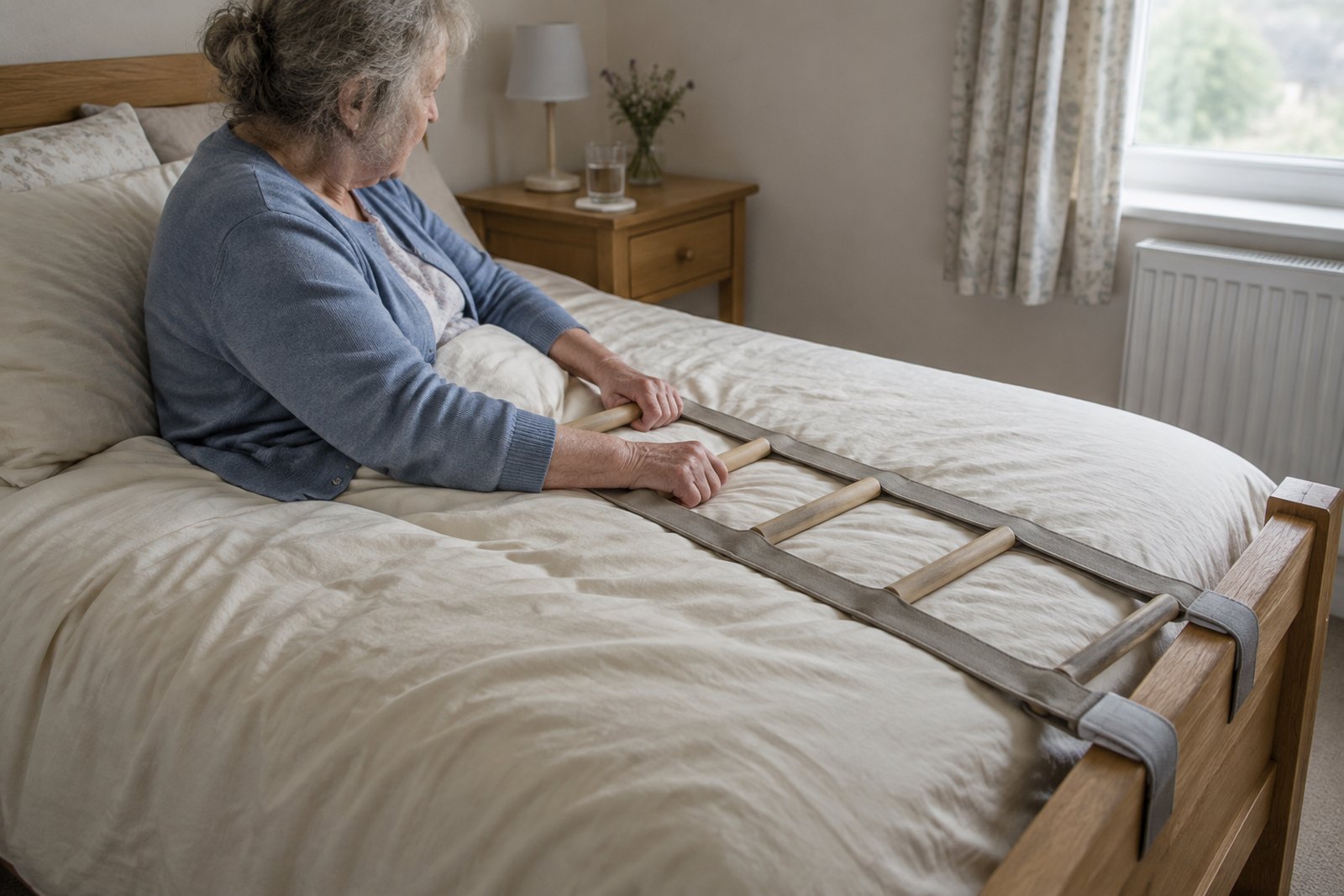
If you can no longer sit up from lying flat in bed, there are three simple pieces of equipment you will usually come across. A bed ladder is a rope or strap ladder tied to the foot of the bed: you pull on the rungs one at a time, hand over hand, to bring yourself up to sitting. A lifting pole, often called a monkey pole, is a frame that stands over the head of the bed with a triangular handle hanging down, which you hold to lift your shoulders or shift yourself up the bed. A bed lever is a fixed handle at the side of the bed that gives you something firm to push or pull on when you roll over, sit on the edge or stand up.
All three rely on your arms. They suit people with reasonable strength in their shoulders, arms and hands whose difficulty is the middle of the body: weak stomach and back muscles, a painful hip, or a body that simply will not fold up from lying any more. They are a poor choice, and sometimes a dangerous one, for people with shoulder problems, people recovering from certain operations and people who are confused. Getting the right one, fitted properly, matters far more than buying the first one you see.
Why sitting up in bed gets hard
Sitting up from lying is one of the hardest movements most of us make in a day, and we usually do it half asleep. It needs your stomach muscles to curl you forward, your hips to bend and your arms to push, all at once. Take away any one of those and it becomes a struggle.
Common reasons include weakness after a spell in hospital, back pain, a new hip or knee, the stiffness of Parkinson's, one-sided weakness after a stroke, and general frailty. Sometimes the problem is partly the bed. A soft mattress you sink into, a heavy duvet pinning your legs, or a bed that is much too low or too high can turn a manageable movement into an impossible one. It is worth looking at those before buying anything.
One important point first. If you or someone you look after has suddenly lost the ability to sit up, especially with new weakness on one side, slurred speech or a drooping face, call 999. If it has crept up over a few days with no obvious reason, or comes with a fever, new confusion or new pain, speak to your GP or call NHS 111. Equipment is for a difficulty that has been understood, not for covering up a new one.
Bed ladders
What they are
A bed ladder is two long straps or ropes joined by a series of rungs, usually made of plastic or wood. One end is fastened securely around the frame at the foot of the bed. The other end lies on the bed near your hands. You pull on the first rung, then reach for the next, walking your hands down the ladder until you are sitting upright.
Who they suit
A bed ladder suits someone who has good grip and decent strength in both arms and shoulders but cannot curl up from lying. It is quiet, cheap, takes up almost no space and can be packed in a bag. People often find it useful when recovering from a lower limb injury or operation, or when stomach muscles have weakened.
It is not much use if one arm is weak or painful, because you end up twisting as you pull. It also does not help you shuffle up the bed or turn over.
Fitting one safely
- Tie it to the bed frame, not the mattress, the castors or a footboard that could come loose. Follow the maker's instructions for how it is meant to be secured.
- Check the bed cannot move. If the bed is on wheels, the brakes must be on. A light bed may slide towards you when you pull.
- Divan beds are awkward. There is often no frame to tie to. Some ladders are designed to go around the base; check this before buying, and do not improvise with a knot around something that was never meant to take your weight.
- Check the maximum user weight on the instructions and make sure it is above the weight of the person using it.
- Keep the loose end tidy. At night it should lie flat and within reach, not coiled near your neck or trailing on the floor where someone could trip over it.
- Check straps and knots regularly for fraying, stretching or slipping.
How to use one
- Lie on your back. If you can, bend your knees so your feet are flat on the mattress.
- Take hold of the rung nearest you with both hands.
- Tuck your chin slightly towards your chest and pull gently, bending your elbows.
- Move one hand to the next rung, then the other, walking down the ladder.
- Once you are sitting, let go one hand at a time and steady yourself before you swing your legs round.
Breathe out as you pull rather than holding your breath. If you feel pain in your shoulders, chest or back, stop. That is a sign the ladder is not the right answer, or that you need advice on technique.
Lifting poles (monkey poles)
What they are and what they are for
A lifting pole is an upright post with an arm that reaches over the bed. A triangular handle, sometimes called a trapeze, hangs from the arm on a strap or chain. Freestanding versions have a flat base that slides under the bed or sits beside it. Others attach directly to the bed frame.
To be honest about what they do: a lifting pole is very good for lifting your head and shoulders, shuffling yourself back up the bed when you have slid down, and raising your hips a little so clothes or bedding can be adjusted. On its own, it is less good at getting you all the way to sitting on the edge of the bed. Many people use it to lift and turn, then finish the movement another way.
Fitting and safety
- The base must be stable and fitted exactly as the instructions say. A freestanding pole that has not been set up properly can tip.
- Set the handle height so you can grip it with your elbows slightly bent while lying down. Too high and you strain your shoulders reaching for it. Too low and you can catch your head on it.
- Check the maximum user weight, and remember a sudden heavy pull puts more force through it than simply hanging on.
- Inspect the strap or chain and the adjusting clips regularly. Look for wear, cracks and loose bolts.
- It is for the person in bed to use, not for a carer to pull on. A lifting pole is not designed for helpers to haul someone up by.
Technique
Hold the handle with both hands. Bend your knees and push through your heels at the same time as you pull with your arms, so your legs do some of the work. To move up the bed, lift your hips slightly and push back with your feet in small movements rather than one big heave.
Bed levers and grab handles
A bed lever is a handle, usually an upright loop, attached to a flat plate that slides between the mattress and the bed base, often with a strap to hold it in place. It sits at the side of the bed, roughly level with your hip or chest. You use it to roll towards, to push up from as you sit on the edge, and to steady yourself as you stand. For many people this is the most useful of the three, because rolling onto your side and sitting up from there takes much less strength than sitting straight up. Our guide to leg lifters and bed levers covers this in more detail.
Bed levers carry a specific risk: entrapment. If there is a gap between the lever and the mattress, or the lever shifts, a person can slip into the gap and become trapped by the head, neck or chest. People who are confused, very frail, restless at night or unable to reposition themselves are most at risk. A lever should fit the bed and mattress it is used with, be fixed according to the instructions and be checked regularly for movement. A thick mattress topper or a replacement mattress can change the gaps completely, so recheck after any change. The same principles apply to bed rails, which we cover in bed rails: when they help and when they are dangerous. Official guidance on the safe use of bed rails is published by the MHRA on GOV.UK.
Who should not use them without advice
Pulling yourself up puts a lot of force through your shoulders, chest and arms. Check with your GP, surgeon or therapist before using any of this equipment if any of the following apply:
- Shoulder problems, such as a painful or stiff shoulder, a rotator cuff injury or a shoulder replacement. Overhead pulling on a lifting pole is particularly hard on shoulders.
- After heart surgery through the breastbone. People are often told not to pull or push with their arms while the bone heals. Follow the specific instructions you were given.
- After some back, abdominal or other operations, where you may have been taught a particular way of getting in and out of bed. Use that method unless the team says otherwise.
- Confusion or dementia. A loose ladder can tangle around limbs or the neck, and bed levers carry the entrapment risk described above.
- One-sided weakness, for example after a stroke, where pulling with one arm twists the body.
- Anyone who needs a carer to help them move. If someone cannot sit up even with these aids, the answer is not for a family member to pull harder. See our guide to safe moving and handling for family carers.
The side-lying method: often better than any gadget
Before you buy anything, it is worth trying the way many therapists teach people to get out of bed. It uses your body weight rather than brute arm strength.
- Bend your knees and roll onto your side, facing the edge of the bed you get out of.
- Let your lower legs slide over the edge of the mattress.
- As your legs go down, push up with your lower elbow and then your upper hand on the mattress.
- The weight of your legs helps swing your body up into sitting.
- Sit for a moment before standing, especially if you get dizzy when you first get up.
A bed lever often makes this easier, and a leg lifter can help if you cannot lift your legs on and off the bed. If this method works, you may not need a ladder or pole at all.
Profiling beds: when the bed does the work
A profiling bed has an electric backrest that raises you to sitting at the press of a button, and usually adjustable height too. For someone who cannot use their arms to pull, who is very weak or who spends long periods in bed, it is often a far better and safer answer than anything bolted onto an ordinary bed. Our guide to profiling beds explains how they work and who they suit.
Where there is an assessed need, profiling beds and much of the equipment in this article can often be loaned through your local community equipment service rather than bought. See borrowing equipment instead of buying for how that route works.
Where an occupational therapist fits
An occupational therapist looks at the whole picture: how you move, what your shoulders and grip can manage, what your bed and mattress are like, the space around the bed, whether you get up in the night to use the toilet, and whether anyone helps you. They can watch you try different methods, suggest the right equipment, check how it is fitted and teach you a technique that does not strain anything. They will also look at whether something like a bed lever is safe for someone with memory problems, which is a judgement best not made alone.
For a free assessment, you can ask your GP about NHS community services, contact your council's adult social care team about an occupational therapy assessment, or ask the ward team before discharge if you are in hospital. Waiting times vary by area. A private occupational therapist visiting at home can assess and advise on equipment and daily living aids if you would rather not wait or want a second view.
An occupational therapist is not always the right first person. If the real problem is weakness that could improve with exercise, a physiotherapist leads on that. If shoulder pain is what stops you pulling, see your GP. And if the difficulty is new and unexplained, the GP comes before any equipment.
Frequently asked questions
Can I use a bed ladder on a divan bed?
Sometimes. Divans often have no frame to tie to, so you need a ladder designed to fasten around the base, fitted exactly as instructed. If it cannot be attached securely, it is not safe to use.
Can a carer use a lifting pole or bed ladder to pull someone up?
No. These aids are for the person in bed to use under their own strength. Pulling someone up by a ladder, pole or their arms risks injuring both of you. If someone needs that much help, ask for an assessment so the right equipment and technique can be put in place.
Can I get a lifting pole or bed lever free?
If an assessment shows you need one, it can often be loaned through the local community equipment service, usually after an NHS or council occupational therapist or other professional has assessed you. Ask your GP or council adult social care team how to request an assessment in your area.
Is a bed ladder safe for someone with dementia?
Often not. Someone who is confused may become tangled in it or use it in unexpected ways, particularly at night. Get advice before using one, and look at alternatives such as a profiling bed.
How much weight can they take?
It depends on the product. Every one should state a maximum user weight in its instructions. Check it is above the user's weight before buying, and do not use anything where the limit is unclear.
Which one is best for getting out of bed, rather than just sitting up?
Usually a bed lever, combined with rolling onto your side first. A bed ladder helps you sit up in the middle of the bed, and a lifting pole helps you lift and reposition, but neither gets you to the edge of the bed on its own.
Next steps
If sitting up in bed has become a daily struggle, an assessment can save you buying the wrong thing. See our equipment and aids or home assessment pages, or current guide prices, and choose your area below.

Talk to an occupational therapist near you
This guide is general information. For advice about your own situation - or someone you look after - a local occupational therapist can visit you at home and see it for themselves.
Choose your area: