

Hospital Beds at Home: A Guide to Profiling Beds and Sleeping Comfortably
By Mobile Occupational Therapist • 17 September 2026 • 9 min read
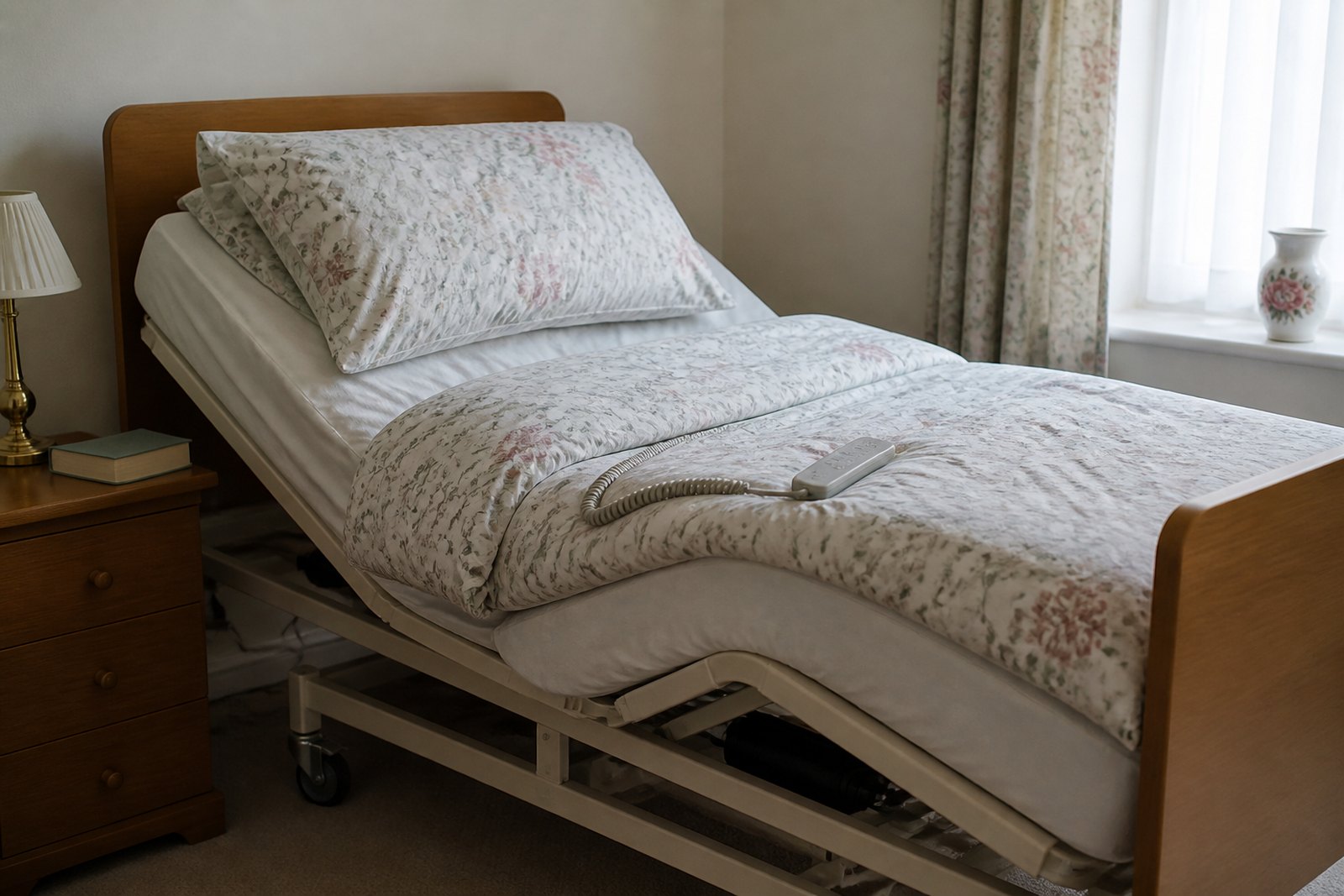
A profiling bed - sometimes called a hospital bed at home - is an electric bed whose mattress platform is divided into moving sections, so the back, knees and overall height can be adjusted at the press of a handset. It genuinely helps when someone cannot change position in bed without assistance, needs to sleep sitting up for breathing or reflux, is at risk of pressure damage, or is being helped in bed by carers who need the bed at a safe working height. For many people, though, a simpler and much cheaper option - a mattress elevator, a bed lever, or better-arranged pillows - solves the actual problem. The right starting point is the difficulty, not the equipment.
Two safety points before anything else
First, skin. If someone spending long periods in bed has a red patch that does not fade when pressed, do not wait for equipment decisions - contact a GP or district nurse promptly. Pressure damage is far easier to prevent than to heal; the NHS guidance on pressure sores explains what to look for.
Second, rails. Profiling beds are often supplied with side rails, and rails fitted badly carry a real entrapment risk, particularly for anyone confused or very frail. Read our guide to bed rails - when they help and when they are dangerous before any rail goes on any bed.
Try the simpler options first
Most night-time difficulties come down to getting comfortable, sitting up, or getting in and out. Each has a simpler answer than a new bed.
- A mattress elevator - a motorised backrest under your existing mattress that raises the head end by handset. If the only real need is to sleep or read propped up, this does the most useful part of a profiling bed's job on the bed you already own, at a fraction of the cost.
- A bed lever or grab handle - a fixed rail at the side of the bed to push or pull against when turning, sitting up or standing. Often the single most effective item for someone unsteady rather than immobile.
- Pillows and wedges - a V-shaped pillow for propped sitting, a wedge for swollen ankles, a pillow between the knees for hip or back pain. Unfashionable, inexpensive, and frequently enough.
- Bed raisers - blocks that lift the whole bed so the transfer height suits the person. A bed you sink too low into is hard to leave; one too high leaves feet dangling.
These are exactly the items an OT tries during an equipment assessment - starting simple is not settling for second best, it is matching the solution to the problem.
What the sections of a profiling bed actually do
A typical profiling bed has four sections and three useful movements.
- The backrest raises the head and trunk, for breathing, reflux, eating or reading - without the slow slide down the bed that stacked pillows allow.
- The knee break raises a gentle bend under the knees. This is the underrated one: it stops the body sliding towards the foot of the bed when the backrest is up - the shearing drag on skin that contributes to pressure damage.
- Height adjustment raises and lowers the whole platform: low for a safe transfer, high so a carer can help without stooping. Where care happens in bed, this is often the feature that matters most, protecting the carer's back as well as the person in the bed.
An adjustable bed for an older person sold on the high street usually offers the first movement and sometimes the second, but not carer height adjustment, and it is not built to take a clinical pressure mattress. Comfort furniture versus care equipment is the honest dividing line.
When a profiling bed is genuinely the right answer
- Position changes need help. When someone cannot reposition themselves, powered adjustment restores a degree of control and reduces the physical load on whoever helps.
- Care is happening in the bed. Washing, dressing, wound care or hoisting all need the bed at working height.
- Pressure damage is a live risk. The bed carries the right mattress and makes regular repositioning practical.
- Breathing or heart conditions demand reliable elevation all night, not a pillow arrangement that collapses by 3am.
- A progressive condition is in the picture. For someone with Parkinson's or multiple sclerosis, it can be sensible to plan for where needs are heading, not only where they are today.
The couples question
This is the decision that causes the most quiet distress. A standard profiling bed is a single, and replacing a shared double with one single rearranges a marriage as well as a bedroom. The options, roughly in order of cost:
- A single profiling bed alongside the existing double or a new single - practical and common, though the beds will differ in height and the room needs the space.
- A companion pair - two singles designed to sit flush together, one profiling and one fixed, keeping the couple side by side at a matched height.
- A dual profiling double - one frame with two independently adjustable halves. These work well but are expensive - typically a four-figure job before the mattresses - and are almost always a private purchase rather than a loan item.
There is no universally right answer. What an OT can do is be honest about which needs are clinical and which are about the life the couple wants to keep - both matter, and only one shows up on an equipment order form.
The mattress is half the decision
A profiling bed needs a mattress that bends with it - an ordinary sprung mattress will not follow the sections. If pressure relief is needed, the choice runs from high-specification foam to alternating-pressure air mattresses, and compatibility cuts both ways: the mattress must suit the bed's platform, and rail height must be rechecked with the actual mattress in place, since a deep air mattress can raise someone above rails that were safe with a thinner one. If a district nurse is involved, ask them before buying anything - pressure care is their territory, and a mattress supplied on clinical grounds is normally loaned, not bought.
How profiling beds are funded
- Community equipment loan. Where there is an assessed clinical need - typically care delivered in bed, or significant pressure risk - a bed for an elderly person at home can be supplied on free loan through the community equipment service, following a council needs assessment you can request yourself, or via the district nursing service. This is the usual route when someone is coming home from hospital with new care needs.
- Private purchase. Reasonable when the need does not meet loan criteria, or when a couple wants a dual double no service will supply. A bed bought because of a disability or long-term condition usually qualifies for VAT relief - see the GOV.UK guidance on financial help if you are disabled.
- Charity help. Some condition-specific charities and local funds contribute towards equipment; Age UK's advice on adapting your home is a good starting point.
Making the room work
A profiling bed arrives in a bedroom that already has a life in it. It needs clearance for the height mechanism, a socket nearby, and space on the transfer side - and if a hoist may follow, space for that too. Just as important is what stays: the bedside table at the right height, the lamp within reach, the photographs where they were. A bedroom that still looks like a bedroom rather than a ward is not a cosmetic detail - it is the difference between equipment that supports a life and equipment that takes it over. This is exactly what a home assessment weighs up in the actual room, with a tape measure, before anything is ordered.
Who benefits most from getting this decision right
- Anyone who cannot change position in bed without help, or whose nights are dominated by discomfort
- People with breathing, heart or reflux problems who need reliable elevation all night
- Anyone at significant risk of pressure damage, or already being treated for it
- Family carers helping someone in bed and feeling it in their own backs
- Couples trying to meet one partner's clinical needs without giving up sleeping side by side
Frequently asked questions
Can I get a hospital bed at home from the NHS or council?
Often, yes - where there is an assessed clinical need, a profiling bed is loaned free through the community equipment service, usually arranged by an occupational therapist or district nurse after a needs assessment you can request yourself. If the need is comfort rather than clinical care, a loan is unlikely and simpler aids or a private purchase are the realistic routes.
What is the difference between a profiling bed and an adjustable bed for the elderly?
A retail adjustable bed raises the back, and sometimes the legs, for comfort. A profiling bed adds carer height adjustment, a knee break that prevents sliding, compatibility with clinical pressure mattresses, and fittings for side rails. If care is delivered in the bed or pressure risk is real, it needs to be a profiling bed.
Is a mattress elevator a good alternative to a new bed?
For the right person, yes. A mattress elevator raises the head end of your existing mattress by handset, so if the only difficulty is sleeping propped up, it delivers the most-used function of a profiling bed without replacing the bed. It does not adjust height for carers or take a clinical pressure mattress.
Next steps
If nights have become the hardest part of the day, this decision is worth getting right first time - beds are large, expensive to get wrong, and emotionally loaded in a way a jar opener is not. An occupational therapist can assess in the bedroom itself, try the simpler options first, and be straight with you about whether a profiling bed is genuinely needed. Find your local therapist through our areas we cover page, or see current guide pricing.
Talk to an occupational therapist near you
This guide is general information. For advice about your own situation - or someone you look after - a local occupational therapist can visit you at home and see it for themselves.
Choose your area: