

Bed Levers and Leg Lifters: Getting In and Out of Bed Safely
By Mobile Occupational Therapist • 17 September 2026 • 7 min read
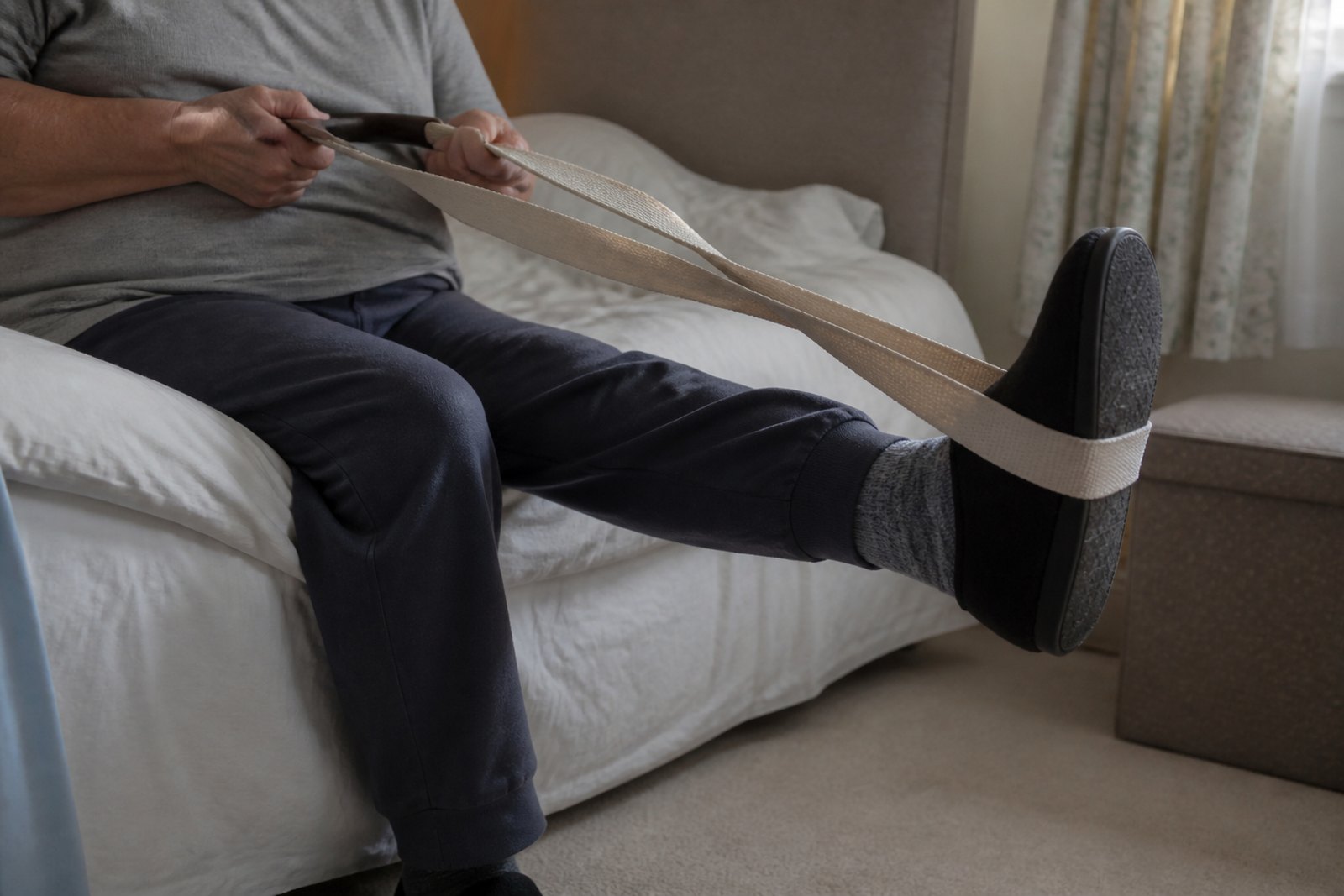
Getting into bed involves one movement most people never think about: lifting your legs up and swinging them across. When that stops working - after a stroke, following hip or knee surgery, with multiple sclerosis, or with arthritis severe enough that the hip will not flex - the whole task collapses, and people end up sleeping downstairs in a chair or waiting for somebody to come and lift their legs for them. A leg lifter is a strap with a loop on the end that costs very little and frequently gives the whole task back. This guide covers leg lifters, bed levers and rope ladders: what each one does, who they suit, and the technique that matters more than any of them.
Leg lifters
A leg lifter is a length of stiffened webbing with a loop at one end for your foot and a rigid handle at the other. You sit on the edge of the bed, drop the loop over your foot, and use your arms to lift the leg that will not lift itself - swinging it up and onto the bed while your body turns to follow.
They are simple, and there are a few things that make the difference between one that works and one that ends up in a drawer:
- Stiffness matters. A limp strap will not stay open, so getting the loop over your foot becomes a task in itself. The semi-rigid ones hold their shape and can be dropped over a foot one-handed, which is the point.
- Length matters. Too short and you are bending forward to reach - which defeats the object, and after hip surgery may break the movement restrictions you have been given.
- One hand or two. If one arm is weaker, as after a stroke, check the handle can be used with the stronger hand alone.
- They work in cars too. Getting a leg into a footwell is the same movement, and this is one of the most common uses. A shorter version is easier in a car.
Leg lifters are for lifting a leg that will not lift. They are not for pulling yourself up, and they are not strong enough to take body weight.
Bed levers and grab handles
A bed lever is a rigid handle, usually a metal loop, whose base slides under the mattress and is held by the weight of the bed. It gives something solid to pull on when moving from lying to sitting, and something to push down on when standing up - and it makes turning over easier for many people.
Two practical points. First, it needs the right kind of bed: an unstable divan, a very soft mattress or a bed on castors can let the whole thing shift, which is worse than no handle at all. Second, position matters - too far up the bed and it is useless for standing, too far down and it does not help you sit up. It is worth having someone watch you use it before deciding where it lives permanently.
An important safety point. Anything fitted around a bed creates gaps, and gaps around a bed carry an entrapment risk - particularly for anyone who is confused, restless or moves involuntarily at night. This is not a small risk and it is not theoretical. Our guide to bed rails explains it in detail, and the rule it sets out applies to levers too: if the person may become confused or agitated, this needs assessing by a professional rather than deciding at home.
Rope ladders
A bed rope ladder is a webbing ladder that attaches to the foot of the bed. You take hold of the first rung, pull yourself up a little, take the next, and so on until you are sitting.
Rope ladders suit fewer people than they are sold to, and it is worth being blunt about why. They need genuinely good grip and real arm and shoulder strength, sustained through several pulls - so they tend not to suit the older person with weak hands who is often the one being bought one. They also do nothing to stop you sliding back down if your grip fails partway. Where they do work well is for someone with good upper-body strength and a specific problem lower down - a younger adult with a spinal injury, or someone recovering from lower-limb surgery who has strong arms. If grip or shoulder strength is doubtful, a bed lever or a profiling bed is the more realistic answer.
The technique matters more than the gadget
Occupational therapists teach the movement before they suggest equipment, because the movement often solves it on its own.
- Break it into stages. Rolling onto your side, pushing up on your elbow, then dropping your legs over the edge as a counterweight is far easier than trying to sit straight up from flat.
- Use the legs as ballast. Letting the legs drop off the side of the bed as you push up does much of the work of lifting your upper body.
- Sit on the edge before standing. Feet flat, count slowly to ten. It prevents the dizziness that causes so many night-time falls - see our guide to night-time safety.
- Get the bed height right. This is the biggest single factor and the most overlooked. Sitting on the edge, feet should be flat on the floor with hips slightly higher than knees. A bed too low makes standing very hard; too high and you slide off. Raisers or a different mattress often fix the whole problem without any handle at all.
When the answer is a bed rather than a gadget
If aids are accumulating one at a time and it is still a struggle, that is the signal to stop buying and get assessed. An electric profiling bed raises the head section to bring somebody towards sitting and raises the whole bed to the right height for standing - solving in one go what three separate gadgets were each half-solving. Our guide to hospital beds at home covers when that step is justified. Where a carer is doing the lifting, the equipment question is also a safety question for them, and our guide to safe moving and handling should be read alongside this one - nobody should be lifting another person's legs into bed by hand night after night.
Frequently asked questions
How do you get your legs into bed after a stroke or hip surgery?
Sit on the edge of the bed first, then use a leg lifter - a stiffened strap with a foot loop and a handle - to lift the leg that will not lift itself, swinging it up onto the bed while your body turns to follow. Getting the bed height right so your feet rest flat on the floor when sitting on the edge makes the whole movement significantly easier. After hip surgery, follow any movement restrictions your surgeon or therapist gave you, as they override general advice.
Are bed rope ladders any good?
For the right person, yes - someone with good grip and genuine arm and shoulder strength who needs help sitting up because of a problem lower down. For the older person with weak hands and reduced shoulder strength who is most often bought one, they usually do not work, and there is nothing to stop a slide back down if grip fails. A bed lever or a profiling bed is more realistic in that situation.
Are bed levers safe?
For most people, yes, provided the bed is stable enough to hold the base securely and the lever is positioned where it is actually needed. The significant exception is anyone who becomes confused, restless or agitated at night: anything creating gaps around a bed carries a risk of entrapment, and in that situation it should be assessed by a professional rather than fitted at home.
Next steps
If getting in and out of bed has become the hardest part of the day, it is worth having the bed, the technique and the equipment looked at together rather than buying aids one at a time. Find your local occupational therapist via our areas we cover page, or see our prices page for current guide pricing.
Talk to an occupational therapist near you
This guide is general information. For advice about your own situation - or someone you look after - a local occupational therapist can visit you at home and see it for themselves.
Choose your area: