

Bed Rails: When They Help, and When They Are Dangerous
By Mobile Occupational Therapist • 19 August 2026 • 8 min read
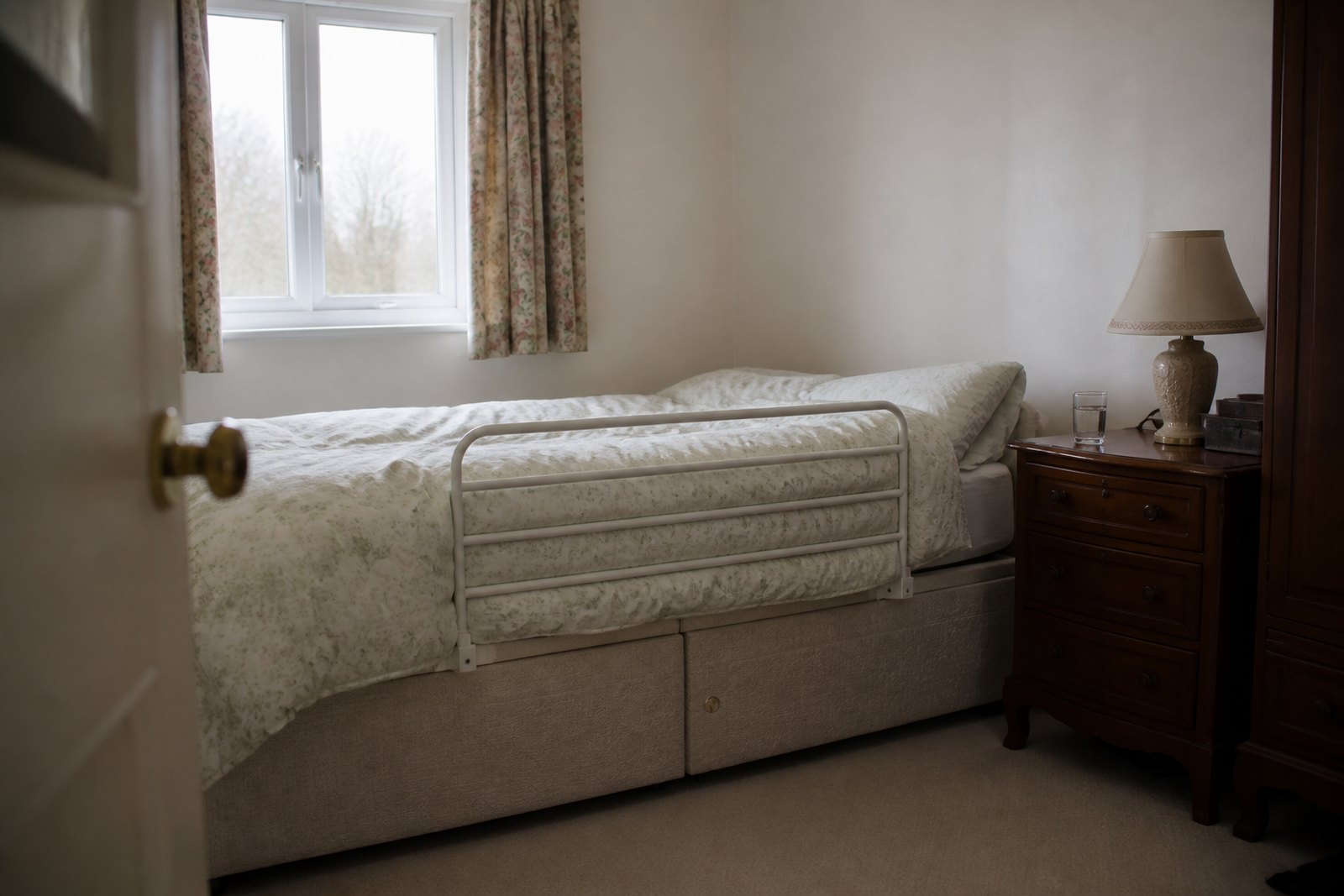
Bed rails are one of the few pieces of equipment where the honest answer is genuinely two-sided. Used for the right reason, fitted correctly to the right bed, they prevent falls. Used for the wrong reason, or fitted to a bed and mattress they do not match, they have caused serious injuries and deaths through entrapment.
That is not a reason to avoid them. It is a reason to be clear about what they are for - and this is one topic where it is worth getting an assessment rather than buying based on a product description.
What bed rails are actually for
Bed rails have one legitimate purpose: to stop someone accidentally rolling or sliding out of bed. That is it.
They are appropriate for a person who moves involuntarily in their sleep, or who has reduced awareness of the bed edge, and who is at genuine risk of ending up on the floor without meaning to get up.
What they are not for
This distinction matters more than anything else on this page.
Bed rails are not a way of keeping someone in bed who is trying to get out. Someone who is determined to get up - because they need the toilet, because they are confused, because they are distressed - will attempt to climb over the rail, or squeeze around it. Falling from the top of a raised rail is considerably more dangerous than rolling out of a bed. Using rails this way also raises real questions about restraint, consent and someone's liberty, which is not a decision to take informally.
If the problem is that someone keeps trying to get out of bed, a rail is the wrong answer, and it makes the situation more dangerous rather than less. The question to work on instead is why they are getting up.
The entrapment risk
The specific danger with bed rails is entrapment: a person becoming caught in a gap, unable to free themselves. The MHRA - the UK regulator for medical devices - publishes guidance on the safe use of bed rails precisely because these incidents have caused serious harm and deaths.
The gaps that matter are:
- Between the rail and the mattress - the most common, and it grows as a mattress ages, softens or is replaced with a thinner one.
- Between the bars of the rail itself - a head or limb passing through and becoming trapped.
- Between the rail and the headboard or footboard.
- Between two sections where split or multiple rails are used on one side.
- Between the mattress and the bed frame, if the mattress can shift sideways.
The people most at risk of entrapment are, unfortunately, often the same people rails are considered for: those who are confused, restless, very frail or of small build, and those who cannot reposition themselves or call for help.
The mattress is part of the safety equation
This is the single most commonly missed point, and the most important practical one.
A bed rail is only safe in combination with a specific mattress. The rail must stand sufficiently proud of the mattress surface to stop someone rolling over it, and the gap between rail and mattress must be small enough that a body part cannot pass through.
Which means the safety of a correctly fitted rail can change without anyone touching the rail:
- A new mattress of a different thickness alters both the height above the surface and the gaps.
- An air or pressure-relieving mattress changes height as it inflates and deflates, and is soft enough for a person to sink into at the edge - a combination that needs specific assessment.
- An ageing mattress compresses over time, often unevenly at the edges.
- A mattress topper raises the surface and reduces the effective rail height.
If the mattress changes, the rail assessment needs redoing. That is not a formality - it is where a previously safe setup quietly becomes unsafe.
Fitting and checking
- Use rails designed for that bed. Integral rails made for the bed frame are generally safer than universal add-ons. Rails from one manufacturer fitted to another's bed is where a lot of gap problems begin.
- Check both sides. A rail on one side only can funnel someone towards the unprotected edge.
- Check the fixings regularly, not once. Rails loosen with use.
- Re-check after any change to the mattress, the bed, or the person's condition and size.
- Consider bumpers instead of bars where the risk is rolling rather than falling - soft padded bumpers eliminate several entrapment gaps entirely.
Alternatives worth considering first
In practice, an occupational therapist will often look at these before recommending rails at all:
- Lowering the bed. A lower bed reduces the distance and therefore the injury if someone does roll out. Some profiling beds lower close to the floor.
- A crash mat beside the bed, which addresses the consequence rather than preventing the event.
- Addressing the reason for getting up. Night-time toilet trips are the commonest reason. A commode or urinal within reach, a clear lit route to the bathroom, and reviewing the timing of diuretic medication with a GP or pharmacist can remove the need entirely.
- Better lighting - a motion-activated night light on the route to the bathroom is cheap and often effective.
- A bed lever or grab handle, which helps someone get in and out safely, rather than preventing them.
- Sensor mats and alarms, which alert a carer rather than restricting the person. See our guide to assistive technology at home.
- Reviewing medication. Sedatives, sleeping tablets and some blood pressure medicines contribute to night-time unsteadiness and confusion. This is a conversation for a GP or pharmacist and is often overlooked.
Consent, capacity and dementia
If the person using the bed cannot consent to a rail - most often where there is dementia or another condition affecting capacity - the decision must be made in their best interests, involving family and the professionals in their care. Where a rail restricts someone's freedom to move, it may amount to a restraint, and there is a formal framework for that. It is not something to decide alone or informally.
If you are caring for someone with dementia and considering rails, raise it with their GP, community nurse or social worker as well as with an occupational therapist. Nobody should be carrying that decision on their own.
Frequently asked questions
Are bed rails safe for elderly people?
They can be, for the specific purpose of stopping someone accidentally rolling out of bed, when correctly fitted to that bed and that mattress. They are not safe as a way of keeping someone in bed who wants to get up, and they carry a real entrapment risk - which is why the MHRA publishes specific guidance on their safe use. Whether they are safe for a particular person is an assessment question, not a product question.
What is bed rail entrapment?
Becoming caught in a gap and unable to get free - most commonly between the rail and the mattress, but also between the bars, between the rail and the headboard, or between rail sections. It has caused serious injuries and deaths. Those most at risk are often the frail, confused or small-built people rails are considered for in the first place.
Do bed rails stop people getting out of bed?
No, and they should never be used to try. Someone determined to get up will climb over or around a rail, and falling from the height of a raised rail is more dangerous than rolling out of bed. It also raises questions of restraint and consent. If someone keeps trying to get out of bed, the useful question is why - most often it is the toilet.
Can I fit bed rails to any bed?
No. Rails must be compatible with the specific bed and mattress. Universal rails fitted to a bed they were not designed for are a common source of dangerous gaps, and rails made integral to the bed frame are generally safer. If the mattress is later changed - including for a thinner one, an air mattress or one with a topper added - the setup needs re-checking.
What can I use instead of bed rails?
Depending on the reason: lowering the bed, a crash mat, a bed lever to help someone get in and out safely, a commode or urinal within reach, better night lighting, sensor mats that alert a carer, or a medication review. An occupational therapist will usually work through these before recommending rails.
Next steps
Bed rails are one of the clearest cases for getting an assessment rather than ordering something. The judgement involves the person, the bed, the mattress and the reason - and getting any one of those wrong changes the answer. An occupational therapist can assess all four in your own home. See the areas we cover or current guide pricing.
Talk to an occupational therapist near you
This guide is general information. For advice about your own situation - or someone you look after - a local occupational therapist can visit you at home and see it for themselves.
Choose your area: