

Bath Seats for Disabled Children: Safer, Easier Bath Times
By Mobile Occupational Therapist • 23 October 2026 • 13 min read
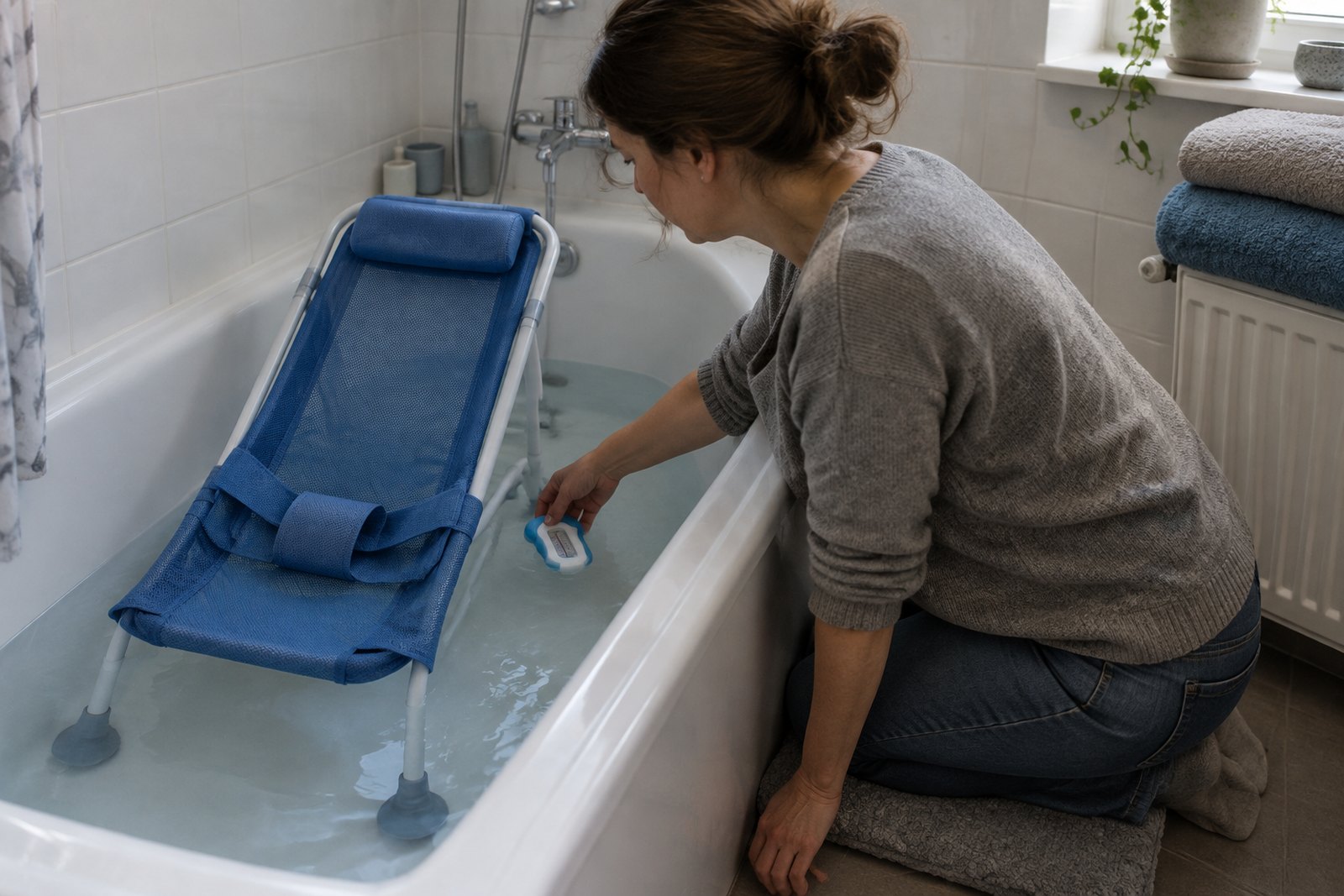
If bath time with your child has turned into a two-person job, a wrestling match or the part of the day you dread, you are not doing it wrong. Children grow, posture changes, seizures and sensory needs add risk, and a bath is a low, slippery, awkward place to hold anyone. A special needs bath seat can make a real difference, but it is one piece of a bigger picture.
The short answer is this. There are supportive bath seats and chairs that hold a child in a safe position, bath lifts that lower and raise them, changing and showering tables, and hoists for older and heavier children. The right choice depends on how your child sits, how heavy they are and who does the bathing. In the UK, most of this equipment can be assessed for and loaned free through a children's occupational therapist at your council or local NHS service, so ask before you buy. And whatever you use, no seat makes it safe to leave a child alone in the bath, not even for a moment.
Why bath time gets harder as children grow
Many parents manage fine for years, then find it unravels fairly quickly. Usually it is several things at once.
- Size and weight. A toddler can be held in one arm. A nine-year-old who cannot sit unsupported is a different matter, and wet skin is hard to grip.
- Posture and sitting balance. Children with low tone may slump or slide down. Children with high tone or spasms may push back, arch or stiffen when they touch water.
- Lifting. Getting a child over the side of the bath and down to the bottom of it means bending, reaching and twisting all at once. It is about the worst lift there is for an adult back.
- Seizures. If your child has epilepsy, water adds a serious extra risk, and you may feel you cannot relax for a second.
- Sensory needs. The noise of running water, the echo, the light, the change in temperature, water on the face, the feel of a towel. For some children it is genuinely overwhelming.
- Tiredness. Bath time usually falls at the end of a long day, for both of you.
Types of bathing equipment for disabled children
Equipment is described here by type. Exact designs vary, and sizes matter more than features, because a seat that is too big will not support and one that is too small will not be safe.
Supportive bath seats
The most common is a fabric or mesh seat stretched over a lightweight frame, a bit like a hammock with a backrest. The backrest angle usually adjusts, so a child with little head or trunk control can lie back at a gentle recline, while a child with some sitting balance can be more upright. The frame sits in the bath, often on non-slip or suction feet.
Other designs are padded and moulded, with extra support around the trunk. Many have optional pieces such as a head support, side supports, a pelvic strap, a chest strap or a pommel between the legs to stop sliding forward. These help with position. They are not restraints and they are not safety devices.
Children outgrow bath seats. Expect to need a bigger one, or a different type, every few years.
Bath chairs and powered bath lifts
A bath lift is a seat that sits in the bath and lowers your child into the water and back up again, usually powered by a rechargeable battery. Many have a backrest that reclines. You still have to get your child onto the seat at the top, but you are not lifting them up from the bottom of the bath, which is the hardest part. Some suit children who can help with a transfer, others need a hoist to get on.
Changing and showering equipment
For many older children, the answer is to move away from the bath altogether. Options include:
- Height-adjustable changing benches or tables, either fold-down from the wall or freestanding, so you can wash and dress your child at waist height with a handheld shower.
- Shower trolleys, a padded, waterproof platform on wheels for children who need to lie down to be washed.
- Mobile shower and toilet chairs, often with a tilting seat (called tilt-in-space) and supports, which can be wheeled into a level-access shower.
Hoists
Once a child is too heavy to lift safely, a hoist is usually the safest way to move them into and out of the bath or shower. A mobile hoist is a wheeled frame you push around. A ceiling track hoist runs on a rail fixed to the ceiling, which takes up no floor space and suits small bathrooms. Bathing slings are often made of quick-drying mesh. Our guide to hoists at home explains the types and what an assessment involves. Hoists and slings must be assessed and fitted for your child, not borrowed from someone else.
Safety: the rules that do not bend
Never leave your child alone
Seats tip, suction feet let go, children slide down or twist out of straps. Drowning can happen quickly, in shallow water, and silently. Gather everything before the water goes in: towels, clean clothes, nappy or pad, toiletries, any medication your child might need. If the doorbell or phone goes, either ignore it or lift your child out, wrapped in a towel, and take them with you.
Water depth and temperature
Use only as much water as you need. Run the cold first, then add hot, and mix it well so there are no hot patches. Check it with a bath thermometer or your elbow before your child goes in, and aim for warm, not hot. Take extra care if your child has reduced feeling in their skin, cannot move away from heat or cannot tell you something hurts. Hot taps can stay hot after use, so turn your child away from them or cover them. A plumber can fit a thermostatic mixing valve that caps the temperature of the water coming out of the tap, which many families find a relief.
Seizures
If your child has epilepsy, ask their epilepsy nurse or consultant for a bathing plan. Many families are advised to use a shower, with the child seated, or very shallow water, and to keep the bathroom door unlocked. Know what to do if a seizure starts in the water: support your child's head above the water, let the water out and keep them warm. If your child may have breathed in water, call 999 even if they seem to recover. Follow your child's own care plan about rescue medication and when to call for help. As general NHS guidance, call 999 if a seizure lasts more than five minutes and you do not have a plan that says otherwise, if seizures follow one another without recovery, if your child is injured or if they are struggling to breathe. Our guide to epilepsy safety at home goes into more detail.
Check the equipment, and the skin
Before each use, check straps, buckles, frames and suction feet. Afterwards, dry carefully in skin creases and look for redness or sore patches, especially where straps and supports touch. If a mark does not fade, or skin breaks, speak to your GP or your child's nurse.
Making bath time easier for children with sensory needs
If your child hates the bath, the cause may be sensory, physical, or both. Things worth trying:
- Run the bath before your child comes into the room, so they do not have to hear it filling.
- Keep the lighting soft and the room warm. Warm the towel on a radiator.
- Use the same order every time, and a simple picture sequence if it helps your child know what comes next.
- Warn before water goes on, and pour it from the back of the head with a cup or jug rather than over the face. A soft hair-washing shield, worn like a visor, helps some children.
- Firm, steady touch with a flannel is often better tolerated than light dabbing.
- Separate hair washing from body washing, and do them on different days if you need to.
- Remember a full bath is not compulsory every day. A good wash at the sink or on a changing table counts.
If bath time has suddenly become distressing, consider pain, a skin problem, constipation or illness, and speak to your GP if you are unsure.
Looking after your back
Parents of disabled children often lift far more than is safe because there seems no alternative. The back injury tends to arrive when you can least afford it.
- Kneel on a cushioned pad beside the bath rather than bending from standing.
- Keep your child close to you, and avoid twisting while you hold them.
- If anyone else helps, agree who says go before you move.
- Ask for proper moving and handling training. Your child's occupational therapist can often arrange it or show you themselves.
A useful rule of thumb: if you are lifting your child over the side of the bath on your own and it feels like a strain, it is time to ask for an assessment. Our guide to safe moving and handling for family carers covers the basics. You are also entitled to ask your council for a parent carer's needs assessment, which looks at the support you need as well as your child.
How to get bathing equipment for your child
In most areas, bathing equipment for disabled children is provided through a children's occupational therapist, either in the council's children's social care service (often a disabled children's team) or an NHS children's community therapy service. Who does what varies by area. Your GP, paediatrician, health visitor or school nurse can refer you, and many councils accept a direct request from parents.
Ask for an assessment of your child's bathing and personal care at home. The occupational therapist will usually watch how bath time works now, look at your bathroom and talk to you about what is hardest. Equipment recommended this way is normally loaned free, maintained, and swapped for a bigger size as your child grows. Waiting times vary widely, so ask how long it is likely to be, and tell them if things are becoming unsafe, because that can change priority.
Some charities, including Cerebra, offer information for families, and some charities give grants towards equipment. If you decide to buy privately, try before you buy, check the weight limit and size range, and get advice on which type suits your child first. A seat that looked perfect online can be wrong in practice.
Adaptations: when the bathroom itself needs to change
For many growing children, the long-term answer is a level-access shower or wet room, sometimes with a changing bench and a ceiling track hoist. It means no lifting over a bath side and room to work. Our guide to wet rooms and level-access showers explains what is involved.
In England, adaptations like these can be funded through a Disabled Facilities Grant from the council. For a disabled child, the grant is not means-tested, so your household income is not assessed, although there is an upper limit and the council has to agree the work is necessary and appropriate. An occupational therapist's assessment usually underpins the application. See our guide to the Disabled Facilities Grant, and check the current rules on GOV.UK and with your council. Wales, Scotland and Northern Ireland have their own arrangements. Council and housing association tenants should also speak to their landlord.
Where an occupational therapist fits
An occupational therapist looks at the whole task: how your child sits and moves, what they can do for themselves, how you lift and handle them, the space you have and what bath time is like for everyone. They can recommend the right type and size of equipment, set it up, show you how to use it safely, write a moving and handling plan and recommend adaptations.
Other professionals lead on some parts. A physiotherapist often leads on posture and positioning, sometimes alongside the occupational therapist. The epilepsy nurse or consultant should agree any seizure plan. Your GP is the right person for skin problems or new pain, and can refer to the children's bladder and bowel service if continence is part of the difficulty.
A private occupational therapist visiting at home can assess your child, advise on equipment and adaptations, and write a report you can share with the council or school. Be aware that councils usually still want their own occupational therapist to agree equipment they supply or grant-funded work, though a clear private report can help. You can read more about children's occupational therapy on our services page.
Frequently asked questions
Can I use an ordinary baby bath seat for my disabled child?
Usually not. Baby bath seats are designed for babies of a certain size and stage, and they do not give the trunk, head or pelvic support many disabled children need. They are not safety devices either. A children's occupational therapist can advise on a seat designed for your child's posture and size.
When does my child need a hoist?
There is no set age or weight. It depends on your child's size, how much they can help, your own health and the layout of your home. If lifting is painful, risky or takes two people, ask for an assessment now rather than waiting until someone is hurt.
Is a shower safer than a bath for a child with epilepsy?
Many epilepsy specialists suggest a supervised, seated shower or very shallow water, but every child is different. Ask your child's epilepsy nurse or consultant what they recommend, and never leave your child unsupervised either way.
Do I have to pay for a special needs bath seat?
Often not. Equipment recommended by a council or NHS children's occupational therapist is usually loaned free. You can buy privately if you prefer, but it is worth getting advice first so you do not spend money on the wrong thing.
My child screams at bath time. Is it behaviour or sensory?
It can be either, or both, or pain or discomfort your child cannot explain. Try the sensory changes above, and keep a note of what seems to set things off. A children's occupational therapist can help work it out. If the distress is new or comes with other symptoms, see your GP.
Will the council pay for a wet room for my child?
It may, through a Disabled Facilities Grant in England, which is not means-tested for disabled children. The council will want an occupational therapist's assessment and has to agree the work is needed. Check GOV.UK and contact your council's adaptations or housing team to start.
Next steps
See our children's occupational therapy and home adaptations pages, or current guide prices, and choose your area below.

Talk to an occupational therapist near you
This guide is general information. For advice about your own situation - or someone you look after - a local occupational therapist can visit you at home and see it for themselves.
Choose your area: