
Hoists at Home: Types, Assessment and Safe Use
By Mobile Occupational Therapist • 31 August 2026 • 9 min read
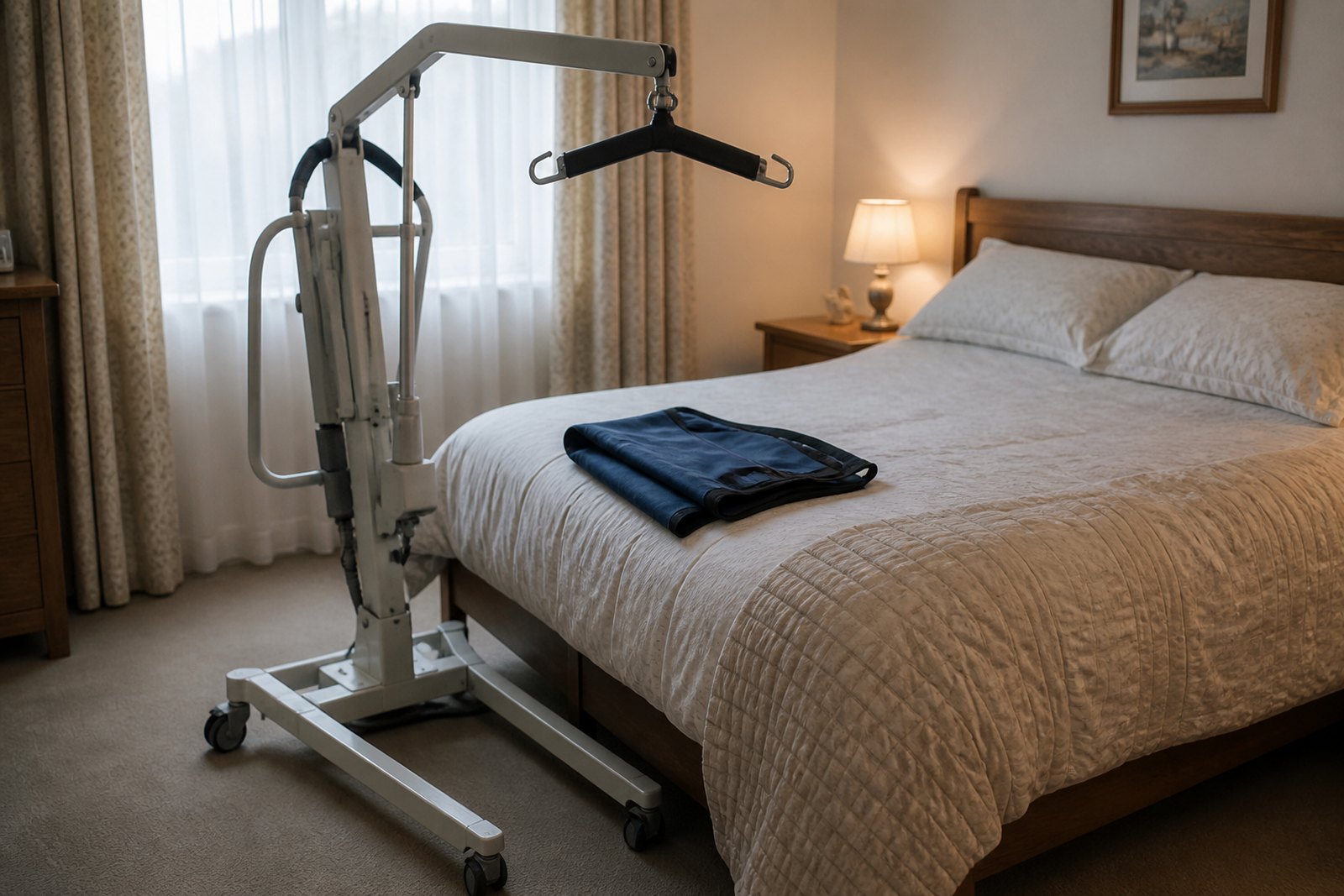
A hoist is a piece of equipment that lifts and moves a person who cannot transfer safely on their own - between bed and chair, on and off the toilet, or in and out of the bath. It works by supporting the person's weight in a fabric sling attached to a lifting unit, which may be a wheeled frame, a track fixed to the ceiling, or a powered seat at the bath. Used well, a hoist protects the person being moved and the person doing the moving. But a hoist should never be bought or used without a professional assessment and hands-on training - and that is the most important sentence in this guide.
Why assessment and training come before everything else
It is worth being blunt here, because someone reading this may be about to lift a relative who has slipped down in bed. The wrong sling, the wrong size, a sling fitted incorrectly, or a hoist used by someone who has never been shown how, can cause skin damage, a fall from the sling, or a serious back injury to the carer. Manually lifting a person - under the arms, by the trousers, in a bear hug - is not a safe alternative either; it is precisely the situation a hoist exists to replace. If you have reached the point of physically lifting someone, that is the signal to ask for an urgent moving and handling assessment, not to order equipment online. The NHS guidance on moving, lifting and handling someone else says the same: get training, and get a professional to look at the situation.
An assessment matters because a hoist is not one decision but several: which type, which sling design and size, how the person tolerates being lifted, whether the room and floor can accommodate it, and whether one carer can use it alone. Getting any one of those wrong can make the whole arrangement unsafe.
How does a hoist work?
All hoists share the same basic idea. A sling is positioned around the person - usually while they are sitting or lying - and its loops or clips are attached to a spreader bar on the hoist. A powered motor raises the person clear of the surface, the hoist (or the person, on a track) is moved to the new position, and they are lowered gently down. The weight is taken entirely by the sling and the lifting unit; nobody is holding or dragging them.
Done properly, it is slow, calm and surprisingly comfortable. Done badly, it is frightening, and one bad hoisting experience can make a person resist every one that follows. Technique is what makes hoisting dignified rather than distressing - which is another reason training matters.
The main types of hoist at home
- Mobile hoists are the most common at home - a wheeled frame with a lifting arm, pushed by a carer, moving a person short distances such as bed to chair. They need clear floor space to manoeuvre and somewhere to be stored and charged, and they do not work well on thick carpet or through narrow doorways - exactly the kind of thing an assessment checks.
- Ceiling track hoists run on a rail fixed to the ceiling, with a motor unit that travels along it. They need no floor space, cope with any flooring, and are generally easier for a single carer to use, but they only cover the routes the track runs - typically over the bed, or bed to en-suite. Installation is a proper building job needing the ceiling structure checked, so it is typically a four-figure undertaking, often grant-funded rather than bought outright.
- Standing hoists (stand aids) suit people who have some weight-bearing ability and trunk control but cannot get up safely alone: the person holds a frame and is helped into standing by a sling behind the back. They keep people actively involved in the transfer, which helps preserve strength - but they are only safe for people with enough ability to use them, which is an assessment decision, not a guess.
- Bath hoists and bath lifts lower a person into the water, either on a powered seat fixed beside the bath or via a sling, and can restore a proper soak to someone who has managed with strip washes for years. Whether a bath hoist, a bath lift or a bathroom adaptation such as a level-access shower is the better answer depends on the person, the bathroom and the years ahead.
The sling matters as much as the hoist
People shop for hoists and forget that the sling is the part actually holding the person. Slings come in different designs - full-body slings with head support, access slings shaped for toileting, and more - and in different sizes and fabrics, including mesh for bathing. A sling must be matched to the person's size, shape, skin condition, muscle tone and the task in hand, and it must be compatible with the hoist: attachments are not universally interchangeable, and mixing incompatible systems is unsafe.
One person may need different slings for different tasks, and someone with changing needs - for example with multiple sclerosis or another progressive condition - needs the sling prescription reviewed as things change, not set once and forgotten. Worn, frayed or damaged slings must be taken out of use; the sling is safety-critical equipment, not laundry.
One carer or two?
Much home care is planned around whether transfers need one carer or two, and the answer affects cost, rotas and family life. There is no blanket rule: it depends on the person's stability, behaviour and tolerance of hoisting, the equipment, and the layout of the room. Ceiling track hoists and well-set-up rooms make single-carer hoisting more achievable; cramped rooms, thick carpets and unpredictable movement push towards two. This is exactly the kind of question a moving and handling assessment answers in writing, which matters when care agencies and funding decisions hang on it.
How to get a hoist, and who pays
Start with a free needs assessment from your local council, which you can request yourself. Where a hoist is assessed as needed, mobile hoists and slings are commonly provided on loan through local community equipment services at no charge, with training for the carers who will use it. Ceiling track hoists, because they involve building work, are usually funded through a Disabled Facilities Grant - our guide to the Disabled Facilities Grant explains how that works, and the current details are on GOV.UK.
Buying privately is possible, and sometimes sensible where waiting lists are long - but the assessment still comes first. A privately purchased hoist still needs the right sling, a layout that works, carer training, and ongoing servicing; hoists are lifting equipment and need regular professional inspection to stay safe. An independent occupational therapist can carry out the assessment at home, specify exactly what to buy, and train the family in using it - which is usually a small fraction of the cost of the equipment itself.
Dignity is the point, not the price
Families sometimes delay a hoist because it feels like a defeat - the moment the house becomes a hospital. In practice it is usually the opposite. A hoist ends the daily wrestling, the near-misses, the bruised arms and the strained backs, and replaces them with transfers that are calm and unhurried. It often makes the difference between staying at home and not - which is worth remembering if a hoist is being discussed as part of hospital discharge planning.
Who benefits from a hoist assessment
- Anyone who can no longer stand and transfer safely, even with help from one person
- Families who have started physically lifting a relative, or catching them mid-transfer
- Carers with back pain, or a person with skin damage from being moved by hand
- Anyone with a progressive condition where transfers are getting steadily harder
- Anyone who already has a hoist that is not being used - often a sign the sling, training or layout was never right
Frequently asked questions
Can I buy a hoist for an elderly relative at home without an assessment?
You can, but you should not. A hoist bought without assessment is very often the wrong type or paired with the wrong sling, and an untrained carer using it puts both people at risk. Ask the council for a needs assessment, or arrange a private OT assessment - either route also tells you whether the hoist could be provided on loan free of charge.
Is a ceiling hoist better than a mobile hoist for an elderly person?
Neither is better in general. A ceiling track hoist needs no floor space, glides over any carpet and is easier for one carer, but it only covers the routes the track runs and needs installation. A mobile hoist is flexible and usually loaned free, but needs space, smooth floors and more effort to manoeuvre. The right answer depends on the person, the home and who is doing the caring - which is what the assessment decides.
Is there a hoist for getting in and out of the bath?
Yes. Bath hoists lift a person over the bath edge and lower them into the water, and simpler bath lifts raise and lower a seat inside the bath itself. Which suits you - or whether a level-access shower would serve better for years to come - is worth deciding with an OT before spending money, because the bathroom is usually the most expensive room to get wrong.
Next steps
If transfers at home have become unsafe, or a hoist has been suggested and you want it set up properly, an occupational therapist can assess the person, the room and the carers together, and put the whole arrangement - hoist, sling, training and funding route - on a safe footing. Find your local occupational therapist via our areas we cover page, or see our prices page for current guide pricing.
Talk to an occupational therapist near you
This guide is general information. For advice about your own situation - or someone you look after - a local occupational therapist can visit you at home and see it for themselves.
Choose your area: