

Special Needs Trikes and Adapted Bikes for Disabled Children
By Mobile Occupational Therapist • 21 October 2026 • 13 min read
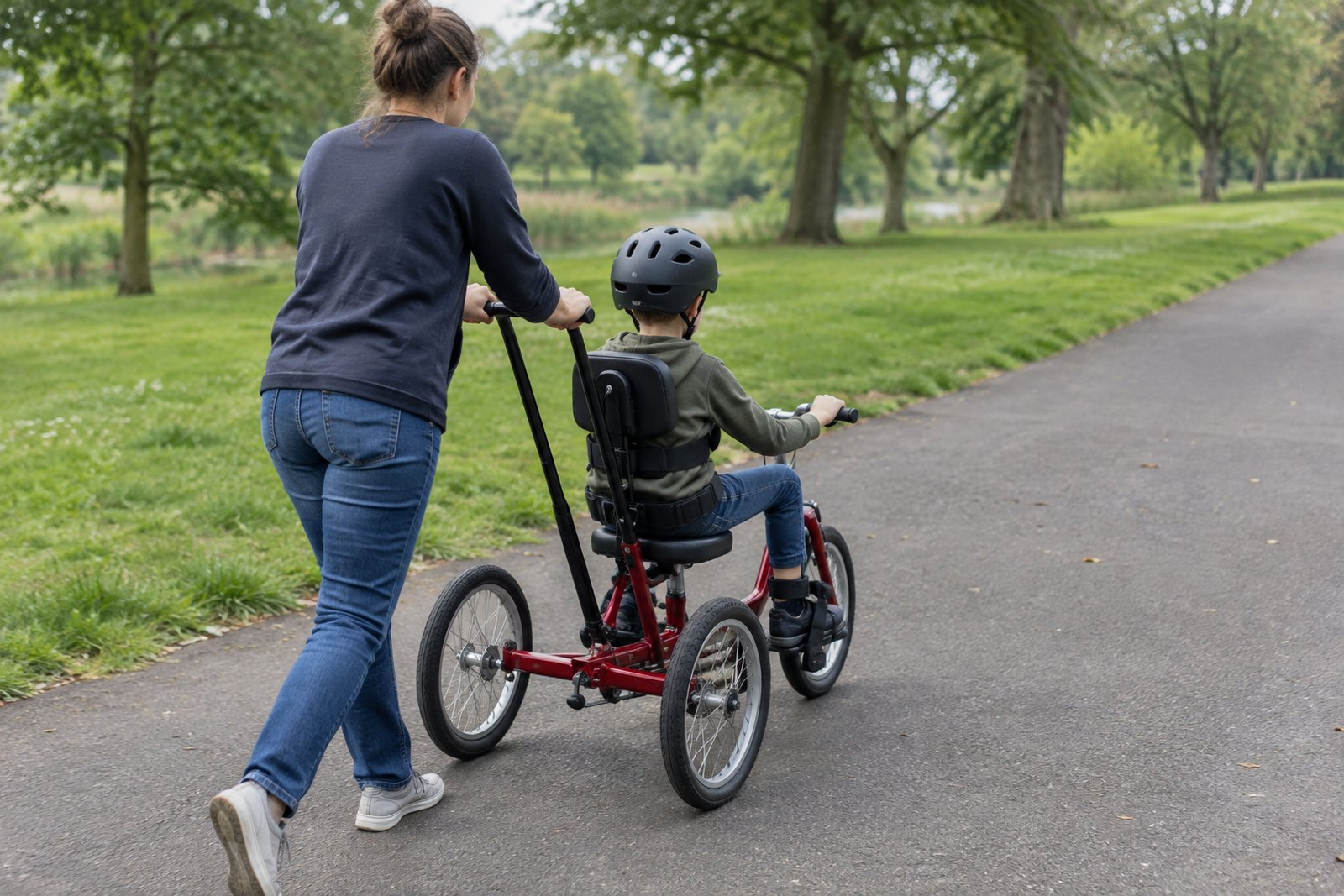
Most disabled children can ride something. It may not look like the bike their brother or sister rides, but there is a wide range of adapted cycles in the UK, and for many families finding the right one is the moment a child stops watching from the side of the park and starts joining in.
A special needs trike (or adapted tricycle) is a three-wheeled bike with extra support built in. That might be a high backrest, a chest harness, a pelvic belt, foot plates with straps, and a long push handle so an adult can steer and brake from behind. Beyond trikes there are tandems, side-by-side bikes, handcycles worked by the arms, and trailers for children who cannot pedal at all. The best way to choose is to try several at an inclusive cycling session, ask your child's physiotherapist or occupational therapist to check posture and safety before you spend money, and look to charities and grants for funding, because these cycles are expensive and are not usually provided as standard by the NHS.
Why cycling is worth the effort
It is fair to ask whether this is worth the cost, the hunt for funding and the sheer logistics of getting a large trike in and out of the car. Plenty of parents ask it. The answer, for a lot of children, is yes.
- Fun and freedom. For a child who spends much of the day being moved by other people, making something go under their own power is a big deal. Even a few metres counts.
- Fitness and movement. Pedalling works the legs, trunk and heart in a rhythmic, repetitive way that is hard to get from other play. It can help with strength, stamina and coordination, and it builds gross motor skills in a way that does not feel like therapy.
- Belonging. Family bike rides, a lap of the playground with friends, cycling to the park. Being part of ordinary family life matters as much as any exercise benefit.
- Regulation. Some children, including many autistic children and those with sensory processing differences, find the steady movement of cycling calming and organising.
None of that means every child must cycle, or that a trike is a treatment. It is an activity. The aim is for it to be enjoyable and safe.
The main types of adapted bike and trike
Adapted trikes with supports
This is what most people mean by a special needs trike. Three wheels mean the child does not need to balance, which takes away the biggest barrier for many. Trikes come in different sizes and set-ups: upright trikes where the child sits as on a normal bike, recumbent trikes where they sit lower and lean back with legs out in front, and trikes with two wheels at the front or two at the back. They can be fitted with a range of supports (more on those below) and many have a parent push handle with its own brake and steering control.
Trikes suit children who can push pedals to some degree but cannot balance a bike, or who need help sitting upright. They are heavy and bulky, so think about where you will store it and how you will transport it.
Tandems and side-by-side bikes
On an adapted tandem the child usually sits at the front or back with an adult doing the steering, braking and much of the pedalling. This suits older or larger children, children with visual impairment, and children who can pedal well but cannot be trusted with road awareness or steering. Some tandems allow the child's pedals to freewheel so they can rest while the adult keeps going.
Side-by-side bikes put the child and adult next to each other, often on a wide four-wheeled frame. They are sociable and stable, and are common at inclusive cycling centres. They are less practical to own because of their size.
Handcycles
A handcycle is pedalled with the arms rather than the legs. It can suit children who have good upper body strength but limited use of their legs, for example some children with spina bifida or spinal cord injury. Some handcycles are standalone; others attach to the front of a wheelchair. A child needs reasonable trunk control or suitable support to use one safely.
Trailers and wheelchair-carrying bikes
If your child cannot pedal at all, they can still come on family rides. Adapted trailers with supportive seating can be towed behind an adult's bike, and some are designed for older and heavier children. There are also bikes with a platform at the front that carries a child in their own wheelchair while an adult pedals from behind. These are about inclusion and shared outings rather than exercise for the child, and that is a perfectly good reason to choose one.
Balance bikes and stabilisers
Some children with milder coordination difficulties, such as dyspraxia or hypermobility, may eventually ride a two-wheeled bike. A balance bike (no pedals, feet push along the ground) is often a better route than stabilisers, because it teaches balance first. Larger balance bikes exist for older children. If your child is stuck, a physiotherapist or occupational therapist can help work out what is getting in the way, whether that is balance, strength, coordination or confidence.
Supports, straps and controls: what they actually do
Supports are what turn an ordinary trike into one your child can use. They should be chosen for your child's body and needs, not added because they come in the brochure. Too little support and your child slumps, tires quickly or slides out. Too much and you take away movement they could manage themselves.
- Backrest. Gives support for children with weak trunk control. Some are high with a headrest, some are low.
- Lateral supports. Pads at the sides of the trunk to stop leaning to one side.
- Pelvic belt. Holds the hips back in the seat. A good pelvic position is the base for everything else.
- Chest harness. Often a vest or H-shaped harness for children who fall forward. It should not restrict breathing or press on the neck.
- Foot plates and straps. Keep feet on the pedals. Some have heel cups or calf supports for children whose feet roll or slip.
- Fixed wheel or freewheel. On a fixed-wheel trike the pedals turn whenever the wheels turn. This can help a child learn the pedalling movement, but it also means the legs are moved round when an adult pushes. A freewheel lets the child stop pedalling while the trike rolls.
- Parent push handle. Lets you push, steer and in many cases brake from behind. Useful while a child is learning, tires quickly or lacks road awareness.
- Steering limiters and hand supports. Restrict how far the handlebars turn, or help hands stay on the grips.
If your child has low muscle tone, tight muscles, hip problems, a curve of the spine or a condition that affects breathing, ask their physiotherapist before choosing supports. Getting posture wrong over many rides can cause discomfort, and in some cases it can work against what the child's therapy team is trying to achieve.
Try before you buy
This is the single most useful piece of advice in this article. Adapted cycles are expensive, and a child who looks perfect for a particular trike on paper may hate it, not fit it, or not be able to pedal it at all.
Inclusive cycling centres and sessions run across the UK, often in parks, sports centres and on closed tracks. Many are run by charities, and some come under well-known national programmes such as Wheels for All. They usually have a fleet of adapted trikes, tandems, handcycles and side-by-side bikes, with staff or volunteers who help with setting up. Search online for inclusive cycling near you, or ask your child's school, therapist or local parent carer forum.
When you go:
- Let your child try several different types, not just the one you expected.
- Watch how they sit after ten minutes, not just at the start. Slumping or leaning shows up when they tire.
- Notice whether they can get on and off, and how much lifting you need to do.
- Take photos (with permission) of the set-up that worked, and write down the type and size.
- Ask whether the centre can loan cycles, or knows of local loan or second-hand schemes.
Some suppliers will also bring trikes to your home or school for a trial. That can be helpful, but a trial with someone selling the trike is not the same as an independent opinion on posture and safety.
Paying for it: funding, grants and keeping costs down
Adapted trikes and bikes cost considerably more than standard children's bikes, and supports add to the price. In most areas they are not something NHS wheelchair services routinely provide, though it does no harm to ask your child's therapist what is available locally. Most families end up piecing together funding from several places.
- Children's disability charities. Several national and regional charities give grants for equipment for disabled children, and some specifically fund trikes. Each has its own rules on age, condition and household income, so read the criteria carefully. The charity Contact has information on finding grants.
- Local charities and community groups. Local trusts, service clubs, churches and businesses sometimes fund one-off items for local children.
- Disability Living Allowance. If your child gets DLA, it can be spent on whatever helps them, including a trike.
- VAT relief. Equipment designed for disabled people can sometimes be bought without VAT. Check with the supplier and read our guide to VAT relief on disability equipment.
- School. Some special schools have trikes children can use in the day, and occasionally they will help with applications.
- Second-hand. Children outgrow trikes, so good second-hand ones do come up. Check the frame, brakes and supports, make sure the size will suit for a while, and ideally have a therapist look at the fit.
- Crowdfunding and fundraising. Many families do this, often successfully, for larger items.
Grant applications usually go better with a short letter from a professional explaining why the cycle is needed and which features your child requires. Ask early, because therapists can be busy.
Safety: helmets, supervision and roads
Helmets
There is no legal requirement in the UK for children to wear a cycle helmet, but the Highway Code recommends one. Choose one that fits snugly and sits level on the head. Some children with sensory sensitivities find helmets hard to tolerate; build up gradually, wearing it for short spells indoors first. If your child has a shunt, a skull condition, or wears a hearing aid or other device on the head, ask their medical team about helmet fit.
Supervision
Children on adapted cycles nearly always need closer supervision than on standard bikes. Trikes feel stable but can tip on tight turns at speed, on sloping pavements and on uneven ground, and a strapped-in child cannot jump clear. Keep the parent handle on until you are confident your child can steer, brake and stop when asked. Never leave a child strapped in on a slope or near a road, even for a moment.
Roads and road awareness
Start somewhere safe and enclosed: a park path, playground, school yard or cycling centre. Many children with learning disabilities, ADHD or visual difficulties will need an adult in control on roads for a long time, and that is fine. A tandem or trike with a push handle lets you do that. Bright clothing and lights help other people see a low trike, which can sit below a driver's line of sight.
Checks before every ride
- Brakes work, including the parent brake.
- Tyres are pumped up.
- Straps and supports are fastened and not twisted, worn or rubbing.
- Feet are secure but not so tight that circulation suffers.
- Your child is comfortable, not too hot or cold, and has had a drink.
Where an occupational therapist fits
Be honest with yourself about who to ask. For many children, the paediatric physiotherapist leads on trikes, because the main questions are about posture, muscle tone, hips and how the legs move. If your child already has a physio, start there. They know your child's body and any risks.
An occupational therapist comes in from a slightly different angle. A private occupational therapist visiting at home can look at how your child sits and which supports they need, but also at the whole activity: getting on and off, motor planning and coordination, sensory reactions to the helmet, harness or movement, attention and safety awareness, and whether the trike will fit into family life and your home. They can write a report or letter setting out what your child needs and why, which helps with grant applications. They can also suggest ways to build the skills that make cycling easier, whether that is strength, coordination or tolerating a helmet. Read more about how paediatric occupational therapy helps children.
What an occupational therapist will not do is replace medical advice. If your child has a heart condition, uncontrolled epilepsy, recent surgery, a hip problem or anything else that affects exercise, check with their consultant or GP first. Our paediatric occupational therapy page explains more about home visits for children.
Frequently asked questions
What age can a child start on an adapted trike?
There is no fixed age. Small trikes exist for toddlers and pre-school children, and larger ones for teenagers and adults. What matters more is whether your child can sit safely with the right supports and enjoys it. Ask their physiotherapist or occupational therapist if you are unsure.
Can the NHS provide a special needs trike?
Adapted trikes are not usually provided as standard by NHS wheelchair services, but arrangements vary. Ask your child's therapist what is available locally, and look at charity grants, which is where most families find funding.
My child cannot pedal. Is there any point?
Yes. A trailer or wheelchair-carrying bike lets them join family rides. Some children who cannot pedal at first learn to with practice on a fixed-wheel trike, but that should be guided by a therapist so legs are not forced into painful positions.
How long will a trike last before my child outgrows it?
It depends on the model and how fast your child grows. Many trikes have adjustable seats, handlebars and supports to allow for growth. Ask the supplier what range of heights a frame covers before you buy, and do not buy far too big in the hope of growing into it, because a poor fit can be unsafe.
Should my child wear a helmet on a trike in the park?
It is recommended, even on a trike and even off road. Trikes can tip, and a strapped-in child cannot break their own fall. If your child struggles to tolerate a helmet, introduce it slowly and talk to their occupational therapist about sensory strategies.
Can my child use a trike at school?
Many special schools have adapted trikes, and some mainstream schools do too. Ask the school, and if it would help your child, it can be discussed as part of their SEN support or EHCP in England, or the equivalent plan elsewhere in the UK (an IDP in Wales, a CSP in Scotland or a statement in Northern Ireland).
Next steps
If you would like help working out which cycle and supports suit your child, or a report to support a grant application, see our paediatric occupational therapy and equipment and aids pages, or current guide prices, and choose your area below.
Talk to an occupational therapist near you
This guide is general information. For advice about your own situation - or someone you look after - a local occupational therapist can visit you at home and see it for themselves.
Choose your area: