

Zones of Regulation: What They Are and How to Use Them at Home
By Mobile Occupational Therapist • 27 September 2026 • 13 min read
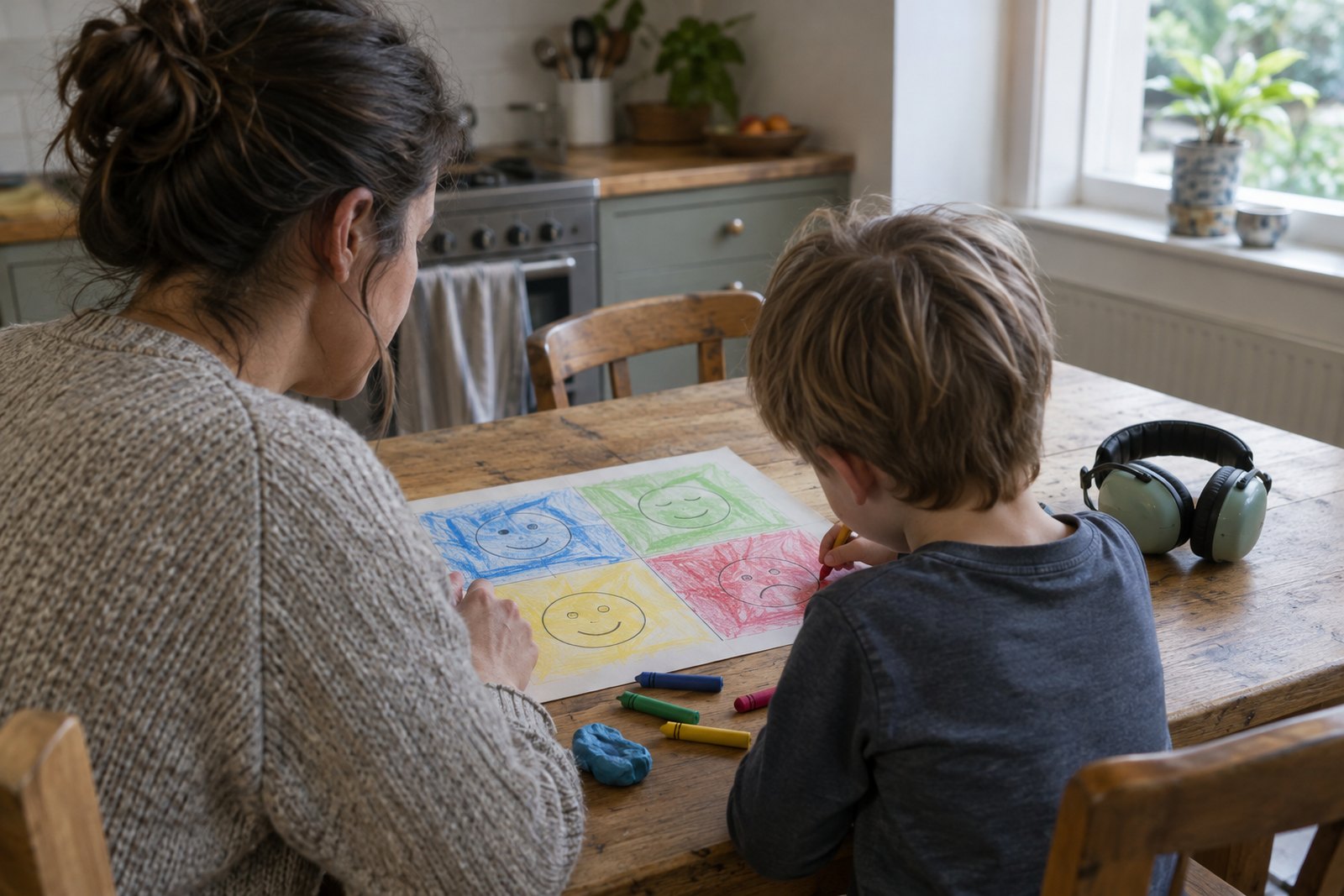
The Zones of Regulation is a way of helping children notice how they are feeling and how alert their body is, and then choose something that helps. It sorts feelings and states into four coloured zones: blue, green, yellow and red. It was developed by Leah Kuypers, an occupational therapist in the United States, as a curriculum for schools, and many UK primary and special schools now use it in class.
If your child has come home saying they were "in the yellow zone" at lunchtime, that is what they mean. You do not need to buy anything or become an expert to use the same idea at home. You need a rough grasp of the four zones, some calm moments to talk about them, and a short list of things that genuinely help your child. This guide covers all three, plus the mistakes that quietly turn a useful tool into a behaviour chart.
The four zones in plain English
The zones describe what is going on inside a person, not how well they are behaving. Think of them as a rough gauge of how fast the engine is running and what feelings come with it.
- Blue zone - low energy. Sad, tired, unwell, bored, a bit flat. The body is running slow.
- Green zone - calm and settled. Content, focused, ready to listen, learn or play. This does not mean bouncing with happiness. A child quietly building with bricks is green.
- Yellow zone - heightened. Worried, frustrated, silly, wriggly, overexcited. There is still some control, but it is starting to slip.
- Red zone - very heightened. Furious, terrified, panicking, or so elated they cannot stop. The thinking part of the brain has largely gone offline.
Two things are worth noticing. First, excitement belongs in yellow or red just as much as anger does. A child tearing round the house before a birthday party is not being naughty; their engine is running high. Second, the zones are about alertness as well as emotion. Being sleepy is blue. Being wired after too much screen time can be yellow. That is why sensory and physical strategies matter so much, which we come to below.
How schools use the Zones of Regulation
Schools vary a lot, so it is worth asking rather than assuming. Common features include:
- A series of lessons introducing each zone, using pictures, stories and games to spot feelings in faces and bodies.
- Check-ins at set points, such as first thing in the morning or after lunch, when children point to or name their zone.
- A calm corner or regulation space in the classroom.
- A personal toolbox of strategies each child has tried and chosen.
Some schools use it with the whole class. Others use it mainly for particular children, sometimes as part of a support plan agreed with the SENCO. The framework's official materials are copyrighted and schools usually work from the published book and resources. You do not need them at home. What helps most is matching the school's language so your child is not learning two systems.
Useful questions to ask your child's teacher:
- Which words and pictures do you use for each zone?
- What is on my child's toolbox at school, and which strategies seem to work?
- When do you do check-ins, and how does my child respond to them?
- What happens if my child reaches the red zone in school?
Using the zones language at home
Start when everyone is calm
Nobody learns a new idea mid-meltdown, adults included. Talk about zones when your child is green: in the car, in the bath, over breakfast, during a bedtime story. Keep it short and light. Five minutes now and then beats one long lesson.
Name your own zones out loud
This is probably the single most useful thing you can do. "I'm in the yellow zone, the traffic was awful. I'm going to have a glass of water and a few slow breaths before I start tea." It shows your child that adults move through every zone too, that the feelings are normal, and that you can do something about them. It also takes the spotlight off them.
Spot zones in stories and on screen
Characters in books and programmes are easier to talk about than yourself. "What zone do you think he's in? How can you tell? What could he do?" Children often understand the idea much faster this way, without feeling put on the spot.
Keep it simple and visual
A homemade chart on the fridge with four coloured sections works fine. Let your child draw faces or stick pictures in each. For younger children, or children with limited language, start with fewer words and more pictures. Some families begin with just two states, calm and not calm, and add colours later.
Ask rather than tell
"Which colour are you feeling?" or "How's your engine running?" works better than "You're in the red zone." Accept the answer, even if you would have picked a different colour. The skill you are building is your child noticing for themselves, and that takes practice. If they say green while clearly stomping about, you can gently add what you notice: "Your fists look tight and your voice is loud. I wonder if you're a bit yellow?"
Building a personal toolkit for each zone
Knowing you are in the yellow zone is only useful if you know what to do about it. The heart of the approach is pairing each zone with tools that work for that particular child.
Build the toolkit together, when your child is calm, by trying things out. Afterwards ask: did that make you feel more settled, or not? Keep what works and drop what does not, without fuss. Draw or write the winners on cards your child can see or carry. Expect the list to change as they grow.
Blue zone: waking up or getting comfort
- A movement burst: jumping on the spot, dancing to one song, a quick run round the garden.
- A cold drink or something crunchy to eat.
- Fresh air or opening a window.
- A cuddle, a favourite toy, or talking to someone they trust if they are sad.
- Rest. If your child is genuinely tired or poorly, blue is the right zone and the answer is sleep, not perking up.
Green zone: staying there
Green is not something you reach and then forget about. What keeps your child there? Usually the basics: enough sleep, regular food and drinks, predictable routines, warnings before changes, and movement breaks during long stretches of sitting or homework.
Yellow zone: bringing the engine down
- Slow breathing made concrete, such as pretending to smell a flower and blow out a candle.
- Squeezing a soft ball or a lump of putty.
- Heavy work: carrying shopping bags, pushing a laundry basket, wall push-ups, helping move cushions.
- Going somewhere quieter, or using ear defenders if noise is the problem.
- Drawing, counting, or a familiar calming activity.
- Telling a trusted adult, in words or by pointing to the chart.
Red zone: safety first
In the red zone, your child cannot use thinking strategies. Asking them to pick a tool from their card will usually make things worse. Your job is to keep everyone safe, talk less, ask for nothing, turn down noise and light, and stay nearby and calm. If you have agreed a plan in advance, such as a safe spot to go to or one simple cue word, use it. Talk about what happened later, once everyone is green again, and keep it about understanding rather than blame. Our guide to autistic meltdowns goes into this in more detail and is useful for any child who reaches the red zone often.
Sensory strategies: why some tools work and others backfire
Many of the best regulation tools are sensory. They work on the body directly, rather than asking a stressed child to think their way calm. But children differ. Some seek out more input; others are easily overwhelmed by it. The same activity can calm one child and wind up another. Our guide to the 8 sensory systems explains the background.
- Heavy work and deep muscle input (pushing, pulling, carrying, climbing) tends to be calming and organising for many children.
- Movement varies. Slow, rhythmic rocking or swinging often settles. Fast spinning or wild bouncing can tip a yellow child into red.
- Mouth-based input such as crunchy or chewy food, or sucking a thick drink through a straw, helps some children focus or calm.
- Touch: firm, deep pressure (a tight hug if they like it, or snuggling under a blanket they have chosen, with their head and face uncovered and free to get out whenever they want) is often calming, while light, unexpected touch can feel irritating or alarming.
- Sound and sight: ear defenders, dimmer lighting and a less cluttered space can help a child who is overloaded.
Watch what your child does when left to it. A child who constantly crashes into sofas may be seeking input, and quiet sit-still strategies will not suit them. Planning these activities through the day, before trouble starts, is the idea behind a sensory diet, and it pairs naturally with the zones.
Mistakes to avoid
Treating any zone as bad
Every zone is normal and expected. Feeling yellow before a test, red when something scary happens, or blue when a pet dies is not a failure. The aim is never to stop feelings, only to help your child notice them and know what to do. If your child starts saying "I'm sorry I was red", the message has gone wrong somewhere.
Turning it into a behaviour chart
The zones are not a traffic light for good and bad behaviour. Moving a peg to red for hitting a sibling, or rewarding a day "in green", teaches children to hide how they feel. Deal with behaviour separately, in whatever way your family does.
Using zones as a threat or punishment
"Go to your room until you're green" turns a support into a sanction. A calm space should be somewhere your child chooses to go, not somewhere they are sent.
Asking mid-meltdown
"What zone are you in?" is a reasonable question in yellow. In red, it is just more words for an overloaded brain. Save the talking for later.
Expecting green all the time
Blue at bedtime is right. Yellow at a party is fine. Nobody is green all day.
Choosing the tools for them
Your suggestions are a starting point, but a toolkit your child has picked and tested is far more likely to be used.
Assuming it suits every child
Some children find it hard to read their own body signals, such as hunger, tiredness or a racing heart. Some find colours too abstract. Some, particularly anxious children, experience repeated check-ins as one more demand. If the approach is causing stress, simplify it or pause it. A tool that does not fit your child is not a failing on anyone's part.
When it is more than everyday ups and downs
The zones are a teaching tool, not a treatment. Speak to your GP if your child's meltdowns are new, getting worse or very frequent, if their sleep or eating has changed noticeably, if low mood or worry lasts for weeks or is stopping them going to school, or if they talk about hurting themselves. Your GP or school can discuss referral to children's mental health services or a paediatrician. If you are worried about your child's safety and it cannot wait, call NHS 111. If anyone is in immediate danger, call 999.
If your child struggles to understand or use words for feelings at all, a speech and language therapist may be the right person, and the school SENCO can advise on how to get one involved.
Where an occupational therapist fits
It is no accident that the framework was created by an occupational therapist. Helping children regulate their bodies and feelings so they can manage daily life, school and play is a core part of children's occupational therapy.
A school can teach the zones. What it often cannot do is work out why the standard strategies are not working for your child. An occupational therapist can:
- Assess how your child processes sensory information, through observation, play, questionnaires and talking with you and school.
- Identify what genuinely regulates this particular child, and what winds them up.
- Spot mismatches, such as a movement-seeking child being given only quiet, sit-still calming strategies.
- Help build a practical toolkit and daily routine for home, and suggest changes to the environment.
- Share recommendations with school so home and school pull in the same direction.
- Write a report that can support a request for extra help, including an EHCP in England.
An occupational therapist does not diagnose autism or ADHD on their own, does not treat anxiety or depression in the way a mental health team does, and is not a substitute for speech and language therapy. NHS children's occupational therapy is available in many areas, though criteria and waits vary. A private occupational therapist visiting at home can see your child in their own surroundings, which is often where regulation is hardest. See our sensory needs page for more on what this involves.
Frequently asked questions
What age is the Zones of Regulation for?
It is most widely used in primary schools, but it is also used with older children, teenagers and some adults. Younger children usually do better with a simpler version, fewer words and lots of pictures.
Is it only for autistic children or children with ADHD?
No. Many schools use it with the whole class, because every child benefits from understanding feelings. It is often especially helpful for autistic children and those with ADHD, but it may need adapting to suit them.
Do I need to buy the book to use it at home?
No. Schools tend to use the official resources, but at home a simple homemade chart and your own words are enough. The most important thing is matching the colours and phrases your child's school uses.
My child always says they are green. What should I do?
That is very common at first. Noticing feelings is a skill that develops slowly. Keep modelling your own zones, talk about characters in stories, and gently point out what you see in their body without insisting they agree.
My child hates talking about zones. Should I keep going?
Not if it is becoming a battle. Drop the check-ins and keep naming your own feelings in passing. Some children come round to it later; for others a different approach suits better, and that is fine.
Can an occupational therapist help if school already uses the zones?
Yes. The school teaches the shared language, while an occupational therapist can assess what regulates your child specifically and help tailor the strategies, both at home and in school.
Next steps
If your child is finding regulation hard and the usual strategies are not landing, an occupational therapy assessment can help work out why. See our children's occupational therapy page, or current guide prices, and choose your area below.
Talk to an occupational therapist near you
This guide is general information. For advice about your own situation - or someone you look after - a local occupational therapist can visit you at home and see it for themselves.
Choose your area: