

Autistic Meltdowns: What Is Happening and What Helps
By Mobile Occupational Therapist • 27 September 2026 • 14 min read
An autistic meltdown is what happens when a person's brain and body have taken in more than they can process, whether that is noise, light, demands, change, worry or sheer tiredness. The system overloads and the person temporarily loses control of how they respond. It can look like shouting, crying, hitting out, running or throwing things. It is not a tantrum, it is not a choice and it is not bad behaviour. The person is not trying to get something. They are trying to get out of a state that feels unbearable.
What helps in the moment is simple to say and harder to do: keep everyone safe, use very few words, cut down noise and light, give space, wait, and never punish. What helps in the long run is working out what fills the person's cup to overflowing and reducing it before it spills. This guide is for parents of autistic children and for autistic adults who want to understand their own meltdowns. We use identity-first language (autistic person) because many autistic people prefer it, but plenty prefer "person with autism", and that is their call.
What is actually happening during a meltdown
Think of it as a fight, flight or freeze response that has been triggered by overwhelm rather than danger. Many autistic people experience sensory input more intensely, find unpredictability harder to manage, and spend a lot of energy all day coping with a world that was not designed for them. Stress builds up. By the time the meltdown arrives, it is usually the end of a long chain, not a reaction to the last small thing that happened.
That last thing (the wrong cup, a sibling's laugh, a changed bus route) is often what adults focus on. It is rarely the real cause. It is the final drop in a full glass.
During a meltdown the thinking, reasoning part of the brain is largely offline. That is why talking someone through it, explaining, bargaining or threatening consequences does not work. They cannot take it in, and extra words are just more input.
Meltdown vs tantrum
From the outside they can look similar, especially in young children. The differences are underneath.
- A tantrum has a goal. A child wants the sweets, the screen, to stay at the park. If they get it, the tantrum usually stops. They often check whether anyone is watching.
- A meltdown has no goal. Giving the person what they seemed upset about rarely ends it. It carries on whether or not anyone is watching, and the person may not be aware of their surroundings at all.
- A tantrum is a developmental stage. Most children grow out of tantrums. Meltdowns can happen at any age, including in adults.
- Afterwards is different. After a tantrum children often bounce back quickly. After a meltdown people are usually exhausted, sometimes embarrassed or upset, and may need hours or longer to recover.
Autistic children can have tantrums too, as all children do. The point is not to label every outburst but to ask: is this about wanting something, or about being overwhelmed? The answer changes what you do.
Shutdowns: the quiet version
Not everyone melts down outwards. Some autistic people shut down instead. They go quiet, stop speaking, freeze, withdraw to a room or under a blanket, stare, or seem to switch off. Some people do both at different times.
Shutdowns are easy to miss or mistake for sulking, rudeness or being fine. They are the same overload, just turned inwards. They need the same respect: less input, no pressure to talk, time and space to recover.
Common triggers
Every autistic person is different, so treat this as a list of places to look rather than a checklist.
- Sensory overload. Noise (hand dryers, crowds, background chatter), bright or flickering lights, strong smells, scratchy clothes, being touched unexpectedly, heat, busy visual environments like supermarkets.
- Change and uncertainty. A plan that changes, a substitute teacher, a new route, not knowing what is happening next, transitions from one activity to another.
- Demands. Too many instructions, being rushed, being asked questions when already stretched, social expectations like eye contact, small talk or performing politeness.
- Tiredness and hunger. Poor sleep, a long school or work day, missed meals, being unwell or in pain.
- Masking. Many autistic people, particularly older children and adults, hold it together all day at school or work by copying others and suppressing their own needs. The meltdown then happens at home, where it feels safe. If your child is "fine at school" but falls apart at the door, this is very common and it does not mean home is the problem.
- Communication difficulties. Not being understood, or not being able to get words out when stressed, is intensely frustrating.
- Emotional load. Anxiety, worry about something coming up, a falling-out with a friend, things that have built up over days.
Spotting the build-up
Meltdowns rarely come from nowhere, even when they seem to. There is usually a rumble stage first. Learning the person's early signs gives you a window to step in before the point of no return.
Signs people often notice include:
- Pacing, rocking or more stimming than usual (stimming is usually helpful and should not be stopped unless it is causing injury, but a change in it can be a signal)
- Covering ears or eyes, pulling at clothes
- Repeating questions or phrases
- Going quiet, or getting louder and faster
- Becoming rigid about small things, insisting on things being exactly so
- Irritability, snapping, saying no to everything
- Physical signs like flushing, clenched fists or restlessness
A simple trick that helps many families: keep a short diary for two or three weeks. Note when meltdowns or shutdowns happen, what the day had been like, sleep, food, where you were and what came before. Patterns appear that you would never spot in the moment. It is also useful evidence if you later see a professional.
When you notice the build-up, this is the time to act. Reduce demands, offer a quiet space, a snack, a drink, headphones, a favourite calming activity, or simply leave the shop. It is not giving in. It is preventing something much harder for everyone.
What helps during a meltdown
- Safety first. Move hard or sharp objects away, guide the person away from roads or stairs if you can do so calmly, and move other children or people out of the way if they could be hurt. Avoid physically holding or restraining someone unless it is the only way to stop immediate serious harm. Restraint usually escalates distress and can injure both of you.
- Fewer words. Stop explaining, questioning and reassuring at length. If you speak, use a calm, low voice and a few short words, like "You're safe. I'm here." Some people prefer no words at all.
- Reduce the input. Turn off the television, dim lights, ask others to leave the room, step out of the noisy place. Offer ear defenders or a blanket if the person usually finds them helpful, but do not force anything on them.
- Give space. Stay nearby if that is safe and wanted, but do not crowd. Many people need you close enough to know you are there but not touching or watching them closely.
- Do not punish. A meltdown is not misbehaviour, so consequences, telling off or removing privileges afterwards do not teach anything except that the person is in trouble for something they could not control. It can increase anxiety and make future meltdowns more likely.
- Look after your own state. Your calm is contagious, and so is your stress. Breathe slowly, lower your shoulders, keep your face soft. If you are losing it, it is fine to step a few paces back while staying in sight.
- Wait. It will pass. Trying to hurry it usually prolongs it.
In public, people may stare or comment. You do not owe anyone an explanation. Some families carry a small card that says the person is autistic and needs space, which can save you having to talk while managing the situation.
If you are the autistic adult
If you have meltdowns yourself, much of the same applies, just from the inside. It can help to have an exit plan agreed in advance: a quiet room at work, permission to leave a meeting, a signal to a partner that means "I need out now". Carry what helps you, such as noise-cancelling headphones, sunglasses or something to fiddle with. Telling trusted people what you need during and after a meltdown means you do not have to explain when you cannot speak. And please go easy on yourself afterwards. A meltdown is not a failure of character.
Afterwards: recovery
Recovery matters as much as the meltdown itself, and it is often skipped. People can be drained for hours and sometimes for a day or two.
- Keep things quiet and low-demand. Cancel what you can. This is not the moment for homework, chores or a big conversation.
- Offer water, food and rest. Bodies burn a lot of energy in a meltdown.
- Let them do what restores them. A favourite programme, a special interest, time alone, rocking, a bath. Whatever brings them back.
- Reassure, do not interrogate. Many people feel ashamed afterwards. A simple "That was really hard. You're OK, we're OK" goes a long way.
- Talk about it later, if at all. When everyone is calm, perhaps the next day, you might gently think together about what built up and what could help next time. Use visuals or writing if talking is hard. Some people never want to discuss it, and that is fine too.
- Look after yourself. Supporting someone through meltdowns is tiring. If it is happening a lot, you need support too, and our guide to carer burnout is written for exactly that.
Reducing the load day to day
The most effective way to reduce meltdowns is not to manage them better but to need to manage fewer. That means lowering the everyday pressure so the glass is not always nearly full.
Sensory changes at home
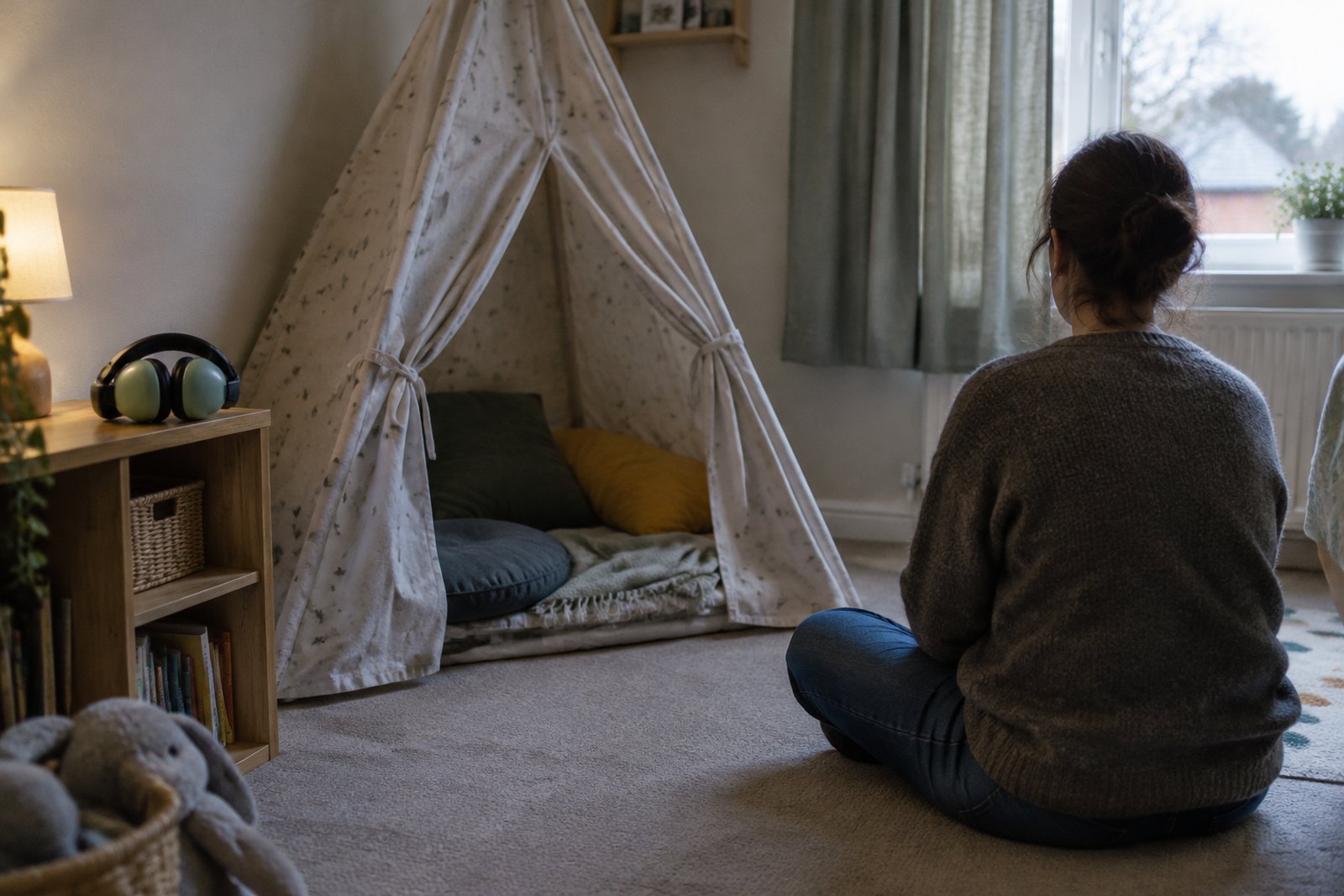
- Create a calm space: a corner, a pop-up tent, a bedroom with soft lighting, cushions and few things on the walls. Make it a refuge, never a punishment area.
- Notice what helps the person regulate, such as movement, deep pressure from a firm hug, chewing, swinging, music, quiet. If you are thinking about a weighted blanket, get advice from an occupational therapist first, as they are not safe for young children or for unsupervised use or sleep in children. Build these into the day, not just after things go wrong.
- Look at clothing: tags cut out, seamless socks, soft fabrics, the same trusted items.
- Cut down background noise and clutter where you can.
Predictability
- Use visual timetables, calendars or a simple list for the day.
- Warn about changes as early as possible and explain what will be the same.
- Give countdowns before transitions ("Five more minutes, then shoes").
- Prepare for new places with photos or a visit beforehand.
Demands and energy
- Plan downtime after school, work or busy outings. Do not stack demanding things back to back.
- Keep instructions short and give one at a time.
- Protect sleep and regular meals as best you can.
- Talk to school or work about adjustments: a quiet place to go, movement breaks, a named person, permission to leave early from noisy events.
When to get urgent help or see a GP
If anyone is at risk of serious harm, call 999. That includes someone injuring themselves badly, a head injury, someone running into traffic or a situation where you cannot keep people safe.
For urgent advice that is not an emergency, call NHS 111. If you are worried about someone's mental health, including thoughts of self-harm or suicide, NHS 111 can direct you to urgent mental health support.
See your GP if meltdowns are new, suddenly more frequent or very different from usual, if there is regular self-injury, or if the person might be in pain or unwell and cannot tell you. Distress can be the only sign of toothache, constipation, an ear infection or other health problems, especially in people who do not speak. Also mention to a GP any episodes involving loss of awareness, stiffening, jerking or confusion afterwards, as these need checking to rule out other causes such as seizures. The GP is also the usual route to an autism assessment if the person does not have a diagnosis.
Where an occupational therapist fits
An occupational therapist does not diagnose autism, does not prescribe and is not there to stop someone being autistic. Their job is to help the person cope better with everyday life on their own terms, and sensory processing is a big part of that.
A sensory assessment by an occupational therapist looks at how the person takes in and responds to information from their senses, including the less obvious ones like balance and body awareness. (Our guide to the 8 sensory systems explains these.) It usually involves questionnaires, observation, talking to the family and, ideally, seeing the person in their own home or at school. From that, an occupational therapist can:
- Identify which sensory experiences are overloading the person and which help them feel settled
- Suggest practical changes to the home, bedroom, routines and clothing
- Help build a daily plan of calming and alerting activities (sometimes called a sensory diet)
- Work on everyday skills that are draining, such as dressing, washing or mealtimes
- Write a report with recommendations that schools, employers or other services can use
There is more detail in our guides to occupational therapy for autistic children and sensory processing differences in adults.
Other professionals lead on other parts. A speech and language therapist helps with communication, including alternative ways to communicate when words are hard. A clinical psychologist or children's mental health service (CAMHS) is the right route for significant anxiety, depression or trauma. Your GP or a paediatrician handles health concerns, and the local diagnostic team carries out autism assessments. In schools in England, the SENCO is the key contact for support and adjustments.
Frequently asked questions
Can autistic adults have meltdowns?
Yes. Meltdowns are not limited to childhood. Many adults have them, often less frequently as they learn what overloads them, but stress, illness, burnout or big changes can bring them back. Adults may also mask until they get home.
Should I hug my child during a meltdown?
Only if you know they find it calming. Some people find firm deep pressure very soothing; others experience touch during a meltdown as more overwhelming. Watch their response, ask them when they are calm, and follow their lead.
Is it giving in if I leave the shop or change plans?
No. Removing someone from overload is like turning down a radiator that is too hot. It is about meeting a need, not rewarding behaviour. A tantrum aimed at getting something is a different situation and can be handled differently.
Why does my child melt down at home but not at school?
This is very common. Many autistic children hold it together all day by masking, then release the stress where they feel safest. It is worth sharing this with school, as it often means the child needs more support there, not that things are fine.
Do I need a diagnosis to get a sensory assessment?
Not necessarily. A private occupational therapist can assess sensory needs whether or not someone has an autism diagnosis. NHS routes vary by area and often require a referral, so ask your GP, health visitor or school.
Will meltdowns ever stop?
For many people they become less frequent as triggers are understood, the environment is adjusted and the person learns their own early warning signs. They may not stop entirely, and the aim is not to make someone suppress their distress, but to reduce how often they get pushed past their limit.
Next steps
If you would like help understanding what is overwhelming you or your child, see our sensory needs and children's occupational therapy pages, or current guide prices, and choose your area below.

Talk to an occupational therapist near you
This guide is general information. For advice about your own situation - or someone you look after - a local occupational therapist can visit you at home and see it for themselves.
Choose your area: