

Rollators: Choosing One, Using It Safely and When to Sit on It
By Mobile Occupational Therapist • 23 October 2026 • 14 min read
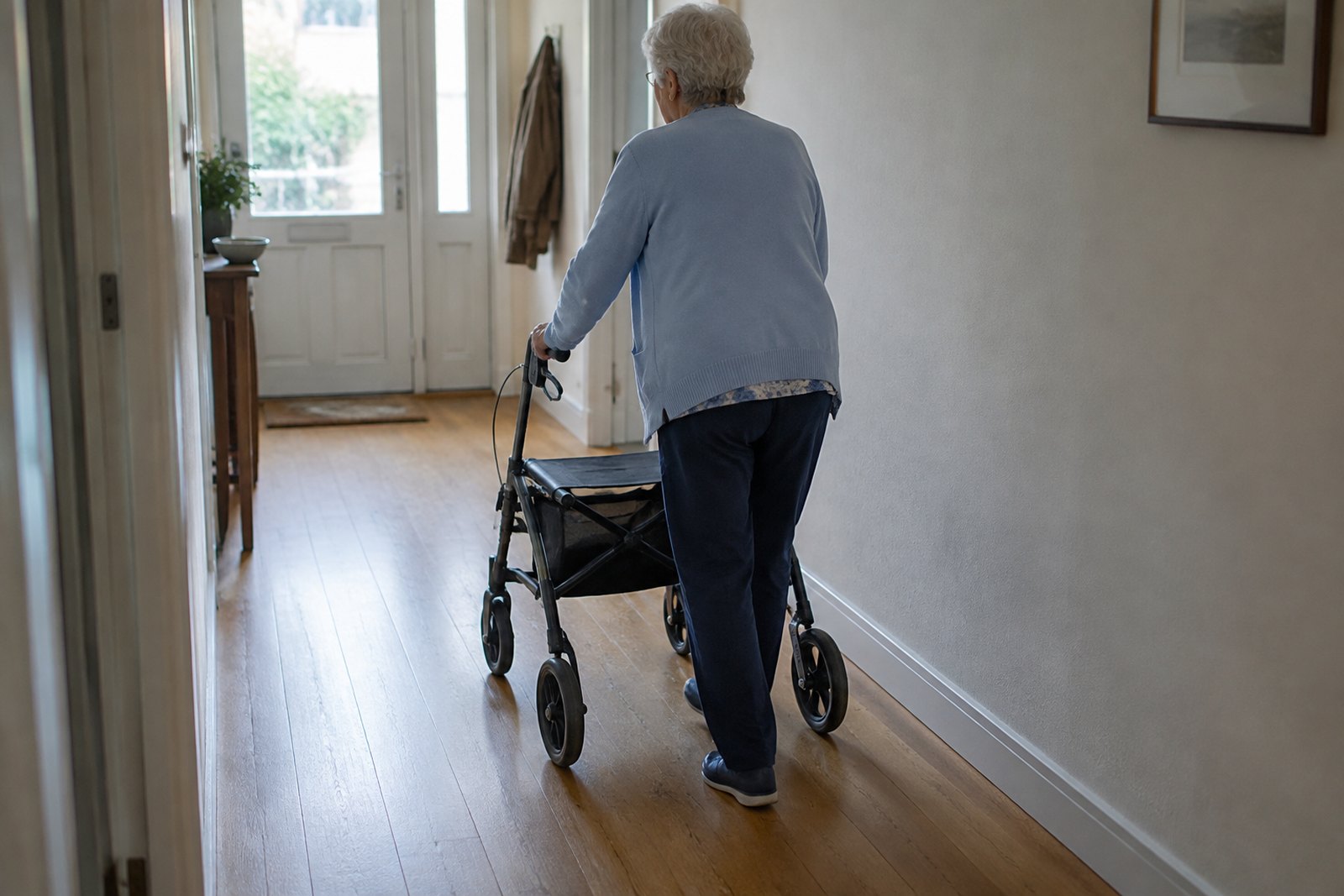
A rollator is a walking frame on wheels, with hand brakes, and usually a seat and a basket. It suits people who need something steady to walk with but can still walk at a reasonable pace without leaning their full weight on it. It does not suit people who need to bear a lot of weight through their arms, or whose walking runs away with them. Choosing between a 3-wheel and 4-wheel model, setting the height correctly and learning the brakes matter far more than the colour or the price.
The seat is the part that causes the most trouble. You can sit on a rollator, but only with both brakes locked, ideally with the back of it against a wall, and never while someone pushes you along. It is not a wheelchair. If you are unsure whether a rollator is right for you at all, an NHS physiotherapist or your council can assess you, and we explain how below.
If you are still deciding between a stick, a standard frame and something on wheels, our guide to walking frames, sticks and wheeled walkers covers that choice. This page assumes you have landed on a rollator and want to get it right.
3-wheel or 4-wheel rollator?
4-wheel rollators
The four-wheeled version is the one most people picture. Two front wheels swivel to steer and two rear wheels are fixed. It is more stable than a 3-wheeler because the base is wider and squarer, and it usually has a seat between the handles and a bag or basket underneath.
The trade-off is size and weight. A 4-wheel rollator takes up more room in a hallway, needs more space to turn, and is heavier to lift into a car boot. Indoors, in a narrow terraced house, it can be a nuisance.
3-wheel rollators
A 3-wheeler has one swivelling wheel at the front and two at the back, in a triangle. It is narrower, nippier round corners and through doorways, and usually folds smaller and lighter. Most do not have a seat.
It is also less stable. The triangle shape means it can tip sideways more easily, particularly if you lean on one handle or turn sharply. It suits someone who is fairly steady and wants something to keep them balanced and confident, not someone who needs to lean.
Indoor and outdoor rollators
Indoor rollators tend to be narrower, with smaller wheels and often a tray on top so you can carry a cup of tea from the kitchen. Outdoor rollators have larger wheels that cope better with cracked pavements, grass verges and gravel. Small wheels catch on every lip and stone outside, which is how people get jolted forward.
Plenty of people end up with two: a light indoor one and a sturdier outdoor one that lives by the front door. If carrying things round the house is the main problem, a kitchen trolley or trolley walker may be the better indoor answer, and our guide to trolley walkers and kitchen trolleys explains the difference.
Getting the height right
A rollator at the wrong height is one of the commonest problems, and one of the easiest to fix.
- Wear the shoes you normally walk in.
- Stand up straight inside the frame, or next to it if that is steadier, with your arms hanging relaxed by your sides.
- The top of the handgrips should be level with the crease on the inside of your wrist.
- When you hold the handles, your elbows should have a slight, comfortable bend.
Too low and you stoop forward, which pushes your weight ahead of your feet and makes you more likely to tip forward. Too high and your shoulders hunch, your arms tire and you lose control of the brakes. Most rollators adjust with a push button or a clamp on each leg. Set both handles to the same height and check that any button has clicked fully into its hole before you put weight on it.
Brakes: how they work and how to use them
Most rollators have loop brakes: a curved lever under each handgrip, connected by a cable to the rear wheels. They do two jobs.
- Slowing down: squeeze the levers up towards the handgrips, like bicycle brakes. Use both at once so the rollator does not swing round.
- Parking: push the levers down until they click into the locked position. The wheels should not move at all. This is the position you need whenever you stand still, sit down or get up.
Some rollators instead have brakes that work when you press down on the handles. These can suit people with weak grip, but they behave differently, so practise before you rely on them.
Practise parking and releasing the brakes until it is automatic. If your hands are stiff or painful, from arthritis for example, and you struggle to squeeze or lock the levers, say so. A different brake design or a different walking aid may be safer. A rollator whose brakes you cannot work reliably is a rollator that can roll away.
Walking with a rollator
Walk inside the frame, not behind it. Your feet should be roughly level with the back wheels, so the rollator moves with you rather than out in front. Stand tall and look ahead, not down at your feet.
- Keep the rollator close. If it creeps ahead and you find yourself reaching after it, slow down and use the brakes.
- On slopes, go slowly and keep a light squeeze on the brakes going downhill.
- Turn in a gentle curve, taking small steps, rather than twisting your body while your feet stay put.
- Go through doorways straight on, not at an angle, so a wheel does not clip the frame.
Kerbs
Use dropped kerbs whenever you can. They are there for exactly this. If you have to tackle a kerb, most rollators have a tipping lever, a small bar near one of the back wheels that you press with your foot.
Going up a kerb, stop close to it, press the tipping lever with your foot to lift the front wheels, place them on the pavement, then step up and roll the back wheels up after you. Going down, approach slowly, lower the rollator carefully so all four wheels are on the road, lock both brakes, and only then step down. Ask a physiotherapist to show you the technique for your particular rollator before you try any kerb, and use dropped kerbs whenever you can.
Stairs and steps
Never use a rollator on stairs. If you live over two floors, you may need one on each floor and a stair rail or other support for the stairs themselves. One or two front steps are a separate problem, and usually need a rail rather than a rollator.
Around the house
Indoors, the usual trip hazards matter more with wheels: rugs, door thresholds, trailing flexes and cluttered hallways. Small front wheels stop dead on a raised threshold and you keep going. Clear a route through the rooms you use most, and check you can turn round in the kitchen and bathroom before deciding the rollator lives indoors.
Sitting on a rollator: the right way
The seat is genuinely useful. It lets you rest on a long walk, sit while you wait in a queue, or perch while you get your breath back. It is also where many rollator accidents happen, because a rollator with the brakes off is a chair on wheels.
To sit down safely:
- Choose your spot. On firm, level ground, ideally with the back of the rollator against a wall, a solid piece of furniture or a kerb edge that will stop it moving.
- Lock both brakes into the parking position. Check they have clicked.
- Turn round slowly in small steps until the seat is behind you.
- Step back until you feel the seat against the backs of your legs.
- Reach back for the handles or the seat frame, and lower yourself down with control. Do not drop onto it.
To get up, keep the brakes locked, shuffle forward to the edge of the seat, put your feet under you and push up. Steady yourself, turn round fully to face the handles, and only then release the brakes.
What not to do with the seat
- Never be pushed while sitting on it. A rollator has no footrests, the seat faces the wrong way for it, the front wheels are small and catch easily, and the frame is not built for it. People get tipped out. Some combined designs convert into a transit chair with footrests, and those can be pushed, but only when they are set up in chair mode exactly as designed.
- Do not sit on a slope, on a camber or on uneven ground.
- Do not stand on the seat to reach something.
- Do not sit with the brakes off, even for a moment.
- Check the maximum user weight on the label or instructions and stay within it.
The basket and carrying things
Baskets and bags are handy for shopping, a purse or a bottle of water. Overload them and the rollator becomes front-heavy or unbalanced. Do not hang heavy bags from the handles, which can pull the frame over when you let go, and check the basket weight limit if one is given. If you regularly come back with a full week's shopping, a delivery or a shopping trolley may be the honest answer.
Folding it and getting it in the car
Most rollators fold, either front to back or side to side. Practise folding and unfolding at home before your first trip out, not in a car park with someone waiting.
- Lock the brakes before you fold it, so it does not roll while you work on it.
- Lift the seat or pull the folding strap, then push the frame together until any catch engages.
- Lift with your knees bent and the folded frame close to your body. Do not twist with it in your arms.
- Check it fits your boot before you buy. Measure the boot and ask for the folded size.
- If you have had recent surgery or have a heart, back or breathing problem, ask whoever is with you to do the lifting.
If lifting the rollator is the problem, a lighter model or a 3-wheeler may help, as long as it still gives you enough stability.
Who should not use a rollator
A rollator is not the right aid for everyone, and getting the wrong one can make falls more likely, not less. Be wary if:
- You need to lean heavily. If you take a lot of weight through your arms, a rollator can shoot forward. A standard frame without wheels, or one with two front wheels, may be safer.
- Your walking speeds up and runs away with you. This can happen with some neurological conditions, and a rollator can encourage it. A physiotherapist will judge whether brakes help or not.
- You push it ahead too fast and end up stretched out behind it.
- You cannot reliably work the brakes, because of grip, hand pain, one-sided weakness or memory problems.
- You get dizzy or black out. A walking aid does not fix that. See your GP.
See your GP if you have started falling, feel unsteady when you did not before, or your walking has changed over weeks. Call NHS 111 if you are worried and not sure what to do. Call 999 if someone has sudden weakness on one side, a drooping face or slurred speech, or has fallen and is badly hurt, cannot get up or has hit their head and is drowsy.
Looking after your rollator
Rollators wear out, and brake cables stretch. Check yours every few weeks:
- Lock the brakes and push. If it moves, the brakes need adjusting.
- Look for worn, split or flat-spotted wheels, and wheels that wobble.
- Check height buttons are fully clicked in and the handles do not twist.
- Make sure the folding catch locks firmly and the seat is not torn or sagging.
- Pick out hair and fluff wound round the wheel axles.
Many brakes have a small adjuster on the cable. If you are not confident using it, ask the supplier or a mobility repair service. If the rollator was loaned by the NHS or council, contact the service that issued it for repairs rather than adjusting it yourself.
Getting assessed: NHS, council or private
Walking aids on the NHS are usually issued after an assessment by a physiotherapist, often through your GP, a hospital team or a falls service. Councils and NHS community equipment services lend equipment too, though what they supply varies by area and some do not routinely issue rollators. Our guide to community equipment services explains how that borrowing works. If you need help with daily tasks more broadly, you can ask your council adult social care team for a needs assessment.
You can buy a rollator yourself, and many people do. If you do, it is still worth having it checked by a physiotherapist, especially if you have fallen or have a condition affecting balance or strength.
Where an occupational therapist fits
Be clear about who leads. Assessing your walking, balance and whether a rollator is the right aid is mainly the physiotherapist's job. If the question is purely "which walking aid, and how do I walk with it?", start there.
An occupational therapist looks at what happens around the walking: whether the rollator actually works in your home and your day. That means checking door widths and thresholds, whether you can turn in the kitchen, how you carry meals and drinks, getting on and off the toilet, in and out of the car, and whether a trolley, rails or rearranging furniture would do more good. A private occupational therapist visiting at home can look at all of this in one go and advise on equipment and aids that fit how you live, and will tell you if you need a physiotherapist or GP first.
Frequently asked questions
Can I get a rollator free on the NHS?
Sometimes. Walking aids are usually issued after a physiotherapy assessment, and whether that service supplies rollators depends on your area and your needs. Ask your GP or the physiotherapist treating you, or contact your local community equipment service.
Is a rollator safer than a walking frame?
Not automatically. A rollator is better for people who can walk at a steady pace without leaning heavily. A standard frame is more stable for people who need to take weight through their arms. The safer one is the one that matches how you walk.
How do I know the height is right?
Stand tall in your usual shoes with your arms relaxed. The handgrips should be level with your wrist crease, and your elbows slightly bent when holding them. If you stoop or your shoulders hunch, adjust it.
Can someone push me while I sit on my rollator?
No. A standard rollator is not built for it and you can be tipped out. Only combined designs that convert into a transit chair, with footrests fitted and set up in chair mode, should be pushed.
Should I buy a second-hand rollator?
It can be fine if you check it carefully: brakes that lock solidly, sound wheels, height buttons that click in, a seat that is not torn, and a weight limit that suits you. Set it to your height before using it, and have it checked if you are unsure.
Can I take my rollator on the bus?
Usually you can fold it and keep it with you, but rules vary between operators, so check with yours. Do not sit on the rollator while the bus is moving. Use a seat and keep the folded rollator held beside you.
Next steps
If you want someone to check how a rollator works in your own home, see our home assessment page, or current guide prices, and choose your area below.

Talk to an occupational therapist near you
This guide is general information. For advice about your own situation - or someone you look after - a local occupational therapist can visit you at home and see it for themselves.
Choose your area: