

Visual Timetables and Now and Next Boards: How to Make and Use Them
By Mobile Occupational Therapist • 8 October 2026 • 14 min read
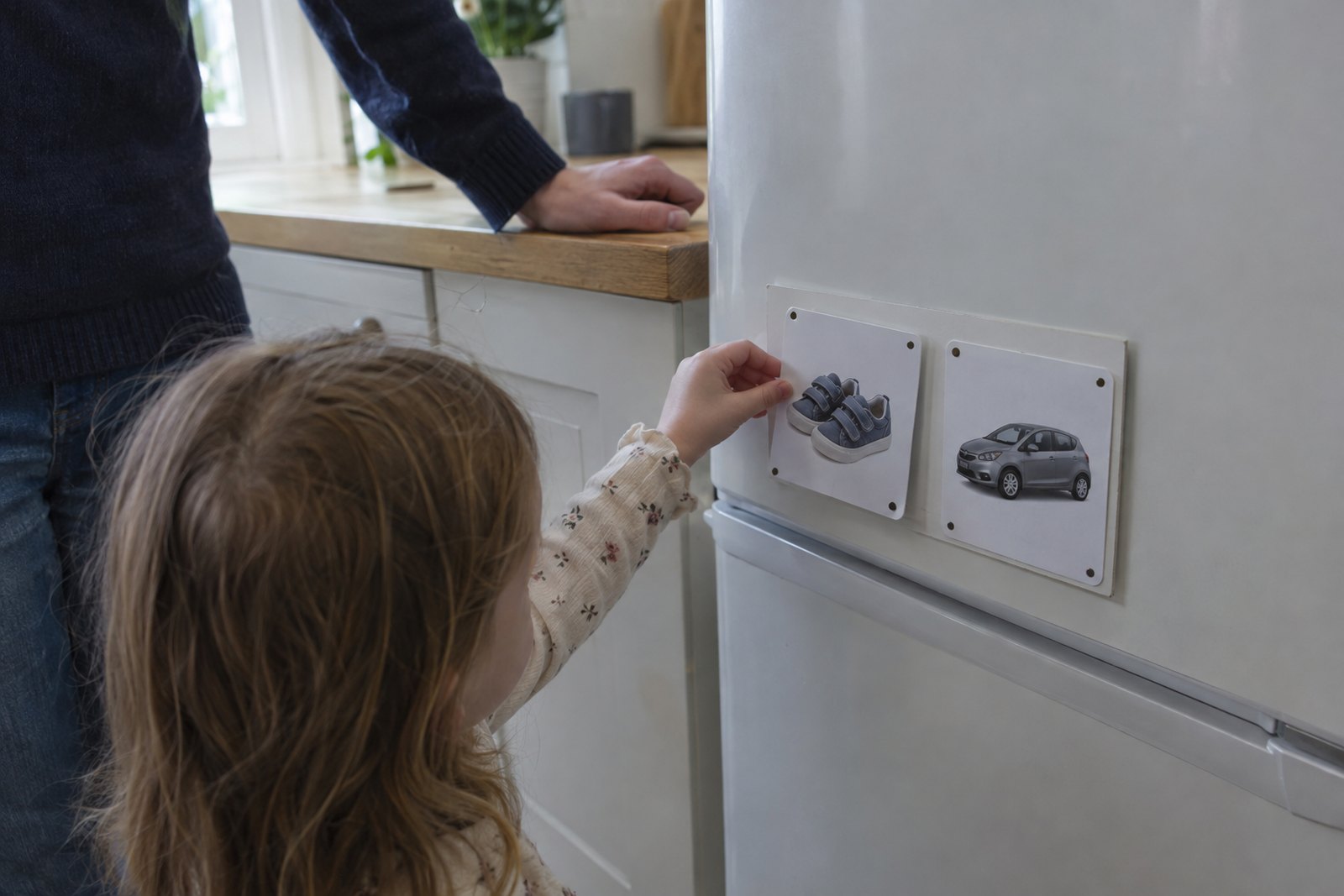
A now and next board is a small board with two spaces. One shows what is happening now. The other shows what comes next. That is all it is. A visual timetable is the bigger version: a row or column of pictures showing several things in order, from a short routine up to a whole day. Both work for the same reason. Spoken words vanish the moment you say them, and a picture stays put. A child who struggles to process language, or who finds not knowing what is coming genuinely frightening, can look back at the board as often as they need.
Most children start with now and next and move to a fuller timetable once they understand it and can cope with seeing more than two steps ahead. You can make either at home this afternoon with photos, card and some sticky hook-and-loop dots. The making is the easy part. What decides whether it works is using it the same way, every time, for long enough that your child learns to trust it.
What a now and next board actually does
Many autistic children, and many children with learning difficulties, find it hard to hold a spoken sentence in their head long enough to make sense of it, especially when they are anxious, tired or overloaded. 'Shoes on, then we're going to Nana's, but we need to stop at the shop first' is a lot. By the time you reach the shop, your child may have lost the thread and only know that something unexpected is happening to them.
A now and next board cuts it down to two things. Now: shoes. Next: car. It answers the question many children cannot ask, which is 'what is going to happen to me?' It also helps with the things they would rather not do, because they can see the end. Now: teeth. Next: story.
It is not a reward chart and it is not a bribe. The next card is not something your child earns. It is simply what happens next. That difference matters, and it comes up again in the mistakes section below.
When to move on to a visual timetable
There is no fixed age. Signs your child may be ready include:
- They look at the now and next board without being prompted, or bring it to you.
- They cope when the now card comes off and the next card moves across.
- They ask, in words, signs or by leading you, what happens after the next thing.
- Transitions are noticeably smoother on days you use the board.
Move up gradually. Go from two cards to three, then to a short morning sequence, before trying a whole day. A strip of a dozen pictures can overwhelm a child who was doing fine with two. Some children need now and next for years, and plenty use both: a timetable on the wall for the shape of the day, and a now and next board in your pocket for the hard moments. Neither is going backwards.
Pick a direction, either left to right or top to bottom, and keep to it. Ask your child's school or nursery which direction they use so your child does not have to switch between home and class.
Choosing what goes on the cards
The pictures need to make sense to your child, not to you. Start with whatever is most concrete for them.
Objects of reference
For children who do not yet understand pictures, a real object stands for the activity. A cup means drink. A small flannel means bath. A set of old keys means car. You hand your child the object just before the activity and they carry it there. Over time the object comes to mean the event. Use the same object every time and keep it only for that purpose, or it stops meaning anything. If your child still mouths things, choose objects too big to swallow.
Photographs
Real photos are often the best place to start. Photograph your actual things: your bath, your front door, your car, the school gate. A picture of a generic bath may mean nothing; a picture of your bath with the blue mat in it means bath. Keep the background plain and let the object fill the frame. Leave people out where you can, because some children focus on the person and miss the activity. The exception is people who matter, such as a grandparent or a childminder, where a photo of the person is the point.
Symbols and line drawings
Symbols are simple drawings that stand for things. Many schools and nurseries use a particular symbol system, and some of these are commercial sets used under licence. Ask the school, or your child's speech and language therapist if they have one, which system they use and whether they can give you copies of the cards your child already knows. That way home and school speak the same picture language. If you are making your own, your own simple drawings are fine. A clear outline of a toothbrush that your child recognises beats a polished image they do not.
Words
Write the word under every picture in plain lower case, whatever stage your child is at. It costs nothing, it helps other adults use the cards the same way, and some children gradually start to recognise the word. Older children and teenagers who read may prefer a written list or checklist, which is still a visual timetable.
How to make one at home
- Choose your first cards. Start with five or six things that happen every day, plus one or two things your child loves.
- Make them big enough. Around the size of a playing card, or a little larger, suits many children. Bigger if your child has any difficulty with their sight.
- Protect them. Laminate them or cover them with clear sticky-backed plastic. Round off the corners with scissors, as square laminated corners can scratch.
- Make the board. A strip of stiff card, foam board or a clipboard works. For now and next, divide it into two clear spaces and label them 'now' and 'next'.
- Add fastenings. Put one side of the hook-and-loop dots on the board and the other on the backs of all cards, and keep it the same so every card fits every board.
- Make a 'finished' pocket. An envelope or small box where cards go when the activity is over. Taking the card off is part of the message.
- Make a portable version. A few cards on a ring, or a small folding board, for the car, the shops and the doctor's surgery.
- Store the rest sensibly. A folder with sections means you can find the 'shoes' card in a hurry.
Put the board where it gets seen: at your child's eye level and near where transitions happen. The fridge, the back of the front door and beside the bed are all common choices.
Introducing it and using it every day
Start at a calm time, not in the middle of a meltdown. For the first few days, make the next card something your child enjoys, so the board's first job is to announce good news.
- Show and say, briefly. Point to now: 'Now shoes.' Point to next: 'Next park.' Fewer words is better.
- Use it in the moment. Put the cards up just before the activity, not hours earlier.
- Finish together. When the activity ends, take the card off with your child and put it in the finished pocket. Move next across to now and add a new next.
- Point rather than repeat. When your child asks for the fifth time, go back to the board instead of explaining again.
- Get everyone on board. The other parent, grandparents, the childminder. A board only one adult uses becomes that adult's thing rather than the family's.
- Use it on good days too. If it only comes out when things fall apart, it starts to signal trouble.
Expect weeks rather than days. Some children reject it at first, occasionally by throwing the cards across the room. Keep it low-key, keep using it and do not argue about it.
Changes, cancellations and surprise cards
Life will not follow the board. The pool closes, Nana is poorly, the bus does not come. Handled well, these moments are where the board earns its keep, because your child learns that changes get shown rather than sprung on them.
- Show the change. Take the card off, put it on a 'not today' card or cover it with a laminated cross, and put the replacement up. Say it once, plainly.
- Use a surprise card. A card with a question mark meaning 'something different, I will show you'. Introduce it with nice surprises first, such as an ice cream or a favourite visitor, so it means something pleasant before you ever use it for bad news.
- Warn early when you can. If the dentist is tomorrow, put it on the board tonight.
- Do not promise what you cannot control. If the park depends on the weather, show a choice of two cards rather than one.
- Have a 'wait' card. For genuine gaps, like queues or waiting rooms, with something to do alongside it.
If changes still lead to big distress, it helps to understand what is going on underneath. Our guide to autistic meltdowns covers this.
Using visuals for everyday routines
A timetable shows the order of the day. A sequence strip breaks one task into its steps. This is often where families see the biggest difference.
Dressing
Lay out a strip in the order clothes go on: pants, socks, trousers, vest, top, jumper, shoes. Your child takes each card off as they finish it. Laying the actual clothes out on the bed in the same order helps too. If your child always gets stuck at one step, ask whether the problem is the order or the physical skill, such as buttons, zips or telling front from back. A small mark inside the back of a garment can solve the last one.
Bedtime
Bath, pyjamas, teeth, toilet, story, light off. Keep the last card the same every night. A predictable ending helps many children settle, and it stops bedtime turning into nightly negotiation over 'one more'.
Toilet, handwashing and leaving the house
Short strips by the toilet, the sink and the front door work well. Four to six steps is plenty for most children. If a strip needs more than that, the task probably needs breaking into two.
Common mistakes
- Too many pictures too soon. A full day before your child has mastered two cards.
- Using it as a threat. Taking the next card away as a punishment turns the board into a bargaining tool and your child stops trusting it.
- Putting a favourite up to get cooperation, then not delivering. Do this once or twice and the board loses its meaning.
- Pictures your child does not recognise. If they do not react to a card, try a photo or an object instead.
- Leaving finished cards up. The board then shows the past, not the future.
- Talking too much alongside it. The point is to reduce the words, not add a picture to a paragraph.
- Keeping it out of sight. A board in a drawer does nothing.
- Giving up after a week. Most families find it takes longer than that to settle in.
Linking with school or nursery
Your child may already use visuals at school, and the closer home and school match, the easier it is. Ask which symbols they use, which direction their timetable runs, and whether they can send photos of the classroom, teacher, playground and dinner hall for your home cards. Before a new term or a change of class, ask for photos of the new room and teacher so you can start talking about it over the holidays.
A photo or short note sent home about what happened that day gives you something to talk about, which many children cannot do from memory. If your child has, or is being assessed for, an education, health and care plan (in England), visual supports can be written into it as provision. Wales, Scotland and Northern Ireland have their own plans, and visual supports can be included in those too. Our EHCP guide explains how that works.
Visual timetables for adults with memory problems
The same idea helps adults living with dementia, a brain injury or memory problems after a stroke. It needs to look adult, though. Childlike cartoons can feel patronising. A whiteboard with the day and date and the plan in plain words usually works better: 'Morning: Sarah visits. Lunch. Afternoon: rest. Tea at five.' Photos of the actual people who visit help, as does crossing items off once they are done. Write it with the person where you can, not just for them.
Labelled cupboards, a clock that shows the day and lighting that makes the board easy to read all help alongside it. See our dementia-friendly home guide for more. If memory problems are new or getting worse, see the GP before anything else. If confusion comes on suddenly, or comes with signs of stroke such as a drooping face, arm weakness or slurred speech, call 999. For other sudden changes, call NHS 111 or your local equivalent the same day.
Where an occupational therapist fits
To be honest, many families make a board, use it well and never need anyone else. Communication is mainly the territory of speech and language therapists. They lead on how your child understands and uses language, and on communication systems. If your child has few or no words, or you are wondering about picture exchange or a communication aid, a speech and language therapist is the right person. Your GP, health visitor or school can tell you how to get a referral locally. Teachers and the school's special educational needs coordinator lead on the visuals used in class.
An occupational therapist comes in on the doing: dressing, washing, sleep, mealtimes, getting out of the house, and the sensory differences that make transitions hard. A private occupational therapist visiting at home can watch the morning routine, work out where and why it falls apart, whether that is sequencing, motor skills or sensory overload from clothes or noise, and build visual routines around what they see. They can also write reports on daily living for school or an EHCP. Read more about what occupational therapy for autistic children involves, or see our sensory needs page.
See your GP if you are worried about your child's development or think they may be autistic, or if their behaviour changes suddenly and they seem unwell or in pain. Distress that looks like behaviour is sometimes a physical problem they cannot tell you about.
Frequently asked questions
What age can you start a now and next board?
There is no set age. If your child can connect an object or picture with something that happens, they can start. For very young children, or those not yet ready for pictures, begin with objects of reference.
Do visual timetables only help autistic children?
No. Children with ADHD, learning difficulties, anxiety or language delay often benefit, and so do many toddlers. Plenty of classrooms use a visual timetable for the whole class.
My child keeps pulling the cards off. What should I do?
This is common. Some children love the feel of the fastening, some are testing what happens, and some want control. Give your child the job of removing finished cards, keep spares, and put the board somewhere they can see but not easily strip.
Will my child become dependent on it?
Some children use visuals less over time and some keep using them. Either is fine. Adults rely on calendars, lists and reminders every day, and nobody calls that dependence.
Should I use photos or symbols?
Use whatever your child recognises. Photos of your own things are often easiest at first. If school uses symbols, match theirs where you can so the cards mean the same thing in both places.
Can a teenager use one?
Yes, but make it fit their age. A written checklist, a planner or reminders on a phone can do the same job without feeling babyish. Let them choose the format.
Next steps
If routines at home are still a daily battle, an occupational therapist can look at what is getting in the way. See our children's occupational therapy page, or current guide prices, and choose your area below.

Talk to an occupational therapist near you
This guide is general information. For advice about your own situation - or someone you look after - a local occupational therapist can visit you at home and see it for themselves.
Choose your area: