

Using Crutches at Home: Stairs, the Kitchen and the Bathroom
By Mobile Occupational Therapist • 29 September 2026 • 15 min read
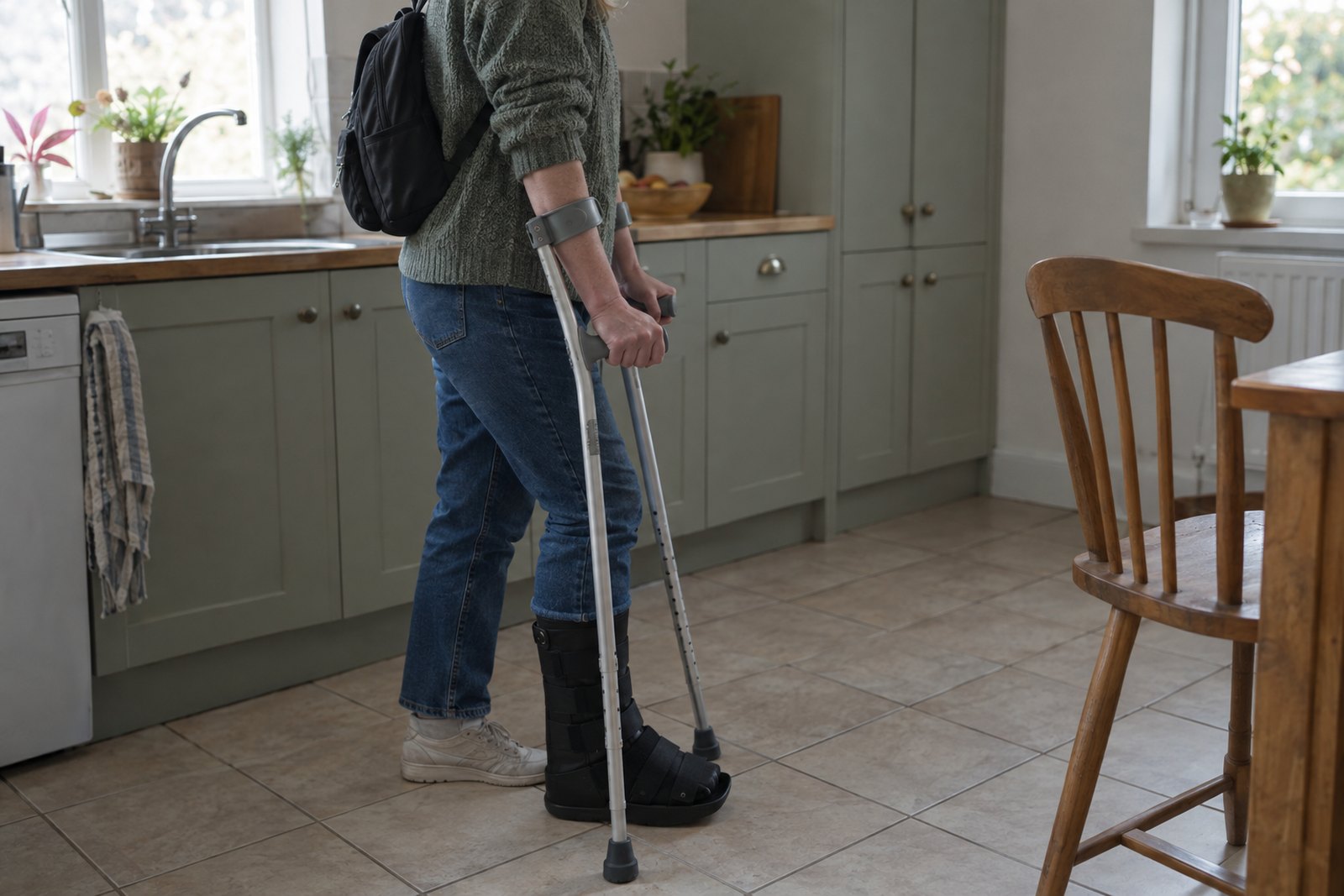
Crutches take a few days to get the hang of, and most of what makes them hard has nothing to do with walking. It is everything else. You cannot carry a cup of tea. The stairs suddenly look like a cliff. The bath, the toilet, your socks and the car door all need a new plan.
The short answer: on stairs, go up with your good leg first and come down with your injured leg first, using the banister and one crutch if you have a rail. Sit down for anything that takes more than a minute, carry things in a backpack or apron rather than your hands, and clear the floor of anything that could catch a crutch tip. This guide covers the daily living side. Your physiotherapist's instructions, especially about how much weight you can put through your leg, always come first. If anything here differs from what you were shown, follow the physio.
First, check what you have been told about weight
Before you think about stairs or kitchens, be clear on one thing: how much weight are you allowed to put through the injured leg? Hospitals and fracture clinics usually give one of a few instructions. Non-weight bearing means the foot does not take any weight at all. Touch or toe-touch weight bearing means the foot can rest lightly on the floor for balance but takes almost no weight. Partial weight bearing means some weight, as your physio describes. Full weight bearing or weight bearing as tolerated means you can use the leg as much as pain allows, and the crutches are mainly for balance and comfort.
If you are not sure which applies to you, ring the ward, fracture clinic or physiotherapy department and ask. It changes how you do almost everything else, and it often changes over the weeks, so check again at each appointment.
Getting the crutches right
Height and grip
In the UK most people are given elbow crutches, the kind with a cuff around the forearm. Standing straight with your arms hanging loosely, the handle should sit roughly level with the crease of your wrist, so your elbow is slightly bent when you hold it. The cuff should sit below the elbow, not on it. Both crutches should be set to the same height, and the push button on each one should be clicked fully through its hole. A button that is only half in can let the crutch slip shorter under your weight.
Hands and armpits
Your hands take a lot of load, and sore palms are common in the first week. Padded gloves, such as fingerless cycling gloves, can help. If you have underarm crutches, never lean your armpits on the top. Pressure there can squash the nerves running into your arm and cause numbness, tingling or weakness in the hand. The top should sit a couple of finger widths below your armpit, with your weight going through your hands and the crutch held against your side by your upper arm. Whatever type you use, tell your physio if you get tingling or numbness in either hand.
Ferrules
The rubber tips at the bottom are called ferrules. They stop the crutch skidding, and they wear out. Look at them every week or so. If the tread has worn smooth, the rubber is cracked or split, or the metal is starting to show through, they need replacing. Ask the service that issued the crutches. Wet ferrules are slippery, so wipe them dry when you come in from the rain, and take extra care on smooth tiles, laminate and anywhere that might be damp.
Stairs on crutches in plain steps
The phrase physios use is 'up with the good, down with the bad'. The good leg goes up first because it does the lifting. The injured leg goes down first so the good leg is the one lowering you. Go slowly, one step at a time, and do not let anyone rush you.
Going up with a rail
- Stand close to the bottom step and hold the banister with one hand.
- Use one crutch in your other hand as normal. The spare crutch has to come with you: either someone carries it, or you hold it in the same hand as your working crutch, in the way your physio shows you.
- Step up with your good leg.
- Bring your injured leg and the crutch up to the same step together.
- Pause, check your balance, and repeat.
Going down with a rail
- Stand close to the edge of the top step, holding the banister.
- Put the crutch down onto the step below.
- Step down with your injured leg.
- Bring your good leg down to the same step.
- Pause, and repeat.
If you are non-weight bearing, the injured foot stays off the steps throughout and your arms and good leg do all the work. That takes real strength. Some people are taught to go up and down on their bottom instead, sitting on the stairs and moving one step at a time using their arms and good leg. It is slow, but it is steady. Only use either method once a physio has shown you and watched you do it.
Plan the day so you are not climbing the stairs more than you need to. Keep a set of essentials downstairs and a set upstairs. If the stairs are not safe for you yet, a temporary bed downstairs and a commode for a few weeks may be the better answer.
Getting up and sitting down
Choose a firm chair with arms that is not too low. Soft sofas and deep armchairs are hard work on crutches, because standing is much easier when your hips start higher than your knees.
To stand up
- Shuffle forward to the front of the seat.
- Hold both crutches together by the handles in one hand.
- Put your other hand on the arm of the chair. If you cannot put weight through the injured leg, keep it slightly forward.
- Lean forward and push up through your hand and your good leg.
- Once you are steady, move one crutch into your other hand, check your balance, then set off.
To sit down
- Walk to the chair and turn until you feel the seat against the backs of your legs.
- Take both crutches into one hand.
- Reach back for the chair arm with your free hand.
- Slide the injured leg forward a little and lower yourself slowly rather than dropping.
Never push up from anything that can move, such as a wheeled office chair or a table on castors. When you sit, lean the crutches somewhere stable so they do not slide to the floor and leave you stranded.
The kitchen
This is where crutches catch most people out. Both hands are busy, so you cannot carry anything in them. Do not try to hook a mug on a finger while holding a crutch handle. That is a very common way to fall.
Carrying things
- A backpack is the simplest answer. Use it for your phone, a book, snacks and a drink bottle.
- An apron or tabard with deep pockets, or a cross-body bag, for small things around the house.
- Lidded cups and flasks. A sealed cup can go in a backpack. An open mug of tea cannot.
- A kitchen trolley can help once you are allowed to walk short distances without crutches, but it is not a substitute for them. Only use one if your physio agrees. Our guide to trolley walkers and kitchen trolleys explains the difference between the two.
- Slide, do not carry. Push things along the worktop from kettle to plate rather than picking them up.
Sitting to work
A perching stool lets you sit at worktop height to prepare food, wash up or wait for the kettle without balancing on one leg. The seat slopes forward, so you are half sitting and half standing. See perching stools for who they suit and how to get one. A kitchen chair at the table also works for chopping and peeling.
Setting the kitchen up
- Move what you use every day to worktop height: a mug, a small pan, a plate, the cereal.
- Avoid low cupboards and high shelves. Bending and reaching on crutches is unsteady.
- Only fill the kettle with as much water as you need.
- Eat in the kitchen if you can, rather than carrying food to another room.
- Keep cooking simple. Freezer meals, food prepared ahead before planned surgery and online shopping deliveries all mean fewer trips across the floor.
- Wipe up spills straight away, or ask someone to. A wet floor and a rubber tip are a bad mix.
The bathroom
Bathrooms are small, hard and often wet, which makes them the riskiest room in the house on crutches.
Washing
Sit down to wash. A strip wash at the basin, sitting on a stable chair or stool, is a perfectly good way to keep clean for the first few weeks. Climbing over the side of a bath on crutches is risky, particularly if you cannot put weight through one leg, so do not attempt it unless your physio or occupational therapist has shown you a safe way. If you have a walk-in shower, a shower seat or stool lets you wash sitting down; see shower stools and shower chairs for choosing a safe one. Leave the crutches just outside the shower within reach, not inside where the tips get wet.
If you have a cast, follow the fracture clinic's advice about keeping it dry. Waterproof cast covers exist, but ask before you rely on one.
The toilet
Standard toilets are low, and getting down and up again on one good leg is hard work. A raised toilet seat, or a toilet frame with arms around the toilet, can make a big difference. After a hip replacement you may have been given specific advice about how low you can sit, so follow it. Do not pull on towel rails, sinks, radiators or toilet roll holders to get up. They are not built to take your weight and can come away from the wall.
At night
If the bathroom is a long walk or up the stairs, a commode or urinal by the bed overnight can be safer than walking half asleep on crutches.
Getting dressed
- Sit down to dress, on the edge of the bed with your good foot flat on the floor, or on a firm chair.
- Dress the injured leg first and undress it last. It is the stiffest, so it goes into trousers first and comes out last.
- Choose loose clothes: elastic waists, wide legs, or shorts if you have a cast or boot.
- Pull trousers up as far as you can while sitting, then stand with the crutches to hand, get steady, and pull them up the rest of the way.
- Wear a supportive shoe with a back on your good foot. Loose slippers and flip-flops are a trip hazard.
- If you cannot bend, which is common after hip surgery, a long-handled shoe horn, a sock aid and a grabber make dressing possible without reaching for the floor.
Sleeping
Keep the crutches within reach of the bed, leaning somewhere they will not slide. Have a lamp you can switch on before you get up, and a clear route to the toilet. A very low bed makes mornings harder; furniture raisers can help but must be fitted securely. If you were told to raise your leg to reduce swelling, follow that advice about how and for how long. When you get up, sit on the edge of the bed for a moment before you stand.
Clearing trip hazards
- Remove loose rugs and mats from the routes you use.
- Move cables, chargers and extension leads away from walkways.
- Clear shoes, bags, laundry and pet bowls off the floor.
- Watch for pets, which like to be under your feet. Shut them in another room while you move about if you can.
- Improve the lighting, especially on the stairs and the route to the toilet at night.
- Make space. Crutches need more width than you do, so move furniture to create clear paths.
- Take care at door thresholds and small steps, which can catch a crutch tip.
Getting in a car
Before you start, push the passenger seat right back and recline it a little. Open the door wide, back up until you feel the seat behind your legs, and hand the crutches to someone or prop them securely. Hold the seat or the door frame, never the door itself, which moves. Sit down first, then swing your legs in together, supporting the injured leg. Our guide to getting in and out of a car covers swivel cushions and other aids. Whether you can drive depends on your injury, which leg it is, your car and your doctor's advice. You must be able to control the car safely, including in an emergency stop, and it is wise to check with your insurer. Ask your surgeon or GP, and check the driving guidance on GOV.UK.
When to get medical help
- Call 999 if you have sudden chest pain or breathlessness, or if you fall and are badly hurt or cannot get up.
- Contact your GP urgently or call NHS 111 if your calf becomes painful, swollen, warm or red. Blood clots are more likely after surgery and when you are moving less.
- Contact the fracture clinic straight away, or go to A&E if it is closed, if a cast feels too tight, your pain is getting much worse, or your toes go numb, tingly, pale or blue.
- Contact your surgical team, GP or NHS 111 if a wound becomes hot, red, more painful or starts to ooze, or you feel feverish and unwell.
Where an occupational therapist fits
Your physiotherapist leads on the crutches themselves: how to walk with them, how much weight to put through your leg, how to manage stairs, and your exercises. If you are unsure about any of that, go back to them. An occupational therapist does not change those instructions.
Where an occupational therapist helps is everything you need to do in between. In hospital, an occupational therapist may check how you will manage at home before you are discharged, particularly after a hip or knee replacement. If you are already home and struggling, a private occupational therapist visiting at home can look at your actual stairs, bathroom, kitchen, bed and chairs, and work out how you can wash, dress, cook and use the toilet safely. That might mean a perching stool, a toilet frame, a shower seat or furniture raisers, a different way of getting into the shower, or a short-term plan for living downstairs. For pain, wound problems or medication, your GP or surgical team is the right person, not an occupational therapist. If your needs look likely to last, your council's adult social care team can also assess you.
Frequently asked questions
How long will I need crutches?
It depends entirely on the injury or operation and how it heals. Your fracture clinic, surgeon or physio will tell you, and the answer often changes at follow-up appointments. Do not stop using them early because you feel better.
Can I use one crutch instead of two?
Only when your physio says so. One crutch is usually held in the hand on the opposite side to the injured leg, but check how you have been told to use it.
Do I have to give my crutches back?
Many NHS services ask for crutches to be returned once you no longer need them. Check any label on the crutches or ask the department that gave them to you.
Can I carry a hot drink on crutches?
Not in your hand. Use a lidded travel cup in a backpack, or make your drink and have it in the kitchen sitting at the table or on a perching stool.
Is a walking frame safer than crutches at home?
For some people, especially older people with balance problems, a frame is steadier on flat floors. Frames cannot be used on stairs, though. Which aid suits you is the physio's decision, so ask them if you feel unsafe on crutches.
What should I do if I fall on crutches?
Stay still for a moment and check whether you are hurt. If you are in severe pain, think you have hurt your injured leg again, or cannot get up, call 999. Otherwise, call for someone to help rather than struggling up alone, and tell your physio or GP about the fall.
Next steps
If you are home on crutches and everyday tasks feel unsafe, an occupational therapist can look at your home with you and suggest practical changes. See our home assessment page, or current guide prices, and choose your area below.
Talk to an occupational therapist near you
This guide is general information. For advice about your own situation - or someone you look after - a local occupational therapist can visit you at home and see it for themselves.
Choose your area: