

Urinal Bottles for Men and Women: Types and Using One With Dignity
By Mobile Occupational Therapist • 10 October 2026 • 14 min read
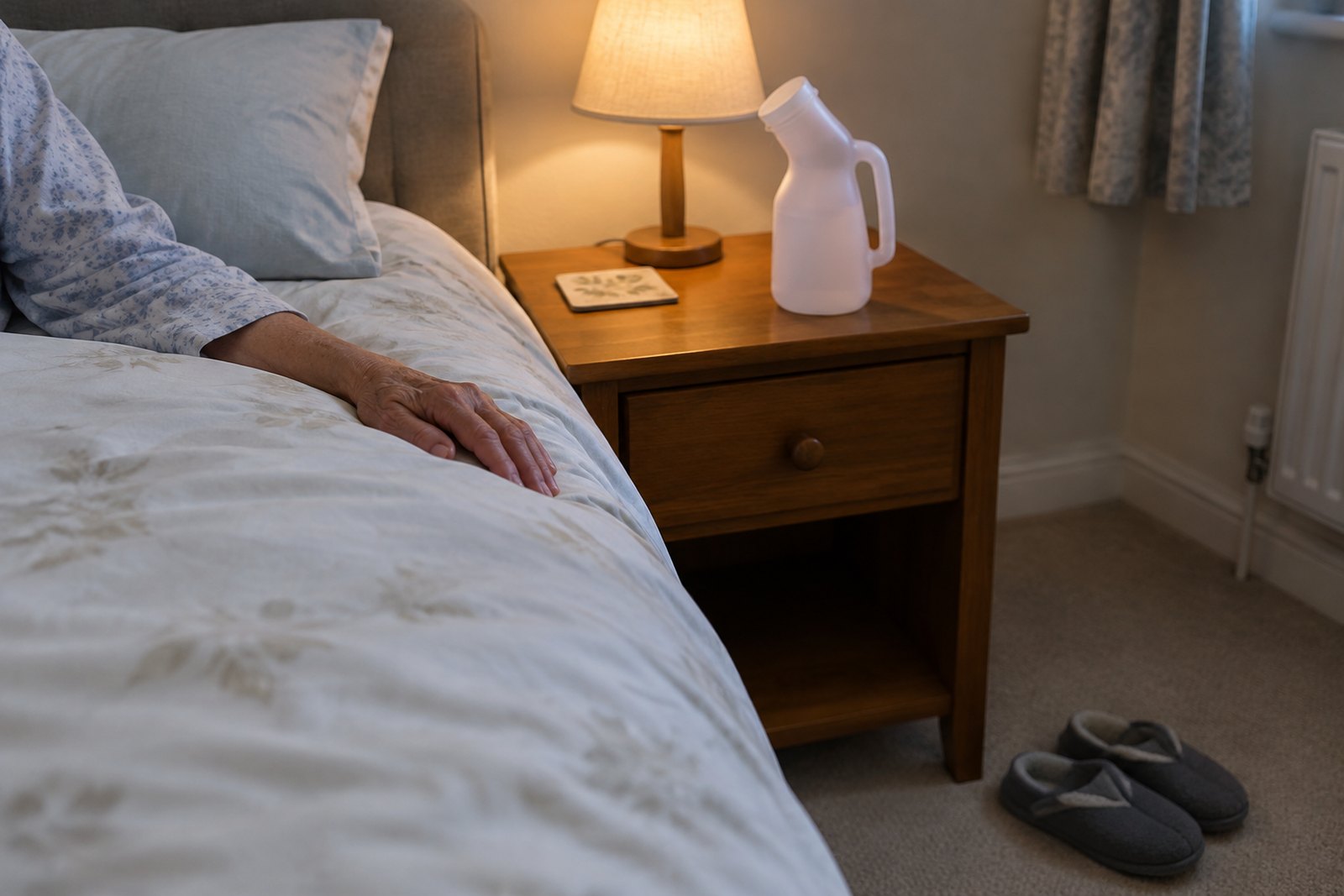
A urinal is a bottle or jug you pass urine into when getting to the toilet is difficult, slow or unsafe. Men's urinals are usually a plastic bottle with a narrow neck, a handle and a lid. Women's urinals have a wider, shaped opening that sits snugly against the body, and some come in a flatter slipper shape that slides underneath you when you are lying down. Both can be used standing, sitting on the edge of a bed or chair, or lying in bed. Some have a spill-proof valve that stops urine escaping if the bottle tips over.
Used well, a urinal means fewer rushed trips to the bathroom in the dark, less reliance on pads and more privacy than a commode. Used badly, it means wet sheets, sore skin and a lot of quiet embarrassment. The difference is mostly about picking the right shape, getting the position right and having a simple routine for emptying and cleaning. That is what this guide covers, along with how to get one and when a change in your bladder needs a GP rather than a bottle.
Who a urinal suits
Urinals are not just for people who are very unwell. They are useful for anyone who can control their bladder but struggles to reach the toilet in time. That includes:
- People who need to pass urine at night and are unsteady when they first get up.
- People recovering from an operation such as a hip or knee replacement, when walking to the toilet is slow and tiring.
- People who get breathless on the short walk to the bathroom.
- People spending most of the day in bed during an illness.
- Wheelchair users, particularly when an accessible toilet is not close by.
- Anyone with urgency who simply cannot get there fast enough.
A urinal is less suitable if the person also needs to open their bowels regularly away from the toilet, cannot hold or position the urinal even with help, or has no awareness of when their bladder is full. In those situations a commode, pads or another approach may work better, and a continence nurse is the right person to talk to.
The main types of urinal
Male urinals
The standard male urinal is a plastic bottle with a handle and a lid. The neck is usually angled so it can be used lying down as well as sitting or standing. Most have markings on the side showing volume, which is useful if a nurse or doctor has asked you to keep a record of how much you pass.
Variations include bottles with a wider, flatter base so they stand up on their own, versions with a non-return valve in the neck, and versions with a length of tubing that drains into a larger bottle or bag beside the bed. Opaque bottles are more discreet than clear ones, which matters more to some people than they will admit.
Female urinals
Female urinals are harder to get right, because there is more variation in body shape and the seal against the body matters more. The main shapes are:
- Funnel or jug style: a wide, contoured rim with a handle, designed to be held against the body while standing, sitting forward on a chair or crouching.
- Slipper or pan style: low and flat, designed to slide under the bottom when lying on your back or sitting on the bed. It looks a little like a small bedpan with a spout.
- Funnel with tube: a shaped rim attached by tubing to a separate collection bottle or bag, so the bit you hold stays small and light.
Some urinals are sold as suitable for both men and women. These can work, but many women find a design made specifically for female anatomy seals better and leaks less. It is quite normal to try more than one before finding the one that works.
Spill-proof valves
A spill-proof or non-return valve is a small flap or one-way seal inside the neck of the urinal. Urine flows in, but cannot flow back out if the bottle is knocked over or tilted. For people using a urinal in bed, or who have a tremor or weak grip, this can be the difference between a damp corner and a full change of bedding.
The downsides are honest ones. Valved urinals are a little harder to clean properly, some drain more slowly when you empty them, and the valve needs checking now and then to make sure it is still sealing. If odour becomes a problem, the valve is often where it lives.
Disposable urinals
Disposable urinal bags contain an absorbent material that turns urine into a gel. They are handy for car journeys, travel or days out, and for situations where emptying a bottle is not practical. They are not usually the cheapest option for daily use at home.
Getting the position right
Most leaks happen because of position, not because the urinal is faulty. A tip that saves a lot of laundry: practise in the daytime, when you are not desperate, sitting on the bed with a towel underneath. Learning the angle under pressure at three in the morning is not ideal.
Standing
Standing is the most straightforward position for men, provided balance is good. Stand with feet apart, ideally with a hand on something stable such as a grab rail or a sturdy piece of furniture. If you need both hands for balance, standing is probably not the safest option and sitting will be better.
Sitting on the edge of the bed or a chair
Shuffle forward so you are near the edge of the seat, with feet flat on the floor and knees apart. Lean forward slightly. Men can hold the urinal between the legs with the neck angled down. Women using a funnel style should hold the rim firmly against the body from front to back, so the whole area is covered, and keep the urinal tilted so urine runs away from the rim. Firm, even pressure is the key to a good seal.
In a wheelchair, the same principles apply. Moving forward in the seat helps, and some people find a funnel with tubing easier because there is less to manoeuvre.
Lying in bed
For men, lie on your back or side with the urinal between your legs. Keep the base of the bottle lower than the penis so gravity does the work, and make sure the neck is angled down. Raising the head of the bed slightly, or using an extra pillow, often helps.
For women, lie on your back with knees bent and apart. Slide a slipper-style urinal underneath, or hold a funnel style firmly against the body, again covering from front to back. A slightly raised head helps urine flow into the urinal rather than back towards you. Many women keep a washable or disposable absorbent pad underneath as a backup, which takes the worry out of it.
Whatever the position, take your time. Rushing is when urinals get knocked, angled wrongly or removed too early.
Emptying and cleaning
A simple routine keeps a urinal hygienic and stops smells building up:
- Put the lid on straight after use, and empty the urinal as soon as is practical. If it has to wait until morning, keep it lidded and upright.
- Empty it into the toilet, not the sink or bath.
- Rinse it with cold water first. Then wash it with warm water and ordinary washing-up liquid, using a brush kept only for this purpose.
- Rinse again and leave it to air dry upside down if possible.
- Wash your hands, and the carer's hands if someone else is helping, every time.
Check the manufacturer's instructions before using bleach or strong disinfectants, as some can damage plastic or valves. Replace the urinal when it becomes scratched, stained, cloudy or smells even after cleaning. Scratches hold bacteria, and no amount of scrubbing gets them out.
Emptying is also a good moment to notice the urine itself. Very dark urine can mean you are not drinking enough. Cloudy or strong-smelling urine, or any sign of blood, is worth mentioning to a GP, as covered below.
Night-time: the real point of having one
For many people the biggest benefit of a urinal is not convenience. It is avoiding the rushed, half-asleep walk to the bathroom in the dark, which is when many falls at home happen. A urinal by the bed only helps if it is actually within reach.
- Keep it on the bedside table, or in a holder that hooks onto the bed frame or a bedside table, on the side you naturally reach towards.
- Have a lamp or touch light you can switch on without getting up.
- If you do still need to get up, sit on the edge of the bed for a moment first before standing.
- Keep a phone or personal alarm within reach as well, in case something goes wrong.
Our guide to night-time safety for older adults covers lighting, clear routes and other ways to make nights safer.
Looking after your skin
Urine on skin, even small amounts left after using a urinal, can cause soreness and break down skin surprisingly quickly, especially in older people and anyone who spends a lot of time sitting or lying.
- Wipe or wash after use with warm water and a gentle, unperfumed cleanser. Women should wipe front to back.
- Pat the skin dry rather than rubbing.
- Change damp clothing, pads or bedding promptly rather than leaving it until later.
- Ask a pharmacist, district nurse or continence nurse whether a barrier product would help, rather than guessing.
- Look for redness that does not fade, broken skin or areas that are painful, and get them checked.
Dignity: the part nobody says out loud
Many people resist a urinal because it feels like a step towards being looked after. That is a real feeling and worth respecting. A few things make it easier:
- Let the person do as much as they can themselves, even if it is slower.
- Offer privacy. If help is needed with positioning, help, then step away or turn round until called back.
- Use a towel or blanket to cover the lap or lower body.
- Choose an opaque urinal and keep it somewhere discreet when visitors come.
- Use plain, matter-of-fact language. Treating it as ordinary helps it become ordinary.
For adult children helping a parent, this can feel awkward on both sides. Agreeing a routine in advance, during the day, is easier than negotiating at night.
How to get a urinal
There are several routes, and which one is right depends on your situation:
- NHS continence services: your GP or district nurse can refer you, and some areas accept self-referral. A continence assessment looks at why you are having bladder problems as well as which products might help. See our guide to NHS continence services and how to get help.
- Hospital discharge: if you are coming home after an operation or illness, the ward or therapy team may supply a urinal or advise where to get one.
- Community equipment services: in some areas, a urinal may be supplied alongside other equipment after a health or social care assessment. What is provided varies by area.
- Buying one: pharmacies and mobility shops sell urinals and they are generally not expensive. If you have a long-term illness or disability, you may not have to pay VAT on products designed for disabled people. Our guide to VAT relief on disability equipment explains how this works, and GOV.UK has the official rules.
When to see a GP
A urinal manages the practical problem. It should not hide a medical one. Contact your GP if you notice:
- New urgency, or needing to go much more often than usual.
- Pain, burning or stinging when you pass urine.
- Blood in your urine, even once.
- New leaking or incontinence. It is often treatable, so do not assume it is just age.
- A weak stream, difficulty starting, or feeling you have not fully emptied your bladder.
Get help the same day, by calling your GP or NHS 111, if there is a high temperature, shivering, or pain in the back or side, or if an older person becomes suddenly confused or more unwell, as this can be a sign of infection. Call 999 if someone is very unwell, for example very drowsy, hard to wake, breathless, has cold or blotchy skin, or has not passed urine all day, as these can be signs of sepsis.
If you cannot pass urine at all and have pain or swelling in your lower tummy, treat it as urgent. Call NHS 111 or go to A&E. This can be urinary retention, which needs prompt treatment.
Where an occupational therapist fits
Bladder problems themselves are the territory of your GP and the continence service. A continence nurse assesses why you are having difficulties and advises on products. A specialist pelvic health physiotherapist leads on pelvic floor exercises, and bladder retraining may be supported by either a physiotherapist or a continence nurse. An occupational therapist does not diagnose bladder problems or treat them medically.
Where an occupational therapist helps is with the practical side of getting to, or not needing to get to, the toilet. A private occupational therapist visiting at home can look at how someone gets in and out of bed, how well they sit and balance, their grip and reach, and whether a urinal, a commode, a raised toilet seat, rails or a change of room layout is the better answer. They can suggest where to put the urinal and holder, what bed height makes sitting on the edge easier, and how a carer can help with positioning without strain. If a urinal is not enough, our guide to commodes and using one with dignity explains the next option.
This is often most useful when a urinal is one part of a bigger picture: night-time falls, recovery after hospital, or a parent who is managing less well than they say.
Frequently asked questions
Can a woman use a urinal lying down in bed?
Yes. A slipper-style female urinal is designed for this. Lie on your back with knees bent and apart, slide it underneath, and press the rim firmly against the body from front to back. Raising your head slightly helps. Keep an absorbent pad underneath until you are confident.
Do spill-proof urinals really stop leaks?
They stop urine pouring back out if the bottle tips over, which is a big help in bed. They do not stop leaks caused by a poor seal or wrong angle during use, so positioning still matters. They also need careful cleaning, as the valve can trap odour.
How often should a urinal be replaced?
There is no fixed rule. Replace it when it is scratched, stained, cloudy, cracked, or smells even after a good clean. If the valve stops sealing, replace it then too.
Is a urinal or a commode better?
It depends. A urinal is smaller, more private and quicker to use for passing urine only. A commode suits people who also need to open their bowels away from the toilet, or who find positioning a urinal too difficult. Some people use both, a urinal at night and a commode or the toilet during the day.
Can I get a urinal free on the NHS?
Sometimes. Continence services, community nurses and hospital wards may supply one, but this varies between areas and depends on your assessment. Ask your GP or district nurse. Otherwise, they can be bought from a pharmacy at relatively low cost.
What if my hands shake or my grip is weak?
Look at urinals with a large handle, a flat stable base and a spill-proof valve, or a funnel with tubing so you only need to hold a small, light piece. A holder fixed to the bed keeps it within easy reach. An occupational therapist can assess hand function and suggest what is likely to work.
Next steps
If getting to the toilet safely is becoming a struggle, an occupational therapist can look at the whole routine, from bed to bathroom. See our equipment and aids page, or current guide prices, and choose your area below.

Talk to an occupational therapist near you
This guide is general information. For advice about your own situation - or someone you look after - a local occupational therapist can visit you at home and see it for themselves.
Choose your area: