

Stand Aids: What They Are, Who They Suit and Safe Use at Home
By Mobile Occupational Therapist • 24 September 2026 • 14 min read
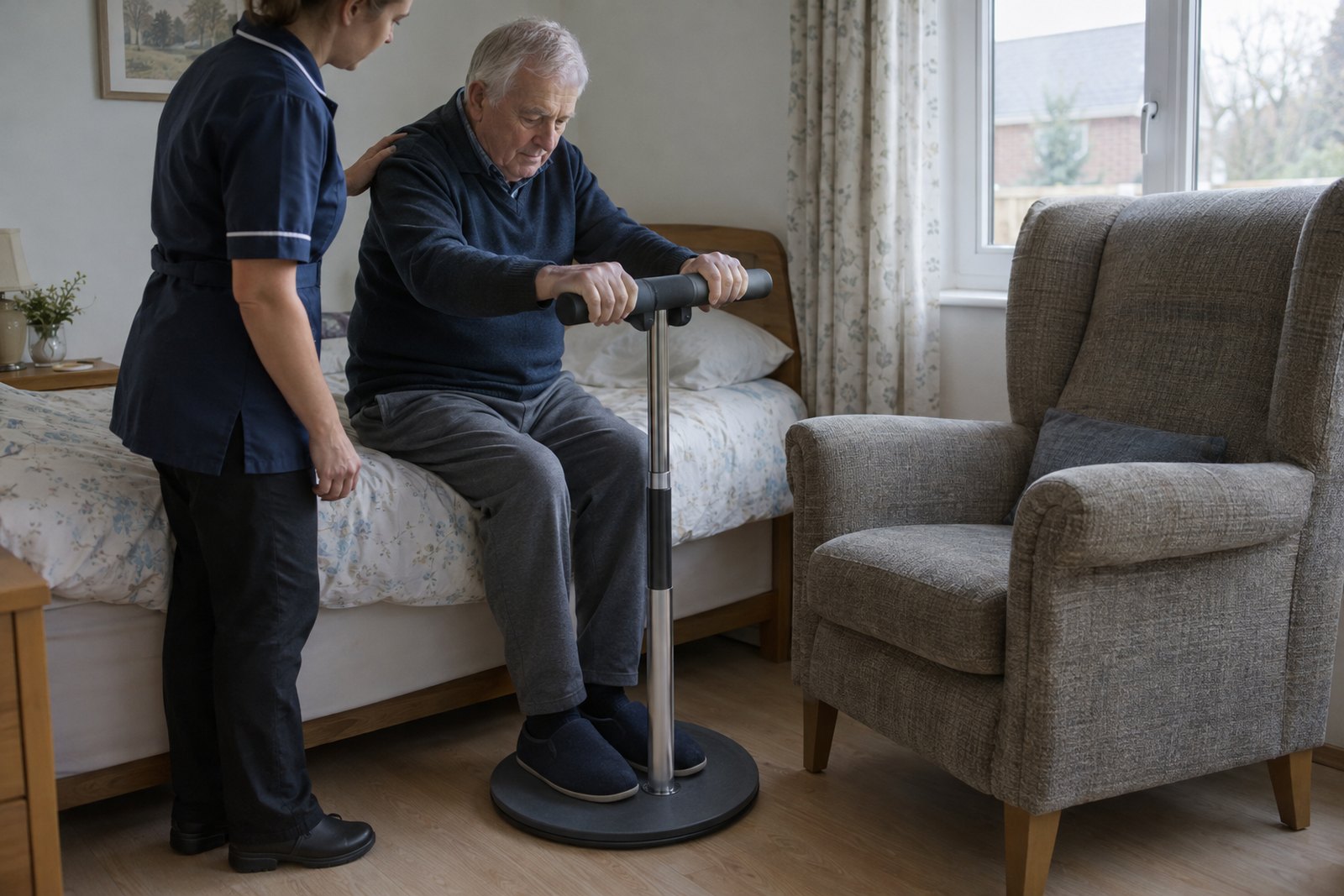
A stand aid is equipment that helps someone get from sitting to standing and then move a short distance, usually from bed to chair, chair to commode or wheelchair to toilet, without walking. There are two main kinds. A standing turner, often just called a rotunda or turning aid, has no motor. The person pulls themselves up on a handle while standing on a turning platform, and a carer turns them round to the new seat. A stand aid hoist, also called a sit-to-stand hoist or standing hoist, is powered. A sling goes around the person's back and a motor helps bring them up to standing.
Both only work for someone who can take weight through their legs, has reasonable control of their upper body, can hold on, and can understand and follow simple instructions. Reliably, every time, not just on a good day. If that is not true, a stand aid is the wrong tool and can cause a fall or an injury, and a full hoist or a different approach is needed. Either type should be chosen after an assessment by an occupational therapist or physiotherapist, and everyone who uses it should be shown how.
The two types, explained
Standing turners (rotundas)
A standing turner is simple. It has a flat round or oval base that rotates on a bearing, a non-slip platform where the feet go, an upright post, and a padded handle or bar at around waist or chest height. Some also have a pad for the shins or knees to rest against.
The person sits on the edge of the bed or chair with their feet on the platform, holds the bar, and stands up using their own strength while the carer guides and encourages. Once they are steady, the carer slowly turns the platform so the person faces away from the new seat, and they sit down. The carer does not lift. If the carer finds they are taking the person's weight, the turner is not right.
The good points are that it is light, small, quick to use and needs no charging. The catch is that the person does almost all of the work. It pivots on the spot only. It is not for moving someone across a room.
Powered stand aid hoists
A stand aid hoist is bigger. It has a base on small wheels with legs that often open wider for stability, an upright mast, a lifting arm with hooks or clips, a footplate, a padded knee or shin support, handles for the person to hold, and a battery motor worked by a hand control.
The sling goes around the person's back, under their arms, and clips to the lifting arm. They put their feet on the footplate, rest their shins against the pad and hold the handles. As the carer presses the button, the hoist draws them forward and up while they push through their legs. Once standing, they can be wheeled a short distance, for example from the bed to a commode beside it, and lowered down.
This suits someone who can take some weight and help, but cannot get up safely on their own or with a turner. It still needs them to take part. It is not a way of lifting someone who cannot stand.
What stand aids are not
- They are not walking aids. Nobody should be walked along in one.
- They are not for getting someone up off the floor.
- They are not a cheaper or easier version of a full hoist. They do a different job for a different person.
Who a stand aid suits
An assessor will usually be looking for most of these:
- Weight bearing. The person can take weight through their legs, at least partly, and their legs do not suddenly give way.
- Sitting balance. They can sit on the edge of the bed without toppling over or needing to be held.
- Trunk and head control. They can hold themselves upright rather than slumping forward or sideways.
- Grip. They can hold on with their hands. A turner usually needs a firm grip and some arm strength.
- Understanding and cooperation. They can follow a short instruction like "lean forward and push" and will not suddenly let go, sit down or twist.
- Consistency. Their ability is broadly the same morning and evening, from one day to the next.
- Comfort. They can tolerate pressure from the knee pad and, for a hoist, the sling around their back.
As a rough rule, a standing turner needs more of everything on that list than a powered stand aid. Someone might manage a turner after a hip operation as they get stronger, while someone with more weakness might need the powered type.
One real benefit of both is that the person keeps using their legs and stays involved in their own care. For many people that matters a great deal, physically and for their dignity.
Who they do not suit
A stand aid is usually the wrong choice, or needs very careful thought, if the person:
- Cannot take weight through their legs, or their knees buckle without warning.
- Has ability that swings a lot, for example with Parkinson's, multiple sclerosis fatigue, or being much weaker late in the day. They may need a separate plan for bad days.
- Slumps, or cannot hold their head and body upright.
- Has painful, injured or weak shoulders, including a weak shoulder after a stroke. A standing sling takes some weight under the arms and can make shoulder problems worse.
- Has knee pain, recent knee surgery, leg ulcers or fragile skin on the shins, because of the knee pad.
- Has fragile skin under the arms or on the back.
- Feels dizzy or faint when they stand. This is worth raising with their GP in its own right.
- Is confused, distressed or unpredictable, may let go suddenly, or grabs at the carer.
- Is heavier than the safe working load marked on the equipment.
- Has had a leg amputation. Many stand aids are not suitable, though an assessor will look at the individual.
For many of these people the safer answer is a full hoist, where the sling takes the whole body weight. Our guide to hoists at home explains the different types and how they are assessed.
Why assessment and training matter
It is tempting to see a stand aid online, think "that would solve it" and order one. Please do not, at least not before someone has looked at the person, the room and the people doing the caring.
A proper assessment looks at how the person moves now, what goes wrong, who will be helping, how much space there is, the height of the bed and chairs, the flooring, and the doorways. It also considers whether the person is likely to get stronger or weaker, because that changes what makes sense.
On the NHS, this is usually done by an occupational therapist or physiotherapist from the hospital ward before discharge, a community team, or council adult social care. If equipment is needed, it is often loaned free through the local service. Our guide to community equipment services explains how that works. A private occupational therapist can also assess, which some families choose if they are waiting or want to buy their own equipment.
Training is not optional. Every person who will use the equipment should be shown how, with the actual person and the actual equipment, and then watched doing it. Ask for the steps to be written down. If a new family member or carer joins, they need showing too. The general principles in our guide to safe moving and handling for family carers apply here as well.
Powered hoists also need looking after. Lifting equipment used for people at work generally needs a thorough examination at least every six months. If paid carers use a hoist in someone's home, their employer has health and safety duties to make sure it is safe and has been examined, even if the family owns it. The HSE website explains the rules. Equipment loaned by the NHS or council is normally serviced by the provider, so find out who to call and when the next check is due. If you own the equipment, servicing is still sensible.
Slings for stand aids
Standing turners do not use slings. Powered stand aids do, and they need their own kind. A sling made for a full hoist is not the same thing.
Names vary between makers, but you will usually come across:
- Standing or stand-up slings. A padded band that goes around the lower back and under the arms, fastens at the front, and has straps or loops that attach to the lifting arm. These suit people with fairly good upper body control.
- Supportive standing slings. A higher or more padded back, sometimes with an extra belt around the waist or chest, for people who need more support to stay upright.
- Toileting or access styles. Designed so trousers and underwear can be adjusted while the person is standing.
Some stand aids use a simple belt rather than a full sling. Whatever the type, a few things always apply:
- The sling must be compatible with that hoist. Check with whoever supplied it. Do not mix and match.
- It must be the right size for the person. Too big and they can slip down. Too small and it digs in.
- Arms go outside the sling, not inside.
- It should sit around the back at the level shown in training, not ride up into the armpits.
- Check it before every use for fraying, damaged stitching, broken buckles or a label that has faded so much you cannot read it. If in doubt, do not use it.
- Wash it exactly as the label says. Ideally each sling belongs to one person.
Using a stand aid safely: the basics
This is not a substitute for being shown how. It is a reminder of the things that matter most.
- Check the person today. Are they as able as usual? If they seem weaker, drowsy, unwell or in pain, do not go ahead. Use the backup plan and get advice.
- Set up first. Clear the floor, put the chair, commode or wheelchair where it needs to be, and put its brakes on.
- Get them ready. They should sit forward near the edge of the seat, wearing well-fitting shoes or the footwear the assessor recommended.
- Position feet and knees. Feet flat on the platform or footplate. The knee pad sits just below the kneecaps, at the height you were shown.
- Fit the sling (hoist only). Arms outside, buckle fastened, straps attached evenly on both sides.
- Talk them through it. Use the same short words every time, such as "ready, steady, stand". Wait for them.
- Go slowly. Rise, pause until they feel steady, then turn or move a short distance. Turn a turner gently, not with a spin.
- Sit down carefully. Lower once the backs of their legs are touching the new seat, and check they are sitting well back and comfortable.
And the things never to do: do not lift them under the armpits, do not let them hold on around your neck, do not leave them standing alone in the equipment, and do not rush because you are late.
Common mistakes
- Carrying on after things have changed. The stand aid was right in March. By June the person is weaker. This is the most common way people get hurt.
- Using it as transport. Wheeling someone around the house in a standing position is tiring and risky. Stand aids are for short transfers.
- Using it to get someone off the floor. A stand aid is not designed for this. See our guide on how to get up from the floor after a fall, and call for help if the person is hurt or cannot get up safely.
- The wrong sling, or a worn one.
- Guessing about brakes. Whether a hoist's brakes should be on or off during a transfer depends on the model and the situation. Follow what you were taught and the instructions for that hoist.
- Not enough room. Thick rugs, door thresholds and furniture make the hoist hard to steer.
- Buying second-hand or online without an assessment. The equipment might be fine. It might also be completely wrong for the person.
- Only one person knowing how. If they are ill or away, someone else ends up guessing.
- Ignoring pain or red marks. Sore shoulders, red skin under the arms or on the shins, or bruising are reasons to stop and ask for a review.
When something changes
Ask for a reassessment if the person needs more help than before, their legs give way, they cannot hold on, they get frightened or distressed, they complain of shoulder or knee pain, or they slip down in the sling.
A sudden change is different. If someone who could stand yesterday suddenly cannot, that may be a sign of illness, such as an infection. Contact their GP the same day or call NHS 111. If there is sudden weakness on one side, a drooping face or slurred speech, call 999, as these can be signs of a stroke. Do not try to force a transfer while you wait.
Where an occupational therapist fits
An occupational therapist looks at how someone manages everyday tasks like getting up, using the toilet and getting dressed, and what would make those safer and easier. For stand aids, an occupational therapist can assess whether the person is suitable, recommend the right type and sling, set it up in the home, train family carers, write a clear moving and handling plan, suggest changes to the room or furniture, and review things as needs change. Our equipment and aids page explains more.
Others have a part too. A physiotherapist often leads on rebuilding strength and standing ability, and may be the one who decides a stand aid is suitable after an operation. District nurses help with skin and pressure concerns. The GP deals with medical causes of weakness, dizziness or pain. If the person is still in hospital, the ward team should sort out equipment before they come home.
A private occupational therapist visiting at home can help if you are waiting for the NHS or council, want a second opinion, or plan to buy equipment and want to get it right first time.
Frequently asked questions
Is a rotunda the same as a stand aid?
A rotunda is a non-powered standing turner, which is one type of stand aid. People also use "stand aid" to mean a powered sit-to-stand hoist. They suit different levels of ability, so it is worth being clear which one is being talked about.
Can I get a stand aid free on the NHS?
Often, yes, if an NHS or council assessment finds it is needed. Equipment is usually loaned through the local community equipment service. Contact your council adult social care team or ask the hospital or GP about a referral.
Can one carer use a stand aid hoist alone?
Sometimes. It depends on the person, the equipment and the assessment. The moving and handling plan should say how many people are needed. Paid carers also have to follow their employer's policy, which may require two.
What is the difference between a stand aid and a full hoist?
A stand aid helps someone who can take weight through their legs to stand and pivot. A full hoist lifts someone who cannot, with a sling that takes their whole weight. If a person's standing becomes unreliable, they usually need a full hoist instead.
How long can someone stay standing in a stand aid?
Only as long as the transfer takes, plus a moment to adjust clothing if needed. Standing in a sling puts pressure under the arms and on the shins, and the person can tire quickly. It is not for standing practice unless a therapist has specifically set that up.
Can a stand aid help someone up after a fall?
No. Stand aids are not designed to lift someone from the floor. If the person is hurt, cannot get up, or you are not sure, call for help, including 999 if they are injured or unwell.
Next steps
If you are wondering whether a stand aid is right, or the current one no longer seems safe, an assessment is the place to start. See our home assessment page, or current guide prices, and choose your area below.

Talk to an occupational therapist near you
This guide is general information. For advice about your own situation - or someone you look after - a local occupational therapist can visit you at home and see it for themselves.
Choose your area: