

Social Stories: What They Are and How to Write One
By Mobile Occupational Therapist • 8 October 2026 • 14 min read
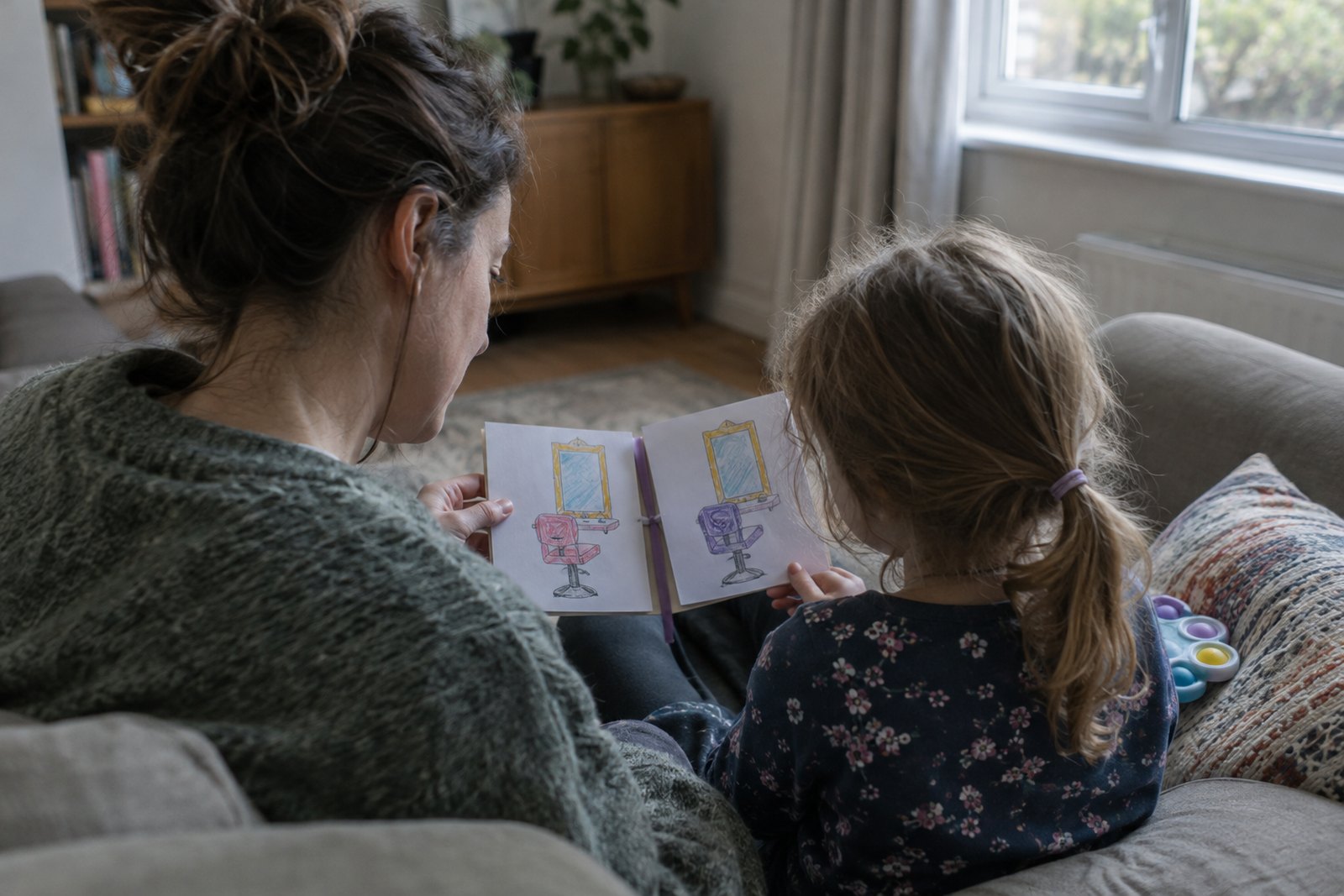
A social story is a short, calm, personalised story that describes a situation your child finds confusing or worrying: what usually happens, who will be there, why it happens, and what might help. It is written from your child's point of view, often with photos or simple pictures, and read together before the situation comes round. The idea is to give information, not orders.
The approach was developed by Carol Gray, an American teacher, in the early 1990s, originally for autistic children. Social stories are now used widely in UK homes, nurseries, schools and therapy services, and you do not need any special training to write a useful one. You need to know your child, pick one situation, and keep it short, honest and kind. This guide shows you how.
What a social story actually is
Most children pick up the unwritten rules of everyday life by watching and guessing. Why the dentist wants you to open wide. Why everyone sings before the cake gets cut. What the noise of the clippers means at the hairdresser. Many autistic children, and others who process the world differently, do not pick this up so easily. The unexpected bits are often the frightening bits.
A social story fills in those gaps. It explains the situation in a way that makes sense to your child, so there are fewer surprises. A good one reads a bit like a calm, friendly guidebook to a small corner of life.
Carol Gray's own version, which she calls Social Stories, has a detailed set of published criteria covering things like tone, sentence types and how much a story describes compared with how much it suggests. If you want to follow her method closely, her published guidance is the place to go. Plenty of parents and professionals write simpler versions based on the same principles, and that is what most people mean when they say "social story" in everyday conversation.
What social stories are not
This matters, because social stories are easy to misuse.
- Not a behaviour-control tool. A story that says "I will not scream at the dentist" is a list of rules in disguise. Children usually spot that, and it can add to their anxiety rather than easing it.
- Not a punishment or a lecture. Reading a story straight after something has gone wrong, while everyone is still upset, turns it into a telling-off.
- Not a promise. If the story says the dentist will definitely be Dr Smith and it turns out to be someone else, you have taught your child the story cannot be trusted.
- Not a fix for sensory overload. If the clippers physically hurt or the dentist's light is unbearable, understanding why it happens will help a bit, but the sensory problem still needs sorting out in its own right.
The best test: would you be comfortable reading this story aloud to your child's grandparent, a teacher and your child at the same time? If it sounds bossy or sneaky, rewrite it.
Who social stories tend to help
They are most often used with autistic children, but they can help any child (or adult) who copes better with clear, predictable information. That includes children with learning disabilities, ADHD, anxiety, developmental delay and language difficulties. Some adults with learning disabilities or brain injury find a written guide to a new situation useful too, written in an adult tone.
They tend to work best for children who can follow a short story, whether by reading it themselves or by listening and looking at pictures. For a child with very little language, a simpler visual sequence of photos may be the better starting point.
If your child is demand-avoidant, go gently. Some children with a PDA profile experience even mild coaching sentences as pressure, and do better with stories that are almost entirely descriptive, or written about a character rather than about themselves.
How to write a social story, step by step
1. Pick one situation
One story, one situation. "Going to the dentist" works. "Going out" does not. Start with something coming up soon that you know causes worry, or something that keeps going wrong in the same way.
2. Find out what is actually hard
Before you write, watch and think. Is it the waiting room, the chair tipping back, the strange taste, not knowing how long it will last? Ask your child if they can tell you. Ask school staff or anyone else who knows them well. The story is only useful if it addresses the bit your child struggles with, which is often not the bit adults assume.
3. Write from your child's perspective
Most stories for younger children are written in the first person: "I am going to the dentist." Some older children prefer the third person ("Sam is going to the dentist") or a story about a character. Use words your child actually uses. If they call it "the tooth doctor", so does the story.
4. Mostly describe, gently coach
This is the heart of it. Most of your sentences should simply describe what happens and why:
- Describing sentences say what happens, where, who is there and why. "The dentist looks at my teeth to check they are healthy."
- Perspective sentences describe how other people might think or feel. "The dentist wants to help my teeth stay strong."
- Gentle coaching sentences suggest something your child could try. "I can try to open my mouth wide." Or "I can hold my teddy if I want to."
Keep coaching sentences few and soft. Carol Gray's guidance stresses describing far more than directing, and that is a sensible rule for anyone writing one.
5. Use flexible, honest words
Words like "usually", "sometimes" and "might" protect you when real life does not match the story. "Usually the dentist counts my teeth" is safer than "The dentist will count my teeth." Avoid promises you cannot keep.
6. Keep it positive
Describe what can happen and what helps, rather than what goes wrong. Do not mention past disasters. Avoid words like "bad", "naughty" or "must".
7. Add photos or pictures
Real photos often work best: the actual dentist's front door, the actual chair, your child's own toothbrush. Many surgeries, schools and hairdressers will let you take a photo if you explain why, and some schools put photos of staff and rooms on their website. Simple drawings or symbols work too. One picture per page, with one or two sentences underneath, is a good format.
8. Keep it short
For a young child, five to ten short sentences may be plenty. Older children can manage more detail. If it is getting long, you are probably covering more than one situation, so split it.
9. End on something reassuring
Finish with what happens afterwards, ideally something calm or pleasant: going home, a favourite activity, the situation being over.
A worked example: going for a haircut
Here is a simple story you can adapt. Each line would sit on its own page with a photo.
- My name is Sam. My hair grows a little bit every day.
- When my hair gets long, Mum takes me to the hairdresser to make it shorter.
- The hairdresser's shop has big chairs and mirrors. Sometimes it is noisy, and it can smell of shampoo.
- The hairdresser puts a cape around my shoulders. The cape keeps the little hairs off my clothes.
- The hairdresser uses scissors to cut my hair. Hair does not have feelings, so most people do not feel the scissors cutting.
- Sometimes the hairdresser uses clippers. Clippers make a buzzing sound and feel tingly.
- Little hairs might feel tickly on my neck. The hairdresser brushes them away.
- I can hold my fidget toy while I sit in the chair.
- When the haircut is finished, Mum and I go home and I can have my bath.
Notice what it does not say. No "I will sit still", no "I will not cry". It explains, prepares and offers one thing to try. If haircuts are a real battle, our guide to sensory-friendly haircuts, teeth brushing and nail cutting covers the practical side.
Other situations worth a story
- The dentist: the waiting room, the chair tipping back, the bright light, the little mirror, opening wide, and why the dentist wears gloves and a mask.
- Starting a new school or class: photos of the building, the classroom, the teacher, where coats go, where the toilets are, what happens at lunchtime and who collects them at the end.
- A birthday party: other children may be loud, there may be games with winners, people sing "Happy Birthday", the birthday child opens presents, and it is fine to take a break in a quiet spot.
- Other common ones: a new baby, moving house, a hospital appointment, a supply teacher, fire drills, getting a vaccination, using a public toilet, or a change to the usual routine.
How to introduce and review a story
When and how you share the story matters as much as what it says.
- Read it when everyone is calm. Not in the car on the way to the dentist and not in the middle of a meltdown. A quiet moment at home, a day or several days beforehand, is ideal.
- Present it as information, not a lesson. "I made you a book about the dentist" works better than "We need to talk about the dentist."
- Let your child keep it. Many children like to look at the story on their own, again and again. That is a good sign.
- Read it a few times before the event. Once a day for a few days is a common pattern, but follow your child. If they lose interest, do not force it.
- Take it with you if it helps, as a familiar reference rather than something to drill.
- Review afterwards. Did anything happen that the story did not mention? Was there a bit that still caused upset? Change the story. Stories are drafts, not finished products.
If your child becomes distressed when you read it, stop. It may be too soon, too detailed, or about something they are not ready to think about. After a hard moment, the priority is calm and recovery, not explanation. Our guide to autistic meltdowns explains what helps in those moments.
Pairing social stories with visual timetables
Social stories explain why and what it is like. Visual timetables show what comes next. They work well together.
For a dentist visit, you might read the story a few days before, then on the day use a simple now-and-next board: car, dentist, home, tablet time. For a new school, the story explains the building and the people, and a visual timetable on the classroom wall shows the shape of each day. Our guide to visual timetables and now and next boards explains how to make and use them.
Who uses social stories: schools, SLTs and others
You will often find social stories already in use in your child's world.
- Schools and nurseries. Teachers, teaching assistants and SENCOs often write stories for transitions, trips, school photos, sports day and changes of staff. If your child has SEN support or an EHCP, it is reasonable to ask whether stories are being used and to ask for copies so home and school say the same thing.
- Speech and language therapists. Social stories are a communication tool, and SLTs often lead on them, especially where a child has language difficulties or uses symbols. If your child's main difficulty is understanding language or social communication, an SLT is usually the right professional to advise on stories.
- Specialist teachers and autism outreach teams. Many local authorities have advisory teams who support schools with strategies like this.
- Clinical psychologists and learning disability teams may use stories as part of wider support, particularly around anxiety.
National guidance on supporting autistic children and young people recommends approaches that make the environment and daily life more predictable and understandable. Social stories are one widely used example, alongside visual supports and adjustments to the setting.
Where an occupational therapist fits
Occupational therapists are interested in the everyday things your child needs and wants to do: dressing, eating, washing, sleeping, toileting, playing, going to school and getting out and about. Social stories are one of several tools an OT might use when a child finds those activities hard.
An occupational therapist is particularly useful when the difficulty is not just understanding the situation but coping with it physically or sensorily. A story can explain why the hairdresser uses clippers, but if the buzzing and vibration are genuinely painful for your child, an OT can look at the sensory side, suggest changes to the environment or routine, and help build the skills and tolerance step by step. The story then becomes one part of a bigger plan.
An OT can also help write stories for self-care routines such as toileting, teeth brushing, showering or getting dressed, pairing them with visual sequences and practical adaptations. Our guide to occupational therapy for autistic children explains what that work usually looks like.
Be clear about the limits. An occupational therapist does not diagnose autism; that is done through an NHS or private diagnostic assessment, usually after a referral via your GP, health visitor or school. If your child's main difficulty is language and communication, a speech and language therapist will usually lead. And if your child is anxious, low or withdrawn to a worrying degree, speak to your GP about mental health support. A private occupational therapist visiting at home can see how routines play out where they actually happen, which is often where the real sticking points show up. See our children's occupational therapy page for more.
Frequently asked questions
Are social stories only for autistic children?
No. They were developed for autistic children and are most often used with them, but they can help any child who copes better with clear, predictable information, including children with learning disabilities, anxiety, ADHD or language difficulties. Adapted versions can help some adults too.
At what age can you start using social stories?
There is no fixed age. What matters is whether your child can follow a short sequence of pictures and words, either by reading or listening. For very young children or those with little language, start with a few photos and a sentence each, or a simple visual sequence.
How long should a social story be?
As short as it can be while still covering what your child needs to know. For a young child, five to ten short sentences is often enough. If you find yourself writing pages and pages, you are probably covering more than one situation.
Do social stories actually work?
Many families and schools find them helpful, especially for one-off events and changes in routine, but they do not work for every child or every situation. They work best when the story is accurate, positive and about the specific thing your child finds hard, and when any sensory or practical difficulties are addressed alongside it.
Can I use a ready-made social story from the internet?
A ready-made story can be a useful starting point, but personalise it. Swap in your child's name, the words they use, real photos of the actual place and the details that matter to them. A generic story about "the dentist" will not mention the noisy fish tank in your dentist's waiting room that your child loves or hates.
Can I use social stories on a tablet or phone?
Yes. Some families make digital versions with photos and recorded voices, and some children prefer them. Others find a paper booklet calmer and easier to carry around. Use whatever your child engages with best.
Next steps
If everyday routines are a daily struggle despite stories and visual supports, an occupational therapist can look at the practical and sensory side at home. See our children's occupational therapy and sensory needs pages, or current guide prices, and choose your area below.
Talk to an occupational therapist near you
This guide is general information. For advice about your own situation - or someone you look after - a local occupational therapist can visit you at home and see it for themselves.
Choose your area: